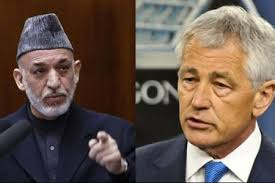
KABUL (Reuters) – Afghan President Hamid Karzai ratcheted up his criticism of the United States on Sunday, marring a debut visit by the new U.S. defense secretary, Chuck Hagel, and highlighting tensions that could undermine Washington’s strategy to wind down the unpopular war.
A day after two Taliban bombings killed 17 people, Karzai accused the United States and the Taliban of colluding to convince Afghans that foreign forces were needed beyond 2014, when NATO is set to wrap up its combat mission and most troops withdraw.
“Those bombs that went off in Kabul and Khost were not a show of force to America. They were in service of America. It was in the service of the 2014 slogan to warn us if they (Americans) are not here then Taliban will come,” Karzai said in a speech.
“In fact those bombs, set off yesterday in the name of the Taliban, were in the service of Americans to keep foreigners longer in Afghanistan.”
It was one of several inflammatory comments by Karzai and his government on Sunday and follow weeks of efforts by the Afghan leader to curtail U.S. military activity in Afghanistan, including a call to kick American special forces out of an important province. U.S. commanders see special operations forces as key to the end-phase of the conflict.
Hours after Karzai’s speech, Hagel said he spoke “clearly and directly” about the comments during his first meeting with the Afghan leader since becoming U.S. defense secretary on February 27.
Hagel appeared at pains to be respectful of Karzai and avoid sharp criticism, but he told reporters that any collusion between the U.S. and the Taliban “wouldn’t make a lot of sense.”
The U.S. and NATO commander in Afghanistan, General Joseph Dunford, was more categorical.
“We have fought too hard over the past 12 years, we have shed too much blood over the past 12 years, we have done too much to help the Afghan security forces grow over the last 12 years to ever think that violence or instability would be to our advantage,” Dunford told reporters travelling with Hagel.
Of Karzai’s remarks, he added: “I’ll let others judge whether that’s particularly helpful or not at the political level.”
Still, politics will be key over the next several months, as the United States and NATO allies work to carry out their strategy of pulling out their troops and decide how large a residual force to leave behind after 2014.
NATO defense chiefs meeting in Brussels last month discussed keeping a combined U.S. and allied force of 8,000-12,000 in Afghanistan, focusing on training Afghan troops and countering the remnants of al Qaeda, the Pentagon has said.
Any deal for a follow-on force, which Washington says must include immunity for U.S. troops, would need Karzai’s blessing.
ABUSING STUDENTS? TALIBAN TALKS?
Karzai has a history of making incendiary statements that exasperate Washington but the nature and awkward timing of his latest remarks about the United States were exceptional.
He also alleged on Sunday that the Taliban and the United States had been holding talks in the Gulf Arab state of Qatar on a “daily basis,” further fuelling his suggestion that Washington and the militants were working at common purposes.
“I told the president that it was not true,” Hagel said. “The fact is any prospect for peace or political settlements – that has to be led by the Afghans.”
The Taliban spokesman in Afghanistan, Zabihullah Mujahid, denied that negotiations with the United States had resumed.
Karzai’s government also alleged that U.S.-led forces and Afghans working with them were abusing and arresting university students. Karzai issued an executive order banning foreign troops from entering all education institutions.
Hagel and Karzai were meant to have appeared together at a joint news conference on Sunday evening. But, in a reminder of the threats posed by the resilient insurgency, U.S. officials said it was canceled because of security concerns.
Hagel was about a kilometer away and within earshot of a Saturday morning suicide attack outside the defense ministry that killed nine people. He was meant to have met his Afghan counterpart there this weekend but the venue was later changed.
Hagel’s visit coincided with the passing of a deadline imposed by Karzai for U.S. special forces to leave Wardak province accusing them of overseeing torture and killings.
U.S. forces have denied involvement in any abuses.
Hagel has sounded hopeful that a deal could be reached on their continued deployment but acknowledged no breakthroughs were made in his talks with Karzai.
It was unclear how Hagel’s trip would be viewed by U.S. Republicans who bitterly fought his nomination to become defense chief, portraying him as soft on Iran and questioning his judgment.
Hagel at times appeared sympathetic to the stresses of political life that Karzai must endure.
“I know these are difficult issues for President Karzai and the Afghan people. And I was once a politician,” Hagel said. “So I can understand the kind of pressures – especially leaders of countries – are always under.”
(Additional reporting by Hamid Shalizi; Writing by Phil Stewart, Michael Georgy and Jeremy Laurence; Editing by Christopher Wilson and Peter Graff)
Drone strikes on display (Credit: thenewstribe.com)
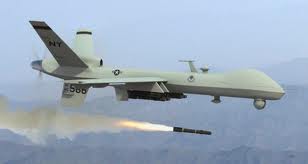
The Obama administration is nearing completion of a detailed counterterrorism manual that is designed to establish clear rules for targeted-killing operations but leaves open a major exemption for the CIA’s campaign of drone strikes in Pakistan, U.S. officials said.
The carve-out would allow the CIA to continue pounding al-Qaeda and Taliban targets for a year or more before the agency is forced to comply with more stringent rules spelled out in a classified document that officials have described as a counterterrorism “playbook.”
The document, which is expected to be submitted to President Obama for final approval within weeks, marks the culmination of a year-long effort by the White House to codify its counterterrorism policies and create a guide for lethal operations through Obama’s second term.
A senior U.S. official involved in drafting the document said that a few issues remain unresolved but described them as minor. The senior U.S. official said the playbook “will be done shortly.”
The adoption of a formal guide to targeted killing marks a significant — and to some uncomfortable — milestone: the institutionalization of a practice that would have seemed anathema to many before the Sept. 11 , 2001, terrorist attacks.
Among the subjects covered in the playbook are the process for adding names to kill lists, the legal principles that govern when U.S. citizens can be targeted overseas and the sequence of approvals required when the CIA or U.S. military conduct drone strikes outside war zones.
U.S. officials said the effort to draft the playbook was nearly derailed late last year by disagreements among the State Department, the CIA and the Pentagon on the criteria for lethal strikes and other issues. Granting the CIA a temporary exemption for its Pakistan operations was described as a compromise that allowed officials to move forward with other parts of the playbook.
The decision to allow the CIA strikes to continue was driven in part by concern that the window for weakening al-Qaeda and the Taliban in Pakistan is beginning to close, with plans to pull most U.S. troops out of neighboring Afghanistan over the next two years. CIA drones are flown out of bases in Afghanistan.
“There’s a sense that you put the pedal to the metal now, especially given the impending” withdrawal, said a former U.S. official involved in discussions of the playbook. The CIA exception is expected to be in effect for “less than two years but more than one,” the former official said, although he noted that any decision to close the carve-out “will undoubtedly be predicated on facts on the ground.”
The former official and other current and former officials interviewed for this article spoke on the condition of anonymity because they were talking about ongoing sensitive matters.
Obama’s national security team agreed to the CIA compromise late last month during a meeting of the “principals committee,” comprising top national security officials, that was led by White House counterterrorism adviser John O. Brennan, who has since been nominated to serve as CIA director.
White House officials said the committee will review the document again before it is presented to the president. They stressed that it will not be in force until Obama has signed off on it. The CIA declined requests for comment.
The outcome reflects the administration’s struggle to resolve a fundamental conflict in its counterterrorism approach. Senior administration officials have expressed unease with the scale and autonomy of the CIA’s lethal mission in Pakistan. But they have been reluctant to alter the rules because of the drone campaign’s results.
The effort to create a playbook was initially disclosed last year by The Washington Post. Brennan’s aim in developing it, officials said at the time, was to impose more consistent and rigorous controls on counterterrorism programs that were largely ad-hoc in the aftermath of the Sept. 11 attacks.
Critics see the manual as a symbol of the extent to which the targeted killing program has become institutionalized, part of an apparatus being assembled by the Obama administration to sustain a seemingly permanent war.
The playbook is “a step in exactly the wrong direction, a further bureaucratization of the CIA’s paramilitary killing program” over the legal and moral objections of civil liberties groups, said Hina Shamsi, director of the American Civil Liberty Union’s National Security Project.
Some administration officials have also voiced concern about the duration of the drone campaign, which has spread from Pakistan to Yemen and Somalia where it involves both CIA and military strikes. In a recent speech before he stepped down as Pentagon general counsel, Jeh Johnson warned that “we must not accept the current conflict, and all that it entails, as the ‘new normal.’ ”
The discussions surrounding the development of the playbook were centered on practical considerations, officials said. One of the main points of contention, they said, was the issue of “signature strikes.”
The term refers to the CIA’s practice of approving strikes in Pakistan based on patterns of suspicious behavior — moving stockpiles of weapons, for example — even when the agency does not have clear intelligence about the identities of the targets.
CIA officials have credited the approach with decimating al-Qaeda’s upper ranks there, paradoxically accounting for the deaths of more senior terrorist operatives than in the strikes carried out when the agency knew the identity and location of a target in advance.
Signature strikes contributed to a surge in the drone campaign in 2010, when the agency carried out a record 117 strikes in Pakistan. The pace tapered off over the past two years before quickening again in recent weeks.
Despite CIA assertions about the effectiveness of signature strikes, Obama has not granted similar authority to the CIA or military in Yemen, Somalia or other countries patrolled by armed U.S. drones. The restraint has not mollified some critics, who say the secrecy surrounding the strikes in Yemen and Somalia means there is no way to assess who is being killed.
In Yemen, officials said, strikes have been permitted only in cases in which intelligence indicates a specific threat to Americans. That could include “individuals who are personally involved in trying to kill Americans,” a senior administration official said, or “intelligence that . . . [for example] a truck has been configured in order to go after our embassy in Sanaa.”
The playbook has adopted that tighter standard and imposes other more stringent rules. Among them are requirements for White House approval of drone strikes and the involvement of multiple agencies — including the State Department — in nominating new names for kill lists.
None of those rules applies to the CIA drone campaign in Pakistan, which began under President George W. Bush. The agency is expected to give the U.S. ambassador to Pakistan advance notice on strikes. But in practice, officials said, the agency exercises near complete control over the names on its target list and decisions on strikes.
Imposing the playbook standards on the CIA campaign in Pakistan would probably lead to a sharp reduction in the number of strikes at a time when Obama is preparing to announce a drawdown of U.S. forces from Afghanistan that could leave as few as 2,500 troops in place after 2014.
Officials said concerns about the CIA exemption were allayed to some extent by Obama’s decision to nominate Brennan, the principal author of the playbook, to run the CIA.
Brennan spent 25 years at the agency before serving as chief counterterrorism adviser to Obama for the past four years. During his White House tenure, he led efforts to impose a more rigorous review of targeted killing operations. But he also presided over a major expansion in the number of strikes.
CIA officials are likely to be “quite willing, quite eager to embrace” the playbook developed by their presumed future director, the former administration official said. “It’s his handiwork.”
Brennan’s confirmation hearing before the Senate Intelligence Committee is scheduled for Feb. 7.
Barack Obama’s election as America’s first black president in 2008 was historic on many levels, but the truth may be that Obama’s re-election in 2012 was a much bigger feat.
Visiting his young campaign staffers the morning after his re-election at his campaign headquarters in Chicago, a tearful Obama told the staffers that they had been part of the best campaign team in history.
“You’re smarter, you’re better organised, you’re more effective,” he said. “So I’m absolutely confident that all of you are going to do just amazing things in your lives.”
With a sluggish economy, unemployment teetering at around the eight per cent mark, and growing anti-Obama sentiment in some parts of the country, a second term seemed an uphill task for Obama and it was going to take an extraordinary campaign to make it happen.
Things were different in 2008. Back then he had the fortune of an electorate grown weary of the Bush presidency looking for change and with no real record to defend. His mercurial rise and the zeitgeist of the country at the time seemed to have coincided at the right time.
This time it was going to be harder, with a first term that had left some of his more ardent supporters with a tinge of disappointment given the promise of his first campaign, and the Republicans growing even more strident in their opposition. America hadn’t been so politically polarized in a long time.
But in a presidential campaign, the incumbent enjoys a few advantages and one of them is a strong organisational setup.
From the get-go David Axelrod, the brain behind the Obama campaign, recognised the role that data and information could play in the election. The process had been initiated in 2008 but databases were scattered and it wasn’t until the 2010 midterm elections that the Democratic Party, despite heavy losses, was able to streamline the data to accurately forecast results in a meaningful way.
Enter Rayid Ghani.
At first impression Ghani comes across as an affable person, who speaks in short, clipped sentences that don’t give away any more than he intends to. Right away you get the feeling that he knows what he’s talking about. But his unassuming manner belies the fact that he is one of the leading experts in the growing field of analytics and data mining.
An alum of Karachi Grammar School, he moved to the Unites States for college where he attended a small liberal arts school in Tennessee called Sewanee: University of the South.
There he studied computer science and mathematics, but as with many undergraduate experiences, he used his time there to find his true calling.
“What I really did there was explore and figure out what I wanted to do, which ended up being a research career in some form of artificial intelligence and machine learning,” Ghani said. “I was motivated by two goals: One was to study and understand how we (humans) learn and two: I wanted to solve large practical problems by making computers smarter though the use of data.”
That eventually led him to Carnegie Mellon University in Pittsburgh for graduate school where he studied Machine Learning and Data Mining.
It was during this period that he started working at Accenture Technology labs as chief scientist, before joining Obama For America.
At Accenture, Ghani mined mountains of private data of given corporations to find statistical patterns that could forecast consumer behavior.
“We were a small group of people who were kind of looking at the next generation of tools that would be beneficial for businesses,” he said. “We were trying to find new approaches to analysing data and see how we could apply it to businesses.”
In today’s data-centric world, the one-size-fits-all model is no longer an efficient use of a company’s resources. More and more, corporations are looking for increasingly targeted approaches to attract consumers.
Similar to how Facebook uses information from user profiles to target its advertising, Ghani helped businesses find patterns in consumer behavior so that his clients could develop different strategies that suit individual preferences. It’s what’s known as customer-relationship management or CRM in the corporate sector.
Having spent 10 years at Accenture, Ghani said he was looking for a move into the non-profit sector, which, serendipitously, is when the Obama campaign came knocking.
“I was always interested in politics,” he said. “Living in the US for 17 years, you tend to follow the politics of the country, because it does affect every person. You read about it, discuss it with co-workers and friends. So [the campaign] wasn’t a completely impossible direction to take.”
Jumping aboard the Obama campaign as chief scientist, Ghani’s job was essentially similar to what he’d done at Accenture — to make sense of huge amounts of information.
“The core of the work I was doing was looking at a large amount of data and making sense of it to help other people make better decisions,” he said.
The basic idea was to merge digital information with details gathered from voting records and interaction in order to provide a blueprint for efficient spending.
“Most of the data we had was from data that we collected either from interacting with people, which might mean either we called someone, someone donated money to us, or if they volunteered, or from voter registration records,” he said.
There’s a common misconception among people that among the data used was voters’ magazine subscriptions, shopping habits, and other specific behavioral data.
“A lot of the things you might have read on the internet are mostly not correct,” he said with a wry laugh. “We don’t care about what car you drive, or what magazines you read. For one thing we don’t have that data, and it’s not very useful. What car you drive doesn’t tell us which way you’ll be voting.”
The real advantage of data is that it helps in using the resources at your disposal as efficiently as you can, which in the case of political campaigns is money.
“How data helps you, is it makes you more efficient and it helps you spend your money carefully and in the right way,” Ghani said. “You could pick up the phonebook and just start calling everyone, but you’ll either waste calls on people who are already going to vote, or on people who can’t be persuaded to vote your way. But with a data-driven approach, you can target those voters who are much more likely be affected by that call and pick up voters you didn’t have.”
By discerning which voters are the most likely to be swayed, the campaign can then design its ad campaigns and alter its strategy for maximum effectiveness. It’s the smart-bomb method to political campaigning.
But the truth is that we’re still in the infancy of this data-based approach to political campaigns.
“My personal hope is that as campaigns get mature in the use of data,” he said. “Data isn’t a secret weapon but an enabler of better democracy and more public participation. I see the future use of data as enabling more personalised and relevant interactions with voters, to get them more education about issues, more involved in political discussions, and have them even participate in creating public policies.”
And it’s an approach that can be applied anywhere if tailored to the circumstances and realities of any given place — even Pakistan.
“A lot of this is certainly applicable in Pakistan but things have to start small,” Ghani said. “First, there is a lack of data, so political parties need to start collecting this data themselves. Then they need to use it to understand the voters and allocate resources more efficiently. Parties that focus more on grassroots organising are the ones most likely to collect and make more effective use of this data and as this process gets more mature and democratic, I hope it leads to a better educated public making informed voting decisions that are good for the country and its people.”
Being of Pakistani origin, it’s not a stretch to wonder what role Ghani’s own politics play in this, especially given the ups and downs the relationship between America and Pakistan has taken over the years. But for Ghani, whose family lives in London, while he works in the US, it’s a lot simpler.
“At this point I really don’t know what I am,” he said. “It’s less about country than about the larger world. For me it was a really easy decision, ‘Is Obama better for the world than (Mitt) Romney?’ Absolutely.”
What attracted Ghani to the campaign was Obama himself as a candidate.
“He is great at emotionally connecting with, motivating, and energising people but what was more important to me was what he had done in his first term and how much still remained to be done,” he said.
In addition to that, it was the diversity of the people on the campaign that was one of the great things about working for the Obama campaign Ghani said.
“There were so many people with different backgrounds and experiences, but they were all there for the same reason,” he said.
The campaign itself was an understandably grueling and exhausting experience.
“It’s unlike any other workplace,” he said. “We were, spending 15, 16, 18 hours a day together, with no weekends. It’s something you enjoy when it’s over, because when you’re in it, it’s not easy.”
So after a long and grueling, albeit rewarding, campaign, what’s next for him?
“Well the campaign’s over now,” Ghani said. “I’m looking at different things and trying to stay connected with the non-profit world, and trying to help non-profits use data to become more efficient and better.”
Ghani is one of a small number of tech wizards in a world that is becoming increasingly data oriented. If the 2008 campaign was about charisma and hope, the 2012 campaign was about science and data. Gone are the days when political campaigns were an art form run by people who played by gut instinct.
Now it’s run by people like Rayid Ghani.
The author is an assistant multimedia producer at Dawn.com.
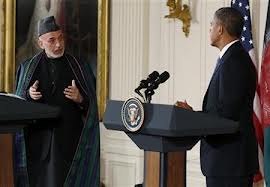
Washington DC Jan 14: While U.S. President Barack Obama and Afghan President Hamid Karzai reached a rough understanding this past weekend on how to wind down the longest war in U.S. history, now in its 12th year, the Afghans have been fighting continuously since the Soviet Union invaded their country in 1979. ]
But the latest agreement didn’t include the key ingredient — Pakistan.
And without Pakistan, no peaceful settlement is possible. But even with Pakistan, reeling from sectarian strife that has taken some 32,000 lives this past year, an Afghan settlement would appear a bridge too far.
Karachi, a port city of 21 million, “is a violent urban jungle with an assortment of lowlifes keeping the population hostage to their bastardly instincts,” columnist Ejaz Haider wrote last week in Pakistan’s The Express Tribune.
Haider’s description of the gigantic port city: “There are the scions of Baloch and Sindhi sardars . . . who move around in SUVs with guards brandishing weapons . . . with a rural-medieval mindset.”
Then there are, adds Haider, “crooked politicians, their guards, political storm troopers, criminal gangs, ranging from thieves to land grabbers to extortionists and murderers to hired guns; cops on the take; a government split along ethnic lines; anyone who can rent a gun and settle a score.”
And at the center of all of this, “Taliban terrorists and sectarian killers and you have, dear non-Karachiite reader, what is Karachi.”
Tehrik-i-Taliban Pakistan (TTP) is the counterpart of Afghanistan’s Taliban. With a major difference: the Pakistani Taliban recruited among the low-life and its ranks now include criminal gangs, including felons and murderers.
TTP specializes in urban terrorism where the army is loath to intervene after driving terrorists from the countryside to inner cities where law enforcement lacks counterterrorism skills — and funds.
When reading about TTP’s criminal and terrorist clout in major cities, it is tempting to conclude this is just one more foreign crisis that doesn’t concern us. But Pakistan is a nuclear power.
And not to be dismissed are opportunities for secret alliances between terrorists and younger anti-U.S. army officers on duty in underground nuclear weapons sites. Many officers believe the deluge of anti-U.S. disinformation in the Pakistani media.
Some of the Pakistani officers who were banned from traveling in the United States throughout the 1990s as retaliation for the country’s secret nuclear weapons program (designed to match India’s) are now one-, two-, or three-star generals.
With the TTP’s stepped up terrorist operations, safe and secure elections in Pakistan are pure fantasy.
On Dec. 22, a suicide bomber killed Khyber Pakhtunkhwa Minister Bashir Ahmad Bilour, a much-respected political figure, while he was attending a pre-election meeting. Bilour had survived three previous attempts to kill him. His crime: Raising his voice against TTP.
TTP accepted responsibility “in the name of war against secular elements in our political life.”
Bilour was a national figure and his Pakistan Peoples Party observed a national day of mourning across the country. The Khyber Pakhtunkhwa government shut down for three days.
TTP’s first prominent target was Benazir Bhutto, killed five years ago. Now influential moderate voices are warned they are on TTP’s hit list. And TTP also announced it planned to go international, especially against the United States.
Pakistan’s TTP terrorists, like the Afghan Taliban, have bases in the mountain tribal areas on the Afghan border and so far they appear to have escaped the U.S. drone attack strategy. They recently sent a message to the Pakistan army command about a “unilateral cease-fire in order to focus on the U.S. enemy in Afghanistan.”
Afghan peace talks cannot be conducted in isolation from a rapidly deteriorating Pakistan security situation.
TTP terrorists are executing a “devastation of Pakistan” strategy, targeting army general headquarters in Rawalpindi, the Mehran naval air station outside Karachi (where they destroyed half a dozen jet aircraft in May 2011); airports; factories; public places, including Christian, Shiite, and Sunni places of worship.
Even polio vaccination places are targeted, which forced the government to stop its anti-polio campaign.
The Taliban, reported one UPI correspondent who asked that his name be withheld for his protection, have their network of sympathizers in every walk of life. Many political and religious parties are reluctant to criticize them in public.
A number of media organs don’t report attacks by TTP. TTP moles are believed to be embedded in security agencies.
Denials notwithstanding, the Pakistani army is also protecting the “good Taliban” and crushing the “bad Taliban.”
There are no easy solutions. Political will, and security wherewithal, are missing.
A recent TTP video said, “The government will have to quit its alliance with the U.S. that will then have to abandon its war in Afghanistan that will then have to rewrite the country’s constitution according to Shariah law — and apologize for the war they launched against us.”
A mouthful — but the message and the ultimate objective are clear.
Pakistan’s nightmare scenario is an election victory for the immensely popular Dr. A.Q. Khan, the notorious nuclear black marketer, who stole nuclear bomb manufacturing secrets from the Netherlands for Pakistan’s nuclear arsenal, and then sold them to Iran, North Korea, and Libya.
On the same election ticket as Khan is fellow traveler Gen. Hamid Gul, a former head of Pakistani intelligence who was the first to launch the canard about 9/11 being the work of the CIA, Israel’s Mossad, and the U.S. Air Force.
Gul is also an admirer of the Afghan Taliban chief Mullah Omar, in hiding since the U.S. invasion of Afghanistan after 9/11. He met with Omar two weeks before 9/11.
This weekend 14 Pak soldiers were killed by a roadside bomb, a Sunni attack on Shiite Muslims killed 86 in Quetta (Baluchistan) and a “Million Man March” led by an anti-TTP cleric who spent the last six years in Canada, left Lahore for Islamabad — with 2,000 volunteers.
Forgoing is a guide for the coming week’s political upheaval in Pakistan.
Noted editor and journalist Arnaud de Borchgrave is an editor at large for United Press International. He is a founding board member of Newsmax.com who now serves on Newsmax’s Advisory Board.
Washington DC, Dec 29: On the brink of a new year, Pakistan faces an unstable future. Can the son of assassinated prime minister Benazir Bhutto break through the chaos?
Bilawal Bhutto Zardari, son of Pakistan President Asif Ali Zardari and former prime minister Benazir Bhutto, stepped onto the national stage for the first time this week, to give a speech marking the fifth anniversary of Benazir’s murder. Still too young to run for office, the 24-year-old Bhutto’s coming out adds more drama to what will be a pivotal year for Pakistan. National elections, turnover at the top military position, and the denouement in the war in Afghanistan all promise to make 2013 a critical year for a country that is both under siege by terrorism and the center of the global jihadist movement.
Bilawal’s grandfather, uncles, and mother all were murdered in political violence. Zulfikar Bhutto was hung in 1979 by Gen. Mohammad Zia ul-Haq, his two uncles died in mysterious plots, and his mother was assassinated by al Qaeda and the Taliban. His family story resembles Pakistan’s reality. Pakistanis a country in the midst of a long and painful crisis. Since 2001, according to the government, 45,000 Pakistanis have died in terrorist-related violence, including 7,000 security personnel. Suicide bombings were unheard of before the 9/11 attacks; there have been 300 since then. The country’s biggest city,Karachi, is a battlefield. One measure of Pakistan’s instability is that the country now has between 300 and 500 private-security firms, employing 300,000 armed guards, most run by ex-generals. The American intelligence community’s new global estimate rates Pakistan among the most likely states in the world to fail by 2030.
wanted on America’s counter terrorism list live in Pakistan. The mastermind of the 2008 Mumbai massacre and head of Lashkar-e-Taiba, Hafiz Saeed, make no effort to hide. He is feted by the army and the political elite, appears on television, and calls for the destruction of India frequently and jihad against America and Israel. The head of the Afghan Taliban, Mullah Mohammed Omar, shuttles between Pakistan intelligence (ISI) safe houses in Quetta and Karachi. The emir of al Qaeda, Ayman al-Zawahiri, is probably hiding in a villa not much different from the one his predecessor was living in with his wives and children in Abbottabad until May 2011.
Pakistan also has the fastest-growing nuclear arsenal in the world, bigger than Great Britain’s. The nukes are in the hands of the generals; the civilian government has only nominal control. President Zardari has only nominal influence over the ISI as well; indeed it deliberately botched the security for Benazir to help get rid of her, and it has conspired for five years to get rid of him, too.
Against the odds, Zardari has survived. By next fall, he will have served five years, becoming the first elected civilian leader to complete a full term in office and pass power to another elected government. It will be a major milestone for Pakistani democracy. Zardari has served years in prison. He often has been called a criminal by many, including in his own family, and the national symbol of corruption. Yet as president he presided over an major transfer of power from the presidency to the prime minister’s office, even the titular National Command Authority over the nukes, to ensure the country is more democratic and stable.
The parliamentary election in the spring will be a replay of every Pakistani election since 1988, pitting Nawaz Sharif’s party against the Bhuttos. Needless to say, many Pakistanis are sick of the same old stale choices. But the odds favor the old parties. Both Sharif and Zardari are committed to cautiously improving relations with India and trying to reform the Pakistani economy. Both have troubled relations with the Army.
If Sharif returns to the prime minister’s job for a third time, it will be a remarkable next turn in his own odyssey. Sharif was removed from the office in 1999 in an illegal coup and barely escaped alive to go into exile in Saudi Arabia. His decision to withdraw Pakistan’s troops in 1999 during the Kargil War prompted his fall from power, but it also may have saved the world from nuclear destruction. It was a brave move. I remember talking to him and his family in the White House the day after he made the decision to pull back. You could see in his eyes that he knew the Army would defame him, but he knew he was in the right.
But many Pakistanis want a new face to lead their country. Out of desperation, some are turning to cricket star Imran Khan to save Pakistan. The ISI is probably helping his campaign behind the scenes to stir up trouble for the others. He is a long shot at best. He is much more anti-American, anti-drone, and ready to make deals with the Taliban to stop the terror at home. Yet he understands well that Pakistanis a country urgently in need of new thinking.
Whoever wins will inherit an economy and government that is in deep trouble. Two thirds of the 185 million Pakistanis are under 30; 40 million of the 70 million ages 5 to 19 years old are not in school. Fewer than 1 million Pakistanis paid taxes last year. Power blackouts are endemic. Clean water is increasingly scarce, even as catastrophic floods are more common. Growth is 3 percent, too little to keep up with population demand.
It is no wonder that the generals prefer to have the civilians responsible for managing the unmanageable while they guard their prerogatives and decide national-security issues.
So it is no wonder that the generals prefer to have the civilians responsible for managing the unmanageable while they guard their prerogatives and decide national-security issues. As important as the elections next spring will be, the far more important issue is who will be the next chief of Army staff.
The incumbent, Gen. Ashfaq Parvez Kayani, was given an unprecedented three-year extension in 2010. He is the epitome of the Pakistani officer corps and the so-called deep state. Pervez Musharraf made him director general of the ISI in 2004. On his watch, the Afghan Taliban recovered and regrouped inQuetta, Osama bin Laden built his hideout 800 yards outside Kayani’s alma mater—the Kakul Military Academy in Abbottabad—in 2005, and planning began for the 2008 Lashkar-e-Taiba attack on Mumbai. His term expires in September.
The history of civilians choosing chiefs of Army staff is not encouraging. Zulfikar Bhutto chose Zia ul-Haq, whom he called his “monkey general” because he thought he was apolitical. Zia staged his own coup and then hanged Zulfi. Nawaz Sharif picked Pervez Musharraf, quarreled over the Kargil War, and fired Pervez, who then staged his coup. No wonder Zardari just rolled over Kayani for another three years in 2010. It was the easy way out.
The next COAS will come from the shadowy group of a dozen corps commanders who run the Army. They do not advertise their political views as a rule. By next summer, a consensus will probably emerge in the inner circle on who should succeed Kayani, and the whole world will try to decipher the implications of the choice.
Washington will be watching all of this carefully. U.S.-Pakistan relations are at a low point and may get worse. It is in Afghanistan that the relationship will be most tested in 2013. This past September, the Taliban attacked a base called Camp Bastion, destroying eight U.S. Marine jet aircraft and killing two Marines. The interrogation of the surviving Taliban fighter indicated the attack was planned at an ISI safe haven in Pakistan with Pakistani army expertise. Then in December, the head of Afghan intelligence, Asadullah Khalid, was almost assassinated by a terrorist who the Afghans say came from Pakistan and was sent by the ISI. Incidents like these promise to make 2013 another year of strained relations in the U.S.-Pakistan deadly embrace.
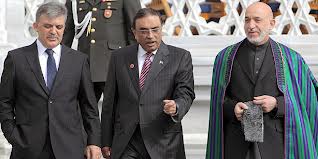
Ankara summit with heads of Turkey, Pakistan and Afghanistan (Credit: afpak.jpg)
Kabul/Islamabad, Dec 13: Afghan officials say Pakistan has released a new batch of Taliban prisoners, in the latest of a series of concessions to Kabul that could signal greater Pakistani support for a peace deal in Afghanistan.
According to sources in Kabul, Pakistan released nine middle-ranking Taliban commanders, making a total of 18 such prisoners let out of Pakistani jails since last month. Afghan and western officials said most of the Taliban prisoners had been arrested because they had shown interest in making peace, without the permission of the Pakistani military, which has long seen its backing for the insurgents as a strategic bargaining chip.
The prisoner releases come amid a flurry of bilateral meetings and a significant warming in the Afghan-Pakistan relationship, which is almost universally seen as critical to hopes of peaceful settlement in the 11-year Afghan conflict.
A hotline has also been established between the leaders of Afghanistan, Pakistan and Turkey. The Ankara summit followed a meeting of security officials in London on 5 December, and a visit to Pakistan by Afghanistan’s high peace council last month.
The head of the council’s executive, Masoom Stanekzai, said: “You can see two things. One is there is a change of language. Second is they are taking some practical steps.”
He added that the prisoner releases “sent a positive message in terms of building confidence both among the public and with the Taliban”.
Another Afghan official, speaking off the record, said: “If Pakistan co-operates, there could be a major breakthrough in 2013, and that means a sustained period of face-to-face negotiations, and a ceasefire leading to Taliban participation in the [2014] election.”
However, there is still significant scepticism about Pakistan’s motives in Kabul and western capitals, which for years have accused it of stoking the insurgency while paying lip service to peace. “We don’t yet know if this is a tactical or strategic shift,” an Afghan official said.
Pakistan has still not released its most senior Taliban prisoners, most importantly the former second in command, Mullah Abdul Ghani Baradar, who Kabul believes could be a key participant in any future peace talks. The Pakistani foreign minister, Hina Rabbani Khar, said on Wednesday that it was still too early to discuss Baradar’s release but that Pakistan would continue to release Taliban inmates.
Afghan officials would also prefer to have had a chance to talk to the Taliban prisoners on their release, but they were instead allowed to disperse. Most are thought to have gone back to their families in Pakistan, though one mid-level official is said to have gone to Saudi Arabia, where he has family, and there were unconfirmed reports that at least one had returned to the fight in Afghanistan and another had been re-arrested.
“The litmus test is the insurgency and that has continued unabated,” said one doubtful western expert on the Taliban. “There is no sign that they have reined in these guys because they still think they are their best asset to get the government in Kabul that they want.”
Optimists inside the Karzai government insist that such views do not take into account the dramatically different atmosphere in the most recent talks. They believe there that is now substantial evidence that Pakistan is taking a new view of its long-term interests and preparing for the possibility of the success of an Afghan settlement rather than its failure. They say the Pakistani leadership appears less preoccupied by the longstanding fear that Afghanistan could become an Indian client state that would contribute to Pakistan’s encirclement.
“That is a real change. They didn’t even mention India,” said a participant in recent talks. “They didn’t ask for India to close its consulates. They didn’t talk about their need for a ‘friendly’ Afghanistan. They said they needed a stable Afghanistan.”
He said Pakistan had made further concessions, agreeing to guarantee safe passage to a Taliban delegation to forthcoming informal talks in Chantilly, outside Paris. The Afghan and Pakistani leadership have also discussed deepening military co-ordination. Stanekzai said that there was agreement to organise a joint meeting of Afghan and Pakistani Islamic clerics early in the new year, focused on “how to change the narrative of violence to a narrative of peace”.
Stanekzai would not comment on reports that Afghan officials had visited Baradar in jail in Pakistan, but US officials said that at least one such meeting took place. It is also believed that senior Taliban inmates in Pakistan have been placed under a more liberal regime, such as being allowed to make telephone calls under supervision.
In light of Pakistan’s more positive approach, Stanekzai said, Kabul was determined that last week’s assassination attempt against its national security director would not derail the improvement in the bilateral relationship, although Afghanistan had evidence that the would-be killer – who hid explosives in his underpants – came from Quetta in Pakistan.
“No doubt there are enemies of the peace [process] everywhere and they don’t want this reconciliation to move forward, people who benefit from the continuation of conflict and war,” he said. “They will always create obstacles in order to prevent it, and every time we make some progress there is an incident that happens”
He also called on the Obama administration to release Taliban commanders from Guantánamo Bay, so they could take part in a peace process that began and then stalled in Qatar earlier this year. The release of five Taliban inmates has been delayed because of a lack of agreement between the US and the insurgent leadership on guarantees that they would not re-enter the conflict.
“We do hope that issue is resolved quickly, as this can be a step forward,” Stanekzai said, adding that in return, the Taliban would have to commit to direct peace talks and a ceasefire. He said: “In negotiation and peace talks, you have to give something and you have to get something.”
Washington, Dec 1: The Pentagon will send hundreds of additional spies overseas as part of an ambitious plan to assemble an espionage network that rivals the CIA in size, U.S. officials said.
The project is aimed at transforming the Defense Intelligence Agency, which has been dominated for the past decade by the demands of two wars, into a spy service focused on emerging threats and more closely aligned with the CIA and elite military commando units.
When the expansion is complete, the DIA is expected to have as many as 1,600 “collectors” in positions around the world, an unprecedented total for an agency whose presence abroad numbered in the triple digits in recent years.
The total includes military attachés and others who do not work undercover. But U.S. officials said the growth will be driven over a five-year period by the deployment of a new generation of clandestine operatives. They will be trained by the CIA and often work with the U.S. Joint Special Operations Command, but they will get their spying assignments from the Department of Defense.
Among the Pentagon’s top intelligence priorities, officials said, are Islamist militant groups in Africa, weapons transfers by North Korea and Iran, and military modernization underway in China.
“This is not a marginal adjustment for DIA,” the agency’s director, Lt. Gen. Michael T. Flynn, said at a recent conference, during which he outlined the changes but did not describe them in detail. “This is a major adjustment for national security.”
The sharp increase in DIA undercover operatives is part of a far-reaching trend: a convergence of the military and intelligence agencies that has blurred their once-distinct missions, capabilities and even their leadership ranks.
Through its drone program, the CIA now accounts for a majority of lethal U.S. operations outside the Afghan war zone. At the same time, the Pentagon’s plan to create what it calls the Defense Clandestine Service, or DCS, reflects the military’s latest and largest foray into secret intelligence work.
The DIA overhaul — combined with the growth of the CIA since the Sept. 11, 2001, terrorist attacks — will create a spy network of unprecedented size. The plan reflects the Obama administration’s affinity for espionage and covert action over conventional force. It also fits in with the administration’s efforts to codify its counterterrorism policies for a sustained conflict and assemble the pieces abroad necessary to carry it out.
Unlike the CIA, the Pentagon’s spy agency is not authorized to conduct covert operations that go beyond intelligence gathering, such as drone strikes, political sabotage or arming militants.
But the DIA has long played a major role in assessing and identifying targets for the U.S. military, which in recent years has assembled a constellation of drone bases stretching from Afghanistan to East Africa.
The expansion of the agency’s clandestine role is likely to heighten concerns that it will be accompanied by an escalation in lethal strikes and other operations outside public view. Because of differences in legal authorities, the military isn’t subject to the same congressional notification requirements as the CIA, leading to potential oversight gaps.
U.S. officials said that the DIA’s realignment won’t hamper congressional scrutiny. “We have to keep congressional staffs and members in the loop,” Flynn said in October, adding that he believes the changes will help the United States anticipate threats and avoid being drawn more directly into what he predicted will be an “era of persistent conflict.”
U.S. officials said the changes for the DIA were enabled by a rare syncing of personalities and interests among top officials at the Pentagon and CIA, many of whom switched from one organization to the other to take their current jobs.
“The stars have been aligning on this for a while,” said a former senior U.S. military official involved in planning the DIA transformation. Like most others interviewed for this article, the former official spoke on the condition of anonymity because of the classified nature of the program.
The DIA project has been spearheaded by Michael G. Vickers, the top intelligence official at the Pentagon and a veteran of the CIA.
Agreements on coordination were approved by Defense Secretary Leon E. Panetta, a former CIA director, and retired Army Gen. David H. Petraeus, who resigned abruptly as CIA chief last month over an extramarital affair.
The Pentagon announced the DCS plan in April but details have been kept secret. Former senior Defense Department officials said that the DIA now has about 500 “case officers,” the term for clandestine Pentagon and CIA operatives, and that the number is expected to reach between 800 and 1,000 by 2018.
Pentagon and DIA officials declined to discuss specifics. A senior U.S. defense official said the changes will affect thousands of DIA employees, as analysts, logistics specialists and others are reassigned to support additional spies.
The plan still faces some hurdles, including the challenge of creating “cover” arrangements for hundreds of additional spies. U.S. embassies typically have a set number of slots for intelligence operatives posing as diplomats, most of which are taken by the CIA.
The project has also encountered opposition from policymakers on Capitol Hill, who see the terms of the new arrangement as overly generous to the CIA.
The DIA operatives “for the most part are going to be working for CIA station chiefs,” needing their approval to enter a particular country and clearance on which informants they intend to recruit, said a senior congressional official briefed on the plan. “If CIA needs more people working for them, they should be footing the bill.”
Pentagon officials said that sending more DIA operatives overseas will shore up intelligence on subjects that the CIA is not able or willing to pursue. “We are in a position to contribute to defense priorities that frankly CIA is not,” the senior Defense Department official said.
The project was triggered by a classified study by the director of national intelligence last year that concluded that key Pentagon intelligence priorities were falling into gaps created by the DIA’s heavy focus on battlefield issues and CIA’s extensive workload. U.S. officials said the DIA needed to be repositioned as the wars in Iraq and Afghanistan give way to what many expect will be a period of sporadic conflicts and simmering threats requiring close-in intelligence work.
“It’s the nature of the world we’re in,” said the senior defense official, who is involved in overseeing the changes at the DIA. “We just see a long-term era of change before things settle.”
The CIA is increasingly overstretched. Obama administration officials have said they expect the agency’s drone campaign against al-Qaeda to continue for at least a decade more, even as the agency faces pressure to stay abreast of issues including turmoil across the Middle East. Meanwhile, the CIA hasn’t met ambitious goals set by former president George W. Bush to expand its own clandestine service.
CIA officials including John D. Bennett, director of the National Clandestine Service, have backed the DIA’s plan. It “amplifies the ability of both CIA and DIA to achieve the best results,” said CIA spokesman Preston Golson.
Defense officials stressed that the DIA has not been given any new authorities or permission to expand its total payroll. Instead, the new spy slots will be created by cutting or converting other positions across the DIA workforce, which has doubled in the past decade — largely through absorption of other military intelligence entities — to about 16,500.
Vickers has given the DIA an infusion of about $100 million to kick-start the program, officials said, but the agency’s total budget is expected to remain stagnant or decline amid mounting financial pressures across the government.
The DIA’s overseas presence already includes hundreds of diplomatic posts — mainly defense attachés, who represent the military at U.S. embassies and openly gather information from foreign counterparts. Their roles won’t change, officials said. The attachés are part of the 1,600 target for the DIA, but such “overt” positions will represent a declining share amid the increase in undercover slots, officials said.
The senior Defense official said the DIA has begun filling the first of the new posts.
For decades, the DIA has employed undercover operatives to gather secrets on foreign militaries and other targets. But the Defense Humint Service, as it was previously known, was often regarded as an inferior sibling to its civilian counterpart.
Previous efforts by the Pentagon to expand its intelligence role — particularly during Donald H. Rumsfeld’s time as defense secretary — led to intense turf skirmishes with the CIA.
Those frictions have been reduced, officials said, largely because the CIA sees advantages to the new arrangement, including assurances that its station chiefs overseas will be kept apprised of DIA missions and have authority to reject any that might conflict with CIA efforts. The CIA will also be able to turn over hundreds of Pentagon-driven assignments to newly arrived DIA operatives.
“The CIA doesn’t want to be looking for surface-to-air missiles in Libya” when it’s also under pressure to assess the opposition in Syria, said a former high-ranking U.S. military intelligence officer who worked closely with both spy services. Even in cases where their assignments overlap, the DIA is likely to be more focused than the CIA on military aspects — what U.S. commanders in Africa might ask about al-Qaeda in Mali, for example, rather than the broader questions raised by the White House.
U.S. officials said DIA operatives, because of their military backgrounds, are often better equipped to recruit sources who can answer narrow military questions such as specifications of China’s fifth-generation fighter aircraft and its work on a nuclear aircraft carrier. “The CIA would like to give up that kind of work,” the former officer said.
The CIA has agreed to add new slots to its training classes at its facility in southern Virginia, known as the Farm, to make room for more military spies. The DIA has accounted for about 20 percent of each class in recent years, but that figure will grow.
The two agencies have also agreed to share resources overseas, including technical gear, logistics support, space in facilities and vehicles. The DIA has even adopted aspects of the CIA’s internal structure, creating a group called “Persia House,” for example, to pool resources on Iran.
The CIA’s influence extends across the DIA’s ranks. Flynn, who became director in July, is a three-star Army general who worked closely with the CIA in Afghanistan and Iraq. His deputy, David R. Shedd, spent the bulk of his career at the CIA, much of it overseas as a spy.
Several officials said the main DIA challenge will be finding ways to slip so many spies into position overseas with limited space in embassies. “There are some definite challenges from a cover perspective,” the senior defense official said.
Placing operatives in conventional military units means finding an excuse for them to stay behind when the unit rotates out before the end of the spy’s job.
Having DIA operatives pose as academics or business executives requires painstaking work to create those false identities, and it means they won’t be protected by diplomatic immunity if caught.
Flynn is seeking to reduce turnover in the DIA’s clandestine service by enabling military members to stay with the agency for multiple overseas tours rather than return to their units. But the DIA is increasingly hiring civilians to fill out its spy ranks.
The DIA has also forged a much tighter relationship with JSOC, the military’s elite and highly lethal commando force, which also carries out drone strikes in Yemen and other countries.
Key aspects of the DIA’s plan were developed by then-Director Ronald L. Burgess, a retired three-star general who had served as intelligence chief to JSOC.
The DIA played an extensive and largely hidden role in JSOC operations in Iraq and Afghanistan, sending analysts into war zones and turning a large chunk of its workforce and computer systems in Virginia into an ana-lytic back office for JSOC.
The head of U.S. Special Operations Command, Adm. William H. McRaven, who directed the operation that killed Osama bin Laden, has pledged to create between 100 and 200 slots for undercover DIA operatives to work with Special Forces teams being deployed across North Africa and other trouble spots, officials said.
“Bill McRaven is a very strong proponent of this,” the senior Defense official said.
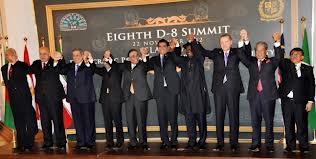
The hosting of the Developing Eight Summit in Islamabad, which commenced on November 22, means more than a gathering of eight Muslim nations, as far as Pakistan goes. The meeting, at which President Asif Ali Zardari took over the chairmanship of the group from his Nigerian counterpart, offers Pakistan a chance to pull itself back into the mainstream of global life from the fringes to which it has been pushed, chiefly due to security reasons. The fact that five heads of state attended the event, with Bangladesh and Malaysia represented at the adviser and ministerial levels respectively, marks a rare success for Pakistan — a nation that stands increasingly isolated.
The D-8 group consists of eight nations with a combined estimated total population of one billion. The theme of the summit was ‘Democratic partnership for peace and prosperity’. Pakistan remained keen to focus on trade issues and economic cooperation during the Summit, the events in Gaza overshadowed Summit proceedings to a considerable degree, especially since Iranian President Mahmoud Ahmadinejad, Egyptian leader Mohamed Morsi and Turkish Prime Minister Recep Tayyip Erdogan are all key players in the Middle East crisis. Pakistan was also able to bring up the main item on the agenda: increasing trade between member countries from $130 billion to $507 billion by 2018.
As significant as the discussions were, the symbolism involved in the Summit, marked a major triumph for the government. The visit by Goodluck Jonathan was the first by a Nigerian leader in 28 years. To ensure safe movement to their respective destinations, massive security was put in place, creating a traffic logjam for the locals. This, however, is the price we pay for the militancy that lives on in the country — an issue also discussed at the Summit. We must hope the meeting with key leaders can bear fruit as intended by the objectives of the Summit.
Published in The Express Tribune, November 23rd, 2012.
More than three years ago, I sat in an overflow room in Washington, DC’s Willard Hotel listening to General David Petraeus explain (pdf) how the only solution for the failing war in Afghanistan was a “comprehensive counterinsurgency (COIN) strategy”, modeled after the one that had allegedly achieved so much success in Iraq.
Petraeus’s speech came at the annual meeting of the Center for New American Security, a DC-based thinktank that had become a locus of COIN thinking in DC. And Petraeus was at the peak of his power and acclaim – heralded by both Democrats and Republicans as the man responsible for saving the Iraq war.
The four-star general’s in-depth powerpoint presentation (pdf), with its discussion of securing and serving the population, “understanding local circumstances” separating irreconcilables from reconcilables and living “among the people” was the apogee of COIN thinking, which dominated national security debates in Washington in 2008 and 2009. But, like Petraeus’s career, COIN and its usefulness as a tool for US military planners now lies in tatters.
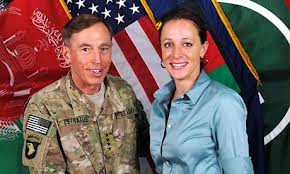
With last week’s revelations that Petraeus was having an affair as director of the CIA with his biographer Paula Broadwell, this tawdry story is likely to become the most glaring black mark on Petraeus’s career. But while his behavior was reckless, arrogant and, frankly, just plain stupid, it’s ironic that Petraeus is likely to be remembered more for that one personal act rather than his most grave professional mistake – namely, that same counter-insurgency strategy in Afghanistan for which he was one of Washington’s most influential proponents.
The event at CNAS was the quintessential example of the blinders and hubris that were so pervasive among COIN boosters and, in particular, Petraeus. They were convinced that the surge in Iraq and the use of counterinsurgency tactics there had turned the tide. But as we know now – and should have even been aware then – the reality was far more complicated.
In truth, a number of key social and political shifts occurred in Iraq in 2006 and 2007, which coincided with the US surge. There was the decision by Sunni militias to turn against al-Qaida in Iraq, a group that was responsible for initiating much of the country’s horrifying violence in 2006; there was the ethnic cleansing and enclaving that took place in Baghdad, which turned a once Sunni-dominated city into one controlled by Shiites, and gave both sides in the civil war fewer individuals to seek out and slaughter; there was the mass exodus of refugees out of the country; and later, there was the Sadr ceasefire.
What’s more, those who pushed the Iraq surge narrative suggested that a more humane and civilian-focused approach there had brought success. In reality, the number of civilians killed by US airstrikes had increased nearly four-fold in Iraq; the number of Iraqis in detention jumped 50%. This is not to suggest Petraeus deserves no credit; he smartly took advantage of these larger shifts in Iraqi society to seek an endgame to the conflict.
But the reality is that much of the decline in violence attributed to the actions of US forces was the result of decisions and actions taken by the Iraqis themselves. The US role was important, but hardly decisive.
This, of course, was a much more complicated explanation for what happened in Iraq – and one far less gratifying to US policy-makers. This more nuanced reality did little to prevent Petraeus and his acolytes from not simply taking a victory lap but far worse, using the supposed “lessons of Iraq” to justify a similar course of action in Afghanistan.
Indeed, around the same time as Petraeus’s speech, COIN boosters were regularly arguing that the key to success in Afghanistan was reducing civilian casualties – and that such a goal could be achieved by the application of counter-insurgency tactics.
In reality, the assumptions of COIN advocates were badly flawed and based on unrealistic views of what the US could accomplish. It failed to take account the key ways in which Afghanistan differed from Iraq: the resilience of and public support for the Taliban insurgency; the presence of safe havens across the border; the incompetence of the central government in Kabul; the delusion that US soldiers could be turned into miniature anthropologists with the wherewithal to have a full appreciation of Afghan cultural idiosyncrasies; and finally, an abject refusal to factor in the lack of political support in the United States for a drawn-out counterinsurgency campaign.
Worst of all, COIN advocates committed the cardinal sin of believing that a shift in military tactics or a new commander would be enough to win a military conflict in which the US was engaged. As the great Chinese war philosopher once wrote, “tactics without strategy is the noise before defeat”. That is a lesson that Petraeus, among others, simply forgot. Indeed, it’s worth remembering that when asked by President Obama, point blank, if a surge of troops to Afghanistan could turn things around in 18 months, Petraeus responded:
“Sir, I’m confident we can train and hand over to the ANA [Afghan National Army] in that time frame.”
Petraeus was wrong – badly wrong. And more than 1,000 American soldiers, and countless more Afghan civilians, have paid the ultimate price for his over-confidence in the capabilities of US troops. And it wasn’t as if Petraeus was an innocent bystander in these discussions: he was working a behind-the-scenes public relations effort – talking to reporters, appearing on news programs – to force the president’s hand on approving a surge force for Afghanistan and the concurrent COIN strategy.
But when he took over as commander of the Afghanistan war in 2010, Petraeus adopted the harsh military strategy that he’d claimed the new, more civilian-focused COIN military plan would eschew. He ramped up airstrikes, which led to more civilian deaths. He increased the use of special forces operations. Perhaps worst of all, he sought to hinder the implementation of a political strategy for ending the war, seeking, instead, a clear military victory against the Taliban.
The greatest indictment of Petraeus’s record is that, 18 months after announcing the surge, President Obama pulled the plug on a military campaign that had clearly failed to realize the ambitious goals of Petraeus and his merry team of COIN boosters. Today, the Afghanistan war is stalemated with little hope of resolution – either militarily or politically – any time soon. While that burden of failure falls hardest on President Obama, General Petraeus is scarcely blameless. Yet, to date, he has almost completely avoided examination for his conduct of the war in Afghanistan.
In an age in which military officers are practically above public reproach – glorified and exalted by politicians and the media – the repeated failures of our military leaders consistently escape analysis and inquiry. This can have serious national security implications. As Joshua Rovner, associate professor of strategy and policy, US Naval War College, said to me in an email conversation, this lack of scrutiny has had grave consequences:
“[W]e have misunderstood our recent history in Iraq and Afghanistan; we have created new myths about strategy that will persist for many years despite their manifest flaws; and we may make bad decisions about intervening in other civil wars based on these myths.”
The wars in Iraq and Afghanistan were more than just bad strategy; they reflected poor military tactics and generalship. Self-interested and incomplete interpretations of what happened in Iraq led to predictably disastrous results in Afghanistan.
Perhaps we should spend a bit more time looking at that issue, rather who was sleeping with whom.
ISLAMABAD, Nov 14 — Pakistan said it had released at least seven senior Afghan Taliban prisoners on Wednesday, rekindling fragile hopes that Islamabad may be ready to help broker peace talks with the militants as the Western military withdrawal from Afghanistan looms.
A senior Pakistani security official, speaking on condition of anonymity, said that “seven to eight” Taliban prisoners had been set free but refused to name them. A Western official said the figure could be as high as 14 prisoners. News reports citing Afghan officials said the freed prisoners included Mullah Nooruddin Turabi, a former Taliban justice minister and religious hard-liner.
It was unclear whether the men were to be transferred to Afghan custody or released in Pakistan. But the announcement was mostly seen as an initial sign of good faith by the Pakistanis — perhaps to Afghan Taliban leaders in exile in Pakistan, perhaps to Afghan or American officials who seek to open talks, most likely all of the above — in a slow-moving negotiations process that has been blighted by deep mistrust on all sides.
“Things are starting to move,” said Najam Sethi, a veteran Pakistani commentator. “This is definitely an attempt by Pakistan to change tack and show both sides that they are serious about a settlement and an endgame.”
For years, the ability of the Pakistani Army’s intelligence agency to limit the movement of Afghan Taliban leaders has been seen as a political trump card — an insurance policy that any deal between the insurgents and the Americans or Afghan government would have to go through Pakistan first. Both countries have lobbied the Pakistanis to at least agree in principle to allow more freedom for Taliban leaders to travel in order to make any attempt at peace talks possible.
The release on Wednesday came at the end of a three-day visit to Islamabad by a delegation of Afghan officials from the High Peace Council, which is spearheading the effort by the government of President Hamid Karzai to draw the Taliban into peace talks.
Prisoner releases have been a core demand of the delegation, which had canceled two trips to Pakistan over disagreements with the Pakistanis. “Our demand was that they should hand over some of those Taliban prisoners to us,” Maulavi Shafiullah Nuristani, a member of the High Peace Council, said in Kabul.
In return, the members of the Afghan delegation presented Pakistani officials with a document outlining their intentions for the faltering peace process, known in Afghanistan as “reconciliation,” for the idea that Taliban representatives could perhaps be brought into the national government in return for ending their campaign of violence.
A joint statement issued by Pakistan and Afghanistan on Wednesday evening noted that Pakistan “supports Afghanistan’s vision and road map for achieving durable and lasting peace” and that all sides would “facilitate safe passage to potential negotiators to advance the reconciliation process.”
The two countries agreed to hold a conference of religious scholars, possibly in Saudi Arabia, to discuss Islamist militancy. And they reiterated calls for the Taliban to cut its ties to Al Qaeda — a major American demand.
It was unclear how many of the freed prisoners were high-level Taliban officials. If his release is confirmed, Mullah Turabi would certainly fall in that category: He was the Taliban’s justice minister, and he had legal responsibility for the brutal public executions during Taliban rule in the 1990s and for the destruction of the Buddha statues in Bamian Province in 2001. He was set free by the Afghan government in 2002 in controversial circumstances, only to be later detained in Pakistan.
The Pakistanis made a point, however, of noting that another influential name was not on the release list: Mullah Abdul Ghani Baradar, a former deputy Taliban leader who was captured with American help in February 2010. Afghan officials say he may hold the key to unlocking a tentative negotiation process with the Taliban.
That process is seen by American officials as a crucial part of their military withdrawal from Afghanistan by the end of 2014 — even as they continue to try to weaken the Taliban’s military footing within Afghanistan. But there are many hurdles to opening talks, with distrust running deep among all four potential parties — the Taliban, the Americans, the Afghans and the Pakistanis.
Hopes of starting a negotiating process seemed to collapse in March, when the Taliban publicly rejected American efforts to set up a back channel in the Persian Gulf state of Qatar amid the Americans’ refusal to release Taliban figures held in the Guantánamo Bay prison camp in Cuba.
American officials believe that an intense debate is under way inside the Taliban leadership over whether to engage in any peace talks or to continue fighting until the bulk of Western forces are gone.
On the Afghan side, even as Mr. Karzai has repeatedly reached out to the Taliban to reconcile with his government, they have rejected the overtures, with some senior figures vowing they will never relent as long as Mr. Karzai or his allies hold power in Kabul. Further complicating matters, Mr. Karzai is suspicious of American overtures toward the Taliban that he views as attempts to go behind his back.
The Pakistani position is also mired in complexity. The United States and Afghanistan have long accused Pakistan’s Inter-Services Intelligence spy agency of providing shelter to Taliban leaders and fighters in the western province of Baluchistan and the sprawling port city of Karachi, where Mullah Baradar was captured. The ISI admits to some contact with insurgents, but insists it has no influence over militant operations.
The most contentious issue is the ISI’s hold over the Taliban ruling council, known as the Quetta Shura, named after the capital of Baluchistan, although experts believe meetings now take place in districts around the province.
In recent years, however, that grip has loosened, according to some Western officials and Pakistani analysts.
The new ISI chief, Lt. Gen. Zaheer ul-Islam, is said by some officials to be seeking to mend fences in order to strengthen his hand at any future negotiating table.
Jawad Sukhanyar contributed reporting from Kabul, Afghanistan.