Taliban ‘no-go zones’ liberated in Karachi

TTP areas in Karachi (Credit: tribune.com.pk)
TTP areas in Karachi
(Credit: tribune.com.pk)

KARACHI, Sept 14: With a machine-gun in the back seat, his foot on the accelerator and wearing “Top Gun” style sunglasses, Azfar Mahesar pushes deeper into the heart of one of Karachi’s “Talibanised” areas.

“This used to be a war zone, but we have liberated it,” says the slightly chubby policeman with pride as his vehicle races through the city of 20 million, where Afghan intelligence says former Taliban leader Mullah Omar made his home in 2013.

Over the past few years, one word has been on everyone’s lips here: “Talibanisation”.

This photograph taken on August 21, 2015 shows Pakistani police officer Azfar Mahesar speaking during an interview in Karachi. PHOTO: AFP

If the remote mountains that straddle the Pakistan and Afghanistan border have been the militant group’s playground, Karachi has been the insurgents’ hideout and cash-cow.

The Taliban dug deep into areas populated by ethnic Pashtuns, creating virtual “no-go zones” and terrorising the local population with extortion and kidnappings for ransom to provide funding for their Mujahideen.

But, say Pakistani officials, that has all changed now.

“Talibanisation in Karachi has died down,” says Mahesar, a former soldier turned senior police officer in the most dangerous, western part of the city.

“I can say very confidently 70 to 80 per cent (are purged). There are a few remnants in Karachi but they are not as capable of coming back with the efficiency that they had a year or so ago,” he adds.

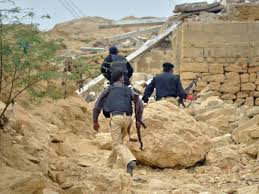
Today, policemen wearing flak jackets are advancing deep into the bowels of one of the remaining “no-go zones”, through dug-up streets and up rocky hills that mark the city’s western edge.


This photograph taken on August 21, 2015 shows Pakistani policemen taking a position at the destroyed hideouts of Taliban militants in the Manghopir area of Karachi. PHOTO: AFP

“This was a local Taliban HQ,” one says as he stands before a pulverised hovel. The Tehreek-e-Taliban has been the country’s public enemy number one since its formation in 2007.

Last December, the group carried out its deadliest attack ever, on a school in northwestern Peshawar, killing more than 150 people, mainly children.

In response, the government gave the police and paramilitaries permission to lay siege to Talibanised areas, killing hundreds of suspected insurgents, without worrying much about due process.

“Peshawar opened the world’s eyes. We had to act, even if it meant killing a thousand civilians,” says one policeman on the mission.

All this occurred as the military made gains in North Waziristan, from where the Taliban of Karachi received orders.

“The disconnection between Karachi and Miramshah (capital of North Waziristan) has helped law enforcers to keep the Pashtun parts of the city safe and clear of the militancy,” said Ziaur Rehman, an expert on security in Karachi.


PHOTO: AFP

Taliban fighters instead sought refuge in neighbouring Afghanistan, and Pakistan is now facing its lowest levels of terrorist violence in almost a decade.

In the Manghophir district of Karachi, residents now say business is picking up. Extortion and racketeering by the Taliban — or criminals posing as them — is now almost a thing of the past.

“God be thanked that the Taliban have gone. People were scared, they wouldn’t go out to the markets,” says elderly Fatima, dressed in a large and multicoloured shawl, in front of the shrine of the Sufi Saint Pir Haji Mangho — which serves as a barometer of militant presence.


PHOTO: AFP

Read: Crime rate in Karachi falls by 70%: police chief

Mystic and moderate Sufism were once the predominant forms of Islam practised by people in the country, but the sect is seen as heretical by the hardline Taliban.

This mausoleum, which was last attacked by militants in 2014, is guarded by crocodiles swimming in a green pond.

When the Taliban controlled the area, “the crocodiles barely got to eat,” says their guardian Khalifa Sajjad, a thin man wearing a red hat shimmering with tiny mirrors. “Now the followers have come back, and are giving their offerings of meat.”

In the hardscrabble Metroville district, where children bounce on a trampoline that has seen better days, Abdul Razzaq Khan, chief of the Jamaat-e-Islami political party in west Karachi, hails the anti-Taliban operation.


PHOTO: AFP

Read: Operation Zarb-e-Azb in final stages: Army chief

“God knows where they’ve gone. They’re maybe hiding out here, or they’ve returned to where they came from, that’s an unanswered question,” he says, though he still believes criminals posing as Taliban were a bigger threat than the group themselves.

But for Rauf Khan, a member of the secular ANP party, who last April survived the latest of several attempts on his life by militants, there is no doubt things have changed drastically.

“Now we are mentally liberated. It somehow hasn’t felt this way in 15 to 20 years,” he said.

“Yesterday, I went to the cinema and came home late. I haven’t done that in years.”
 

Govt mulls criminalisation of Muslims declaring another ‘kafir’

ISLAMABAD, Sept 10: The federal government is considering legislation to ban sectarianism and any attempt to finance sectarian hatred. Takfir, meaning one Muslim declaring another Muslim Kafir (apostate), will be considered a serious offence, under the proposed law which will be discussed at a meeting on Thursday in the Prime Minister’s Office.

“The purpose of the new law is to ban sectarianism and come down hard on financers of sectarian violence in the country,” said an official monitoring progress on the National Action Plan (NAP). “Both the centre and the provinces will pass legislation towards this end,” he said.

Experts believe the state is facing a major threat from sectarian groups, many of whom have been active in south Punjab, interior Sindh and Balochistan for several years now.

Hundreds have been killed in targeted killings motivated by sectarian hatred, which according to some experts, has been fueled by certain ‘brotherly’ allies of Pakistan.

“We will take up the issue of provinces’ hurdles in way of swift action against all banned outfits,” the official told The Express Tribune on the condition of anonymity. “Under new laws, no one will be allowed to declare a member of any other Muslim sect apostate.”

Talking to The Express Tribune, senior lawyer Ali Zafar said the government could amend relevant clauses of the Pakistan Penal Code (PPC) after reviewing the chapter of “deliberate and malicious acts intended to outrage religious feelings of any class by insulting its religion or religious beliefs.”

“It is a serious issue. The 1973 Constitution gives everybody the right to freely exercise his or her religion or belief,” he said. Former interior secretary Mahmood Shah said sectarianism should be considered a serious offence under the new laws. “It is high time we got rid of this chronic issue. Funds coming from abroad is also fueling sectarian violence which must be stopped and the issue should be taken up with brotherly countries,” he said.

Pakistan’s top civil and military authorities are scheduled to hold a crucial meeting in Islamabad today (Thursday) to discuss the next phase of the operation against militants. Participants include the prime minister, military and intelligence chiefs, chief ministers for the four provinces and Gilgit-Baltistan, and the premier of Azad Jammu and Kashmir.

“We are going to discuss a three-point agenda, with a focus on counter-terrorism and how to de-radicalise our society,” said a senior National Counter-Terrorism Authority (Nacta) official who will also attend the meeting.

The other two areas to be focused in the meeting are controlling proliferation of weapons and implementation of NAP in the provinces, the Nacta official said. He added that the Foreign Office would also convince authorities in Saudi Arabia and Iran to send funds to seminaries in Pakistan only through official channels. According to the official, the interior minister will also formulate a draft policy for deweaponisation in the country.

Published in The Express Tribune, September 10th, 2015


52 govt officers arrested in Sindh amid anti-corruption drive, Qaim told

PPP top brass charged (Credit: iamkarachiapp.com)
PPP top brass charged
(Credit: iamkarachiapp.com)
KARACHI, Aug 30: Sindh Anti-Corruption Establishment (ACE) Chairman Mumtaz Shah on Sunday told Chief Minister Qaim Ali Shah that 52 officers from different government departments had been arrested over charges of corruption, embezzlement and misappropriation of government funds across the province in the past two months.

He said 72 first-information reports (FIRs) were registered, while 209 inquiries were initiated against officials in the said time period.

Briefing the chief minister at the CM House, the ACE chairman said the Federal Investigation Agency (FIA) and the National Accountability Bureau (NAB) had begun sending him inquiries into land, revenue and local government matters – such as illegal and double land allotments, bogus allotment files and other such forgeries and criminal acts.

“So far I have received more than 40 inquiries and have constituted a two- member committee to scrutinise them and conduct thorough inquires so that action could be taken accordingly.”

The chief minister said matters being forwarded by the NAB and FIA must be taken seriously followed by swift action.

“It is a good omen that the federal agencies have started posing confidence in ACE,” said Qaim Ali Shah.

Giving details of the FIRs, inquiries and arrests, the ACE chairman said since July 22, 2015, four raids have been conducted in Karachi South, which resulted in three arrests and four FIRs.

From Karachi East, he said, six FIRs have been registered and five accused have been detained in the said time frame, while two FIRs, four arrests and 26 inquiries were initiated after action in Karachi West.

Mumtaz Shah said in Hyderabad, four surprise visits and three raids were conducted resulting in 17 FIRs and as many arrests of government officers. He added that in Jamshoro, nine FIRs were registered, 46 inquiries initiated and eight officials arrested in the aftermath of seven raids.

Similarly, four surprise visits and seven raids were carried out in Mirpurkhas after which eight FIRs were lodged and four officers were apprehended.

In Shaheed Benazirabad, eight surprise visits and two raids were conducted, whereas in Sukkur, five surprise visits and six raids were carried out resulting in 13 FIRs, 24 inquiries and nine arrests.

In Larkana 13 FIRs were registered, 135 inquiries initiated and eight officers arrested after action by the anti-corruption body.

ACE Chairman Mumtaz Shah told the chief minister that most of the initiated inquires were against officials in the local government, education, health, works & services, irrigation, and revenue departments.

He said he had also initiated a process to computerise records of the anti-corruption establishment.

“Entire initiatives would be computerised right from receiving a complaint, process of inquiry, registration of FIRs, arrests and other such actions,” he said, adding that software would be developed to meet all requirements.

The ACE chief said on his directives commissioners in Sindh had held five meetings in which 37 matters related to Karachi West, 50 from district Jamshoro, 14 from Shaheed Benazirabad, 14 from Sukkur and 213 from Larkana were decided.

“This implies we decided 328 cases from five districts, which is in itself a record,” Mumtaz Shah said.

The chief minister appreciated the provincial anti-corruption body’s efforts, urging the ACE chairman to eradicate corruption from government departments.

The Struggle for Survival in Karachi

This is the simple story of an ordinary man who leads an ordinary life in Karachi. What separates him from others is that not a single day passes without some unpleasant incident taking place between him and members of the traffic police, who are beholden to implement the highway code of Pakistan. It is no staggering epic. Just a simple tale of an ordinary man who buys sells and repairs computers for a living. Well, perhaps he’s not really all that ordinary. He is, in fact, an expert and there is literally nothing that anybody can teach him about computers, laptops and printers. He is more expensive than most practitioners. But he works fast and quietly.

As I am a dinosaur when it comes to technology, I invariably call him when something goes wrong with my desktop. As he happens to belong to the Bohra community, which requires him to wear specific headgear, he becomes a target for the vultures in the police force. He owns a motorcycle. Or rather, he owned a motorcycle. But that bit in this sordid tale will come later.

For various reasons, he had to cross PIDC House on his daily assignments and that is where the first of the official hold-ups began. Whether the flatfoot was a burly cop with a fierce handlebar moustache who communicated in the tart tones of repressed rage, or a lean and wiry hombre flushed with polemic, the computer expert was invariably detained for not wearing a helmet. As the policeman on duty had rather strong views about not encouraging law-breakers to pay fines to the exchequer, but to subsidise the salaries of underpaid officers of the law, a number of bank notes rapidly changed hands. And while negotiations were taking place over the amount of the bribe, at least a dozen motorcyclists who were not wearing helmets sailed by like ballerinas in a Tchaikovsky ballet. At times this ritual was repeated in another location. Eventually, the expert got a press card from one of the local newspapers which stated he had been appointed their official correspondent for culture.


That did the trick for a while. And then, two days ago, while stopping at a traffic light in Punjab Colony, wondering what the missus was preparing for lunch, he was held up by a couple of mean looking robbers wielding weapons. They took away his motorcycle, bag, wallet and cell phone. The bag contained among other things an Apple laptop worth over Rs100,000. It belonged to a client who will soon ask for a replacement or reimbursement. But instead of throwing himself off the roof of the Finance Trade Centre, he kept a stiff upper lip, rented a motorcycle for Rs500 a day and carried on as usual.

Now when he sees the amber light turn to red at a traffic signal, he slows down. And when the light turns to green, he shoots through the maze of cars like Barry Steven Frank Sheene of the United Kingdom. Life has to go on in one of the world’s worst managed and most corrupt administrations. Just think about it. Despite the presence of the Rangers in Karachi, the crime rate has not decreased. In Karachi’s Orange County where the Clifton Cantonment has put up notices about keeping Clifton clean and green, the area has achieved a high degree of notoriety for having the worst rubbish dumps in the city. And to make matters worse, lots of house-owners are charged a water tax without getting a drop of water. So the citizens have to grin and bear it. For there really is no escape.

Published in The Express Tribune, August 30th, 2015.


Robbed at gunpoint: Citizens vulnerable despite Rangers operation

Karachi's streets (Credit: nbc.com)
Karachi’s streets
(Credit: nbc.com)
KARACHI, Aug 17: For Sana Sheikh, the scene is all too familiar; a furtive figure approaches the car at a traffic light, the advance timed perfectly between the switch from red to green. He leans in and taps a menacing weapon on the window, giving her husband no choice but to comply. With a gun fixed to his temple, the young couple quickly hands over mobile phones, cash and jewellery.

Ms Sheikh has been robbed at gunpoint on three occasions –– twice at the same spot in Clifton Block 7 and the most recent time at the traffic light on the Khayaban-i-Shaheen and Khayaban-i-Bahria intersection. “We have given everything each time,” she says, grateful that they have remained unhurt.

Unfortunately, Mehreen Ali Shah was brutally gunned down. The 48-year-old mother of two was shot fatally on DHA’s 26th street on the night of Aug 4, as she headed home after a meal at a Phase VIII restaurant. Ms Shah is among scores of people shot dead by robbers in the metropolis in the past eight months.

According to data collected by Human Rights Commission of Pakistan, around 29 people have been killed by robbers in different areas from January to June 2015. The number of phones stolen from January to July is estimated at over 21,000.

________________________________________
As muggings show no signs of letting up, police mull new strategy to tackle street crime
________________________________________
“On average, 50 people are killed during street crimes in the provincial capital each year,” a senior police officer tells Dawn.

Police admit an alarming rise in street crime and mention several reasons for their apparent failure to curb it, with lack of manpower cited as a major reason.

“There is only one police mobile with two policemen for patrolling in Phase VIII, Defence, where the murder of the woman took place,” says Darakhshan police station SHO Ghulam Hussain Pirzado.

Mr Pirzado, who was removed after the killing of Ms Shah, said the police mobile on that day was deployed for the security of business tycoon Malik Riaz.

“There are a total of 100 policemen for Darakhshan police. Of them only 70 perform their jobs and the rest are deployed on guard duty etc,” the former SHO discloses. Among them, 40 policemen perform their duty in the morning shift while 30 are assigned to night duty.

“This number of policemen can hardly be declared sufficient for 400,000 to 500,000 residents living in Phase V to Phase VIII [jurisdiction of Darakhshan police].”

Should Rangers confront street crime?

While the Rangers report weekly gains made in the Karachi operation launched in September 2013, there has been no respite for citizens when it comes to street crime.

There is a growing realisation among law enforcement agencies to shift the focus of the operation towards street crime, as the operation has yet to prove effective against the bane of muggings.

“This is partly because law enforcement agencies’ main focus has been to control major crimes such as targeted killings, kidnapping for ransom and extortion,” says the DIG (administration) Karachi, Sultan Ali Khowaja.
Mr Khowaja, who recently also served as DIG CIA, says the focus on alleviating political crime has paid off. “For six months, there has been no case of kidnapping for ransom. Extortion has become nil,” he boasts.

But he acknowledges that the attention must shift to street crime. “Initiatives are being taken and impact will be visible soon,” the senior police officer says.

New chief of the Citizen Police Liaison Committee (CPLC) Zubair Habib agrees that other crimes have ‘drastically’ decreased but feels there has been no decline in street crime. Citing ‘reported crime data’, the CPLC head says 17,000 mobile phones were either snatched or stolen in 2014 from January to July. In the current year, 22,000 mobile phones have been snatched for the same period.

“Street crimes, especially muggings, have not dropped partly because it is easy,” says Mr Habib. He says there are at least 100 points where traffic is congested, allowing criminals to swoop on and loot their victims in a jam. He also feels there are deserted areas –– such as in Defence where Ms Shah was shot dead – where it is easy to commit crime due to absence of police.

Two-pronged strategy

“Karachi police are going to sign a MoU (memorandum of standing) with NGO Voice of Karachi very soon to establish kiosks at these 60 places. Each will be supported by CCTVs and strong deployment of police,” says Mr Khowaja.

As a first step, a kiosk will be set up at the old ‘Submarine Chowrangi’ on Ch Khaliq-uz-Zaman Road near Gizri. At least 16 CCTV cameras will be installed, with two motorcycle squads of police that will perform their duty round the clock, especially during ‘peak hours’.

Each such kiosk is expected to cost up to Rs5 million.
For the second initiative, police are negotiating with cellular companies and the Pakistan Telecommunication Authority to register the IMEI number of each subscriber which will enable them to block a snatched mobile phone immediately after an incident is reported. A few meetings have taken place to discuss this, he says.

“This initiative should be supported by a legal framework and be made part of cyber crime,” suggests Sultan Khowaja. He says past police action against Karachi’s electronic market to curb the sale of stolen and snatched mobile phones was not effective as it was not supported by a legal framework to punish such elements.

The CPLC chief, too, refers to a recent meeting with AIG police Mushtaq Ahmed Mahar, where the two discussed a strategy to tackle street crime and proposed a solution to improve traffic flow with a ‘surveillance system’ which makes snatching. A proposal to set up a dedicated cell to deal with street crime is also under consideration.

But as law enforcement agencies scratch their heads and vow reform, citizens are left at the mercy of armed thugs operating brazenly throughout the city.

“I have been mugged but luckily they only took away my phone and some cash, and couldn’t snatch my wallet with ID documents and credit cards,” says Jamila Ali, wondering how she should securely carry these documents. “I have started keeping a cheaper phone to give to the muggers but I worry they will catch on.”

On Facebook group Haalat Updates –– an online forum where subscribers share security related concerns –– two muggings were reported in PECHS Block 2 in a span of two days. The CCTV footage of a similar mugging outside an apartment building on Islamia College road near Jail Chowrangi elicited sarcastic responses, betraying the frustration of hapless citizens from all walks of life.

Commenting on the ease with which an armed youth secures an unsuspecting biker’s phone by showing a pistol, one member writes: “It’s very casual, just like someone is holding up a cigarette to ask for a lighter…”

Published in Dawn, August 16th, 2015

Ground offensive begins: Army troops roll into Shawal Valley

Shawwal valley offensive (Credit: tribune.com.pk)
Shawwal valley offensive
(Credit: tribune.com.pk)

Pakistan Army has launched a ground offensive in North Waziristan Agency’s (NWA) mountainous Shawal Valley, regarded as the last haven of fleeing homegrown militants and their foreign cohorts. Meanwhile, the army’s fighter jets on Thursday continued to target militants’ hideouts in the agency for the fifth consecutive day, killing at least 43 suspected terrorists.

“Ground operation in Shawal, North Waziristan begins,” announced Major General Asim Salim Bajwa, the chief of army’s media-wing – Inter-Services Public Relations (ISPR) – on micro-blogging website Twitter.

Maj Gen Bajwa said the army chief General Raheel Sharif has directed the security forces to achieve the objectives as soon as possible. General Raheel lauded the ideal air and ground forces coordination, he said.

Meanwhile, an official of the security forces said fighter jets on Thursday targeted militants’ hideouts in Lwara Madai, Gharlamai, Ocha Bibi, Zvi Naray and several other areas of tehsil Shawal and Datta Khel in the NWA.

“These aerial attacks killed 43 militants, including 15 in Shawal and 28 in Datta Khel,” he said.

The local sources said residents of all these areas had started migrating to safer places in nearby provinces of Afghanistan, including Khost, Paktia and Paktika.

After Thursday’s strikes, the number of insurgents killed in the region this week climbed up to more than 150. The army earlier claimed its airstrikes killed 10 suspected militants on Wednesday, 18 on Tuesday, 50 on Monday and 40 on Sunday.

Since May, the military has stepped up operations in the deeply forested ravines of the Shawal Valley – which straddles North and South Waziristan agencies along the border with Afghanistan – and softened militant targets in the valley through continued airstrikes.

The deeply forested ravines of Shawal Valley and Datta Khel are popular smuggling routes between Pakistan and neighbouring Afghanistan, and are dotted with militant bases used as launch pads for attacks on Pakistani forces.

The area is a stronghold of Khan Sajna Said, the leader of a Taliban faction whose name the United States put on a sanctions list of ‘specially designated global terrorists” last year.

Banned Tehreek-e-Taliban Pakistan used to control all of mountainous NWA, which includes the Shawal Valley and Datta Khel, and runs along the Afghan border. But Pakistan Army recaptured most of the region in a major armed operation, codenamed Zarb-e-Azb, which was launched in June 2014.

North Waziristan used to be the Pakistani Taliban’s last key stronghold until the start of the operation. Officials claim that nearly 3,000 militants have been killed since the launch of the offensive. Authorities have now vowed to intensify operations both in the border regions and across the country.

Forces kill 12 militants in South Waziristan clash

Meanwhile, security forces also had a clash with militants in the neighbouring South Waziristan’s Asman Panga area of Lahda subdivision, where they killed 12 militants.

A security official told The Express Tribune, that a soldier was killed while two security forces’ personnel also got injured in the encounter.  He said the area where the clash took place is regarded as a stronghold of militants.

Published in The Express Tribune, August 21st, 2015

Punjab minister Shuja Khanzada killed in Pakistan blast

Col Shuja Khanzada (Credit: tribune.com.pk)
Col Shuja Khanzada
(Credit: tribune.com.pk)

Punjab’s Home Minister Shuja Khanzada has been killed in a suicide attack in the Pakistani province, police say.

Twelve other people died in the attack at Mr Khanzada’s office in District Attock, about 80km (50 miles) north-west of the capital, Islamabad.

Mr Khanzada was seen as the man in charge of the anti-terror campaign in Pakistan’s biggest province.

A Sunni militant group with ties to al-Qaeda has said it ordered the attack.

Lashkar-e-Jhangvi said it was in response to last month’s killing of its leader, Malik Ishaq.

Shuja Khanzada is the most senior Pakistani politician to have been killed by militants this year.

The minister’s death is being seen as a significant blow to Pakistan’s recent gains in the fight against militancy and extremism, says the BBC’s Shahzeb Jillani in Islamabad.

Our correspondent says questions are being asked about his security as the home minister had reported threats made against him.

Mr Khanzada was meeting supporters in his hometown of Attock when a large bomb exploded, causing the roof to cave in, trapping dozens under the rubble.

Leading tributes to the home minister, Prime Minister Nawaz Sharif said: “The courage and valour of Shuja Khanzada is message to the masterminds of terrorists that they are bound to be defeated.”

Lashkar-e-Jhangvi has been behind some of the most violent attacks in recent years.

It was banned in Pakistan in 2001 and designated a terrorist group by the US in 2003. It has claimed the killings of hundreds of mainly Shia civilians in Pakistan.


PM Approves Peace Plan for Balochistan

QUETTA, Aug 5: Prime Minister Nawaz Sharif approved on Thursday a plan to make Balochistan completely peaceful and take measures to ensure flawless security for the China-Pakistan Economic Corridor.

Presiding over a meeting of the Apex Committee, the prime minister reviewed progress of implementation of the National Action Plan and said the law and order situation in Balochistan had improved satisfactorily because of joint civil and military efforts.

Interior Minister Chaudhry Nisar Ali, Balochistan Governor Mohammad Khan Achakzai, Chief Minister Dr Abdul Malik Baloch, Minister for Saffron retired Lt Gen Abdul Qadir Baloch, Chief of Army Staff Gen Raheel Sharif, Commander Southern Command Lt Gen Nasser Khan Janjua, provincial Home Minister Mir Sarfaraz Bugti, Chief Secretary Saifullah Chattha, Home Secretary retired Capt Akbar Hussain Durrani, Inspector General of Frontier Corps, Balochistan, Maj Gen Sher Afgan and IG Police Mohammad Amlish attended the meeting.

Mr Sharif was briefed on the security situation and measures taken by the federal and provincial governments, armed forces and law-enforcement agencies for maintaining peace in Balochistan.

According to official sources, the meeting was informed that there was a remarkable decline in incidents of terrorism and heinous crimes.

Civil and military officials submitted a security plan which focused on providing complete security to the CPEC and projects related to it and restoring lasting peace in the province.

The prime minister said that Balochistan had a bright future and it would be the main beneficiary of CPEC projects. The infrastructure and communication network would be developed for effective use of resources of Balochistan. Gwadar Port would be connected with Central Asian states through rail and roads, he said.

He directed the authorities concerned to prepare a plan for developing the port and the city as an economic hub. He ordered them to reach out to the people to make them partners in the development process.

The prime minister approved a ‘Pur-amn Balochistan’ plan for bringing the angry Balochs back into the national mainstream.
He expressed satisfaction over the unanimous approach of all stakeholders on national issues and said that it would take the country forward.

He said the economic turnaround in the country was being acknowledged by international financial institutions which were now ready to work with Pakistan.

Earlier, the prime minister laid the foundation stone of Mangi Dam, the Balochistan Agriculture University and Samungli Road Flyover and inaugurated the Sariab Phatak Flyover in Quetta.

‘Altaf’s speech exceeded all limits’ – Pak interior minister

ISLAMABAD, Aug 2: Interior Minister Chaudhry Nisar Ali Khan lambasted Muttahida Qaumi Movement (MQM) Chief Altaf Hussain on Sunday for his last night’s speech, saying the purpose of such a speech was to bring a bad name to Pakistan and its institutions.

“Speeches made from London have crossed limits of all the principles, laws and regulations,” said Chaudhry Nisar while addressing a press conference here.

He said Altaf’s invitation for NATO forces to come to Pakistan and launch an operation is completely preposterous and that his speech is tantamount to waging a war against the country.

The minister also said that the government is reviewing all aspects of Hussain’s speeches and the issue will be raised with the British government legally.

The interior minister said the MQM’s reaction to the ongoing operation in Karachi has grown intense over the past few weeks. “MQM is actually angry at the cases being faced by Altaf Hussain in London,” he added.

He clarified that Pakistan has nothing to do with Altaf Hussain’s cases in Britain.

He also dispelled the perception that the ongoing operation in Karachi is targeting only MQM. “No political party including MQM is being targeted in the Karachi crackdown; the operation is being pursued indiscriminately against all the criminal elements,” he explained.

Nisar said people belonging to various parties were apprehended during the operation and those who were arrested wrongly were released later.

He said there has been a marked improvement in criminal activities in Karachi including targeted killing, extortion and kidnapping for ransom. He added that targeted killing saw an 87 percent decline in the month of July 2015 alone while not a single case of kidnapping for ransom was reported in the same month.

Altaf Hussain’ speech from last night:

MQM Chief Altaf Hussain asked his party workers to stage protests in front of United Nations, White House and NATO to raise the demand for sending their troops to Karachi.

Addressing MQM’s Annual Convention in the US city of Dallas via telephone, Altaf said India itself is a coward country, if it had some honour it would not have allowed ‘bloodshed of Mohajirs’ on Pakistani soil.

He also reiterated the demand for a separate province for Mohajirs.

In Pakistan, Detainees are Vanishing in Covert Jails

Families of disappeared protest (Credit: nytimes.com)
Families of disappeared protest
(Credit: nytimes.com)

KOHAT, July 25 — Niaz Bibi’s son disappeared into the night, whisked away by Pakistani soldiers who accused him of being a Taliban fighter. For 18 anguishing months, she could find no word of his fate. Then she got a phone call.

“Come to Kohat prison,” said the man on the other end. “Tell nobody.”

At the prison, in northwestern Pakistan, she was directed to a separate, military-run internment center where her son, Asghar Muhammad, was brought to her. They touched hands through a metal grill, and she wept as he reassured her that he would be home soon.

But when the phone rang again, one month later, an official delivered crushing news. “Your son is dead,” he said. “Come collect his body.”

Mr. Muhammad was one of dozens of detainees who have died in military detention in Pakistan in the past year and a half, amid accounts of torture, starvation and extrajudicial execution from former detainees, relatives and human rights monitors. The accusations come at a time when the country’s generals, armed with extensive new legal and judicial powers, have escalated their war against the Pakistani Taliban by sweeping into their strongholds and detaining hundreds of people.

Critics warn that those gains may be coming at the cost of human rights, potentially weakening Pakistan’s fragile democracy and, ultimately, undermining its counterterrorism effort.

“People live in abject fear of speaking out about what the military is doing,” said Mustafa Qadri of Amnesty International, which received reports of more than 100 deaths in military custody in 2014.

At issue is a network of 43 secretive internment centers dotting Khyber Pakhtunkhwa Province and the tribal belt. Little is known about the centers, formally established in 2011 and given greater powers by a tough antiterrorism law passed last year. Most are based in existing jails and military bases and operate far from public view. The total number of detainees has not been made public.

Relatives of missing people have filed 2,100 cases with the Peshawar High Court, seeking news of their fates.

In many instances, the first news comes when a body is sent home.

Last year, for instance, a man from the Kurram tribal district told the court that three of his six sons who were detained in Kohat had died in custody. The man’s lawyer said he had not brought a criminal complaint against the military out of fear that his remaining sons would meet a similar fate.

The chief military spokesman, Maj. Gen. Asim Bajwa, did not respond to a detailed list of questions about conditions at the internment centers.

Classified documents leaked last year by the former National Security Agency contractor Edward J. Snowden made clear that American officials were aware of widespread human rights violations by the Pakistani military, even as billions of dollars in American military aid kept flowing to Pakistan.

Pakistani military officials tortured and killed people suspected of being militants “with the knowledge, if not consent, of senior officers,” said one American assessment in 2011.

Advertisement

Continue reading the main story

“The military took care to make the deaths seem to occur in the course of counterinsurgency operations, from natural causes, or as the result of personal vendettas,” said the document, first cited by The Washington Post.

The Obama administration, which has gradually improved its relationship with Pakistan this year, has been muted in its public criticism of the violations and has not invoked a provision of American law that limits assistance to foreign militaries guilty of human rights abuses.

Instead, the administration approved more weapons for the Pakistani military: In April, it approved almost $1 billion worth of helicopters and laser-guided Hellfire missiles for use in counterterrorism operations.

State Department officials say they have warned the Pakistani military that the accounts of rights violations could lead to future restrictions on military assistance.

Until recently, accusations of such abuses by Pakistani soldiers and intelligence officers have been sharpest in western Baluchistan Province, where the army has faced accusations of abducting, torturing and killing people suspected of being Baluch nationalists as part of a decade-old effort to quell a separatist rebellion there.

The deaths at internment centers have come in conjunction with the military’s battlefield gains — in the past year, it has seized control of much of North Waziristan — and a general hardening of public opinion against the Pakistani Taliban.

Tough new antiterrorism laws have given the army greater legal powers, and the number of deaths in military custody has declined in recent months since a military court system, authorized by Parliament in January, became active. Fayaz Zafar, a journalist in the Swat Valley, counted 48 bodies being returned to that area in 2014 and five so far this year, the latest on June 2.

Experts say the military-run courts fall far short of international standards, and their authority is being challenged in Pakistan’s Supreme Court. But public opposition to the courts has been muted, particularly since a Taliban massacre that killed 150 people, most of them children, in December. The authorities have taken harder action against militants on other fronts, too, lifting a moratorium on executions that has led to 178 convicts being hanged.

The executions have drawn repeated protest from the United Nations and the European Union but barely a whimper of public complaint.

By several accounts, conditions at the internment camps can be brutal. One former detainee from Swat said he had been thrashed with barbed wire, reduced to eating soap because he was fed so little and forced to give false testimony against other detainees in court.

“I felt guilty, but I knew I would be beaten if I refused,” said the man who, like others, spoke on the condition of anonymity to avoid further trouble.

Relatives of detainees who die in custody say they have been pressured into conducting hurried funerals, often at night, and sometimes coerced into declining an autopsy, even if the corpse bears signs of ill treatment. In other instances, they say, local mullahs are forbidden from offering prayers for the dead.

Asma Jahangir, a leading human rights lawyer, has brought a Supreme Court case challenging the detention of 33 men. When brought to court two years ago, two of the men said they had been tortured. They have since died in custody. “They supposedly had heart attacks,” Ms. Jahangir said.

In Swat, several women have formed a protest group to seek news of their missing relatives through street demonstrations and court actions. Their leader, Jan Saba, said in an interview that she had “knocked on every door” in search of news of her missing husband, but that she still had heard nothing.

Few dispute that many of the military detainees are linked to the Taliban. Mr. Muhammad, the detainee who died in Kohat last year, admitted to his family that he had spent eight months in the company of Taliban fighters before being arrested, relatives said.

One of his brothers, Abid, said that when the family asked Mr. Muhammad what he was doing during that time, he replied, “The less you know, the better.”

Such tales have led civilian officials to turn a blind eye to conditions at the internment centers. Jamaluddin Shah, the top civilian official in Kohat, said in an interview that he did not believe the military practiced torture or conducted executions at the center. But, he added, “even if such cases were true, why would that be an issue?”

“Have you seen them slaughtering people and distributing those videos?” Mr. Shah asked, referring to Taliban execution videos. “Do you think they deserve any human rights?”

But although the army has clearly weakened the Taliban in recent months, experts warn that reports of abuse could ultimately hurt its counterterrorism effort, in much the same way that harsh American tactics after 2001 led to global condemnation and bolstered militant recruitment.

Ms. Jahangir, the lawyer, calls the network of internment centers “Pakistan’s little Guantánamo Bay.”

“These laws risk turning Pakistan into a security state,” Ms. Jahangir said. “We cannot afford torture and killings on a mass scale, even in a time of war.”

Taha Siddiqui reported from Kohat, and Declan Walsh from London. Eric Schmitt contributed reporting from Washington, and an employee of The New York Times contributed from Pakistan.