Balochistan’s Genuine Grievances are Exploited from Outside

The Balochistan government has offered general amnesty to the warring youth in the province. Cash rewards were offered to entice those who are ready to renounce violence. This generous offer reminds us of an even rosier package of Aghaz-e-Huqooq-e-Balochistan a few years ago. Hardly anybody knows any tangible outcome of the much trumpeted package.

Amnesty and appeasement packages will not yield results until a multidimensional course correction approach is adopted. Violence in Balochistan has refused to subside. The provincial government led by a nationalist party has taken pains to fetch militants from the mountains to the negotiating table but without any significant fruition.

Sporadic news of capitulation by a few beleaguered commanders could not drastically alter the overall security landscape of the province.

The current spell of insurgency is now almost a decade old. No one has accurate figures of fatalities and disappearances. Inflated figures are a norm in such situations. However, the severity can easily be gauged even without digits. In fact, numbers only partly narrate the convulsion and gravity of the situation on ground.

Balochistan is no more a local or national issue. It has become a chessboard of regional game players.

Involvement of foreign hands is not a mere canard that can be debunked as rhetoric. In a country that has remained a surrogate battlefield for decades to serve interests of global powers, any conflict of this ferocity cannot be a purely localised phenomenon. However, it would be equally inept to dismiss the deplorable local realities. Use of force can be a double-edged sword. If triggers of conflict are not addressed, suppression by gun power will prove ephemeral. This is not the first insurgency in the province. Each time triggers of the insurgency were ignored amid the euphoria of triumph, the conflict resurrected after a brief hiatus of few years.

Foreign hand is not the only factor shaping the current state of affairs. It is rather an accumulated indignation of several decades that has ostracised the local population from the mainstream business of the state. Bringing them back to the national fold needs remedial and not repressive measures.

The province had been an energy basket of the country since early 1950s that spurred industrialisation in the country, but regrettably people in the province continued to live in primitive ages.

In May 2014, a startling disclosure was made in the upper house of the parliament. The Ministry of Petroleum and Natural Resources revealed that out of the 32 district headquarters of Balochistan, only 13 towns had the natural gas facility and 59 per cent of the urban population in the province was without the basic energy commodity. Successive governments have failed to divert a fraction of accruing benefits to the province from where these precious resources were being extracted.

For decades, the province has been deprived of basic necessities like education, health and drinking water. The state abdicated its responsibility and the people were left to toil in an anachronistic tribal society.

The vacuum created by state institutes was occupied by tribal chiefs. Eventually musketeer sardars became janitors of the society and people of the provinces were virtually made subservient to them. A protracted colonial treatment with the province resulted in complete alienation in the ensuing years.

Rather than understanding and addressing the root causes of disgruntlement among the Baloch, almost every government resorted to contemptuous measures that enraged the aggrieved people. Had the province been treated with a modicum of sagacity and had the local population been given judicious treatment of compatriots, no foreign hand would ever have found foothold in Balochistan.

One important role of a responsible state is to act as an equalizer and provide level playing field to all citizens. Balochistan is trailing behind on all development indicators and people find little reason to own the system that has failed to fulfill their genuine constitutional rights as a citizen. It would be outrageous to blithely shrug it off by just accusing a handful of sardars. A state that claims to squash insurgency with its insurmountable might should have veered a minuscule of its muscle for the benefit of dejected masses.

According to the national report on Millennium Development Goals-2013, the country has performed poorly on vital targets of human development — Balochistan’s indicators are even grimmer. Net enrollment ratio in the province is 53 per cent against the national average of 57 per cent.

The mother mortality rate in the country is 276 (per 100,000 live births), whereas Balochistan’s mother mortality rate is 758 which is alarmingly high. 78 per cent children are fully immunised in Pakistan compared to only 43 per cent in Balochistan.

Pakistan Demographic Health Survey reveals that an estimated 111 children of every 1,000 births are dying before their fifth birthday in the province. Ninety-seven of these children do not make it to the age of one year. Additionally, Unicef found that there is no vaccination centre in 39 per cent of union councils in the province. Developing Balochistan would have cost much lesser than a series of military operations.

Balochistan deserves a legitimate share in provincial as well as federal array of power web. Sindh and Balochistan have been continuously underrepresented in the federal government departments and institutions. Many instances can be cited to substantiate this argument.

According to a newspaper report in December 2012, Balochistan was grossly underrepresented in postings at foreign missions. 209 officials were assigned for diplomatic missions since the government came into power and Haji Mira Jan was the only official from Balochistan who was serving as a driver at the Pakistan High Commission in London. Quoting an official document, the scribe claimed that that out of 209 in foreign mission postings by the current government, 130 people were appointed only from Punjab.

According to another newspaper report in January 2014, over 4,000 posts reserved for Balochistan in 52 departments were lying vacant. A special committee tasked to deal with issues pertaining to Balochistan also identified that around 272 of these vacancies were BPS-17 to BPS-21 positions.

In March 2014, the provincial government approached the federal government to fill the vacancies as per the share allocated to the province. In response to the request, joint secretary (Admin) informed the principal secretary to the chief minister that as of September 12, 2013 a total of 3,692 positions were vacant in the federal ministries/divisions/autonomous bodies/corporation against the provincial quota, however the government has imposed a ban on all recruitments.

Simple measures like ensuring due recruitment from Balochistan would enhance the province’s representation in the federal government and create a reasonable amount of goodwill among the people.

More importantly, the provincial government has little say in the strategic matters of the province. In February 2013, the Balochistan government in a statement said that ports and shipping the subjects handled by the federal government and the provincial government has no role in the award of Gwadar Port contract to China. Gwadar Port is purportedly a game-changer project in the region. Apprehensions of the local population are not mere refrains.

The Baloch expect visible and measureable measures and not mere statements. They expect that history of Sui gas will not be repeated in Gwadar. People in power ought to adopt saner means to address this anxiety which has roots in bitter experiences. An enhanced role of provincial government to safeguard local interests would be a right beginning.

Law and disorder is a major challenge that has imperiled stability in the province. Inexorable violence is impeding strategic development initiatives including trans-boundary gas pipelines, economic corridor and the Gwadar Port. Only an inclusive political solution can guarantee sustainable peace and prosperity.

Missing people, extra-judicial killings and targeted ethnic murders of non-local communities are major stumbling blocks in resolving the conflict. Since the provincial government is not at the steering, credibility of the ongoing operation is murky. Law enforcement agencies are operating without any oversight of the provincial government.

On January 30, 2014, the Balochistan government conceded before the Supreme Court about its handicap in recovering Baloch missing people saying it has no effective control over the Frontier Corps which is accused of detaining people. The provincial government should be given an enhanced role in handling security challenges and taking responsibility of local affairs.

The establishment needs to revisit its strategy of solving the Balochistan conundrum. Kill and dump tactics may trounce militants but cannot win back people. Empathy would be better than apathy to salvage the bleeding Balochistan.

The parliament should play a meaningful role to resolve this protracted conflict. An all-party parliamentary committee should be constituted to develop and execute a comprehensive healing plan of political, administrative and developmental measures to bring back Balochistan into the national fold. Credible representation and swift implementation of the healing plan can create space for a political dialogue — to end insurgency and restore peace in the province. A peaceful and harmonious Balochistan will open up new vistas of economic development and stability for the country.
The Benazir murder mystery

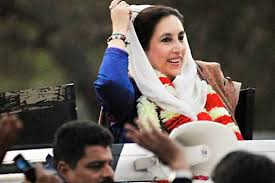
BB's last rally (Credit: dunyanews.com)
BB’s last rally
(Credit: dunyanews.com)
ON the recent occasion of Benazir Bhutto’s 62nd birth anniversary, her husband and PPP’s co-chairman spoke about her murder and said: “We cannot withdraw the FIR, no matter how much pressure you exert on us and how much you fight for that.”

Heraldo Munoz of Chile, the head of the UN commission that probed Benazir Bhutto’s murder concluded as follows: “Probably no government will be able or willing to fully disentangle the truth from the complex web of implication in Benazir Bhutto’s assassination.”

I read the former Chilean diplomat’s personal account in his book Getting Away With Murder with great sadness because the Federal Investigation Agency (FIA) under my command on Aug 6, 2009 was entrusted with the responsibility of taking over the investigation from Punjab police. The Special Investigation Group was given the task of putting together a joint team of various law-enforcement and intelligence agencies to carry out further investigation and interrogate possible suspects.

The investigation into Benazir Bhutto’s murder has hinted at a complex web of implication.

I distinctly recall that night of Oct 18, 2007 when as inspector general police, Balochistan, I was glued to the TV watching the huge procession Ms Bhutto was leading in Karachi after finally returning home from a nine-year exile. The bombings that targeted her cavalcade that night resulted in 149 deaths and injuries to 402.

Ms Bhutto survived that deadly attack and lodged an FIR by becoming a complainant herself. Police did not register the case that she filed on Oct 21, 2007 in which she wrote: “I was informed by the government that certain militant groups wanted to attack me. After receiving this information I wrote a letter dated Oct 16, 2007 to the president of Pakistan informing him of my grave concern regarding my security and specified the forces and persons behind them whom I suspected were likely to harm me physically.”

The investigations remained stalled until she was assassinated on Dec 27, 2007. The Karsaz case was finally re-registered on Oct 17, 2008, after Gen Musharraf was forced to quit as president in August that year and Mr Zardari had become president.

Meanwhile, the UN mission started the formal probe in July 2009 and the federal government entrusted further investigation to the FIA on Aug 6, 2009. Codenamed ‘Operation Trojan Horse’, the case investigation team was tasked with collecting ocular testimony as well as documentary, forensic and circumstantial evidence prior to the Oct 18 Karsaz attack, events between Oct 19 and Dec 27, and post Dec 27, 2007 developments.

It was decided to record testimony of all those travelling in the vehicle along with BB: driver Javed; SSP Security Imtiaz Hussain; Makhdoom Amin Fahim; Naheed Khan; Safdar Abbasi; and valet Razzaq. Senator Safdar Abbasi and his wife Naheed Khan had publicly claimed that “sharp sniper fire and a typical intelligence operation” was carried out to eliminate their leader. PPP spokeswoman Sherry Rehman declared she had died from a bullet injury. These statements and the suspicious conduct of Khalid Shahenshah, a security guard who had been caught on TV footage making suspicious signals from near the stage close to BB prior to the exit from the rally where she was murdered, required a thorough probe.

We decided to start our investigations by seeking assistance from interior minister Rehman Malik, who was Ms Bhutto’s chief security officer. Accordingly, I sent across to him in writing on Aug 12, 2009 a note through his trusted staff assistant director of FIA, seeking the following: 1) copy of the letter sent by BB to Gen Musharraf on Oct 16, 2007 naming three suspects; 2) copies of emails sent by BB to Mark Siegel and others identifying threats from Gen Musharraf; 3) a copy of BB’s original will; 4) a copy of the final agreement exchanged between BB and Gen Musharraf; and 5) copies of correspondence between CSO [Rehman Malik] and the governments of Pakistan and Sindh on security-related matters. There was no response.

Meanwhile, interrogation of five arrested accused, namely Aitzaz Shah, Sher Zaman, Hussnain Gul, Muhammad Rafaqat and Rasheed Ahmed, as well as some other crucial leads led us to aim for arrest of one Ibadur Rahman resident of Malakand who, we believed, played a key role in BB’s murder. (However, this key plotter was reportedly killed in the first-ever drone strike in Khyber Agency in May 2010 or in an attack carried out by a Pakistani fighter plane.)

Another suspect was al Qaeda’s No 3 leader and financial and operational chief Mustafa Abu Yazid alias Sheikh Saeed Al-Masri who was said to have claimed responsibility for “terminating the most precious American asset who vowed to defeat Mujahideen”. He was reportedly killed in a CIA drone attack on May 22, 2010 in North Waziristan.

Similarly, the crucial suspect or witness Khalid Shahenshah, the security guard hired allegedly by a trusted confidant of the party leadership, was killed in Karachi a few months after Ms Bhutto’s murder.

An important meeting of the FIA investigation team was held on Oct 28, 2009 in the interior minister’s presence. My directions were clear: place all the evidence and leads before the UN team. While the UN commission was generally critical of the conduct of relevant stakeholders, including the earlier Punjab police JIT, it did note in its report that the second JIT by the FIA “has been more vigorous in carrying out its investigations”.

In yet another important meeting held at the interior minister’s residence on Nov 25, 2009, the FIA investigators reviewed the progress and asked the agencies concerned for apprehension of key suspect Ibadur Rehman from Khyber Agency. They were also given the go-ahead to visit Madressah Haqqania in Akora Khattak for adducing further evidence. Officers were also assigned to visit the UAE, Saudi Arabia and United States for obtaining evidence from key sources that could shed further light on the conspiracy.

Within days of setting a clear direction for the investigators to move forward on the case, I was transferred from the FIA.

The case is under trial and I will avoid drawing conclusions. The UN commission submitted its report in May 2010 and their conclusions and recommendations were commented upon by me as a professional in a confidential letter addressed to the then prime minister. The political and security establishment consigned those recommendations to the dustbin of history. Truth hopefully shall prevail eventually.

The writer is former DG, FIA.

Pakistan’s MQM ‘received Indian funding’

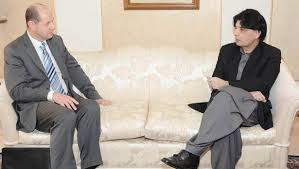
Ch Nisar meets UK High Commissioner (Credit: breakingnewspak.com)
Ch Nisar meets UK High Commissioner
(Credit: breakingnewspak.com)

Officials in Pakistan’s MQM party have told the UK authorities they received Indian government funds, the BBC learnt from an authoritative Pakistani source.

UK authorities investigating the MQM for alleged money laundering also found a list of weapons in an MQM property.

A Pakistani official has told the BBC that India has trained hundreds of MQM militants over the past 10 years.

The Indian authorities described the claims as “completely baseless”. The MQM also strongly denied the claims.

Party spokesman Saif Muhammad Ali told BBC Urdu that the MQM had never received any funding or training from India. He said authorities in Pakistan were running a campaign against the party.

With 24 members in the National Assembly, the Muttahida Quami Movement (MQM) has long been a dominant force in the politics of Pakistan’s largest city, Karachi. denied the allegation telling the BBC the

British authorities held formal recorded interviews with senior MQM officials who told them the party was receiving Indian funding, the BBC was told.

Meanwhile a Pakistani official has told the BBC that India has trained hundreds of MQM militants in explosives, weapons and sabotage over the past 10 years in camps in north and north-east India.

Before 2005-2006 the training was given to a small number of mid-ranking members of the MQM, the official said.

More recently, greater numbers of more junior party members have been trained.

The arrest of Altaf Hussain prompted unrest in Karachi

The claims follow the statement of a senior Karachi police officer that two arrested MQM militants said they had been trained in India. In April, Rao Anwar gave details of how the two men went to India via Thailand to be trained by the Indian intelligence agency RAW.

In response, MQM leader Altaf Hussain issued a tirade of abuse at Rao Anwar.

Asked about the claims of Indian funding and training of the MQM, the Indian High Commission in London said: “Shortcomings of governance cannot be rationalised by blaming neighbours.”

The UK authorities started investigating the MQM in 2010 when a senior party leader, Imran Farooq, was stabbed to death outside his home in north London.

In the course of those inquiries the police found around £500,000 ($787,350) in the MQM’s London offices and in the home of MQM leader Altaf Hussain. That prompted a second investigation into possible money laundering.


Who is Altaf Hussain?

  • § Born in Karachi in 1953 to a middle-class family; studied pharmacy at university.
  • § Formed MQM party in 1984 to represent Mohajirs – descendants of Urdu-speaking Muslims who migrated from India to Pakistan.
  • § Requested political asylum in UK in 1992, later gained British citizenship; continues to run MQM from north London.

Pakistan’s powerful but absent politician

In the course of the inquiries the UK authorities found a list itemising weapons, including mortars, grenades and bomb-making equipment in an MQM property, according to Pakistani media reports that the BBC believes to be credible. The list included prices for the weapons. Asked about the list, the MQM made no response.

As the UK police investigations have progressed, the British judiciary has been taking an increasingly tough line on the MQM. Back in 2011 a British judge adjudicating an asylum appeal case found that “the MQM has killed over 200 police officers who have stood up against them in Karachi”.

Last year another British judge hearing another such case found: “There is overwhelming objective evidence that the MQM for decades had been using violence.”

The MQM is also under pressure in Pakistan. In March the country’s security forces raided the party’s Karachi headquarters. They claimed to have found a significant number of weapons there. The MQM said they were planted. The MQM has the ability to put thousands of protesters on the streets of Karachi

The party has a solid support base made up of the Mohajirs, or refugees who left India at the time of partition so that they could settle in Pakistan.

The Mohajirs complain that they have been the subject of sustained discrimination in Pakistan. The MQM insists it is a peaceful, secular party representing the interests of the middle classes in Pakistan.

As well as its electoral base, the MQM has formidable street power. When it orders a strike the streets empty and the whole of Karachi grinds to a halt.

Altaf Husain has lived in self-imposed exile in the UK for more than 20 years. He was given a British passport in 2002. For many years the party has been accused of using violence to impose its will in Karachi.

A number of MQM officials, including Altaf Hussain, have been arrested in relation to the money-laundering case but no-one has been charged. The party insists that all its funds are legitimate and that most of them come from donors in the business community in Karachi.

India has long accused Pakistani officials of involvement in sponsoring militant attacks in India. Delhi, for example, has demanded that Pakistan take firmer action against those suspected of plotting and managing the Mumbai attacks of 2008.

The latest developments in the MQM case suggest that Pakistan will now counter such complaints with demands that India stop sponsoring violent forces in Karachi.

Zardari’s outburst followed by dash to Dubai

Asif & Faryal leave for Dubai (Credit: siasat.pk)
Asif & Faryal leave for Dubai
(Credit: siasat.pk)

KARACHI, June 26 – Former president and Pakistan People’s Party (PPP) Co-Chairman Asif Ali Zardari left for Dubai on Wednesday, party sources said.

However, they said they were not aware of reasons for his sudden flight and the number of days he planned to stay in the United Arab Emirates. Zardari flew to Dubai in the evening from Karachi.

“Bilawal Bhutto Zardari did not accompany him and media reports in this regard are not true. He is here till late Wednesday though his future plan about international travel is not known.” Zardari’s departure came a day after his elder sister and key leader of the party Faryal Talpur made the same move on Tuesday.

Zardari surprises with outburst against establishment

Zardari speech against army (Credit: newsmedialive.com)
Zardari speech against army
(Credit: newsmedialive.com)

In a surprising outburst ostensibly against the powerful security establishment, Pakistan Peoples Party Co-Chairman Asif Ali Zardari said on Tuesday that politicians were better suited to running the affairs of the country. “You are here for only three years,” he said in an apparent jab at the army chief.

Addressing an oath-taking ceremony for PPP office-bearers from Khyber-Pakhtunkhwa and the Federally Administered Tribal Areas, Zardari said, “I know the art of war better than anyone else.”

Organised by former MNA and PPP Fata President Akhunzada Chattan, the event was attended by PPP Chairman Bilawal Bhutto Zardari and other prominent leaders of the former ruling party.

The PPP co-chairman expressed annoyance at the purported character-assassination campaign against him and his party. “It needs to stop! There is a limit to everything.”

Warning the establishment, which he accused of tarnishing PPP’s and his image, Zardari said, “Anyone who tries to disturb us will get a befitting response. Be wary! If this doesn’t stop now, I shall come out with a list of generals who have been accused starting from the time Pakistan came into being. And then you’ll spend the rest of your lives providing explanations.”

In an apparent reference to the power he is supposed to wield, the former president said he could bring the whole country to a standstill on a single call. “If I give one call, the whole country from Karachi to Khyber will come to a grinding halt. The lockdown will continue until I call it off.”

Zardari said he wanted to support the Pakistan Army since it was “being challenged by the neighbouring India on the borders while terrorist organisations and India’s primary foreign intelligence agency, the Research & Analysis Wing, were creating chaos within Pakistan”.

In the same vein, Zardari said he was aware who pulled the strings of banned outfits and mullahs, alluding to their alleged collusion with the establishment.

Lashing out at his political rivals, the PPP co-chairman said had he supported Imran Khan’s Pakistan Tehreek-e-Insaf when it arrived in Islamabad with a sit-in to topple the ruling Pakistan Muslim League-Nawaz (PML-N) government, Imran would have succeeded.

“Being a supporter of democracy, I wanted the PML-N government to complete its tenure,” he said. “It would make me happy if the incumbent administration could improve the economy.”

The ruling party will have no excuse that they were not given enough time, said Zardari. “I am not in a hurry. I can wait for the sake of democracy.”

He also lashed out at former president Pervez Musharraf, who has been in Karachi for the past several months and has been politicking from the platform of his party, the All Pakistan Muslim League. “I spent years in jail… but the commando could not spend three months in prison.”

Zardari’s speech comes days after Rangers Sindh chief Maj-Gen Bilal Akbar blamed a nexus of political leaders, civil servants and gang lords of fostering and harbouring organised crime and terrorism in Karachi, as well as amid reports that the authorities were mulling over extending the scope of the ongoing operation in Sindh, the province that the PPP has been governing since 2008.

PPP leaders have been making angry speeches in parliament after the Rangers chief’s statements, but political pundits are attaching much importance to the timing of Zardari’s speech, since the former president had been in a conciliatory mode on a number of issues after his party lost the 2013 general elections after completing their five-year tenure.

Public officials in Sindh are Nabbed in Corruption Cases

HYDERABAD/SUKKUR, June 18: The National Accountability Bureau (Nab) spent a busy day on Thursday when they arrested at least four public officials on charges of corruption.

The Nab Karachi circle raided the office and residence of a former town municipal officer (TMO) in Sehwan, Jamshoro, early on Thursday, and arrested three TMOs on corruption charges. The team, led by assistant director Aslam Pervez Abro, arrived at the office on Wednesday afternoon but they stayed till past midnight as they looked through records.

The TMOs were taken into the custody along with the official record at around 4am. The NAB sources said they delayed the arrest because the Jamshoro police deployed their men outside the TMO’s office to prevent their arrest. Over 100 workers of the TMO and their supporters also gathered outside the office apparently to deter the NAB team from detaining them.

The men who were arrested include former Sehwan TMO Rehmatullah Memon, who is currently posted in Matiari district, town officer finance Zahoor Ahmed Shahani and engineer Idrees Memon. The team also raided the residence of incumbent TMO Asghar Bhund but he had already escaped from his residence.

“The arrested accused persons and others are involved in corruption worth Rs120 million, which they committed through withdrawal of illegal cheques and issued huge amounts to fake contractors and parties,” said a NAB press statement issued on Thursday.

According to a NAB official, they called Memon from Matiari to ask some questions but when he could not justify the expenditures on various schemes during his tenure, they arrested him for further investigations.

The police allowed the NAB team to take the officers after recording a ‘musheer nama’ about their detention at Sehwan police station. The officers are charged with falsifying accounts, making fake purchases and releasing salaries to ghost employees, besides embezzlement in the budget.

Separately, a NAB team also raided TMO Bathoro in Sujawal district on Thursday and seized records. They also arrested TMO Wasif Malik. Another former TMO of Sujawal, Mumtaz Ali Zardari, was also arrested from Karachi. Zardari was posted as TMO Sujawal between June and July last year. “The arrested accused was allegedly involved in corruption worth Rs100 million, which he committed through withdrawal of illegal cheques and issued huge amounts to fake contractors and parties,” said the NAB statement.

Excise and taxation secretary arrested

Earlier on June 4 this year, NAB had also arrested excise and taxation secretary Badar Jamil Mandhro on charges of selling gold worth Rs100 million to a jeweller in Karachi.

When Mandhro was the minority affairs secretary, he sold gold worth Rs100 million to a jeweller in Karachi in 2013, a NAB official told The Express Tribune. He was also accused of illegally handing out jobs in exchange for bribes. Sources said that the secretary was arrested from his office, after he had failed to show up before the NAB officer despite being issued a notice. After the initial investigation, Mandhro was produced before the court, which granted him a 15-day remand.

On May 8, NAB deputy director for the financial crimes investigation wing issued a notice to Faheemuddin, the owner of Islamia Jewellers in Karachi, directing him to appear before him on May 14, along with the original purchase register, purchase bills, details regarding the mode of payment and relevant records. This notice, according to the NAB official, was issued to the jeweller regarding the purchase of gold worth Rs100 million from Badar Jamil Mandhro in 2013.

The officer previously worked as a secretary under the women development ministry, was appointed the minority affairs secretary and is presently serving as the excise and taxation department secretary. A highly placed officer in the Sindh government told The Express Tribune that Mandhro’s arrest means that NAB has sufficient evidence against him.

Published in The Express Tribune, June 19th, 2015. 

Suspects detained in London murder of Pak politician Imran Farooq

Mohsin Ali & Kashif Khan (Credit: siasat.pk)
Mohsin Ali & Kashif Khan
(Credit: siasat.pk)

Two key suspects in the 2010 murder of a Pakistani politician in London have been arrested, it has emerged.

Dr Imran Farooq was stabbed to death outside his home in Edgware almost five years ago in what detective believe may have been a politically motivated killing.

Scotland Yard named Moshin Ali Syed, 29, and Muhammad Kashif Khan Kamran, 34, as suspects after records showed they left the UK on the night of the murder.

Moshin Ali was detained on Thursday as he tried to enter Pakistan from Afghanistan, local frontier police said.

He was held with another man, Khalid Shamim, but sources revealed that Kashif Khan was also already in the custody of the Pakistan security services.

The men are due to appear in court and are likely to face moves to extradite them to the UK.

Dr Farooq was a founding member of the Muttahida Qaumi Movement (MQM), the biggest political force in Karachi, and was killed close to its London headquarters.

Detectives have been investigating whether the murder was linked to his plans to break away from the MQM leadership and launch a new, independent political career.

Khalid Wasey, a spokesman for the Frontier Constabulary in Pakistan, said the two men arrested on Thursday are expected to be handed over to the Federal Investigation Agency (FIA).

He said both belonged to the “the political party of the Karachi”.

An Interior Ministry source said: “It is believed that Moshin |Ali was involved in the high profile murder of the Dr. Imran Farooq in the London.

“An important breakthrough is expected in the Imran Farooq murder case.”

MQM law maker Farooq Sattar denied any MQM link with the two arrested men, adding: “Islamabad must stop targeting a major political party of Karachi.”

Save the Children allowed to resume operations in Pakistan

SCF shut down order (Credit: agencieslive.com)
SCF shut down order
(Credit: agencieslive.com)

ISLAMABAD, June 14: Days after authorities in the federal capital sealed the offices of international non-governmental organisation Save the Children, the interior ministry has allowed the INGO to resume operations in Pakistan.

Save the Children has previously been accused of involvement with the Central Intelligence Agency and Dr Shakeel Afridi in tracking down the whereabouts of Osama bin Laden in Abbottabad.

Suspending its first order in which it sealed offices and operations of the INGO in Islamabad earlier this week, the Ministry of Interior let the international NGO to continue its work in the country.

“The undersigned is directed to refer to this ministry’s letter of even number dated 11th June 2015 on the subject noted about. The competent authority has desired that the action on above letter may be held in abeyance till further order,” reads the letter issued by Ministry of Interior. A copy the letter issued by a senior officer of the ministry is also available with The Express Tribune.

“The organisation [Save the Children] can continue its work in Pakistan as it has been doing for decades until any further orders,” a senior official of interior Ministry said.

“We are in process of regulating all INGOs and NGOs and all international organisations have been directed to follow the new laws or close their offices,” he added.

Interior Minister Chaudhry Nisar has said the government is working on streamlining the operations of all non-profit organisations working in the country to regulate their activities.

Speaking to reporters outside the National Assembly in Islamabad on Friday, Nisar said a committee constituted by Prime Minister Nawaz Sharif was working on drafting new laws to set a mechanism for operations of all such organisations. PM’s Adviser on Foreign Affairs Tariq Fatemi heads the committee.

He added that no non-governmental organisation (NGO) working against the country’s national interest would be allowed to continue working in Pakistan. “We just want to regulate the system. We do not want to shut down NGOs, which follow our laws.”

Axact Chief Executive Arrested in Pakistan Over Fake Diplomas Scandal

Axact CEO arrested (Credit: deccanchronicle.com)

KARACHI, May 27 — Pakistani investigators arrested the chief executive of Axact, a software company accused of running a global diploma mill, early Wednesday after discovering a storage room filled with blank fake degrees.

The chief executive, Shoaib Ahmed Shaikh, and four other Axact executives were initially charged with fraud, forgery and illegal electronic money transfers, law enforcement officials said. The charges were later expanded to include money laundering and violating Pakistan’s electronic crimes act.

The arrests were a sharp blow to a company that claimed to be Pakistan’s biggest software exporter and that was on the cusp of starting a major television network. Axact has been under investigation since May 19, after an article in The New York Times described how the company had made millions of dollars by running hundreds of fake online education websites.

Since then, federal investigators have sealed Axact offices in Karachi and Islamabad and requested help from Interpol and the F.B.I. Mr. Shaikh sought to defend himself in a series of television interviews and video appeals, and asked the courts to halt the investigation.

But his legal move proved unsuccessful, and late Tuesday, after hours of questioning, he led investigators to a building next to the Axact headquarters in the upscale Karachi neighborhood of Defence.

Inside, they found a room filled with blank certificates bearing the letterheads of dozens of fake universities and high schools operated by Axact under names like Bay View, Cambell State, Oxdell and Nixon.

“There were hundreds of thousands of documents there,” said Shahid Hayat, head of the local office of the Federal Investigation Agency, which is leading the inquiry.

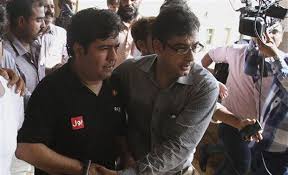
Pakistani television networks broadcast images of the room, and of Mr. Shaikh, wearing a black polo shirt with the Axact logo, being led to a car waiting outside the office. As he got into the car, he could be heard telling officials of the investigation agency that he would “see to every one of them.”

Mr. Hayat, the investigator, expressed surprise at the remark. “I don’t think he can threaten us,” he said.

Mr. Shaikh appeared in court later on Wednesday. A judge granted the Federal Investigation Agency custody of Mr. Shaikh and the four other executives until June 4. Investigators had said earlier that they would seek to extend his detention by 14 days while they examined the Axact network, which spans a number of countries and includes several offshore companies.

Axact’s online activities appear to have effectively shut down. Attempts by a reporter to contact sales agents at 221 of the company’s websites in recent days produced no response. Several of the fake accreditation bodies set up by the company, in a bid to bestow legitimacy on the universities, have gone offline.

Pakistan has requested F.B.I. assistance because many of the universities run by Axact purported to be based in the United States, operated bank accounts and mailboxes there and sold fake degrees to Americans. Axact sales agents also sold State Department authentication certificates bearing Secretary of State John Kerry’s signature.

Experts say that fake degrees can pose dangers to public safety and national security in many parts of the world and can enable immigration fraud. They can also have serious consequences for customers who are caught using them.

Two former Axact officials, speaking separately, said that in 2009, an American married couple, both members of the United States military serving in Iraq, had emailed Axact to say that they faced courts-martial for having presented academic credentials bought from a university run by Axact.

The couple requested an accreditation certificate from the university to help defend themselves, said Ahmed, a former sales agent who asked that his last name not be used. An Axact manager instructed subordinates to block the couple’s calls, he said.

Mr. Shaikh has vehemently denied any wrongdoing but admitted some involvement in the online degree business. In his last video message before his arrest, he said that Axact provided telephone support and what he termed “document management services” for other companies. He did not identify those companies.

The scandal has cast a cloud over Bol, the Axact television and newspaper group that had planned to begin broadcasting in June. On Saturday, the network’s editor in chief and several leading journalists resigned, after Pakistan’s interior minister spoke of “substantive” evidence against Axact.

Saba Imtiaz reported from Karachi, and Declan Walsh from London. Griffin Palmer contributed reporting from New York.

Exodus in the making: Senior journalists quit Bol TV as Axact controversy deepens

BOL studios (Credit: journalismpakistan.com)

KARACHI, May 24: As the scandal surrounding Axact’s fake degree empire roiled the country, several senior journalists announced on Saturday that they were leaving the Bol Network, a sister concern of the controversial IT company.

Those who quit Bol included the network’s two top executives, Kamran Khan and Azhar Abbas.

“Charges against Axact are far from having been proved in court but my conscience is not letting me continue,” tweeted Bol’s president and editor-in-chief Kamran Khan, who had earlier called on the Supreme Court to form an independent panel of experts to look into the NYT claims about Axact.

“I have decided to disassociate from Bol immediately,” he continued in his post on the microblogging website.

Bol News President and Chief Executive Officer Azhar Abbas has also stepped down. “I have resigned after speaking to my editors and staff. I put together a great team of journalists and I wish them [the] best,” he tweeted.

Kamran and Abbas were followed by Iftikhar Ahmed, who in a post on Twitter said he “cannot work for an organisation whose basic workings conflict with my professional commitment.”

“I have decided to disassociate myself from Bol,” he added.

Bol Executive Vice-President and senior anchorperson Asma Shirazi, who had earlier said she would quit the network immediately if any allegation against Axact was proved, also announced her resignation on Twitter.

“I have resigned from Bol News. Truth must prevail,” she posted on the microblogging website.

Other senior anchorpersons to leave Bol on Saturday included Wajahat S Khan and Nusrat Javeed.

“It’s done. I will be back, but not on Bol,” announced Wajahat, who joined Bol News as executive vice-president and senior anchorperson.

“Although I strongly feel that my colleagues in the media rushed to pass a final judgment regarding our relations with Bol, I am quitting,” tweeted Nusrat Javeed.

Other anchorpersons said they would remain with Bol News for now and take a final decision later.

“I have not resigned yet from Bol… I will let my viewers know about my decision soon,” said Jasmeen Manzoor.

Published in The Express Tribune, May 24th, 2015.