To say that the exposé done by the New York Times on a Pakistan-based IT company, Axact’s shady business practices has caused ripples in the Pakistani media industry would be an understatement. The way it has divided opinions among the working journalists, be it senior or those still learning the ropes, is even more startling.
The NYT story had detailed alleged involvement of Axact in running an international network selling fake online diplomas and degrees through sleek websites of ghost foreign schools and universities. However, among the circles having anything to do with the Pakistani media, most of the content in the NYT story about Axact has already been common knowledge. The fact that the NYT has done a story quoting sources has only led credence to these rumors and made it more sensational. The other part of the allegations against Axact that they also host pornographic websites has not even been mentioned by the Times. Axact emerged as a known name in Pakistan’s media fraternity in mid-2013 when they announced plans to bankroll a new television channel, BOL. They offered unprecedented salaries and perks to the aspiring employees and subsequently hired several eminent journalists. At times, the figures simply didn’t add up and their claims about revolutionizing Pakistan’s media landscape sounded too good to be true. Still, the surreal nature of these promises and the rumors about questionable funding behind this new entity hardly deterred the journalists, including some very senior and celebrated names of Pakistani journalism, from joining this new company. It defies logic that these journalists got duped during the hiring process and didn’t know of the accusation on Axact when Pakistan’s media landscape was abuzz with these rumors about shades of grey. For many of them, this was not the first time because hardly any new player in Pakistan’s television industry, since it was deregulated in 2001, could be absolved of having an entirely above-board financial record.
Soon after the Axact scandal broke in the media, a war of words broke out between the journalists from both sides (BOL and other organizations) in the mainstream as well as social media. The severity with which they attacked each other was not only surprising but also disturbing. In more than 15 years of being an active journalist before taking a break to return to school, I have never seen such polarization in the Pakistani media. Both sides are nitpicking, showing selective perception, and speaking only half-truths to justify their own positions. The battle lines have been drawn based on the affiliation with different media organizations, leaving no room for objectivity.
Those who have already joined BOL have accused their former colleagues in other media organizations of siding with their owners to spread misconceptions about the new venture (BOL) to block its potential success. Somehow, they conveniently forgot that a few weeks ago, they were themselves employed by the very same media organizations that they were now criticizing. What is happening with BOL now has already happened with Dunya and Geo but these protectors of media;s integrity and independence were silent at that time for obvious reasons. The question is that if the already existing organizations were so bad and the owners were such Satans, did these noble souls question those practices when they were part of that set-up? If the answer is no, then does it mean that the ethics and morals are dependent on the “doctrine of necessity” and material interests?
On the other hand, those journalists who have not (or not yet) joined BOL have been critical of their colleagues who moved on and joined BOL for better prospects as somebody who sold their souls to an allegedly corrupt organization (Axact) only for a few bucks. Could these torch-bearers of uprightness and clean reputation look inwards and say with certainty that everything about their own organization and the respective managements is absolutely transparent? Moreover, how many of them never changed a job for higher salaries or better working conditions? If they cannot answer these questions, then they have no right to point fingers at those who can’t be faulted for availing the opportunities coming their way.
Most of the journalists in Pakistan have knowingly and willingly joined these new channels left, right and center during the last decade or so. For a majority of them, the increasing zeros on the paycheck after years of professional struggles and financial strife have provided enough justification to fall for this bargain. They have taken solace in the fact that their professional working wasn’t getting affected by whatever reputation their organizations’ owners had otherwise. There was a general acknowledgment of what was wrong at least in private conversations, if not very openly. The last thing I expected was to witness both sides to defend these wrongdoings so vehemently. It is clear that both sides are sitting in glass houses and throwing stones on each other, taking a self-righteous position. In trying to take potshots at each other, they have conveniently forgotten the skeletons in their own closet.
There are no two opinions that journalists in Pakistan have endured several decades of tough professional and financial circumstances and have every right to good earnings and lifestyle. But becoming part of an alleged scam, and getting blinded by the digits on the paychecks, does not provide any justification whatsoever to shy away from the troubling questions staring everybody associated with the Pakistani media in the face. If it does happen to be of no priority for anybody, then that person is clearly in the wrong profession. If the “so what” argument being presented by the journalists predominantly on the social media on the grounds that “none of the earlier media owners has clean hands” is to be bought, then what would they say about the police officials who were being offered more money by Taliban to switch sides at the height of counter-terrorism operation in Pakistan?
If the accusations have been raised on Axact management, it is true that they are innocent until proven guilty in a court of law. Simultaneously, it is also true that the accusations are of very serious nature and rubbishing them or making claims of innocence are also a bit premature. Being a journalist is much more than being somebody’s employee (and mouthpiece) to ensure taking a fat paycheck back home every month. The last thing a journalist is expected to do is to act as an irrational activist of a political party but that has started happening increasingly in Pakistan. Driven primarily by financial rewards, all ethical and professional journalistic considerations have been put on the backburner and both sides are equally at fault in doing so. That’s certainly a far more disturbing big picture that merits attention, debate and some honest soul-searching on the part of all those involved.
The reality of employment opportunities and working conditions available for Pakistani journalists at the moment is not all black and white but has definite shades of grey about it. They can either (at least) acknowledge and get on with it or take a clear stand against it based on nothing but strict principles. The latter option is easier said than done. But some honesty from both sides would do no harm. In this small industry, nothing remains hidden forever and there are no permanent friends and foes. Let journalism retain some sanctity as a profession and allow each other to remain professional colleagues instead of making it resemble a chessboard. Remember, at the end of the game, the king and the pawns go into the same box.
It is clarified that NYT in Pakistan is partnered with Express Media Group to publish International NYT in Pakistan and receive earnings from the group. Express Group was under a restraining order and contempt of court proceedings by Sind High Court for publishing a defamatory news item and further from publishing anything detrimental to Axact’s reputation. (Click here to view the courts restraining order). Hence Express Media Group to counter the success of BOL and to circumvent the court order has got this story published via its partner NYT in collaboration with some reporter called Declan Walsh.
It should also be noted that a few months back in a registered criminal case by Axact for Data Theft (Criminal case No.561/2015), Police investigations led to Mr. Sultan Lakhani as the ultimate hidden owner of that company involved in Data theft of Axact and other IT companies and his name was included in the interim police Challan. (Click here to see the police challan mentioning Sultan Lakhani). After which Mr. Sultan also tried to transfer the investigations to another Police department of his choice but on 12th May 2015 that transfer was also suspended by Sind High Court and the criminal investigation again started against Mr. Sultan Lakhani. (Click here to view the request for transfer,transfer order and court order suspending the transfer).
The story is authored by some reporter Declan Walsh of NYT who was expelled from Pakistan as Persona non-grata by Pakistan Interior Ministry allegedly due to his involvement in damaging Pakistan’s national interests. Even the media group he is affiliated with, the Express Tribune, published a story against him (click here to read more). Several other organizations have also written about him (click here to read more). This reporter has worked and devised a one-sided story without taking any input from the company. A last-minute, haphazard elusive email was sent to the company demanding an immediate response by the next day to which the attorney for Axact responded. Click here to view the response.
Moreover, this reporter has not mentioned the conflict of interest which the NYT has due to its association with Express Media as its revenue source in Pakistan. This necessary disclosure regarding the criminal cases on NYT Partner in Pakistan was deliberately omitted and is an injustice to the reader not expected of a publication like NYT.
In an exemplary display of poor journalistic skills and yellow journalism, the writer quoted references from several imaginary employees to corroborate accusations made out of thin air. None of these accusations have been substantiated with any real proof. Search engines have been used to type ‘fake degrees’ and whatever images have turned up have been portrayed as evidence. Additionally, no proof has been given linking any of these sites and allegations to Axact and widely recognized names such as that of John Kerry have been used to increase the impact of the story. In fact the writer himself admits that when he approached these universities, they denied having any links with Axact. Furthermore, in a glaring display of bias, he didn’t even mention the fact that all these previous published allegations have been more than adequately addressed by Axact earlier in the civil suit 907/2013 filed against GEO and others.
One aspect that stands very clear from all this is that a personal grudge has been displayed by the writer. Parallels laded with negativity have been drawn with the portrayal of positive Pakistan and also including references to the Silicon Valley as if offering world-class facilities to employees is something that we should be ashamed about when it is our pride. This reminds us of the story made by Forbes against NYT reporters of publishing false stories.Click here to read more
For information on Axact Education Unit, it is hereby clarified that Axact provides a comprehensive education management system that benefits diverse bodies of students and caters to all types of educational institutions—online and traditional. It is a 360 degree solution for students and faculty around the globe, available on multiple educational platforms being its core capability. For details on this, click here.
Furthermore, Axact’s Online Education Management System is World’s Leader outside North America. And Axact is now collaborating with other renowned education groups in the USA to provide its Education Management System and is poised to be a major player in the online education industry of USA by 2018.
All ten business units of Axact are completely legitimate, legal and committed to enhancing the quality of IT services across the world.
From the very first day of announcement of BOL, certain elements have started campaigning against Axact and BOL. The GEO/Jang group and Express Media Group being direct competitors of BOL (initiated by Axact) have started a defamation campaign and other criminal pursuits since last 2 years accusing BOL of belonging to multiple groups, sometimes establishment, sometimes a real estate tycoon and sometimes other controversial personalities and were coining all kind of conspiracy theories. Now they have planned this story in collaboration with this reporter as evident from the fact that within less than 60 seconds of the publishing of this article, these media outlets started spreading this maligning campaign via different means. It is also come to our notice that they are planning with other foreign media groups to publish this story with different angles.
It should be noted that the announcement of BOL as a positive and pro-Pakistan channel in Pakistan who cares for its employees has shaken these traditional media houses who have promoted hatred, despair, negativity and hopelessness in Pakistan. Axact and BOL have vigorously pursued these elements that are desperate to malign BOL and Axact.
BOL has addressed this in the past and the following link on its website gives details of these defamation and other criminal activities and how Axact and BOL have addressed these legally.
Seen from the Internet, it is a vast education empire: hundreds of universities and high schools, with elegant names and smiling professors at sun-dappled American campuses.
Their websites, glossy and assured, offer online degrees in dozens of disciplines, like nursing and civil engineering. There are glowing endorsements on the CNN iReport website, enthusiastic video testimonials, and State Department authentication certificates bearing the signature of Secretary of State John Kerry.
“We host one of the most renowned faculty in the world,” boasts a woman introduced in one promotional video as the head of a law school. “Come be a part of Newford University to soar the sky of excellence.”
Yet on closer examination, this picture shimmers like a mirage. The news reports are fabricated. The professors are paid actors. The university campuses exist only as stock photos on computer servers. The degrees have no true accreditation.
In fact, very little in this virtual academic realm, appearing to span at least 370 websites, is real — except for the tens of millions of dollars in estimated revenue it gleans each year from many thousands of people around the world, all paid to a secretive Pakistani software company.
Axact makes tens of millions of dollars annually by offering diplomas and degrees online through hundreds of fictitious schools. Fake accreditation bodies and testimonials lend the schools an air of credibility. But when customers call, they are talking to Axact sales clerks in Karachi.
That company, Axact, operates from the port city of Karachi, where it employs over 2,000 people and calls itself Pakistan’s largest software exporter, with Silicon Valley-style employee perks like a swimming pool and yacht.
Axact does sell some software applications. But according to former insiders, company records and a detailed analysis of its websites, Axact’s main business has been to take the centuries-old scam of selling fake academic degrees and turn it into an Internet-era scheme on a global scale.
As interest in online education is booming, the company is aggressively positioning its school and portal websites to appear prominently in online searches, luring in potential international customers.
At Axact’s headquarters, former employees say, telephone sales agents work in shifts around the clock. Sometimes they cater to customers who clearly understand that they are buying a shady instant degree for money. But often the agents manipulate those seeking a real education, pushing them to enroll for coursework that never materializes, or assuring them that their life experiences are enough to earn them a diploma.
To boost profits, the sales agents often follow up with elaborate ruses, including impersonating American government officials, to persuade customers to buy expensive certifications or authentication documents.
Revenues, estimated by former employees and fraud experts at several million dollars per month, are cycled through a network of offshore companies. All the while, Axact’s role as the owner of this fake education empire remains obscured by proxy Internet services, combative legal tactics and a chronic lack of regulation in Pakistan.
“Customers think it’s a university, but it’s not,” said Yasir Jamshaid, a quality control official who left Axact in October. “It’s all about the money.”
Axact’s response to repeated requests for interviews over the past week, and to a list of detailed questions submitted to its leadership on Thursday, was a letter from its lawyers to The New York Times on Saturday. In the letter, it issued a blanket denial, accusing a Times reporter of “coming to our client with half-cooked stories and conspiracy theories.”
In an interview in November 2013 about Pakistan’s media sector, Axact’s founder and chief executive, Shoaib Ahmed Shaikh, described Axact as an “I.T. and I.T. network services company” that serves small and medium-sized businesses. “On a daily basis we make thousands of projects. There’s a long client list,” he said, but declined to name those clients.
The accounts by former employees are supported by internal company records and court documents reviewed by The New York Times. The Times also analyzed more than 370 websites — including school sites, but also a supporting body of search portals, fake accreditation bodies, recruitment agencies, language schools and even a law firm — that bear Axact’s digital fingerprints.
In academia, diploma mills have long been seen as a nuisance. But the proliferation of Internet-based degree schemes has raised concerns about their possible use in immigration fraud, and about dangers they may pose to public safety and legal systems. In 2007, for example, a British court jailed Gene Morrison, a fake police criminologist who claimed to have degree certificates from the Axact-owned Rochville University, among other places.
Little of this is known in Pakistan, where Axact has dodged questions about its diploma business and has portrayed itself as a roaring success and model corporate citizen.
“Winning and caring” is the motto of Mr. Shaikh, who claims to donate 65 percent of Axact’s revenues to charity, and last year announced plans for a program to educate 10 million Pakistani children by 2019.
More immediately, he is working to become Pakistan’s most influential media mogul. For almost two years now, Axact has been building a broadcast studio and aggressively recruiting prominent journalists for Bol, a television and newspaper group scheduled to start this year.
A screengrab taken from the website Columbiana University. This and other Axact sites have toll-free American contact numbers and calculatedly familiar-sounding names.
Just how this ambitious venture is being funded is a subject of considerable speculation in Pakistan. Axact has filed several pending lawsuits, and Mr. Shaikh has issued vigorous public denials, to reject accusations by media competitors that the company is being supported by the Pakistani military or organized crime. What is clear, given the scope of Axact’s diploma operation, is that fake degrees are likely providing financial fuel for the new media business.
“Hands down, this is probably the largest operation we’ve ever seen,” said Allen Ezell, a retired F.B.I. agent and author of a book on diploma mills who has been investigating Axact. “It’s a breathtaking scam.”
Building a Web
At first glance, Axact’s universities and high schools are linked only by superficial similarities: slick websites, toll-free American contact numbers and calculatedly familiar-sounding names, like Barkley, Columbiana and Mount Lincoln.
But other clues signal common ownership. Many sites link to the same fictitious accreditation bodies and have identical graphics, such as a floating green window with an image of a headset-wearing woman who invites customers to chat.
There are technical commonalities, too: identical blocks of customized coding, and the fact that a vast majority route their traffic through two computer servers run by companies registered in Cyprus and Latvia.
Five former employees confirmed many of these sites as in-house creations of Axact, where executives treat the online schools as lucrative brands to be meticulously created and forcefully marketed, frequently through deception.
The professors and bubbly students in promotional videos are actors, according to former employees, and some of the stand-ins feature repeatedly in ads for different schools.
The sources described how employees would plant fictitious reports about Axact universities on iReport, a section of the CNN website for citizen journalism. Although CNN stresses that it has not verified the reports, Axact uses the CNN logo as a publicity tool on many of its sites.
Social media adds a further patina of legitimacy. LinkedIn contains profiles for purported faculty members of Axact universities, like Christina Gardener, described as a senior consultant at Hillford University and a former vice president at Southwestern Energy, a publicly listed company in Houston. In an email, a Southwestern spokeswoman said the company had no record of an employee with that name.
The heart of Axact’s business, however, is the sales team — young and well-educated Pakistanis, fluent in English or Arabic, who work the phones with customers who have been drawn in by the websites. They offer everything from high school diplomas for about $350, to doctoral degrees for $4,000 and above.
“It’s a very sales-oriented business,” said a former employee who, like several others, spoke on the condition of anonymity because he feared legal action by Axact.
A new customer is just the start. To meet their monthly targets, Axact sales agents are schooled in tough tactics known as upselling, according to former employees. Sometimes they cold-call prospective students, pretending to be corporate recruitment agents with a lucrative job offer — but only if the student buys an online course.
A more lucrative form of upselling involves impersonating American government officials who wheedle or bully customers into buying State Department authentication certificates signed by Secretary Kerry.
Axact employees often follow up aggressively with previous customers, pushing them to buy more. Some pose as American officials, badgering clients to spend thousands of dollars on State Department authentication letters. Payments are funneled through offshore firms.
Such certificates, which help a degree to be recognized abroad, can be lawfully purchased in the United States for less than $100. But in Middle Eastern countries, Axact officials sell the documents — some of them forged, others secured under false pretenses — for thousands of dollars each.
“They would threaten the customers, telling them that their degrees would be useless if they didn’t pay up,” said a former sales agent who left Axact in 2013.
Axact tailors its websites to appeal to customers in its principal markets, including the United States and oil-rich Persian Gulf countries. One Saudi man spent over $400,000 on fake degrees and associated certificates, said Mr. Jamshaid, the former employee.
Usually the sums are less startling, but still substantial.
One Egyptian man paid $12,000 last year for a doctorate in engineering technology from Nixon University and a certificate signed by Mr. Kerry. He acknowledged breaking ethical boundaries: His professional background was in advertising, he said in a phone interview, speaking on the condition of anonymity to avoid potential legal trouble.
But he was certain the documents were real. “I really thought this was coming from America,” he said. “It had so many foreigner stamps. It was so impressive.”
Real-Life Troubles
Many customers of degree operations, hoping to secure a promotion or pad their résumé, are clearly aware that they are buying the educational equivalent of a knockoff Rolex. Some have been caught.
In the United States, one federal prosecution in 2008 revealed that 350 federal employees, including officials at the departments of State and Justice, held qualifications from a non-Axact-related diploma mill operation based in Washington State.
Some Axact-owned school websites have previously made the news as being fraudulent, though without the company’s ownership role being discovered. In 2013, for instance, Drew Johansen, a former Olympic swim coach, was identified in a news report as a graduate of Axact’s bogus Rochville University.
The effects have sometimes been deeply disruptive. In Britain, the police had to re-examine 700 cases that Mr. Morrison, the falsely credentialed police criminologist and Rochville graduate, had worked on. “It looked easier than going to a real university,” Mr. Morrison said during his 2007 trial.
In the Middle East, Axact has sold aeronautical degrees to airline employees, and medical degrees to hospital workers. One nurse at a large hospital in Abu Dhabi, United Arab Emirates, admitted to spending $60,000 on an Axact-issued medical degree to secure a promotion.
But there is also evidence that many Axact customers are dupes, lured by the promise of a real online education.
Elizabeth Lauber, a bakery worker from Bay City, Mich., had been home-schooled, but needed a high school diploma to enroll in college. In 2006, she called Belford High School, which had her pay $249 and take a 20-question knowledge test online.
Shoaib Ahmed Shaikh, the founder of Axact, in an image taken from social media.
Weeks later, while waiting for the promised coursework, Ms. Lauber was surprised to receive a diploma in the mail. But when she tried to use the certificate at a local college, an official said it was useless. “I was so angry,” she said by phone.
Last May, Mohan, a junior accountant at a construction firm in Abu Dhabi, paid $3,300 for what he believed was going to be an 18-month online master’s program in business administration at the Axact-owned Grant Town University.
A sales agent assured Mohan, a 39-year-old Indian citizen who asked to be identified only by part of his name, of a quality education. Instead, he received a cheap tablet computer in the mail — it featured a school logo but no education applications or coursework — followed by a series of insistent demands for more money.
When a phone caller who identified himself as an American Embassy official railed at Mohan for his lack of an English-language qualification, he agreed to pay $7,500 to the Global Institute of English Language Training Certification, an Axact-run website.
In a second call weeks later, the man pressed Mohan to buy a State Department authentication certificate signed by Mr. Kerry. Mohan charged $7,500 more to his credit card.
Then in September a different man called, this time claiming to represent the United Arab Emirates government. If Mohan failed to legalize his degree locally, the man warned, he faced possible deportation. Panicking, Mohan spoke to his sales agent at Axact and agreed to pay $18,000 in installments.
By October, he was $30,000 in debt and sinking into depression. He had stopped sending money to his parents in India, and hid his worries from his wife, who had just given birth.
“She kept asking why I was so tense,” said Mohan during a recent interview near his home in Abu Dhabi. “But I couldn’t say it to anyone.”
Chasing Bill Gates
In Pakistan, Mr. Shaikh, Axact’s chief executive, portrays himself as a self-made tycoon of sweeping ambition with a passion for charity.
Growing up in a one-room house, he said in a speech posted on the company’s website, his goal was to become “the richest man on the planet, even richer than Bill Gates.” At gala company events he describes Axact, which he founded in 1997, as a global software leader. His corporate logo — a circular design with a soaring eagle — bears a striking resemblance to the American presidential seal.
Unusual for a software entrepreneur, Mr. Shaikh does not habitually use email or a cellphone, said several people recruited to his new station, Bol.
But his ambition is undimmed: Last year he announced plans for Gal Axact, a futuristic headquarters building with its own monorail system and space for 20,000 employees. His philanthropic vision, meanwhile, has a populist streak that resonates with many Pakistanis’ frustrations with their government.
Barkley University claims that its degrees are recognized all over the world.
“There is no power in the universe that can prevent us from realizing this dream,” he declared in the speech.
But some employees, despite the good salaries and perks they enjoyed, became disillusioned by the true nature of Axact’s business.
During three months working in the internal audit department last year, monitoring customer phone calls, Mr. Jamshaid grew dismayed by what he heard: customers being cajoled into spending tens of thousands of dollars, and tearful demands for refunds that were refused.
“I had a gut feeling that it was not right,” he said.
In October, Mr. Jamshaid quit Axact and moved to the United Arab Emirates, taking with him internal records of 22 individual customer payments totaling over $600,000.
Mr. Jamshaid has since contacted most of those customers, offering to use his knowledge of Axact’s internal protocols to obtain refunds. Several spurned his approach, seeing it as a fresh effort to defraud them. But a few, including Mohan, accepted his offer.
After weeks of fraught negotiations, Axact refunded Mohan $31,300 last fall.
The Indian accountant found some satisfaction, but mostly felt chastened and embarrassed.
“I was a fool,” he said, shaking his head. “It could have ruined me.”
Deception and Threats
Axact’s role in the diploma mill industry was nearly exposed in 2009 when an American woman in Michigan, angry that her online high school diploma had proved useless, sued two Axact-owned websites, Belford High School and Belford University.
The case quickly expanded into a class-action lawsuit with an estimated 30,000 American claimants. Their lawyer, Thomas H. Howlett, said in an interview that he found “hundreds of stories of people who have been genuinely tricked,” including Ms. Lauber, who joined the suit after it was established.
But instead of Axact, the defendant who stepped forward was Salem Kureshi, a Pakistani who claimed to be running the websites from his apartment. Over three years of hearings, his only appearance was in a video deposition from a dimly lit room in Karachi, during which he was barely identifiable. An associate who also testified by video, under the name “John Smith,” wore sunglasses.
Mr. Kureshi’s legal fees of over $400,000 were paid to his American lawyers through cash transfers from different currency exchange stores in Dubai, court documents show. Recently a reporter was unable to find his given address in Karachi.
“We were dealing with an elusive and illusory defendant,” said Mr. Howlett, the lawyer for the plaintiffs.
In his testimony, Mr. Kureshi denied any links to Axact, even though mailboxes operated by the Belford schools listed the company’s headquarters as their forwarding address.
Today, Belford is still open for business, using a slightly different website address. Former Axact employees say that during their inductions into the company, the two schools were held out as prized brands.
Axact does have regular software activities, mainly in website design and smartphone applications, former employees say. Another business unit, employing about 100 people, writes term papers on demand for college students.
But the employees say those units are outstripped by its diploma business, which as far back as 2006 was already earning Axact around $4,000 a day, according to a former software engineer who helped build several sites. Current revenues are at least 30 times higher, by several estimates, and are funneled through companies registered in places like Dubai, Belize and the British Virgin Islands.
Axact has brandished legal threats to dissuade reporters, rivals and critics. Under pressure from Axact, a major British paper, The Mail on Sunday, withdrew an article from the Internet in 2006. Later, using an apparently fictitious law firm, the company faced down a consumer rights group in Botswana that had criticized Axact-run Headway University.
It has also petitioned a court in the United States, bringing a lawsuit in 2007 against an American company that is a competitor in the essay-writing business, Student Network Resources, and that had called Axact a “foreign scam site.” The American company countersued and was awarded $700,000, but no damages have been paid, the company’s lawyer said.
In his interview with The New York Times in 2013, Axact’s chief executive, Mr. Shaikh, acknowledged that the company had faced criticism in the media and on the Internet in Britain, the United States and Pakistan, and noted that Axact had frequently issued a robust legal response.
“We have picked up everything, we have gone to the courts,” he said. “Lies cannot flourish like that.”
Mr. Shaikh said that the money for Axact’s new media venture, Bol, would “come from our own funds.”
With so much money at stake, and such considerable effort to shield its interests, one mystery is why Axact is ready to risk it all on a high-profile foray into the media business. Bol has already caused a stir in Pakistan by poaching star talent from rival organizations, often by offering unusually high salaries.
Mr. Shaikh says he is motivated by patriotism: Bol will “show the positive and accurate image of Pakistan,” he said last year. He may also be betting that the new operation will buy him influence and political sway.
In any event, Axact’s business model faces few threats within Pakistan, where it does not promote its degrees.
When reporters for The Times contacted 12 Axact-run education websites on Friday, asking about their relationship to Axact and the Karachi office, sales representatives variously claimed to be based in the United States, denied any connection to Axact or hung up immediately.
“This is a university, my friend,” said one representative when asked about Axact. “I have no idea what you’re talking about.”
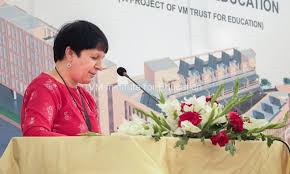
Dr Bernadette Dean (Credit: dawn.com)The coercion worked. Fearing for her life, Dr Bernadette Dean, an eminent Pakistani educationist and one of the 12 members of the Government of Sindh’s advisory committee on school curricula reform, has fled the country. She is a victim of a decades-long effort by religious extremists to control our education system.
The driving force behind the campaign against her has been the Jamaat-i-Islami (JI). On March 28, 2015, its student wing the Islami Jamiat-i-Talaba (IJT) organised a multiparty conference on curriculum change. JI’s Sindh emir, Dr Meraj-ul-Huda Siddiqui, declared as “intolerable” the Sindh advisory committee’s efforts to remove mandatory religious lessons from general knowledge, Sindhi, Urdu and Pakistan Studies textbooks
Singling out the only non-Muslim member of the committee, the JI and IJT launched a personal attack on Dr Dean. Karachi was plastered with inflammatory banners targeting her. She was accused of being “a foreigner woman who has single-handedly made changes to the curriculum and textbooks that made them secular” and called an enemy of Islam. The truth is that she was targeted for trying to ensure that school textbooks meet the requirements of the Pakistani Constitution.
Empowered by the 18th Amendment, the Sindh government set up an expert advisory committee in October 2013 to reform the existing school curricula. The committee was mandated to review “the curriculum of primary schools, from class one to five, in order to identify the missing links, gaps and concepts in it … While proposing changes in curriculum the committee will also point out the duplication, overlapping, repetition, bias and other negative values affecting the learning, growth and worldview of the students”.
It was inevitable that in reviewing the curriculum, the committee would confront the fact that the National Curriculum 2006 and public school textbooks based on it clearly violate Article 22(1) of the Constitution. This article says: “No person attending any educational institution shall be required to receive religious instructions, or take part in any religious ceremony, or attend religious worship, if such instruction, ceremony or worship relates to a religion other than his own.”
Article 22(1) of the Constitution clearly means that teaching any particular faith as part of the curriculum must be restricted to students of that faith and such teaching must not be imposed on students of other faiths. It is a simple protection of religious freedom. In practice, this means that the teaching of Islam should be confined to Islamiat classes and textbooks, and should be studied only by Muslim students. Islamic teachings should not be included in classes and textbooks on Urdu, English, social studies, etc which are used by all students, including children from non-Muslim families.
Despite the constitutional obligation, the National Curriculum 2006 required children of all faiths from classes one to three to be taught to “recite and memorise Kalima Tayyaba with its meaning”, and “memorise and recite Darood Sharif with translation” and “memorise and recite prayers for starting and ending fasts in Ramzan”.
Then there are outright expressions of hate against people of other faiths in parts of the curriculum and textbooks covering independence and partition.
The advisory committee was performing its task according to the terms of reference it received. It was trying to purge the curriculum and textbooks of this kind of material. Dr Dean explained that the new textbooks which tried to be consistent with the Constitution had Muslim authors and that she was only a co-author. She also explained that all the books were reviewed multiple times before being approved by the authorities. Regardless, the Sindh government did not come to her defence.
It is not just in Sindh that Islamist parties and activists and their supporters are trying to protect an intolerant national curriculum that violates the Constitution. In Punjab, textbooks written and approved in the past few years continue to violate Article 22(1). In KP, the JI has allied with the Pakistan Tehreek-i-Insaf government to reverse reforms in textbooks that had been initiated by the previous Awami National Party government.
Thirty years ago, in 1985, Pervez Hoodbhoy and I had written an essay Rewriting the History of Pakistan in which we argued that Gen Zia and his political ally the JI “view education as an important means of creating an Islamised society” and that this effort included “the revision of conventional subjects to emphasise Islamic values”. We had warned then, “the full impact … will probably be felt by the turn of the century, when the present generation of schoolchildren attains maturity”. The religious violence the country is now suffering, directed especially at religious minorities, is one result. Without urgent fundamental reform of our education system, this terrible war may last at least another generation.
The writer is a retired physicist who taught at Quaid-i-Azam University and LUMS.
ISLAMABAD, April 30: The government is all set to approach five countries and the United Nations to seek extradition of top Baloch insurgents accused of fomenting unrest in Balochistan which has been in the throes of a low-profile separatist insurgency since 2006.
The security agencies have identified 161 training camps of Baloch insurgents, nearly two dozen of them are believed to be located in Afghanistan and two in Iran.
“We are taking up the issue of Baloch insurgents with five countries [India, Switzerland, United Kingdom, Iran and Afghanistan],” said a top security official, who did not want to be named in this report. Dr Allah Nazar, Hyrbyair Marri, Brahumdagh Bugti, Javed Mengal
and some other wanted insurgents are commanding their fighters in the province, he added.
Hyrbyair Marri, the head of the Baloch Liberation Army (BLA), has been living in self-exile in the United Kingdom where he has been granted political asylum. The BLA has been responsible for most violence in Balochistan.
Army chief General Raheel Sharif and Interior Minister Chaudhry Nisar Ali Khan had taken up Marri’s issue with British officials and sought his repatriation to Pakistan, the security official said.
Brahumdagh Bugti, the founder of the Baloch Republican Army (BRA), has been living in Switzerland seeking political asylum. The BRA has been involved in attacks on security forces, national installations and civilians in Balochistan.
The security official said Islamabad through diplomatic channels was also in contact with Swiss authorities to bring Brahumdagh back to Pakistan. “The Afghan government has assured Pakistan its full support to stop Baloch insurgents from operating from its soil,” he added.
The government has requested Iran through its Deputy Foreign Minister Hassan Qashqavi to make maximum efforts to block the influence of some Baloch separatists operating from Iranian soil, he added. “Pakistan is considering taking up the issue of Indian involvement in Balochistan unrest at the United Nations,” he added.
Earlier this month, the government quietly expanded the scope of a targeted military operation in Balochistan with the consent of the provincial government in an effort to dismantle the training camps of insurgents, the security official said. “We have expanded the military operation in Balochistan.”
The paramilitary Frontier Corps is assisting the military in targeted operations against separatists. “IGFC Balochistan Maj Gen Sher Afgun had briefed Interior Minister Chaudhry Nisar Ali Khan on such operations earlier this week,” he added.
The expansion of the operation came under the National Action Plan against terrorism, which is being executed by the armed forces across the country to wipe out militancy from the country, another senior official of the interior ministry told The Express Tribune.
The FC has been tasked to expedite operations against anti-state elements as well as to enhance border security, security of important places and state properties, said the official who is familiar with the meeting between the IGFC and Chaudhry Nisar.
The IGFC also floated the idea of bringing police from Karachi, Quetta, Peshawar and Lahore under the federal government for the time being to restore peace in the country’s metropolitan cities, he added. “The IGFC also requested the interior minister for more funds to expand the scope of the operation.”
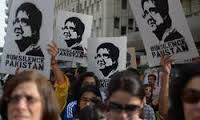
Sabeen’s supporters (Credit: dawn.com)ISLAMABAD, May 3: Can the words of a grief-stricken woman be used to accuse her of treachery against the state? From the sentiments of social media users, it would appear so.
On the night of Sabeen Mahmud’s murder, social media was awash with expressions of anger, disgust and disbelief at the killing of one of Karachi’s leading civil society activists. One of the many tweets that expressed utter disgust and disillusionment with the current state of the country came from a woman who was close to Ms Mahmud.
“I stood in a dark corner of the house and cried. I was overcome with grief and couldn’t process it. I was fed up with all the senseless violence that plagued Pakistan and in that state, I sent out the tweet.”
That expression of grief, however, unleashed a nightmare for the woman in question. Days after the incident, when civil society members gathered to remember Ms Mahmud, the same tweet was re-circulated, this time amongst a more militant and decidedly more extreme segment of social media users.
Countless death threats, rape threats and messages inciting violence against her and other activists – such as Lums professor Taimur Rehman and National Students Federation activists – who were talking about human rights violations in Balochistan and asking for justice for Sabeen Mahmud, were issued by various social media users and pages.
“I’ve worked on sensitive issues before, and have received my share of hate mail. But this harassment was on a scale I had never seen before. The rabidity of the comments, across all social media platforms, got to me and, on the advice of some friends, I deactivated my accounts on social media,” she told Dawn.
Threats of physical and sexual violence against women are not a new phenomenon on social media and the fact that many of the users copy-and-pasted the exact same message again and again has led a number of IT experts to observe that this appeared to be a coordinated effort.
Fahad Desmukh, a journalist and rights activist, told Dawn that even though freedom of expression activists preferred to err on the side of more freedom, the reality of social media was that users – especially public figures – would have to put up with a certain amount of abuse and venom from others who do not agree with their ideas.
“However, when that abuse turns into threats of rape, physical violence or incitement to violence against the victim, that is very scary,” he said.
Shahzad Ahmed, country director of the digital rights group Bytes For All, said that even though offences such as these were covered in the Criminal Procedure Code (CrPC) and the Pakistan Penal Code (PPC), law enforcement agencies aren’t the best forum for victims, especially women, to take their cases.
The law provides protection, for example, against incitement to violence under Section 109 of the PPC; against intimidation and threats to a person’s life under Section 506; and against threats of injury or damage to property under Section 503. However, Mr Ahmed said that these laws had never been properly enforced in cases where online activity has been concerned.
“If an individual, especially a woman, takes her case to the National Response Centre for Cyber Crimes (NR3C), local law enforcement or even the courts, there is a tendency to blame the victim,” he said, adding, “a woman exposes herself to more scrutiny and name-calling by pursuing their case through the authorities”.
This is reminiscent of what happened to the late Sabeen Mahmud around Valentine’s Day two years ago, when she ran a campaign extolling peace and love. ‘Faasla na rakhein, pyaar honay dein’ was the message she and her fellow campaigners were spreading.
However, around the same time, a parallel movement that cited Islamic texts and opposed the observance of ‘decadent festivals’ such as Valentine’s Day, cropped up in Karachi and other cities. When Ms Mahmud dismissed their views via her social media account, a concerted campaign was initiated by conservative elements to malign her. They even insinuated that Ms Mahmud had insulted scripture and termed her a blasphemer.
This is a very dangerous accusation in Pakistan, where dozens are killed in the name of blasphemy every year, without anything in the way of due process. So when Ms Mahmud approached the authorities, her plight was belittled and she was asked, “Why did you do this in the first place?”
Both Mr Ahmed and Sana Saleem of Bolo Bhi told Dawn that even though social networking sites such as Twitter and Facebook have strict policies regarding incitement to violence and threats of sexual or physical assault, the sites are not always quick to take action against malicious content.
“A good way to get a dangerous post removed is to get a couple of dozen people to report that post or user. If enough people report it, the website is forced to review it. Sometimes they don’t and we get in touch with them directly and plead the case. But we can do this because we’ve had contact with the Facebook team. Not everyone has that kind of access,” Ms Saleem said.
The situation becomes more perilous when the vitriol is echoed by Facebook pages and Twitter accounts that purport to have intimate knowledge of the military’s workings. For example, the Facebook page called simply ‘ISI’ – with over 341,000 subscribers, as well as its allied Twitter page, ‘@ISI_RT’ – have posted photographs of human rights activists, including women, and extolled followers to murder, rape or do bodily harm to them.
Due to the nature of the incident – Ms Mahmud was killed shortly after hosting a controversial seminar titled #UnsilencingBalochistan where Baloch nationalist activist Mama Qadeer was also invited – many of her friends placed the blame for her killing squarely on the state’s shoulders.
A military official Dawn spoke to regretted the practice, but said that the army had little to no control over such pages.
“Journalists and media savvy individuals know that ISPR has one official website and only one Facebook and Twitter page. Most of these other pages copy information from the official websites in order to establish their credibility. They can be operated by anyone, but the average user is not necessarily in a position to judge that,” he said.
The official pointed out that ISPR had issued formal statements in the past, explaining that neither the chief of army staff, nor the DG ISI, have accounts on social media. This was because imposter accounts purporting to be run by the two senior functionaries became quite popular on social networking websites, leading many users to believe that they were, in fact, genuine.
“Social media is a comparatively new medium, so we are looking into what can be done. But in the absence of a proper mechanism whereby such content can be checked, e.g. a cybercrime law, there is only so much the institution can do to clarify its position,” he said.
Veteran rights activist Hina Jilani disagrees. “Defending human rights is one of the most difficult things to do in this country. If the state cannot protect lawyers or activists who are involved with sensitive cases, what guarantees are there that the state is not backing their actions,” she asked, rhetorically.
Ms Jilani – who has been a vocal human rights activist for many decades – was also targeted by several social media users for her defence of Sabeen Mahmud. However, saying that she did not bother with the social media at all, she said that the situation today was far scarier than it was back in her day.
“If journalists or activists fell afoul of the state, they were mostly hauled off to jail. Now, they are just bumped off. This practice began under Gen Zia but gained prominence under the rule of Gen Musharraf,” she said.
Disagreeing with the impression that those with extremist views are ‘lone wolves’ without an agenda, she said that the fact that their views were freely aired on mainstream media, while progressive voices were stifled, proved that they enjoyed state support.
This is exactly what the woman grieving for Ms Mahmud is worried about.
“I have limited my presence on social media and am staying at home until the outcry dies down,” she told Dawn, adding that even though she knew the cause was worth fighting for, it was only natural to be scared for one’s own life given the extent to which Pakistani society had become intolerant of others’ opinions.
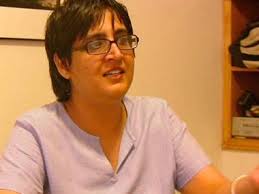
NOBODY, of course, had anything to do with it, when Sabeen Mahmud’s car was stopped by two men on a motorbike who shot her at point-blank range through the windows. The Pakistani Taliban denied all responsibility. The Inter-Services Intelligence, ISI, promised all possible help to the police. Nawaz Sharif’s government ordered the police to find the perpetrators within three days. The police said they were very busy ascertaining a motive.
Really, it wasn’t hard to spot one. Here in the midst of anarchic, dysfunctional, crammed, crazy, noisy Karachi was a woman who was even more anarchic, crazy, noisy and in-your-face. She was at the heart of every disturbance, from supporting rank outsiders in the local elections to organising flash protests on social media, and spiced up every organisation she belonged to, which was any outfit committed to challenging discrimination or injustice.
No veil or scarf for her; with her short-cropped hair and black-rimmed glasses, she looked like a New York intellectual and felt like a postmodern hippie child. She loved Jimi Hendrix, Bruce Springsteen and the Beat poets. She’d give you a straight, cool stare, equally straight talk, an easy laugh, and a philosophy of absolute fearlessness. If you were afraid, she’d say, you’d get nothing done: especially not in army-ridden, intolerant Pakistan, where so much was never to be questioned or discussed, and certainly not by women.
The centre of all she did was the Second Floor (T2F for short), the café/bookshop/ performance space she founded in 2007. She had a pittance in the bank at the time, but a reckless dream of copying the old Pak Tea House in Lahore where radicals used to meet. By working on tech projects all the hours she could, maxing out her credit cards and begging money from relations, she gave Karachi a place where talk—about art, science, politics, anything—could flow freely, and citizens could get online and organise. Two years later, when the nervous landlord kicked her out, the café had become such a lifeline for Karachi’s free-thinkers that she easily found a better place. She called the performance area “Faraar”, Urdu for “escape”.
There, in a comparatively shabby street in the posh Defence district, poets on open mic advocated revolution; people sat around for hours discussing life on Mars; musicians tried out their pieces, artists hung weird stuff on the walls, home-made films were screened, and anyone could wander in and shoot the breeze, no matter what their creed or disposition or label— Punjabi, Bihari, or whatever. In 2007, when President Pervez Musharraf fired some Supreme Court judges, Ms Mahmud invited lawyers to plot their protests there. In 2013 she organised a hackathon, Pakistan’s first, where for a whole weekend people brainstormed new ideas and apps to make Karachi work better. Don’t just bad-mouth the government, she would say. Take charge! Change things!
No one paid to belong to T2F, though you could buy good coffee and brownies, as well as alternative books. Those takings covered about half the costs and gave her a salary, not that she cared much. She ran her own media-and-tech consulting firm and was president for a time of the Karachi outpost of an organisation that fostered tech entrepreneurs, but didn’t want to make money. The point was to fight the “horrible stuff” going on in Pakistan and the world.
Where had all this adrenalin-boosted energy come from? She blamed her mother, Mahenaz, for instilling “mad ideas at a young age” and supporting her ever after. (Mahenaz was in the car with her, and was hurt in the attack.) But she was spurred on just as much by anyone who told her she could not or must not do a thing. When a computing teacher belittled her at school she decided to master computers by herself, falling in love at 14 with a Macintosh Plus that had Pink Floyd and Lenny Bruce in it, and teaching herself to solder wires and write programs. Small wonder she believed, first, that formal education was stultifying, and second that computers, especially Macs, could shake everything up in the way she longed to see.
Even sport pricked her defiance. Her school, Karachi Grammar, didn’t let girls play cricket, so she played it at home with any spare passing males she could find. A bat, stumps and proper hard ball went with her to the office—to whack assailants over the head, apart from anything else.
Inviting enemies in
Abuse and threats came often. She laughed them off. Other dissidents left Karachi, but she loved it too dearly to live anywhere else. Friends said she should put a security guard on the café door; she preferred to invite her enemies in, to eat panini and join the conversation. In 2007 she hosted a talk by an author who had uncovered army finances; ISI people were invited, and some came. On April 24th she had just held a meeting to “un-silence” Baluchistan, Pakistan’s most neglected and separatist province, where hundreds of activists and students had been abducted, probably killed. Lahore University had been warned off the subject. There would probably be “blowback”, she told a friend; “I just don’t know what that blowback entails.”
The authorities and jihad-makers were all most extremely sorry. Not half as sorry as the artists, poets and thinkers of Karachi, who suddenly found it hard to breathe.
It’s done it again. The Muttahida Qaumi Movement’s recent victory in Karachi’s NA-246 constituency, its seventh in a row, has dealt a blow to its critics, who claimed the party’s grip was loosening in a city yearning for political change.
Far from weakening the party, the Rangers’ raid on MQM’s headquarters on March 11 and subsequent events seem to have revitalized the link between the party and its constituents. The by-election on April 23 reaffirmed its capacity to bounce back in challenging times. Its core constituency (the Urdu-speaking middle- and lower-middle classes of Karachi’s District Central) sent packing the self-styled ‘liberators’ who promised voters “freedom from fear.” Opponents have had to face the fact that the “living dead,” as Pakistan Tehrik-e-Insaf described MQM voters, are alive and kicking.
On closer inspection, however, the ‘landslide’ victory of the MQM is not as blatant as it seems. And while this victory is certainly a shot in the arm for an embattled party, it provides only temporary respite.
Rarely has a by-election captured as much attention at the national level as the one in NA-246. On one hand, everyone was eager to see how the MQM was going to get out of the awkward corner where the military establishment, with the support of the federal government, had pushed it in the preceding weeks. The involvement of all the contenders’ central leadership only contributed to raise the stakes even further.
Once again, PTI chief Imran Khan and his entourage demonstrated their unfamiliarity with Karachi’s ground realities by convincing themselves that their rhetoric of salvation would be enough to ravish the MQM’s home constituency, where it has remained undefeated since 1988. By equating Mohajirs at large, in a constituency where they account for more than 80 percent of registered voters, with passive victims waiting to be liberated from the yoke of crime and authoritarianism, the PTI alienated potential voters and probably even drove a significant number of its past voters back toward the MQM.
Instead, the PTI should have realized that the MQM’s grip over Azizabad and other Urdu-speaking localities of NA-246 is less the outcome of its coercive tactics than of its patronage politics. The MQM has delivered, providing its constituents with public jobs, helping them overcome bureaucratic and legal hurdles, facilitating their access to water and electricity (however imperfect these services remain). Khan and the PTI also ignored the fact that the largely uncontested authority of the MQM over this part of the city has preserved a semblance of peace in the area. Every MQM voter may not sympathize with the party’s muscular style of politics, but most residents of these localities will admit that at least some order reigns in this part of town.
Kunwar Naveed Jamil, the MQM candidate, received 95,644 votes or a bit more than 73 percent of the total cast. This is similar to what Nabil Gabol, whose resignation from the National Assembly required this by-election, secured in the 2013 election as an MQM candidate. As such, Jamil’s score puts paid to allegations, including from Gabol, that the MQM owed its recent victories to wholesale rigging. Conducted under the close watch of the Rangers, no one can claim that the MQM’s comfortable win was the outcome of electoral malpractices. The party has demonstrated that it has retained a large vote-bank in its home constituency.
At the same time, despite its relatively poor showing, the PTI has seen its vote share (percentage of votes polled minus invalid ones) increase from 17 percent to 19 percent. This should already be a source of concern for the MQM. Clearly, the PTI has made a dent into the MQM’s vote bank and it seems here to stay. But this is not the only matter of concern. Electoral assessments in terms of vote share always present a strong bias as they fail to account for invalid votes and, more importantly, for the abstention rate. This bias is particularly blatant in the case of NA-246, a constituency known for its erratic level of participation since 1990.
After 1988, when the constituency registered a record rate of participation (53 percent), this rate declined to 28 percent in 1990 and further to 9 percent in 1993 (when the MQM boycotted the polls). During the following elections this rate increased steadily: 17 percent in 1997, 37 percent in 2002, and 63 percent in 2008. In 2013, however, the turnover fell to 52 percent, only to decline further during this by-election, where it fell to its 2002 level, at 37 percent. This corresponds to the average rate of participation registered since 1988 but the significant reduction of votes polled (131,418 in 2015 against 189,405 in 2013) raises several questions nonetheless. How much does this decline owe to delays in the voting process (which, according to the MQM, were instigated by law and order agencies), greater scrutiny over this particular election (which made electoral malpractices nearly impossible), and more simply to the electoral fatigue of local residents?
The fact remains that only 27 percent of registered voters of NA-246 gave their votes to the MQM, against 38 percent in 2013 and 60 percent in 2008. One might argue that large-scale rigging biased the results of the 2008 and 2013 elections. Indeed, a recent review of the constituency’s electoral history suggests that the MQM’s average bag in NA-246 (except for 1988) is around 19 percent. In this sense, the results of this by-election are indeed a significant success for the MQM, as they point toward an increase of its actual vote share. And yet, what has emerged from this election is a downsized political party which will have to come to terms with a harsh reality: even in its home constituency, where its political journey begun in the late 1980s, it can no longer claim to enjoy the unconditional support of the masses.
For all its claims that NA-246 ‘belonged’ to the party (a claim resonating with larger claims of ‘ownership’ over Karachi), the MQM leadership will have to cope with the fact that voters’ behavior can no longer be taken for granted, be it in the party’s strongholds or, a fortiori, in more contested constituencies. Gone are the days of the MQM’s uncontested authority over Karachi and, in this sense, this by-election could prove to be an important milestone in Karachi’s political history, confirming its transition toward a post-hegemonic political order—a configuration where the MQM, for now, remains the predominant political force but where it has to cope with unprecedented competition from electoral rivals and, thus, has to resort to more active campaigning to win the day.
So where do the MQM and Karachi politics go from here?
In the short term, Karachi’s predominant party has won a certain breathing space but is not yet over the hill. Those who had started questioning MQM chief Altaf Hussain’s authority within the party, however surreptitiously, have been silenced for now even as his succession remains an open question. As investigations into Imran Farooq’s murder and pending money-laundering cases follow their course, Hussain’s future in the U.K. remains uncertain. In any case, and however inconceivable this may still be for MQM workers and sympathizers, Hussain will not always be there to steer the party in the face of adversity. Sooner or later, it will have to generate a new leadership, a process which will be fraught with tensions and for which, considering the absence of a strong and consensual second-tier leadership within the party, the MQM seems largely unprepared. The transition of the party to a post-charismatic politics, what Max Weber called the “routinization of charisma,” will be its greatest challenge and this time there is no guarantee that the party will emerge victorious, or survive at all.
The reaction of the military establishment to this electoral victory also remains uncertain. Targeted operations against the party’s alleged “militant wing” will probably continue, while judicial pressure on party leaders and activists may increase in the coming months, both in Pakistan and in the U.K. This pressure will severely constrain the margin of maneuver of the party and might contribute to its normalization. But one cannot entirely exclude a return to its militant posturing and disruptive tactics, especially in the case of Hussain’s forced retirement.
The by-election results suggest that the PTI’s time has not yet come. But for all its shortcomings, the PTI has confirmed that it could become a serious challenger to the MQM’s supremacy, provided it draws lessons from its relatively poor showing on April 23. If the PTI is to consolidate its position in Karachi politics, it will have to consider joining forces with the Jamaat-e-Islami to avoid excessive scattering of votes expressing a desire for political change. At the same time, however, such an alliance might compromise the growing support for the PTI among the Shia. At a more structural level, the PTI will have to strengthen its local apparatus in order to embed itself firmly in the everyday life of Karachi’s low-income residents, who hold the key to electoral success. For this, the PTI leadership will have to relinquish its histrionics and start addressing the more pressing concerns of local voters, while engaging more serenely with its main rival, which, during this by-election, proved unequivocally that it is not ‘occupying’ Karachi by force.
The uncertainties surrounding the current reconfiguration of Karachi’s political landscape also have to do with the future of ethnic and sectarian politics in the city. This by-election signaled a return of the MQM to its earlier ethnic posturing, which compromised its attempts to expand its constituency beyond Mohajirs. Not that this really matters electorally. For all its attempts to tone down its ethnic rhetoric and field non-Mohajir candidates in recent elections, the MQM has always failed to draw a significant number of voters from non-Mohajir backgrounds. The MQM’s capacity to retain the support of Shia voters, both among Ismaili and Twelver Shia communities, will likely be more significant for its future. In NA-246, the Shia vote seems to have scattered and, following the alliance of the Majlis-e-Wahdat-e-Muslimeen with the PTI, a large number of Shia voters appear to have opted for the latter.
The capacity of the PTI to woo Shia voters is proof of its capacity to overcome the ethnic and sectarian fault lines that have come to characterize Karachi politics and social life. Here lies the major challenge to the MQM’s predominant position: in the PTI’s potential to emerge as a truly pan-ethnic and/or pan-Islamic party. While this potential remains largely unrealized, the PTI has an obvious advantage over its rival: it is less bounded to a specific linguistic group. In a city whose demography is fast changing and where Mohajirs are no longer the majority, this could prove to be a major strategic advantage, provided the emerging challenger starts to understand this city in all its complexity, rather than through the simplistic dyad of occupation and liberation.
Gayer is a research fellow at the Centre d’Études et de Recherches Internationales, Paris, and author of Karachi: Ordered Disorder and the Struggle for the City (Hurst, 2014), available in Pakistan through HarperCollins India.
ISLAMABAD, April 30: Pakistani pilgrims wishing to perform Hajj this year will have to declare whether they are Shia on their Hajj application forms if they have any hopes of making the sacred pilgrimage.
Confirming that the conditions had been forward by Saudi Arabia, government officials responsible for making Hajj arrangements said, “Saudi Arabia will not entertain any Hajj application from aspirants that fail to specify whether the applicant is a Shia or a Sunni.”
Taking Saudi requirement seriously, the government has added a question on page eight of the Hajj application form with the question “Are you Shia.”
The Ministry of Religious Affairs Spokesperson Muhammad Farooq said, “Aspirants are supposed to fill it with: ‘Yes’ or ‘No’.”
Riyadh has made it mandatory for all Hajj pilgrims to declare their sect as it fears that sectarian tensions could rise in the kingdom owing to the conflict in Yemen.
“Saudis do not want a repeat of the 1987 demonstrations during the Hajj pilgrimage, which led to the deaths of over 400 people in Makkah,” a senior official of Pakistan Hajj mission observed.
Religious affairs ministry officials, who are facilitating applicants (under government scheme) for getting visa, said the Saudi authorities also slightly amended the new Hajj visa form requirements. Though officials insisted that there was no such written instruction from Saudi authorities. But they said that the decision to insert the question was taken at a high level.
On the other hand, the religious affairs ministry spokesperson claimed that the question had been added on the request of representatives of Shia community in the country in order to prevent exploitation of the ‘mehram’ rule by Sunni women for performing hajj. Shia women, unlike their Sunni counterparts, can perform Hajj without a ‘mehram’. There have been reports that Sunni women have in the past exploited this provision.
Commenting on the new condition put forward by the Saudi Arabia, Chairman Pakistan Ulema Council Tahir Ashrafi said that he supports the Saudi move, adding that every country has the right to set new terms and condition to ensure better security.
“It’s not a new move. Pilgrims should abide by Saudi laws and declare their sect. Pilgrims are treated equally regardless of their sect,” he stated.
Amin Shaheedi, a representative of the Shia community in the Council for Islamic Ideology, said that, “We have no problem with this new addition. If Saudis are satisfied with this new move, Shia community is ready to abide by newly amended laws.”
LONDON, April 14 — Hours before he was scheduled to be executed last month, the Pakistani hit man made an incendiary accusation.
Speaking into a video camera at a remote desert jail, Saulat Mirza, a death-row convict from the port city of Karachi, said his orders to kill had come from Altaf Hussain, the city’s most powerful and, until recently, untouchable political leader.
“Altaf Hussain directly gave us the murder instructions,” Mr. Mirza said in footage that was broadcast on several television news channels later that evening in March.
It was enough to earn Mr. Mirza a last-minute reprieve, as the authorities investigated his claims. Mr. Hussain, for his part, called it a conspiracy to damage his image.
But in Karachi, Pakistan’s largest and most volatile city, the accusations were seen as further evidence that the political winds were violently shifting against Mr. Hussain after decades of iron-fisted dominance.
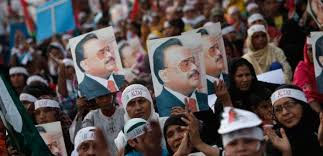
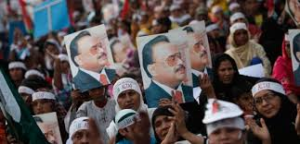
On March 11, Rangers in balaclavas raided Nine Zero, the fortified headquarters of Mr. Hussain’s party, the Muttahida Qaumi Movement, confiscating weapons and files. One political worker was killed by gunfire during the raid, and several others were taken into custody, some on murder charges.
On the political front, Mr. Hussain has come under attack from the opposition leader Imran Khan, who has started an aggressive foray into his electoral heartland. On Friday, in a symbolic challenge, Mr. Khan held a small event just a few hundred yards from Mr. Hussain’s party headquarters.
In London, the British police are continuing to press criminal investigations of Mr. Hussain and his inner circle. On April 1, a senior aide, Muhammad Anwar, was arrested on suspicion of money laundering.
Mr. Hussain, who was arrested in connection with the same case in June, underwent further questioning at a London police station on Tuesday. His bail has been extended until July.
Not long ago, any of those shocks would have caused an immediate shutdown of Karachi, a city of 20 million people where Mr. Hussain’s ability to empty the streets at an hour’s notice has long been a sign of his immense influence.
But this past month, life has largely continued as normal. Muttahida’s militant wing — organized groups of armed supporters who carry out extortion and intimidation, and are seen as the enforcers of Mr. Hussain’s authority — has melted off the streets.
The news media, which previously treated the party with caution, has aired criticism of the party. (Among those arrested was a Muttahida supporter charged with the murder of Wali Khan Babar, a prominent television journalist who was shot dead in his car in 2011.) And in the city’s political back rooms, senior Muttahida officials have begun to quietly consider the possibility of a new leader — an unthinkable idea until recently.
“The fear factor is gone,” said a senior party official who, like several others, spoke on the condition of anonymity out of fear of retribution.
But the upheaval has also brought worries of new instability in a city that is awash with armed groups. Noting that Karachi is in a “state of flux,” the newspaper Dawn warned in an editorial this month that “when the chips fall, they may not do so without considerable violence.”
The moves against Muttahida are part of a broader effort to stem a cycle of political and criminal violence that has left Karachi prone to Taliban infiltration in recent years. Militants disrupted election campaigning in 2013, leading to a crackdown that has broken several Taliban cells, according to police officials and ethnic Pashtun community leaders.
Now the authorities have turned their attention to the armed wings of the city’s political parties, of which Muttahida is by far the largest.
But few are writing off Mr. Hussain, a wily political player with a long record of survival, just yet.
For much of the 1990s, Mr. Hussain’s supporters waged a street war against the security forces in Karachi, only to ultimately re-emerge stronger than ever.
Since then, he has enjoyed unquestioned support from the city’s Mohajir population — mostly Urdu-speaking families that migrated from India in 1947 — by playing on their sense of grievance at the hands of local ethnic groups, creating a magnetic cult of personality in the process.
This time, however, the challenges also come from within. Mr. Hussain’s stewardship of the party has become increasingly erratic recently, several officials said.
The opposition leader Imran Khan during an anti-government demonstration in Islamabad, Pakistan, last year. Credit Aamir Qureshi/Agence France-Presse — Getty Images
In addresses to party rallies in Karachi, delivered over the phone from London (his usual mode of communication with the party faithful), he frequently appears to be under the influence of alcohol, they said.
During one lengthy tirade on March 30, Mr. Hussain publicly resigned his leadership and urged his followers to take up charity work, only to reappoint himself hours later.
“We never know if it’s going to be happy hour or sad hour,” said one senior official who privately advocated a change in leadership and spoke on the condition of anonymity.
To many, it seems clear that the Pakistani military, which has a long history of meddling in politics, is trying to engineer a change in leadership. Journalists say the videotaped accusations from Mr. Mirza, the death-row convict, bore the hallmarks of a military intelligence operation.
In political circles, the army has started to take informal soundings about a possible successor to Mr. Hussain, the same party official said.
“They want to keep the M.Q.M., but without Altaf or anyone directly associated with violence,” he said.
But experts warn that such a strategy is fraught with danger. “If the M.Q.M. implodes, what will happen to Karachi?” said Laurent Gayer, author of “Ordered Disorder and the Struggle for the City,” a recent book on Karachi. “It seems that few people are thinking about the consequences of a militarized, fragmented party.”
In any event, Mr. Gayer said, Mr. Hussain is unlikely to be unseated through conventional politics, and therefore much hinges on the outcome of the long-running police investigation in London.
Mr. Hussain looked unsteady as he pushed through reporters at the entrance to the London police station on Tuesday. He has said a large sum of money found at his house — about $650,000, party officials say — came from legitimate political donations.
But his circle faces potentially greater peril from a related police investigation into the murder of Imran Farooq, a former ally who was stabbed to death outside his London home in 2010. On Monday, the Pakistan Interior Ministry announced that a suspect in the case had been arrested.
Still, the British police seem mainly interested in two other suspects, both Muttahida supporters, who fled to Pakistan from London just after the killing in 2010.
The police have not brought charges in either case. But just the possibility of a prosecution has visibly destabilized Mr. Hussain’s party and has weakened his grip on Karachi.
For now, though, the most immediate threat is political. The opposition leader Mr. Khan, whose party is close to the military, and Muttahida are running in an important by-election in Karachi on April 23. Mr. Khan has declared his intention to “liberate” Karachi from Mr. Hussain.
“It is time for M.Q.M. and Altaf Hussain to decide whether they want to be a democratic party or want to do politics through a militant wing,” Mr. Khan told reporters last week.
Few believe the choice is that simple. But even among Muttahida officials, there is a gnawing worry about what will happen if Mr. Hussain, who long commanded the respect of figures like Mr. Mirza, suddenly loses control.
“The militants are confused and worried,” another senior party official said. “They don’t want to follow instructions from a man who says one thing in the morning, and another in the afternoon. That’s a worry for us all.”