Pakistani Lawmakers Urge Diplomacy in Yemen Conflict but Decline Combat Role

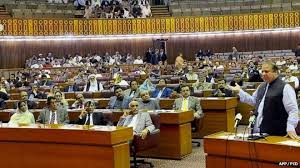
Pak Parliament (Credit: bbc.com)

ISLAMABAD, April 10 — The Pakistani Parliament voted on Friday to stay out of the conflict in Yemen, but it urged the government led by Prime Minister Nawaz Sharif to play a diplomatic role in defusing the crisis.

The decision came as international aid agencies reported rising desperation in Yemen, the Middle East’s poorest country, where half the population suffered chronic shortages of basics before the conflict escalated last month.

While a limited amount of emergency medicine was airlifted into Sana, the capital, millions of Yemenis have little or no food, water and fuel; hundreds have been killed, and more than a quarter-million displaced. The United Nations humanitarian relief coordinator for Yemen, Johannes van der Klaauw, told reporters at a news conference in Geneva that the crisis was “getting worse by the hour.”

Analysts in the Arab world saw the Pakistani Parliament’s vote as a significant setback for Saudi Arabia, which is leading a campaign of airstrikes against the Houthis in Yemen. Saudi Arabia, a major donor to Pakistan, had incorrectly advertised Pakistani participation in the campaign from the night it began more than two weeks ago.

While declining a military role, the lawmakers vowed to stand “shoulder to shoulder” with Saudi Arabia, a long-term Sunni ally that had requested aircraft, warships and troops. The lawmakers also pledged to defend Saudi Arabia if its “territorial sovereignty and integrity” was violated.

Saudi Arabia has accused Iran, the region’s most influential Shiite country, of providing military aid to the Houthis, whose leaders follow a variant of Shiite Islam, and leaders in Tehran condemned the Saudi air campaign on Thursday. Most experts say that Iran supports the Houthis but that it does not control them.

The parliamentary measure, which was passed with unanimous support, followed four days of lively debate in a joint session of Pakistan’s Senate and National Assembly.

Critics of military action warned that Pakistan risked getting sucked into a broader sectarian conflict in the region, particularly at a time of growing violence against Shiites at home.

Pakistan is a predominantly Sunni country, but Shiites represent about 20 percent of the population.

The Iranian foreign minister, Mohammad Javad Zarif, visited Islamabad, the Pakistani capital, this week and urged Pakistan to press for a cease-fire in Yemen.

Mr. Sharif’s government has close ties to Saudi Arabia, which gave Pakistan a $1.5 billion grant last year. Mr. Sharif also lived in the Saudi city of Jidda in the early 2000s, when he went into exile to escape the military rule of Pervez Musharraf.

The parliamentary resolution on Friday appeared to largely align with Iran’s wishes. “Pakistan should maintain neutrality in the Yemen conflict so as to be able to play a proactive diplomatic role to end the crisis,” read the resolution, which had been presented by Finance Minister Ishaq Dar.

Lawmakers said they supported “regional and international efforts for restoration of peace and stability in the region.”

Continue reading the main story

Continue reading the main story

Still, the pledge to stand with Saudi Arabia and to defend its sovereignty was seen as leaving open a door to possible military action if the situation in Yemen were to worsen.

Citing sources close to Mr. Sharif, some Pakistani news outlets reported on Friday that the Pakistani prime minister had privately warned Mr. Zarif, his Iranian counterpart, against supporting the Houthis.

In a statement on Thursday, Mr. Sharif said he had used the meeting to express concern about the Yemeni government being overthrown by “nonstate actors.”

“Beside the loss of innocent lives, the crisis can undermine the unity of Muslim world,” Mr. Sharif said in the statement.

The emergency airlift of medical supplies to Sana, arranged by the International Committee of the Red Cross and Unicef, arrived on Friday at the international airport. The agencies said the supplies would be distributed to hospitals across the country. The Red Cross said the shipment included 16 tons of medicine, bandages, intravenous fluids and surgical equipment.

But relief workers in the country reported increasingly dire problems. Doctors Without Borders said it had treated more than 800 war wounded over the past few weeks, but that fighting had left many people, including pregnant women, stranded in their homes or at checkpoints in need of medical treatment.

“Every day we are getting calls from patient in a critical condition — sometimes war-wounded, sometimes with other serious health problems — who cannot reach our hospitals,” Dr. Ali Dahi said in an interview posted on the Doctors Without Borders website. He was working for the charity in Ad Dhale, a town in southern Yemen.

Nuha Abdulljabbar, a Yemeni aid worker for Oxfam, the British charity, said in a telephone interview from Sana that daily bombings by the Saudi-led coalition had paralyzed the city.

“You never know when they will start to bomb,” she said. “There’s no warning, nowhere to go. It’s pretty scary.”

Asked what Yemenis fear the most, she said, “I think the main thing the people are fearing is the silence of the world.”

Salman Masood reported from Islamabad, and Rick Gladstone from New York. Declan Walsh contributed reporting from London.
 

Pakistan’s decision is “dangerous” and “unexpected” – UAE foreign minister

Slamming Pakistan’s decision to not join the Saudi-led coalition targeting Houthi rebels in Yemen as ‘dangerous and unexpected,’ the United Arab Emirates said the country was favouring Iran over the Gulf nations.

“The Pakistani parliament’s resolution, which promoted neutrality on the Yemeni conflict, and voiced support for Saudi Arabia is contradictory and dangerous and unexpected from Islamabad,” UAE’s minister of state for foreign affairs Anwar Gargash said on Twitter.

Gargash accused Pakistan of choosing Iran over the Gulf nations at a time when they face an “existential confrontation” in the Yemen conflict, according to Al Arabiya.

“Tehran seems to be more important to Islamabad and Ankara than the Gulf countries,” Gargash added.

After a marathon debate on Riyadh’s request for Pakistan to join the military coalition against Houthi rebels in Yemen, federal lawmakers asked the government on Friday with one voice to stay out of the conflict in the Arabian Peninsula, but backed its commitment to protect Saudi Arabia’s territory which is currently under no threat.

Read: Will of parliament: ‘Stay out of Yemen conflict’

“Though our economic and investment assets are inevitable, political support is missing at critical moments,” he wrote, referring to the Gulf countries economic assistance to Pakistan.

“The Arabian Gulf is in a dangerous confrontation, its strategic security is on the edge, and the moment of truth distinguishes between the real ally and the ally of media and statements,” the minister further said.

“The vague and contradictory stands of Pakistan and Turkey are an absolute proof that Arab security — from Libya to Yemen — is the responsibility of none but Arab countries, and the crisis is a real test for neighbouring countries.”

Read: Yemen conflict will have serious implications for regional security: Army chief

Turkey expressed its support for the Saudi-led coalition and said it would offer logistics and intelligence support.

“This is nothing but another chapter of laggard impartial stand,” Gargash added.

Not only criticising Pakistan’s stance, the minister also demanded Pakistan to show a clear stand “in favour of its strategic relations with the Gulf nations, ad contradictory and ambiguous views on this decisive matter will have a cost highly.”

Meanwhile, the military spokesperson for the Saudi-led offensive code named Operation Decisive Storm, Brigadier General Ahmed Asiri claimed on Friday, Pakistan is yet to announce its official position.

Asiri said while Pakistan’s participation would be an addition to the coalition, its absence in the operation wouldn’t affect the coalition’s work.


Curbing Hate Speech

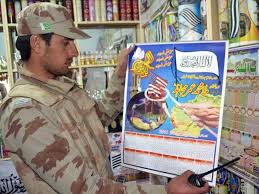
FC Seizes Hate Material (Credit: tribune.com.pk)

Following up with the counterterrorism plan of action, the police raided several hundred bookstores and offices of publishers throughout the country in January. This entailed thousands of arrests and confiscation of printed, audio and visual material. The seizures from Urdu Bazaar, Lahore were the highest as it is the largest site of the printing and publishing business in the country.

According to Amjad Saleem Minhas, Director of Sanjh Publishers, “About 90 per cent of the business in Urdu Bazaar Lahore survives on printing religious books and a large chunk of it is inflammatory and derogatory against different Muslim sects and religions while the publishers and users of the materials include various Madrassas.”

The police also launched a crackdown against the abuse of loudspeakers in mosques. A new law carrying heavier penalties was introduced days before the arrests of several hundred accused in Punjab province alone.

The arrested persons succeeded in securing release on bail using two alibis. The publishers argued that the government never specifically banned the publications in question whereas those accused of misuse of sound amplifiers reported that they were merely reciting holy verses. This shows that the issue of hate speech needs a broader, cohesive and serious response in the area of public policy rather than scattered administrative measures.

Considering the above example of inconsistency in the public policy, the hate speech is likely to find a strong alibi in its favour if the education policy was used as a standard. This area needs immediate attention considering that hate speech in the textbooks is pervasive and acute while more than 37 million students and teachers in the country use textbooks every day.

Despite painstaking efforts by experts over the years to highlight this problem, the textbooks in 2014 were no different than before. These books are approved by the Punjab Textbook Board. However, the studies carried out annually by National Commission for Justice and Peace since 2010 show that textbooks in Sindh, Khyber Pakhtunkhwa and Balochistan, were not healthier.

The History textbook for first year class of FA published by Standard Book Center and approved by Federal Board for Intermediate wants student to believe that “Hindus consumed urine of cow and women of easy virtue occupied Hindu temples”(page 4). In 2015 the course was replaced by Tareekh-e-Islam. The preface of this textbook is devoted to highlighting blasphemy against Islam by non-Muslims. Textbooks for languages, Islamic and social studies carry frequent remarks disrespecting religious diversity and illogical comparison between different creeds.

Ostensibly these textbooks pose equal, if not greater, risk of incitement to violence in the name of religion because of the sheer size of readership as well as their function and status. Stuffed with factual misrepresentations, negative portrayal of minority religions in Pakistan and stereotypes, the textbooks for schools and colleges promote a mindset misfit to live in peace with the world at large.

The textbooks are mostly copy pasted rather than authored and printed in Urdu Bazaar largely by private publishers. Authors increase the hate material trying to compete with one another.

The five education policy reviews since 1959 only added to the problem rather than addressing it as the education sector was assigned to fulfill certain political objectives of each regime rather than educating the nation. Besides low budgetary allocation, institutional overlap of responsibility and privatisation of publishing, the complacent curriculum review process was responsible for allowing the religious biases to creep into textbooks and contaminate the environment of educational institutions.

After the devolution of power to provinces under 18th Amendment, each province adopted different institutional approaches though ending up with similar and dismal results.

According to data compiled by Dr Baela Raza Jameel, the Balochistan province has a Curriculum Bureau and Textbook Board, mostly borrowing their textbooks and policy from Punjab. The Punjab government set up an Education Commission in 2011 only to abolish it in 2013. The Punjab Curriculum Authority was created in 2012 that worked along with Punjab Textbook Board. These two bodies were merged into one Curriculum and Textbook Board in February 2015 through a provincial legislation.

Despite a large resource base, Punjab did not achieve better than Balochistan in review of textbooks due to institutional overlap and swift changes. The incumbent government in Khyber Pakhtunkhwa was quick to reverse some positive changes that the Awami National Party’s government introduced in textbooks in 2012.

The Sindh government recently announced that it will introduce Quaid-e-Azam’s hallmark speech on August 11, 1947 to encourage plurality and nondiscrimination but has taken eight long years to review textbooks. It also formed an Advisory Committee on Curriculum in 2013 that is moving at a snail’s pace.

With the abolition of Curriculum Wing at national level in 2011, the provincial governments were empowered to introduce positive changes. However, their failure to do so strengthened the centralist views which claimed that provincial autonomy was ineffective in the education sector.

In 2014, the Federal Ministry of Education set up a National Curriculum Council, involving education ministries from four provinces as well as Gilgit-Baltistan, Azad Jammu and Kashmir and FATA. The council also runs the risk of becoming toothless due to lack of consensus about its powers.

This state of affairs leaves us with a vague institutional framework and a burgeoning vacuum of responsibility disabling the governments to meet the challenge of curbing hate speech in its roots. Therefore, Prime Minister Nawaz Sharif and chief ministers of the provinces need to spare some time during the Council of Common Interest to discuss and devise a policy response to the issue. Eradicating hate speech comprehensively will require a revision of education policy, allowing religious diversity, academic freedom and acceptance of cultural plurality.

The Federal Ministry of Education can set the example by undertaking the review of textbooks for schools run by the federal government to weed out religion based hate material. After all, it is against the constitution and general law to discriminate and provoke hatred against any creed, colour, gender and race.

Some Facts & Falsehoods on the Yemen Conflict

In a rare act of irrationality, the government of Pakistan announced its decision to protect the territorial integrity of Saudi Arabia. A high-level delegation comprising the defence minister, the prime minister’s adviser on national security and foreign affairs and representatives of the armed forces were promptly dispatched to take lessons on how to participate in an international military coalition built solely for the purpose of aggression against a small country. The region’s richest country has now formally asked one of the poorest for ‘boots on the ground’, ‘airplanes in air’ and ‘ships on water’ to protect its royal family.

Still grievously suffering from the wounds of our past voluntary services, we seem to have learnt very little. Here is a disaster in the offing — visible to a blind man in a dark room — waiting to embroil and push back the entire region by another few hundred years. What ‘substance abuse’ is making us ‘high’ and reckless on an issue that we need not touch with a long pole? Not only do we appear to be bending backwards to comply with the self-seeking desires of a belligerent gang, but we also seem to be fabricating lies that could easily outdo the beauty of the book 1984 by George Orwell.

There are at least six falsehoods being purposely used to mislead the people of Pakistan. The first of these fabrications suggests that we ought to support Saudi Arabia because it is a brotherly Muslim country. In doing so, we meaningfully remain silent on the fact that Yemen is also a Muslim country. If brotherhood is based on being Muslim, then all or no Muslim country should be our brother. How come we appear to have agreed to kill one group of our brothers by taking money from the other? The second falsehood that is being propagated is the impression that Yemenis are attacking Saudi Arabia. The truth is just the opposite. It is Saudi Arabia and its allies that are attacking Yemen and not the other way round.


The third falsehood is to intentionally create ambivalence about three completely different entities — the Saudi state, the Saudi Royal family and the holy sites. The fourth falsehood advocates that it is in Pakistan’s national interest to support Saudi Arabia. The fact is that Pakistan’s national interest will be irreversibly compromised by becoming an ally of the Saudi-led coalition. The coalition is blatantly violating the UN Charter by engaging in an unprovoked and illegal act of aggression against a small country.

The fifth falsehood underscores Saudi Arabia’s deep-rooted friendship with Pakistan and its people. The fact is that Saudi Arabia has funded militant groups and fought its proxy wars in Pakistan for many decades. Yemen has done no such thing. Does anyone need to be convinced on how the Saudis treat Pakistanis with servant-like contempt and disrespect, which is even worse than how the rich of Pakistan treat the guards standing outside their gates?

The sixth falsehood is built on how Pakistan’s international prestige and status will go up because of its involvement in the Saudi-led war. The fact is that Pakistan will only be looked down upon as a country that is willing to rent its services when its own house is on fire. There should be no doubt that our involvement will generate a new set of enemies — including Iran that has traditionally held good relations with Pakistan.

One finds it impossible to appeal to the good sense and sanity of our rulers. So here is a plea to the Saudi government. Please leave our country alone. We have enough on our plate, which is far more significant and far more meaningful than protecting families in foreign lands.

Published in The Express Tribune, April 4th, 2015.


Militant attacks declined in Pakistan during March 2015 – PICSS Report

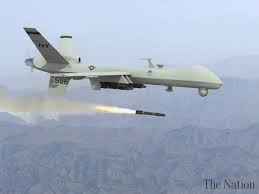
Airforce strikes in FATA (Credit: nation.com.pk)
ISLAMABAD, April 2: Though there was a decline in militant attacks in the wake of the operations in Karachi and Waziristan in March, 63 terror incidents were reported in different parts of the country which left 100 people dead and 162 injured.

This was stated in a monthly report released by the Pakistan Institute for Conflict and Security Studies here on Wednesday.

“In March, there was over 23 per cent decline in militant attacks, almost 12 per cent in deaths and more than 19 per cent in the number of injuries compared to February.”

The report added that militant attacks had been decreasing since the start of the operations in Fata, particularly post-National Action Plan (NAP) after the attack on the Army Public School in Peshawar on December 16, 2014.

According to the report, security forces conducted 97 actions across the country in which 230 people (mostly suspected militants) were killed, 43 others injured and 667 arrested.

Report says compared to February, there was over 23pc decline in militant attacks and 12pc in deaths

Though the number of actions remained almost the same as in February, casualties increased by almost 166 per cent, suggesting that it was due to the military operation Khyber-II in Khyber Agency, which was a sequel to the operation Khyber-I.
Militant activities in Balochistan also witnessed a decline compared to the first two months of the year. In 30 militant activities during the month, 36 people were killed, 19 others injured and five kidnapped.

However, militants continued targeting national installations, gas and electricity infrastructure.

In Fata, terror activities remained on the decrease during the first quarter of the year. In seven militant activities reported during March, 19 people were killed and 20 injured. With the start of the military operation Khyber-II, which is particularly targeting militants in Tirah Valley and close to the Afghan border, spaces for the militants are further squeezed.

The report added that militants tried to put a joint show in Khyber Agency through the recently-announced alliance between the outlawed TTP, Jamatul Ahrar and Lashker-i-Islam.

“However, the strong arm tactics of the state seemed to overpower the alliance to pose any serious threat in near future.”

Khyber Pakhtunkhwa witnessed 13 militant attacks in March in which 12 people were killed and 16 injured. Though militant activities were slightly higher than in February as well as January, the resultant deaths and injuries were less than the previous month.
In Sindh, militant activities were almost identical as were witnessed in the previous two months.

However, the number of deaths and injuries went slightly up compared to February.
In Karachi, the targeted operation by Rangers is showing positive results.
The report stated that militant activities in Punjab showed the previous trend but the number of casualties and injuries increased.

In three militant activities recorded during the month, 18 people were killed and 72 injured.

Two suicide attacks were recorded during March — one on two churches in Lahore which left 17 people dead and the other in Karachi in which two Rangers personnel were killed. Moreover, 20 bomb explosions, two grenade attacks, 18 assaults, three rocket attacks and 14 target killing incidents were also reported in March.

Defence analyst Imtiaz Gul told Dawn that though the graph of militant attacks had been falling for the last six months, after the APS incident the National Action Plan was put in place and the military operation expedited.

“A major reason for the decline in terror activities is that Operation Zarb-i-Azb was started in Fata, Rangers launched an operation in Karachi while the Balochistan government engaged nationalists in a dialogue,” he said.
Published in Dawn, April 2nd, 2015

MQM uses us like ’tissue papers’ – Death row inmate Saulat Mirza

Saulat Mirza (Credit: tribune.com.pk)
KARACHI/ISLAMABAD: Saulat Mirza, in a video statement aired on Geo News, hurled startling allegations on Muttahida Qaumi Movement (MQM) and its top leadership, just a few hours before his execution was scheduled to take place on Thursday at 5:30AM. Mirza’s execution has now been postponed for 72 hours.

Mirza said he was an MQM worker and received direct orders from MQM leader Babar Ghauri to assassinate KESC chief Shahid Hamid. “I was summoned at Babar Ghauri’s house where I took Altaf Hussain’s orders via telephone. Altaf Hussain would usually pass on instructions through Babar Ghauri,” alleged Saulat Mirza.

Speaking to ARY News, MQM Chief Altaf Hussain said, “Without any proof or evidence, Saulat Mirza’s statement will not have any effect on the party.” Hussain termed the allegations a conspiracy against MQM.

Babar Ghauri speaking to Geo News dismissed Mirza’s statement as a “fable” and denied having given any order for a murder.

“This is a made up story, we are not allowed to call workers to our house and deal with them there,” he said. When asked if Saulat Mirza has never come to his house, Ghauri said “no”.

“When he [Mirza] was in North Nazimabad, I met him then as an MPA,”.
“Then he was removed from the party and I maintained no communication or relationship with him.”

Mirza, however, said workers like him were used as “tissue papers” by MQM, and were disposed off when there was no use left for the party. “Other workers should take a lesson from my ending,” said Mirza. “Criminals in the party would get protection under Governor Sindh,” he claimed.

Meanwhile Sindh Governor’s spokesperson has stated that Dr. Ishratul Ibad has never supported any accused or criminal.

Saulat went on to say that workers in the MQM who gained popularity among the public are eventually sidelined.

“Mustafa Kamal was humiliated and then sidelined from the party because he had grown popular and Azeem Tariq was murdered for the same reason,” Mirza said.
“I have no vested interest in making these allegations at this hour. I just want to leave a message for those who wish to join, or are part of political organisations, to learn from my mistakes,” said the death-row inmate.
Meanwhile, Machh Jail Deputy Superintendent Sikandar Kakar while talking to DawnNews confirmed that they have received orders to postpone the hanging of Saulat Mirza for three days.

Mirza was found guilty of murdering the then managing director (MD) of Karachi Electric Supply Corporation (KESC), now K-electric, Malik Shahid Hamid, his driver Ashraf Brohi, and his guard Khan Akbar outside Hamid’s residence in DHA on July 5, 1997.

Previously a resident of Block J in North Nazimabad, Karachi, Saulat was his parents’ fourth child.

Having received his intermediate education from Pakistan Shipowners’ College in Karachi, he became active in student politics and joined the All Pakistan Mohajir Students Organisation (APMSO), the students’ wing of MQM, then an acronym for Mohajir Qaumi Movement.

His name first appeared on intelligence and security agencies’ radar in 1994, after the killing of two US diplomats at Karachi’s Shahrah-i-Faisal and murder of four workers of an American oil company, Union Texas, near PIDC bridge.

He was believed to have been arrested from Karachi airport after his arrival from Bangkok; police confirmed his arrest at a press conference on December 11, 1998.
During that press conference, in the presence of the then Karachi DIG, Ameen Qureshi, Saulat Mirza made revelations about his involvement in the murder of scores of innocent people, including several high-profile personalities.

Mirza was initially detained by FIA immigration officials for traveling on a fake identity but was handed over to the then Station House Officer (SHO) of Gulbahar police station, Mohammad Aslam Khan (Chaudhry Aslam), who was also present at the airport on intelligence reports.

Noose tightens around MQM

Rangers raid 90 (Credit: thenews.com.pk)

Shrugging off allegations of being politically motivated, the law enforcers showed Wednesday morning that even the big guns could be silenced. A heavy contingent of Rangers raided Nine Zero, the headquarters of the Muttahida Qaumi Movement (MQM) in Karachi’s Azizabad area, detained around 20 criminals and seized a large cache of illegal weapons and ammo.

In the operation, which was managed and executed by members of the paramilitary force alone, a number of party workers, including MQM’s Rabita Committee member Amir Khan, and notorious convicts were detained during the raid which also incidentally claimed the life of a young MQM supporter.

After breaking barricades leading to MQM headquarters, Rangers personnel cordoned off the area and searched through departments of the party’s offices. During the raid, the Rangers cut off the telephone lines at Nine Zero, disabling communication with MQM’s international secretariat.

Scores of activists and party members protested the raid by Rangers by chanting slogans. Aerial firing also ensued outside Nine Zero as activists attempted to break the Rangers’ cordon. As the situation turned chaotic, Waqas Ali Shah of MQM’s Central Information Committee was killed during the raid while Express News cameraman Waseem Mughal was injured in the firing.

Shah’s death invoked the need of an enquiry into the incident as it remained unclear if he died due to Rangers’ aerial firing or someone at the spot killed him.

MQM spokesperson Wasay Jalil claimed that Shah was killed in straight fire by Rangers personnel around 7:45am Wednesday.

“Dozens of mobiles of Rangers appeared at Nine Zero around 6am. Personnel proceeded to raid 50 offices in our headquarters. They went to each office, went through all the files and broke telephones.”

Sindh Police Additional IG Ghulam Qadir Thebo said that Shah was not shot by Rangers personnel, but that the bullet fired was from a handgun.

Rangers Director General (DG) Major General Bilal Akbar said that MQM activist Shah was shot with a TT pistol and the fact would become clear once the medical board’s report is received.

SINDH CITIES COME TO A STANDSTILL:

MQM announced a day of peaceful protest against the search operation by Rangers and urged for transport services to be suspended throughout the day.

MQM leader Farooq Sattar termed the raid “deeply upsetting and worth investigating”. He said that MQM is compliant of all laws and instead of appreciating the party’s efforts of promoting peace, it is being treated with contempt.

He demanded of Prime Minister Nawaz Sharif, Interior Minister Chaudhary Nisar and Sindh Governor Ishratul Ebad to play their due roles. Sattar also warned that the situation could be a setback to the enhancement of democratic process.

Commercial activity was suspended with shops, markets and educational institutions remained closed not just in Karachi but in other cities of the province, such as Hyderabad, Sukkur, Nawabshah, Jamshoro and Mirpur Khas.

Petrol pumps and private schools in several areas of Karachi were also reportedly shut down as activists in large numbers protested against the Rangers. Children who managed to get to schools were sent back to their homes and examinations were cancelled in colleges and universities.

While the MQM has maintained that the protest against the Rangers raid will be peaceful, a bus was set alight at Gulistan-i-Jauhar while a rickshaw was torched in Karimabad.

MQM leaders and activists gathered outside the headquarters but were not allowed to enter its premises.

RANGERS MAKE IT CLEAR:

A press release issued by Rangers soon after the raid on MQM’s headquarters said: “Pakistan Rangers Sindh has conducted a series of targeted raids at surrounding areas of 90 including Khursheed Memorial Hall today. During the above mentioned action, following hardcore criminals have been arrested: Faisal Mota, Farhan Shabbir aka Mullah Amir, Nadir and Ubaid K 2.”

Faisal Mota was awarded the death sentence in absentia on March 1, 2014 by an anti-terrorism court in the murder case of Wali Khan Babar, a Geo TV reporter while Nadir had also been convicted and sentenced 13 years imprisonment.

Rangers spokesperson Colonel Tahir called the two-hour raid a “purely information-based operation” and divulged that the Khursheed Memorial Hall at Nine Zero has been sealed and will be handed over to police for further investigation.

Col Tahir added that ammunition stolen from NATO containers was also seized during the search operation.

Speaking to media, MQM leader Faisal Subzwari and Haider Abbas Rizvi admitted that weapons were seized during the raid, but said that they were all licensed and were being kept for security in view of the threats being received from “the Taliban and other extremist elements”.

“After the Army Public School attack, even schools and colleges are now being asked to keep weapons for security. We were also told to keep weapons for our security,” Subzwari said.

MQM CHIEF DILLYDALLIES:

Contrary to his party leaders’ statement, MQM chief Altaf Hussain claimed that the weapons presented were “brought by the Rangers themselves in blankets”.

Claiming that the Establishment does not tolerate MQM’s presence, he maintained that the ammunition seized from Nine Zero by Rangers does not belong to MQM. He further said that if the weapons belonged to MQM, they would not have been stored in Nine Zero.

In a telephonic address, Hussain denounced the raid by Rangers on Nine Zero and said that this was the first time that the house and office of a political party chief was raided.

Addressing Rangers personnel, he remarked that Rangers have authority but “they are unable to deliver justice”. Claiming that more than 60 people were arrested during the raid by Rangers, he demanded that “terrorism in the name of search operations” be stopped.

However, later retracting from his stand point, MQM chief told a news channel that he was supportive of cracking down on criminals irrespective of where they were. In the same breath, he maintained that his party headquarters was not harbouring terrorists but “they were just living in the vicinity”.

Earlier, the MQM chief had stated in a telephonic address that “people who had committed mistakes should not have stayed at the MQM headquarters as they had jeopardised the security of others”. “Such people should have sought refuge elsewhere as I have been staying in Britain for the last 20 years,” said the MQM chief.

After condemning the raid, Altaf Hussain apparently appreciated the “valour” of Rangers personnel for “having dared to raid his house”. In an apparent naked threat, Hussain said that the Rangers’ officers who participated in the raid at his elder sister’s house “would soon become a part of the past”.

The MQM has in the recent past accused the Rangers of involvement in illegal detention and extrajudicial killings of its members and the raid and arrests appear to be the climax of the complex dynamics between the two sides.

The Rangers last month in a report implicated the MQM in the Baldia Town factory inferno fire that claimed the lives of at least 258 factory workers, a charge the party vehemently denies. The JIT report also contains several other disclosures about the involvement of MQM workers in several criminal cases as well rigging in the 2013 general elections.

Suicide Attacks on Churches in Pakistan Kill at Least 15

Taliban attack Punjab churches (Credit: dawn.com)

LAHORE, March 15 — Suicide bombers attacked two Christian churches during Sunday services in the Pakistani city of Lahore, killing at least 15 people and wounding dozens in the latest attack on religious minorities in the country.

The attacks occurred in quick succession outside Catholic and Protestant churches in Youhanabad, one of Pakistan’s biggest Christian neighborhoods.

A man rigged with explosives blew himself up outside the main gate of St. John’s Catholic Church after being prevented from entering by a security guard, said Haider Ashraf, a senior police officer.

A second blast went off minutes later in the compound of Christ Church, about half a mile away.

In the aftermath of the attacks, an enraged crowd lynched two people suspected of being accomplices in the bombings, one of whom was wrenched from police custody. Local news outlets reported that the mob set their dead bodies on fire.

The crowd also prevented the police from entering the scene of the attacks, and angry protests spread across the city. Demonstrations were also reported in Karachi and other cities.

Jamaat-ul-Ahrar, a splinter faction of the Pakistani Taliban, claimed responsibility for the attack.

Local television stations broadcast images of wailing and distraught relatives in hospital corridors. One woman wept hysterically as relatives tried to calm her.

Pervez Masih, 45, who was in one of the churches, said the explosion went off just as the prayer service was concluding. “Afterward people were running here and there, trying to save their lives,” he said.

Religious minorities including Shiites, Christians and Ahmadi Muslims have been under violent attack for years in Pakistan. At least 85 people were killed in an attack on All Saints Church in Peshawar in September 2013.

There have also been sporadic attacks on Christians in Punjab, the country’s most populous province, often triggered by accusations of blasphemy against the Prophet Muhammad.

But Pakistan has been particularly on edge in recent months since a Taliban assault on a Peshawar school that killed at least 150 people, most of them children.

Nabila Ghazanfar, a spokeswoman for the Punjab police, said the deaths from the attack on Sunday included 13 worshipers, two police officers deployed for security outside the churches and the two suspects beaten to death by the mob, in addition to the two bombers.

Television images showed police officials struggling to keep the angry crowd away from one of the men who was later lynched.

Dr. Muhammad Saeed, the chief doctor at Lahore General Hospital, where scores of the wounded were brought, said that many were in critical condition.

Sohail Johnson, a witness who lives close to the churches, said the Sunday services were usually attended by more than 1,000 worshipers.

Salman Masood contributed reporting from Islamabad, Pakistan.


OBL-Sharif connection revealed in Abbotabad Files

Files recovered from Osama bin Laden’s compound in Abbotabad reveal that the prime minister’s brother, Punjab chief minister Shahbaz Sharif, sought to strike a peace deal with the Tehreek-e-Taliban Pakistan (TTP) through al Qaeda, The Long War Journal reported.

The files were revealed in terror convict Abid Naseer’s trial by a Brooklyn jury earlier this month. One of the files is a letter written by Atiyah Abd al Rahman (Mahmud), who was then the general manager of al Qaeda, to Osama bin Laden (identified as Sheikh Abu Abdallah) in July 2010.

The letter reveals a complicated nexus involving Al Qaeda, the Pakistani Taliban, Punjab Chief Minister Shahbaz Sharif, and the ISI.

According to one letter from Rahman, one of bin Laden’s top deputies, dated July 2010, Bin Laden was informed that Shahbaz Sharif wanted to cut a deal with the TTP, whose leadership was close to Bin Laden. The government “was ready to reestablish normal relations as long as [the Pakistani Taliban] do not conduct operations in Punjab.”

Attacks elsewhere in Pakistan were apparently acceptable under the terms of the alleged proposal.

Rahman’s letter stated that Punjab Chief Minister Shahbaz Sharif initiated negotiations with the militant group. In the letter, Rahman informed TTP commanders Hakeemullah Mehsud and Qari Husayn that Shahbaz Sharif “sent them a message indicating they [the government] wanted to negotiate with them, and they were ready to reestablish normal relations as long as they do no conduct operations in Punjab.”

Rahman clarified that the deal was limited to the “governmental jurisdiction” of Punjab and did not include Islamabad.

“The government said they were ready to pay any price…and so on,” the letter states. “They told us the negotiations were under way.”

Read: Osama wanted to rebrand Al Qaeda: Whitehouse

Rahman then made it clear that the TTP was to keep Al Qaeda leadership in the loop at all times. “We stressed that they needed to consult us on everything, and they promised they would.”

According to the report, Shahbaz Sharif’s willingness to negotiate is consistent with his public opinion at the time. The chief minister was a vociferous critic of General Pervez Musharraf’s policies and “blamed the escalation of violence in Pakistan on Pervez Musharraf.”

ISI’s role

The report states that al Qaeda’s negotiating tactic was simple. They wanted Pakistanis to either leave them alone, or they would suffer more terrorist attacks. Rahman’s letter reveals how bin Laden’s men sought to convey their message. They relied on Haqqani Network leader, Siraj Haqqani, which has been supported by the military and intelligence establishment.

One of Pakistani intelligence’s emissaries was Fazlur Rehman Khalil, leader of Harakat ul Mujahedin (HUM). Khalil was an ally of Osama bin Laden ally. The intelligence agency used Khalil’s HUM to send al Qaeda a letter.

“We received a messenger from them bringing us a letter from the Intelligence leaders including Shuja Shah, and others,” Rahman wrote, according the US government’s translation. “They said they wanted to talk to us, to al Qaeda. We gave them the same message, nothing more.”

Read: Pakistan probably knew Bin Laden’s whereabouts, says former ISI chief

Beyond his role as a leader in Pakistani intelligence, “Shuja’ Shah” is not further identified in the letter. Ahmad Shuja Pasha was the head of Pakistan’s Inter-Services Intelligence (ISI) agency at the time. Some have alleged that Pasha knew bin Laden was located in Abbottabad.

Pasha has repeatedly denied this. Rahman’s letter does not indicate that “Shuja Shah” or Pakistani intelligence knew of the Al Qaeda chief’s whereabouts, but it shows that they knew how to get in touch with his top lieutenants.

ISI got in touch with al Qaeda again a “little later,” sending the “same man” who had acted as a messenger the first time.

Rahman noted: “This time the surprise was that they brought Hamid Gul into the session, and Fazlur Rehman Khalil attended with them as an adviser!” Hamid Gul headed the ISI in the late 1980s.

“Be patient with us for a little bit,” Rahman quoted them as saying, indicating that the Pakistan had requested a cooling off period of up to two months.

If “we can convince the Americans,” the Pakistanis said, then we “have no objection to negotiating with you and sitting with you,” the letter states further.

‘Al Qaeda was cautious, but willing to make a deal’

In July 2010, Rahman wrote another letter to bin Laden, revealing that group was cautious but willing to strike a deal with the negotiators.

“Are the Pakistanis serious, or are they playing around and dissembling?” Rahman wrote. He believed that “Caution is mandatory, as is preparedness, awareness, and staying focused on the mission and resolve.”

Afghan refugee on 1984 National Geographic cover embroiled in ID row

 Sharbat Bibi (Credit: tribune.com.pk)
Sharbat Bibi (Credit: tribune.com.pk)

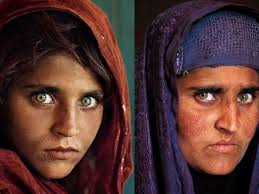
Islamabad, Feb 25 – The image of Sharbat Gula that featured on the cover of National Geographic magazine in 1984. In 1984 a photo of a green-eyed girl staring out of the front cover of National Geographic became an icon of the plight of Afghan refugees forced by war into Pakistani refugee camps.

Three decades on and a new picture of Sharbat Gula, this time a cheap mugshot of a middle-aged woman, has come to symbolise the hostility many Pakistanis feel towards people they believe have outstayed their welcome.

On Tuesday the national media published the photograph from Gula’s computerised national identity card (CNIC), a vital document that she should not have been able to acquire as a foreign national.

That one of the most famous of the nearly 3 million Afghan refugees living in Pakistan should have been able to get the card underlined for many the corruption that riddles much of government.

© National Database and Registration Authority Sharbat Gula’s photograph on her Pakistani national ID card. As an Afghan refugee she is officially not entitled to hold such a document. Afghans can only buy property, open a bank account and be confident they will be able to remain indefinitely in a country that wants rid of its refugee population by having a CNIC, usually acquired with fake documents and bribes.

Faik Ali Chachar, a spokesman for the national database and registration authority (NADRA), said Gula’s card had been detected and blocked in August and that four officials had been suspended for their suspected involvement.

He said the agency has so far found more than 22,000 cards illegally held by Afghans.

That two men said to be her sons were also able to get CNICs further highlighted the deep roots Afghans have put down in Pakistan, where many have established businesses and families.

Afghans first began moving to Pakistan following the Soviet invasion of their country in 1979, and generations have grown up without ever having visited their ancestral homeland.

The refugee population continued to grow after the withdrawal of Russian troops in 1989 as Afghanistan descended into civil war.

Millions of Afghans have returned to their homeland since the international community uprooted the Taliban regime in 2001, but more than 2.5 million are thought to remain – the second largest refugee population in the world.

They have long been unpopular, with many Pakistanis blaming them for crime and terrorism.

“We need them to leave Pakistan because we are badly suffering,” said Hamid-ul-Haq, an MP who represents Peshawar, the north-western city where many Afghans are settled. “All our streets, mosques, schools are overloaded because of them. It is time for them to leave Pakistan honourably.”

There have been several half-hearted attempts to force more of them to quit the country, including a threat to cancel their refugee status, but official deadlines have repeatedly been ignored or allowed to slip.

The government has also attempted to clear slums in Islamabad that are populated by Afghans.

Action against Afghan refugees has intensified following last December’s attack by the Pakistani Taliban on the army public school in Peshawar, in which more than 130 schoolboys were killed.

In the month after the attack more than 33,000 undocumented Afghans flocked across the border according to the International Organisation for Migration – double the figure for the whole of 2014.

Those arriving in Afghanistan have claimed to have been beaten by police, arrested and evicted from their houses.

Human Rights Watch (HRW) this week called on Pakistan to stop trying to coerce refugees to return.

“Pakistan’s government is tarnishing the country’s well-deserved reputation for hospitality toward refugees by tolerating the punitive and potentially unlawful coercive repatriation of Afghan refugees,” said HRW’s deputy Asia director, Phelim Kine.

Gulzar Khan, a politician and former commissioner for Afghan refugees, said Pakistan could not expect such a large number of people to leave overnight.

“The current Afghan government is in a very vulnerable situation both economically and politically. If roughly two millions refugees are pushed back the Afghan government will have a major crisis on its hands,” he said.