Suicide Attackers Kill 19 in Assault on a Shiite Mosque in Pakistan

Peshawar Shia mosque blast (Credit: ibtimes.com)

PESHAWAR, Pakistan — Heavily armed militants killed at least 19 people and wounded more than 40 after they stormed into a Shiite mosque during Friday Prayer in a suburb of Peshawar, the main city in northwestern Pakistan, doctors and officials said.

The assault was the most fearsome show of violence in the Peshawar area since a Taliban attack on a school in December that killed about 150 people, and it offered a chilling reminder of the continuing threat from militants in Pakistan despite a concerted crackdown by the security forces.

The police said that at least four gunmen wearing vests rigged with explosives and lobbing grenades entered the crowded Imamia Mosque in Hayatabad, an upscale suburb that is adjacent to the Khyber tribal district, a notorious militant sanctuary.

Security guards at the mosque shot and killed one attacker, but three others made it into the main hall. They fired guns and flung grenades into a crowd of worshipers before detonating their vests, the provincial police chief, Nasir Khan Durrani, told reporters at the scene.

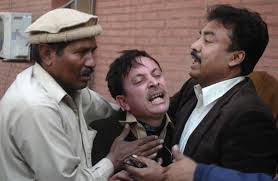
Policemen surveyed the scene after Taliban suicide bombers attacked a Shiite mosque in Peshawar, Pakistan, while victims were rushed to the hospital.

The number of casualties would have been higher if several grenades had not failed to explode, Mr. Durrani said.

A United Nations employee was among the dead. In a statement, the United Nations coordinator in Pakistan, Timo Pakkala, condemned the attack, saying, “Any violent act targeting minorities is totally unacceptable.” He also called on the government to foster tolerance in the country as it fights Islamist militancy.

Some witnesses said the attackers were wearing black police uniforms. Outside the mosque stood the charred remains of a vehicle they had used to reach the area and had set on fire moments before the assault.

The Pakistani Taliban claimed responsibility for the attack through a spokesman who said it was in revenge for the execution of a convicted militant known as Dr. Usman, who was hanged on Dec. 19. “This is a continuation of blood for blood,” he said in a statement emailed to journalists. “The government should expect further, and stronger, reaction.”

In a video sent from the same email address, a Taliban commander identified as Omar Mansoor, who also claimed responsibility for the Peshawar school attack in December, issued further warnings to the government. “Either Pakistan will become your graveyard, or God’s law, Shariah, will be implemented,” he said.

Government officials have blamed a Taliban-affiliated group for a suicide bomb attack on Jan. 30 at a Shiite mosque in Shikarpur, in the southern province of Sindh, that killed 61 people.

That attack was Pakistan’s deadliest sectarian assault since February 2013, when a bombing at a market in Quetta, the capital of the western province of Baluchistan, killed 89 people.

But government officials at the scene of Friday’s attack described it as a likely response to continuing Pakistani military operations in the nearby tribal belt, which have been stepped up since the assault at the Peshawar school in December.

Pakistan’s Parliament has also empowered the army to start trying Taliban suspects in military courts.

The government lifted a moratorium on executions in the wake of the Peshawar attack and on Friday hanged two convicted prisoners, bringing the number of executions since mid-December to 24.

Unlike those executed earlier, the two men hanged on Friday had not been convicted under Pakistan’s terrorism laws, a fact that Amnesty International criticized as a dangerous escalation by the country’s authorities.

“The death penalty is always a human rights violation, but the serious fair trial concerns in Pakistan make its use even more troubling,” the group said in a statement.

On Thursday, Pakistan’s military spokesman told reporters that the security forces had arrested 12 militants linked to the school attack but that six others, including the Taliban leader Maulana Fazlullah, remained at large.

Pakistani officials have said they believe Mr. Fazlullah is hiding in the mountains of eastern Afghanistan, but they have credited Afghan officials with helping pursue him, in a sign of thawing relations between the two countries.

Declan Walsh contributed reporting from London.
For Saudis and Pakistan, a Bird of Contention

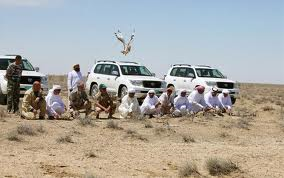
Gulf hunters in Balochistan (Credit: siasat.com)

For decades, royal Arab hunting expeditions have traveled to the far reaches of Pakistan in pursuit of the houbara bustard — a waddling, migratory bird whose meat, they believe, contains aphrodisiac powers.

Little expense is spared for the elaborate winter hunts. Cargo planes fly tents and luxury jeeps into custom-built desert airstrips, followed by private jets carrying the kings and princes of Persian Gulf countries along with their precious charges: expensive hunting falcons that are used to kill the white-plumed houbara.

This year’s hunt, however, has run into difficulty.

It started in November, when the High Court in Baluchistan, the vast and tumultuous Pakistani province that is a favored hunting ground, canceled all foreign hunting permits in response to complaints from conservationists.

Those experts say the houbara’s habitat, and perhaps the long-term survival of the species, which is already considered threatened, has been endangered by the ferocious pace of hunting.

That legal order ballooned into a minor political crisis last week when a senior Saudi prince and his entourage landed in Baluchistan, attracting unusually critical media attention and a legal battle that is scheduled to reach the country’s Supreme Court in the coming days.

Anger among conservationists was heightened by the fact that the prince — Fahd bin Sultan bin Abdul Aziz, the governor of Tabuk province — along with his entourage had killed 2,100 houbara over 21 days during last year’s hunt, according to an official report leaked to the Pakistani news media, or about 20 times more than his allocated quota.

Still, Prince Fahd faced little censure when he touched down in Dalbandin, a dusty town near the Afghan border on Wednesday, to be welcomed by a delegation led by a cabinet minister and including senior provincial officials.

His reception was a testament, critics say, to the money-driven magnetism of Saudi influence in Pakistan, and the walk-on role of the humble bustard in cementing that relationship.

“This is a clear admission of servility to the rich Arabs,” said Pervez Hoodbhoy, a physics professor and longtime critic of what he calls “Saudization” in Pakistan. “They come here, hunt with impunity, and are given police protection in spite of the fact that they are violating local laws.”

The dispute has focused attention on a practice that started in the 1970s, when intensive hunting in the Persian Gulf nearly rendered the houbara extinct there, and with it a cherished tradition considered the sport of kings.

As the houbara migrated from its breeding grounds in Siberia, newly enriched Persian Gulf royalty flocked to the deserts and fields of Pakistan, where they were welcomed with open arms by the country’s leaders.

For the Pakistanis, the hunt has become an opportunity to earn money and engage in a form of soft diplomacy.

Although only 29 foreigners have been permitted houbara licenses this year, according to press reports, they include some of the wealthiest and most powerful men in the Middle East, including the kings of Bahrain and Saudi Arabia, the Emir of Kuwait and the ruler of Dubai.

Their devotion to the houbara can seem mysterious to outsiders. The bird’s meat is bitter and stringy, and its supposed aphrodisiac properties are not supported by scientific evidence.

But falcon hunting, and the pursuit of the houbara, occupy a romantic place in the Bedouin Arab culture.

In Pakistan, the lavish nature of the winter hunts, which take place largely away from public scrutiny, have become the stuff of legend. In the early ’90s, it was reported, the Saudi king arrived in Pakistan with a retinue of dancing camels.

To curry favor with local communities, the Arab hunters have built roads, schools, madrassas and mosques, as well as several international-standard airstrips in unlikely places.

The only airport, at Rahim Yar Khan in the south of Punjab Province, is named after Sheikh Zayed bin Sultan al-Nahayan, the former ruler of Abu Dhabi.

In recent times the hunts have also played a role, albeit unwitting, in the United States’s war against Al Qaeda.

Osama bin Laden took refuge at a houbara hunting camp in western Afghanistan in the late 1990s, by several accounts, at a time when the C.I.A. was plotting to assassinate him with a missile strike.


A falcon, right, tried to catch a houbara bustard during a falconry competition in Hameem, the United Arab Emirates, last December. Baluchistan is a popular place to hunt the bustard. Credit Karim Sahib/Agence France-Presse — Getty Images

The journalist Steve Coll wrote in his Pulitzer Prize-winning book, “Ghost Wars,” that American officials declined to take the shot, fearing that the Arab sheikh who was hosting Bin Laden would have been at risk of dying in the attack.

For several years starting in 2004, the C.I.A. used an Arab-built airstrip at Shamsi, a barren desert valley in central Baluchistan, to launch drone strikes against Islamist militants in Pakistan’s tribal belt.

When news of the American base stirred a scandal in Pakistan’s Parliament in 2011, the country’s air force chief sought to deflect blame onto the United Arab Emirates government.

The deserts around Dalbandin, where Prince Fahd landed on Wednesday, were the site of Pakistan’s first nuclear test explosion in 1998, and are an established way station for heroin smugglers and Taliban insurgents.

But the growing influence of Gulf Arab countries is not universally appreciated. Progressive Pakistanis bemoan their conservative influence on society, and the infusion of petrodollars for jihadi groups.

The hunts have also come under attack. In Baluchistan, where the houbara is the provincial symbol, some royal hunts had to be curtailed after Baluch separatist rebels opened fire on hunting parties.

Now the battle has shifted to the capital, Islamabad. The prime minister, Nawaz Sharif, enjoys close relations with the rulers of Saudi Arabia, where he spent much of his exile between 2000 and 2007 — one reason, critics believe, for the indulgence shown toward Prince Fahd.

Mr. Sharif sent his federal planning minister, Ahsan Iqbal, to greet Prince Fahad in Dalbandin, as well as Baluchistan’s minister for sports and culture.

“Not a single political leader reacted against illegal hunting by Arab princes,” Asma Jahangir, a prominent human rights campaigner, posted on Twitter.

Although Mr. Sharif never confirmed it, Saudi Arabia is widely believed to have injected $1.5 billion into Mr. Sharif’s government last year to help prop up the ailing economy. Last year in Islamabad, Mr. Sharif laid out a lavish welcome for the other Saudi hunting permit holder: Salman bin Abdul-Aziz Al Saud, who last month was inaugurated as king.

The International Union for the Conservation of Nature has termed the houbara a vulnerable species, and India has banned the hunt. The Baluchistan court order in November cited Pakistan’s obligation to international conservation treaties.

Hunt supporters say the houbara population has never been scientifically surveyed, and complain that the royal visits are being unnecessarily politicized.

“The foreigners are a blessing, not a problem,” said Ernest Shams of Houbara Foundation International Pakistan, a charity that works with the United Arab Emirates government to boost houbara stocks. “They bring so much money into the country.”

In a bid to overcome the court ban, the Baluchistan government has lodged an appeal in Pakistan’s Supreme Court that is likely to be heard on Wednesday, officials in Islamabad said Friday.

Prince Fahd is currently at his hunting camp in Bar Tagzi, surrounded by his falcons and a contingent of security — and most definitely not hunting any houbara, according to Pakistani officials.

“They are visiting development sites,” said Obaidullah Jan Babat, an adviser to the Baluchistan chief minister. “They are not hunting.”

Salman Masood contributed reporting from Islamabad, Pakistan.

Middle East Providing Funds to Religious Seminaries – Inspector Generals

ISLAMABAD: During Friday’s session of the Senate, Minister of State for Interior Baligur Rehman informed the House that Middle Eastern countries namely Saudi Arabia, Kuwait, Qatar, Iran and the United Arab Emirates were giving aid to religious seminaries in three provinces.

The information was compiled on the basis of a report sent by provincial Inspector Generals (IGs). However, Rehman said he would not support or defend the statements made by the IGP on the matter.

According to the report presented before the Senate, 23 religious seminaries in the country are receiving foreign assistance. Out of the 23 seminaries, five belong to the Shia sect and are located in Balochistan.

Other seminaries are based in KP, Sindh and Balochistan and are part of the Sunni sect. No information was given with regards to the province of Punjab. However reports have said that the seminaries in Punjab are not receiving any assistance.

Following a demand made by Senator Sughra Imam, Acting Chairman of the Senate Sabir Ali Baloch referred the question to Senate Privileges Committee with directives that IG of Punjab police may be summoned before the committee to explain his position on foreign assistance being received by religious seminaries in Punjab.

The federal minister told the Upper House of Parliament that according to the anti-money laundering law, financial transaction of religious seminaries and Non Governmental Organisations (NGOs) would be monitored.

The minister further told the House that some NGOs are receiving assistance from the United States, Netherlands and Australia.

Earlier, the opposition also walked out from the proceedings of the House over the absence of Interior Minister Chaudhry Nisar and Minister of State for Interior.

Later, on directives issued by the chair, Rehman showed up at the house and responded to the questions relating to the Interior Ministry.

The Senate has been adjourned to meet again on Monday at 4 pm.

JUI-F chief warns govt‏ against stopping foreign funding
Meanwhile, Jamiat Ulema-i-Islam Fazal (JUI-F) chief Maulana Fazlur Rehman has warned the government against stopping foreign assistance from being received by Pakistan’s religious seminaries.

“The government cannot stop this and if the buildings of seminaries are occupied, we would continue to teach under the shadow of trees,” he told the media after chairing a parliamentary committee meeting on Kashmir.

He said the government was taking this action to please the United States which he alleged was creating disturbance within the country.

Federal minister accuses Saudi govt of destabilising Muslim world

Federal Minister Riaz Hussain Pirzada (Credit: dawn.com)
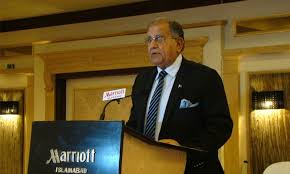
ISLAMABAD, Jan 25: Federal Minister for Inter-provincial Coordination (IPC) Riaz Hussain Pirzada has accused the Saudi government of creating instability across the Muslim world, including Pakistan, through distribution of money for promoting its ideology.

Addressing a two-day ‘Ideas Conclave’ organised by the “Jinnah Institute” think tank in Islamabad, the federal minister said ‘the time has come to stop the influx of Saudi money into Pakistan’.

He also blasted his own government for approving military courts in the presence of an ‘independent and vibrant judiciary’ and said that military courts reflect ‘weak and coward leadership’.

“Such cowardly leadership has no right to stay in power,” Pirzada added.

In her opening remarks, Chairperson of Jinnah Institute Sherry Rehman said that the two-day conference would deliberate upon new ideas needed for a progressive and better Pakistan.

Pakistan Tehreek-i-Insaf (PTI) leader Shafqat Mehmood said the government has failed to address the problems being faced by the common man.

Awami National Party (ANP) leader Afrasiab Khan Khattak expressed regret over military courts and said their establishment ‘has eroded democracy’. He called upon democratic elements to play their role in reversing the 21st constitutional amendment.

Muttahida Qaumi Movement (MQM) leader Farooq Sattar supported military courts and said there was no other option to deal with terrorists.

The Federal Minister for Commerce Khurram Dastgir while addressing the conference, said that for an elected government to deliver, they need at least a modicum of security that their leadership will exist tomorrow.

He said that lawmakers have little incentive to read legislation. They are judged by their constituents on how much patronage they can deliver.

“We are answerable to the people. No general would stand up here and take your criticism,” said Dastgir.

He further added that there is no excuse for not holding local body elections.

A plan without action

The Peshawar incident could become a turning point of in history only if the state institutions demonstrate their commitment to change of narrative. Anything less than that would mean moving in circles and waiting for next tragedy.

The government has launched a national plan of action with tall promises and fresh commitment to confront the menace of terrorism. More than a month past, the plan has yielded a number of meetings, press conferences and mounting figures of rounded up suspects. Meanwhile hangings of previously convicted criminals have become more conspicuous, encounters are on rise and it is being repeatedly asserted that the government will not discriminate between good and bad Taliban. This would be a major shift from the past if happens at all.

Newspaper reports, however, suggest that the purpose-built good Taliban still enjoy safe havens and not much has changed on ground. Some of the recently reported incidents indicate that a complete dissociation with good Taliban is not imminent even if there is a serious will to do so.
Sources in the Interior Ministry revealed that the ministry is contemplating a ban on Haqqani group and Jamaat-ud-Dawa. It is customary in Pakistan that the banned outfits continue their operations unhindered by just adjusting to a new innocuous title.

With a simple change of brand name, leaders of such outfits stand absolved of all the previous baggage. As long as they fall under the category of good warriors of security establishment, they can operate with a new license. Some two dozen such outfits enjoy complete impunity in Pakistan. Most of them have their sanctuaries in Punjab where state apparatus lacks both courage and will to lay hands on them.

The same attitude explains inaction against the Lal Mosque cleric Mullah Aziz, who openly challenged the jealously guarded writ of the state. A court has issued his non-bail-able warrants that he brazenly defied by saying he will neither seek bail nor will he surrender before the law.
The state apparatus that recklessly dumps mutilated bodies in Balochistan and Sindh to secure writ of the law, becomes spineless when it comes to religious fanatics. Few days back an incident was reported in newspapers that narrate the degree of patronisation enjoyed by sectarian elements.
The PML-N represents a wider sentiment among Punjabi middle class that enjoys a negotiated peace on its land at the expense of bloodshed in other parts of the country.

On the evening of December 31, a leader of Ahle Sunnat Wal Jamaat (AWSJ), was arrested by a joint patrolling team of police and Rangers. The cleric who is a proclaimed offender was heavily guarded. His guard also included a properly armed policeman. According to the newspaper reports, the cleric received a VIP treatment at the SHO’s office. He was ceremoniously released even before the magistrate of the area came to grant him bail.

As the news story appeared in leading newspapers, the Interior Ministry found a scapegoat and a competent police officer, SSP Asmatullah Junejo was suspended. Internal inquiry conducted by senior police officers revealed that the release orders of the cleric came from IGP office yet an honest police officer had to bear the brunt of departmental action, enough to demoralise a handful of honest and committed officers in the police department. The police inquiry is silent on who deployed a police guard to protect a proclaimed offender and who actually ordered his release. This single incident reported in Islamabad is enough testimony that the narrative of good Taliban is immune to the current wave of action.
In September 2014, Maulana Asmatullah Muawiya, head of TTP Punjab announced that his faction would no more carry out attacks in Pakistan. Muawiya however unequivocally mentioned that his group will continue his activities in Afghanistan. He subsequently surrendered before military officials in Miramshah. The episode was trumpeted as a great success of the military operation without narrating details of the heinous incidents of terrorism that he perpetrated. A long list of barbaric acts is attached to his credit. No action has been heard against him and his aides so far. The newspaper reports confirm that he has been allowed to return to his hometown in Punjab. No one knows about the deal that erased all the blood stains from his hands.

According to findings of the interior minister, Islamabad is infested with religious seminaries, mostly illegal. The small town with a population of about two million, houses some 401 seminaries compared to only 422 government schools and colleges. It includes illegally functioning 160 madarassas and 72 Quranic institutions that are not registered with any government authority. Number of seminaries’ students in the capital territory is 31,769 that include 14,377 non local students. Most of these seminaries are located in Sihala, Bhara Kahu, Shahzad Town and Margalla Town, located barely few miles away from the Interior Ministry offices.
Intelligence agencies have been reporting about their involvement in dubious activities.

Other cities and towns of Pakistan have much higher number of seminaries and students. Many of them operate illegally and possess tentacles to mobilise financial resources without much effort.
While the Interior ministry finds it hard to track their financing, channels funneling money into these seminaries are not too veiled. Both charitable and illegal sources of their income are well known to those who matter. However, most of these resources are not availed through formal methods and hence cannot be regulated through banking channels and tax authorities.

Religious parties that openly coddle madrassas are not too naïve about the streams of resources flowing into these seminaries and the education being imparted in these institutions. Madarassa reform is an anachronistic prescription that has never worked in the past. Just tweaking their curriculum and introducing modern subjects would not suffice anymore. Their number has swollen beyond the regulatory capacity of government bodies. Proselytization of unimaginable proportions is being practiced in these seminaries and the narrative has been intelligently aligned with the ideology of state.
According to one study conducted by noted scholar Dr Tariq Rehman, when seminary students were asked priorities for Pakistan, 99.2 per cent answered conquering Kashmir whereas 97.7 per cent students wanted enforcement of Sharia law. This is only tip of the iceberg. Extremist jihadi literature is widely taught in many seminaries and young minds are openly indoctrinated. Much before conceiving any action, the government is apologetic on madarassas issue.

The interior minister dutifully keeps issuing clean bill of health to more than 90 per cent seminaries without revealing details about the remaining ones. Media reports indicate that the government is completely confounded and bereft of clarity on how to tackle madarassas issue.
The PML-N’s soft corner and ideological tilt towards extremist groups is no more a secret. The PML-N in fact represents a wider sentiment among Punjabi middle class that enjoys a negotiated peace on its land at the expense of bloodshed in other parts of the country. However as these terrorist groups are spinning out of their centre of gravity, this aperture of peace is shrinking at a faster pace. It is practically not possible to regulate militancy beyond a certain limit.

Once for all, civilian and security establishment has to take an unambiguous position against terrorism in all its forms. A three-sixty degree policy shift is inevitably required to retrieve peace from the knife-edge.

Shifting paradigms

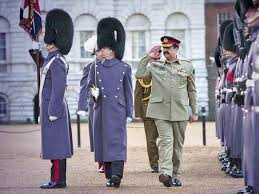
Gen Raheel Sharif in London (Credit: tribune.com.pk)

General Raheel Sharif is a very busy man. In particular, he is seen as advancing parts of the National Action Plan (NAP) that sit in his bailiwick. Currently, he is in London for three days and he is meeting people who make things happen. On his first day in the UK, he met British Prime Minister David Cameron and had talks with Secretary of Defence Michael Fallon as well as “other senior officials”, according to reports. The UK is home to a large population of people of Pakistani origin, not all of whom seem to have the best interests of their motherland in their hearts. Of particular concern is an organisation that is banned in Pakistan — the Hizbut Tahrir (HuT) — which is said to have strong support in parts of the UK’s Pakistani population. The army has a particular concern about the HuT as in 2012, four military officers which included a brigadier, were convicted of their links to the HuT. Also present in the UK are several prominent members of the Baloch separatist movement, who give the government another headache.

The purpose of raising these matters with the UK government is to seek its support and assistance in preventing funds being channelled to the HuT and Baloch separatists, as well as exploring the possibility of the UK similarly banning HuT, which is a proscribed organisation in a number of countries other than Pakistan — which may strengthen the argument that General Raheel presents. Given that the HuT has the goal of establishing a global caliphate and considering events in Paris in the last 10 days, any move to limit expansionism by extremist groups must be welcomed.

Baloch separatists have been in the UK for many years, and at least since 2004. The head of the Balochistan Liberation Army (BLA) lives in London from where he often speaks on the Balochistan insurgency, and is reportedly a funding magnet. The BLA is prominent among the several groups active in Balochistan and has claimed responsibility for a number of attacks, including on those people who have settled in Balochistan from other parts of the country. Whether the argument that fighting terrorism is a global responsibility is going to sway the British remains to be seen, but it is the first time Pakistan has reached out and sought help from the British in this way.

On the same day that General Raheel was busy in London, there was a move in Islamabad that may be an indicator of just how far paradigms have shifted since the tabling of the NAP. Many of the terrorist organisations operating in Pakistan get their money from overseas, and some of it comes from Saudi Arabia. Saudi Arabia is a close friend and ally of Pakistan and has been for many years. A fresh facet of that relationship is now being explored and the interior ministry has approached the Saudi embassy in Islamabad to urgently discuss matters relating to the funding by Saudi philanthropists of madrassas and mosques in Pakistan. This is a sensitive matter and will require deft handling, but it comes on the back of a recommendation from a NAP committee that Tehran, Riyadh and the United Arab Emirates all be asked to help stop the funding of groups that are banned in Pakistan and which fan religious and sectarian fires. The interior ministry is to share intelligence reports on foreign funding in support of its request.

Taken together, events in London and Islamabad in pursuit of the goals set out in the NAP are beginning to look like the government is starting to put its money where its mouth is. There have been arrests for the misuse of loudspeakers, hate material has been confiscated in a number of places and now the diplomatic machine is beginning to turn. We welcome these developments, and hope for more of the same.

Published in The Express Tribune, January 16th, 2015.


Pakistan bans Haqqani network after security talks with Kerry

Pakistan has outlawed the Taliban-linked Haqqani network, officials said on Friday, days after US Secretary of State John Kerry urged Prime Minister Nawaz Sharif’s government to fight groups that threaten Afghan, Indian and US interests.

American officials blame high-profile attacks in Afghanistan on the powerful Haqqani network, which mainly operates out of Pakistan’s border areas.

Senior Pakistani government officials told Reuters a formal announcement of the ban would be made “within weeks”.

“We have decided to ban the Haqqani network as a step in implementing the National Action Plan devised after the (Peshawar) school attack,” said a cabinet member, referring to a massacre of 134 children by Taliban gunmen last month.

“The military and the government are on the same page on how to tackle militancy. There is no more ‘good’ or ‘bad’ Taliban.

“Kerry specifically pressed for action against the Haqqanis, including banning the group,” the official added.

A second official, a minister who spoke on condition of anonymity, confirmed the decision to outlaw the Haqqani group.

The United States accuses the Pakistani intelligence agency of supporting the Haqqani militants and using them as a proxy in Afghanistan to gain leverage there against the growing influence of its arch-rival India. Pakistan denies this allegation.

A formal announcement of the ban would show the government is keen to convince the United States it will no longer differentiate between ‘good’ and ‘bad’ militants.
But it remains to be seen if the ban will translate into significant action.

There has been intense debate within the government on whether to brand the group a terrorist organisation.

Some officials have argued the move would have little battlefield impact but risks setting back Afghan reconciliation efforts and unleashing more attacks against Pakistan.
In June last year the Pakistan army launched a long-expected military operation in the troubled North Waziristan region, said to be the base of the Haqqani group.

“Pakistan has done a lot already to disrupt the activities of the Haqqanis…within Pakistan,” said a Western diplomat.
“But they must also take follow up steps … to ensure the Haqqanis and other groups are not allowed to regroup or return to sanctuaries, their assets are frozen, their funding is blocked and their networks dismantled.”

Intelligence Agencies Directed Briefing on Benazir’s Murder – Cheema

Brig Javed Cheema (Credit: ibnlive.in.com)
ISLAMABAD, Jan 16: Retired Brigadier Javed Iqbal Cheema, former director general of the National Crisis Management Cell (NCMC), told a Rawalpindi Anti-Terrorism Court (ATC) on Friday that he had addressed a press conference following the assassination of Benazir Bhutto after discussing it with the spymasters and then secretary interior.

This statement differs from the one the Federal Investigation Agency (FIA) produced before the ATC on February 7, 2011, where the prosecution included Brig Cheema as a prime witness against former president retired General Pervez Musharraf, in connection with the Benazir murder case.

As per Brig Cheema’s previous statement, submitted by the FIA along with case challan, the former DG NCMC was quoted as saying that a day after Ms Bhutto’s assassination, on December 28, 2007, he held a press conference on the advice of Gen Musharraf. In the FIA’s version of Brig Cheema’ statement, he maintains that he held the press conference, in compliance with Gen Musharraf’s orders, to dispel the negativity against the regime, that prevailed in the aftermath of the assassination.

Brig Javed Iqbal Cheema says he was told by spymasters to present Baitullah’s video claiming responsibility for assassination

A reporter who attended the press conference in question told Dawn that during the presser, Brig Cheema had said that the cause of Ms Bhutto’s death was an injury to the head, sustained when her head hit the sunroof lever of her own vehicle. The second thing he disclosed during the press conference was that Baitullah Mehsud, who was the leader of the banned Tehreek-i-Taliban Pakistan at the time, had claimed the responsibility for the attack in a video message.

Brig Cheema had also shared the video — where Mehsud had indirectly claimed responsibility for the assassination of Benazir Bhutto — with members of the press corps.

But on Friday, when the prosecution produced Brig Cheema as a witness before the ATC, he told the court that the decision to hold the press conference was taken by then-interior secretary Kamal Shah.

He said that before the press conference, he was summoned to the headquarters of the Inter-Services Intelligence (ISI), where he met the interior secretary and the heads of the ISI, Military Intelligence and Intelligence Bureau.

He told the court that the spymasters briefed them about their meeting with Gen Musharraf and handed him the video and instructed him to hold a press conference to this effect. He also told the court that he also consulted then-interior minister retired Lt-Gen Hamid Nawaz before holding the press conference.

Pakistan Needs a Fundamental Shift to Tackle Militancy

Army Public School Parents Protest PTI chief's visit (Credit: siasat.com)
Army Public School Parents
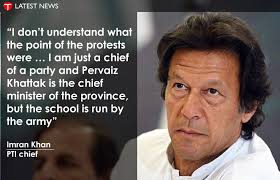
Protest PTI chief’s visit (Credit: siasat.com)
After the terrorists executed their barbarous action, the government mercifully woke up to develop a plan for its action. A committee of political wizards, including Sheikh Rashid who had been publicly inciting violence, has been constituted to contemplate measures to curb terrorism in the country.

Heart-wrenching incidents like the one in Peshawar normally prompt such reaction from government quarters. Committees are constituted, thundering statements are issued, a wish list of punitive measures against the perpetrators is suggested and then all fizzles out without a measurable outcome. Depending on gravity of the incident, sometimes a flurry of ephemeral actions is also witnessed. However, root causes are barely touched. In the spirit of fairness, one may eschew criticising an unborn plan of action, yet the track record is undeniably dismal.

After a decade-long battle against terrorism, the country does not merely need a set of cosmetic actions to mollify enraged masses but it requires a fundamental shift in the thought, approach and policies on terrorism. A major policy retrofit is unavoidably needed to put the course on right track. The State ought to adopt an unambiguous position on all forms of terrorism without any classification of its degree, location and suitability.

Analysing and responding to Peshawar incident as an isolated act and perpetrators as just a rouge group of militants would be a blunder. An appalling naivety, insincerity or political bankruptcy of leadership was evident from a news report published on December 19 in a leading national daily. The news report of the prime minister’s meeting with the president carried a paragraph leaving every reader’s head spinning. It reads “A spokesperson for the president said Mamnoon Hussain had asked PM Sharif to involve non-political religious scholars to contact militants and convince them to give up their ‘un-Islamic’ and ‘inhuman’ agenda.” This conversation took place only two days after the gruesome and barbaric incident in Peshawar.

What is bewildering is that the head of the State still believes that militants should be communicated with and convinced to abandon their barbaric tactics! The statement was not much different from the one issued by the cleric of Lal Masjid Maulana Aziz. Misusing Friday sermon to discuss his personal matters he suggested to the military and political leadership to negotiate peace with the Taliban, ostensibly for a more worthy cause. He further suggested that a united force of Pak army and Taliban should be established to fight the infidels.

An even more glaring affection for good Taliban was expressed by Sartaj Aziz, Adviser to the Prime Minister on National Security and Foreign Affairs. In his interview to BBC exactly a month before the incident he was sloppy enough to say “Pakistan should not target militants who do not threaten the country’s security. Why should America’s enemies unnecessarily become our enemies? When the United States attacked Afghanistan, all those that were trained and armed were pushed towards us. Some of them were dangerous for us and some are not. Why must we make enemies out of them all?

The ill-advice of the president to the prime minister and the wisdom showered by the foreign minister were not merely their piteous personal utterances. These manifest the policy paradigm prevailing in the highest policy corridors of the country. It does not remain confined in the policy avenues but also trickles down sapping the administrative web that runs day-to-day affairs of the country.

This characteristic confusion was echoed on December 19 when Islamabad police registered an FIR against civil society activists who were holding a peaceful demonstration outside Laal Masjid demanding an unconditional condemnation of the perpetrators of the Peshawar incident from the mullah. The cleric of the mosque flatly refused to condemn the incident in a talk show that infuriated the whole country. The efficient Islamabad police that did not waste a minute to register FIR against peaceful civil society activists had been too indolent to act against law breaking clerics. The same police did not have courage to book the cleric when he openly instigated violence during Friday sermon. According to a news report, the custodian of law, Islamabad police were able to arrest only three of the 193 clerics booked for amplifier act violations during the whole year.

The present government’s lenient tilt to religious extremists is not much obscure. The incumbent chief minister Punjab while speaking at a seminar held in Lahore to commemorate the services of late Mufti Muhammad Hussain Naeemi in March 2010 beseeched Taliban to spare Punjab. In his cavalier choice of words he said that the Taliban and Pakistan Muslim League-Nawaz both opposed former military dictator Pervez Musharraf and, therefore, he is surprised that this common stance has failed to stop the Taliban from carrying out terror attacks in Punjab. He went on saying “Gen Musharraf planned a bloodbath of innocent Muslims at the behest of others only to prolong his rule, but we in the PML-N opposed his policies and rejected dictation from abroad and if the Taliban are also fighting for the same cause then they should not carry out acts of terror in Punjab.”

Not just that but the ruling party leadership also outlandishly used proscribed outfits to muster support during recent anti-government movement. A newspaper reported on August 23, 2014 that Ahle Sunnat Wal Jamaat (AWSJ), formerly banned as Sipah-i-Sahaba Pakistan, marched from Lal Masjid to Islamabad Press Club registering their support for the Nawaz government. The PML-N’s members were present on the stage and thanked AWSJ for supporting their government.

Confronting political opponents with the support of religious extremists amply indicate the bankruptcy of a supplicant ruling party. Legitimising religiosity to prop up political vested interests is a clear lack of political acumen and stewardship. Similarly, the PTI’s avoidance of condemning Taliban in unequivocal terms is another example of apologetic approach. It was five days after the Peshawar incident when the PTI’s core committee named the perpetrators and condemned them. If leading political parties adopt a policy of pandering terrorist outfits, the country will remain trapped in the quagmire of terrorism.

This approach encourages violent mobs to lynch putative blasphemers without any evidence. It lets clerics to freely abuse pulpits to incite hate and violence in society. The very approach glorifies heinous murderers and elevates their stature from a condemned criminal to an adorable hero and epitome of piety. On the other hand, it muzzles every voice of sanity that demands to demarcate the limits of lunacy. Thus demand for separating faith from the State business becomes an unpardonable sin likened to infidelity. Infusing society with this scale of bigotry breeds intolerance and lunacy of unfathomable proportions. A precipitous descent of the society into chaos and anarchy is a logical corollary of the course. Practicing this prescription for decades, Pakistan has become a nursery of pathological obscurantists.

While it is customary to blame foreign hand behind every act of terrorism, reciprocally we are also blamed for offering cozy sanctuaries to the elements involved in the acts of naked terrorism in other parts of the world. Some of them not only roam freely but also convene public rallies, persuade people and forces to take up arms for jihad, brazenly promote violence and exhort pogroms of sectarian and religious minorities.

They are at liberty to use every public space from mosques to media shows to spew verbal venom with complete impunity. They do not need licenses from poor PEMRA to operate radio or tv channels to air any uncensored content. They can publish literature full of distorted interpretations of religious scriptures. Patted by the powerful patrons, these clerics can conveniently demonize anyone with the charge of apostasy, issue decrees of capital punishment and even publically decapitate the accused yet stay unscathed.

They hardly tolerate existence of womenfolk on earth. From legislation to moon sighting, almost every State and public affair has been made subservient to the clergy. Some of these self-proclaimed guardians of religion were instrumental in instigating gruesome acts of arson against Christian, Hindu, Qadyani and Shia Pakistanis. They do not hesitate to burn them alive, mercilessly kill their innocent children, defile their sacred places and vandalise their deities. All this would not have been possible without tacit support or nonchalance of the highest power centers in the country.

Peshawar incident is nothing but the continuum of this insanity that has plagued the country for decades now. This is high time to decide if this Frankenstein is a strategic asset or an eternal enemy of this country and the humanity. Rather than exterminating the monster of extremism, exploring possibilities of an armistice, as suggested by the president to the prime minister, would be tantamount to paving way for more Peshawar-like macabre scenes.

Parliament Gives Constitutional Cover to Special Courts

Parliament meets on special courts (Credit: expresstribune.pk.com)

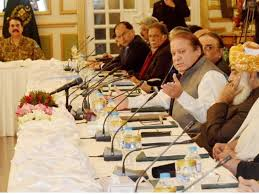
ISLAMABAD, Jan 2: The All Parties Conference (APC) at the PM House on Friday reached consensus on providing constitutional cover to special courts through an act of Parliament, while a roadmap regarding the 20-point National Action Plan was presented.

Speaking to the media after the meeting on Friday evening, PTI Vice-Chairman Shah Mehmood Qureshi said that members of the APC agreed on the proposition that amendments be made to the Army Act to enable “speedy” trials against “hardened criminals”.

He added that the meeting was prolonged because of the discussion on whether what they were doing was enough.

“Legal experts were of the opinion that challenges are expected to any possible amendment to the Army Act or the Constitution in superior courts,” Qureshi said. “Legal experts believe that if amendments are made with constitutional cover it will be easier to defend them [in superior courts].”

Earlier, Prime Minister Nawaz Sharif said legislation regarding the the National Action Plan, which would possibly amend the Constitution to establish military courts, should be tabled in the National Assembly today.

“The time has come for a final decision to be made today. I am hopeful that this bill should be presented before Parliament today. There is no room for further debate on NAP,” Nawaz said, urging political leaders to finalise the draft for the amendment in the Constitution.

“The nation wants to see the National Action Plan in action,” the prime minister said while addressing an All Parties Conference at the PM House in Islamabad.

Further, the premier reiterated that the military courts would only be set up for two years.

Nawaz lauded the efforts made by the leadership of all political parties for being on the same page following the aftermath of the tragic attack on the Army Public School in Peshawar in which 150 people were killed.

“I am happy to announce that the day after the incident, on December 17, all political parties’ leaders were in Peshawar and on the same page,” he said.

“In that APC, we unanimously decided that a parliamentary committee will be made to take action after the horrific incident,” said the premier.

Further, the prime minister said another meeting was held on December 24, which lasted 11 hours, in which the 20-point National Action Plan was also agreed upon collectively.

“I am happy that the political leadership of Pakistan is standing together to work towards eliminating terrorism,” he said.