Lahore High Court Bar Opposes Military Courts

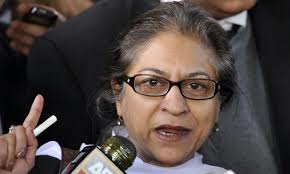
Human Rights lawyer, Asma Jehangir (Credit: dawn.com)

LAHORE, Jan. 1: The parliament mustn’t give legal cover to military courts, the Lahore High Court Bar Association said at its general house meeting on Thursday. The LHCBA passed a resolution condemning the plan to set up military courts to hear terrorism cases.     

A general house meeting was called to deliberate on the issue. The LHCBA announced that it would call an All Pakistan Lawyers’ Convention to devise a strategy to resist the move.

Former Supreme Court Bar Association president Asma Jahangir said there was a need to cooperate with the armed forces in fighting the menace of terrorism. The people of the country gave a massive portion of the national budget to the armed forces each year to help them fight terrorism. “But they couldn’t even protect a school in their own cantonment.”

Jehangir said the judiciary and the democratic setup had its faults but they were still better than martial law or military courts. “These courts cannot resolve conflict.” Under the military, there could be no separation of powers, she said. “The whole system would collapse.”

Jehangir said that the parliament should not wait for the judiciary to declare the amendment illegal. It shouldn’t pass the bill at all.

The first step the government needs to take is to take note of all sympathisers of terrorists from among politicians and within the armed forces. “Everyone knows that the FC is protecting Lashkar-i-Jhangvi in Balochistan. The only solution to the problem of terrorism is the supremacy of civil rule.”

There is no doubt that Pakistan is faced with a severe terrorism problem, but setting up military courts will not change a thing, former SCBA president Advocate Hamid Khan said.

Pakistan had tried and tested military courts since 1958 and nothing good had come of it, he said. “Setting up military courts gives the impression that the attack in Peshawar was the judiciary’s fault.” It was clear that the military and intelligence agencies had failed in gathering intelligence about the attack and pre-empting it, said Khan. The armed forces hadn’t been able to kill any terrorists involved in the attack, the culprits blew themselves up.

Khan said the prosecution was to blame for not collecting enough evidence to bring the culprits to book. Whatever reforms the country needed in light of the war on terror must be taken within the Constitution, he said. “The security and protection the government plans to provide military courts should be extended to judges.” The state has created the impression that protection and security extends to the armed forces and not the civilians. “This is a failure of the state,” he said.

Small militia groups under the banners of Lashkar and Sippah needed to be disbanded immediately, said Khan. “Regardless of their reputation, every organisation that preached a version of militant Islam needs to be disarmed,” he said.

Advocate Tanveer Chaudhry was critical of judges. Today courts act like dictators, he said. “One of the judges took a traffic warden into custody after he asked him to queue up to get a driving licence; another judge ordered four robbers to be shot dead for robbing the house of a civil court judge in Sheikhupura,” Chaudhry said. “An MS was put in handcuffs for not treating an LHC judge’s daughter on priority… Is this a civilian judiciary?” He said the country’s judiciary were acting like core commanders. Advocate Raja Zulqarnain said lawyers would not accept a move to set up military courts. He said politicians and military men provided weapons to the Jamatud Dawa and the Sippah-i-Sahaba. “Why are they protecting hardliners?”

LHCBA’s acting president Amir Jalil Siddiqi said the bar should have announced its view point right after political parties made an announcement in this regard. He said Nawaz Sharif became prime minister because of the Lawyers’ Movement. “We will not let him commit an illegal act.”

Published in The Express Tribune, January 2nd, 2015.

Why is Sindh being Sinned Against?

While we all got used to missing persons and tortured bodies in Balochistan, it’s odd to find Sindh becoming part of the same tragic cycle.

Death and dead bodies are not new to Sindh. Every decade since the 1980s, the province has bled for one reason or the other. But this current spate of killings seems to be a new pattern. It is almost as if Sindhi nationalism is being woken up. Interestingly, the six dead bodies found recently did not belong to violent nationalists. In fact, five out of the six were men who had moved on in life. Notwithstanding old associations with the JSMM, these people were not actively involved in any ‘anti-state’ activity or even in party politics.

In any case, one thought that from the state’s perspective, Sindh was not Balochistan. The province had been through this phase during the 1980s when people challenged the military regime and were killed for it. Like Balochistan, Sindh was politically vibrant. The Sindhi media and intelligentsia was politically active and educated people about issues in its own language. Fast-forward to the 2000s, things were manipulated and changed. Despite the media still being active, it has begun to behave and sound more like the media in the rest of the country. What the state couldn’t purchase or silence was bought over by influential dons.

One also thought that the state was using two other tools to repair relations with Sindh. First, approximately 80,000 men were inducted into the army during the Musharraf period that naturally increased effectiveness of old and new cantonments and cadet colleges in different places in the province. In fact, one came across Sindhi expatriates and intellectuals, who would argue in favour of their people joining the civil and military bureaucracy. Many scions of influential families joined the security establishment in different positions to enhance their power and influence. Second, the province was gradually but systematically infested with militant organisations, madrassas and other infrastructure. In any case, the JUI-F and the JUI-S were expanding their influence, which was obvious from the votes that the late Khalid Soomro got in Larkana contesting the 1990 elections against Benazir Bhutto. Given the absence of a forceful narrative to counter the gradually melting feudalism (that turned into neo-feudalism), the new middle class in Sindh was getting attracted to religious discourse. Certain religious organisations got lots of opportunities to bring back traditional support for them in Sindh back to life in a newer form.

So, one really wonders why it was felt that there was a need to light a fire in Sindh. Such killings can only provoke anger and resentment, especially amongst the youth who are abandoned both by the state and the political governments. The stories of poor governance, corruption and neglect of the people are far too gory for anyone to claim that the PPP and its leadership are not to blame. As a political party, the PPP is both a perpetrator and victim of the wave of violence. It is responsible for not crying out loud against what is happening in the province it claims to control. The collusion between its key leaders and the security apparatus denoted by joint exploitation of resources makes its behaviour questionable. Yet, it is a party that will find itself in a deeper mess if the violence doesn’t stop. It would be even more tragic if it has to become party to the greater intrusion of the security apparatus that will step in under the pretext of securing the place against ‘violent nationalism’.

Recently, the chairman of the Sindhi Taraqi Pasand Party, Qadir Magsi, rightly warned the JSMM against an armed struggle as it could result in greater losses and deaths of Sindhi youth. Moreover, violence will eventually open doors even wider for both the military and religious militants to expand their existing influence. Then, things will get so muddled that no one will seem to have a recipe other than perhaps, the Chinese. But in the process, the tranquility and serenity of the place will disappear forever. The Sufi tradition, multiculturalism and tolerance, which are already drifting away, will become things of the past. Even nationalists wouldn’t realise when they start seeking help of militants because there is no other help available. It is quite likely that, like in Balochistan where al Qaeda seems to have taken up the cause of Baloch nationalism, forces of extremism will determine Sindh’s politics.

While we try to solve the mystery of why Sindh is being sinned against, it is important to note that all moderate political forces are disappearing. This is also a reference to the recent killing of the JUI-F’s Dr Soomro. Although the partnership between the PPP and the JUI-F during the last six years played a critical role in strengthening the latter and bringing in militant elements into Sindh, which mostly came under the religious party’s umbrella, Dr Soomro was a political man who cared for Sindhi nationalism as well. Even if he hadn’t died, he would find himself less effective in the face of the evolving politics of Sindh. Some people even argue that his death may be linked with his nationalistic perspective rather than anything else. Not to forget that the JUI-F has an interesting legacy and historically had a leadership that opposed the official nationalist narrative. This was also a party where the politics of the left and right merged together. The death of leaders like Dr Soomro indicate a transition towards a different kind of leadership or the rising influence of new militant groups in Sindh, which are more aligned with Islamabad’s nationalist perspective. A new hybrid-theocratic society is in the process of being born.

Sindh has had a legacy of great history and traditions. While we can all think of demons that can be held responsible for the current mayhem, there is no time to waste if we want to stop the bleeding. The state must be held accountable and made to stop this bloodshed.


The Legacy of Benazir Bhutto

BB's 7th anniversary (Credit: dailytimes.com.pk)
BB’s 7th anniversary (Credit: dailytimes.com.pk)

KARACHI, Dec 26 — Seven years have passed since Benazir Bhutto, Pakistan’s former prime minister, was assassinated in Rawalpindi, on Dec. 27, 2007. Her legacy and significance in world history continue to hold a special place in the hearts of the millions of Pakistanis who mourn her death as much as they mourn the death of the dream of what Pakistan might have been had she lived to rule the country just one more time.

As with that of many political icons, Ms. Bhutto’s sudden death left a void in both leadership and inspiration; no politician in Pakistan has been able to fill it. She also left behind a checkered past, with allegations of corruption that still linger, unproved in court for lack of evidence. The two governments she led were dismissed on corruption charges, and she was accused of amassing a large personal fortune for her own family while doing far too little to alleviate the burdens of Pakistan’s poor.

In her own life, she carved out a brilliant academic career at Harvard and Oxford, and political achievements of undeniable import as the daughter of an assassinated prime minister battling to restore democracy in Pakistan; later, she became the first woman elected to lead a Muslim country. She inhabited a marriage that puzzled people as much as it fascinated them — to a controversial man who ruled Pakistan in her name for years after her death. She raised a son and two daughters, who now strive, with mixed results, to serve the Pakistani people she claimed to have lived for.

Yet Ms. Bhutto left behind more than success or scandal. In her wake are the millions of Pakistani girls and women who look at her life, her determination, her perseverance in the face of all odds. They appropriate even the smallest part of these elements of her life and add it to the blueprint they envision for their own. And they thrill to the idea, still radical in Pakistan 40 years after Ms. Bhutto began her political career, that gender doesn’t have to stop them from achieving their dreams.

One of the more literal examples of Ms. Bhutto’s legacy that helps Pakistani women is the Benazir Income Support Program, which distributes cash, without conditions, to low-income families throughout Pakistan. These poorest of the poor, 5.5 million families in 2013, receive 1,200 Pakistani rupees — about $12 — twice monthly, most of which is spent on food. Ms. Bhutto worked on the vision, concept and design of the program with a renowned Pakistani economist, Dr. Kaiser Bengali. After her death, the initiative was enacted by Prime Minister Yousaf Raza Gilani, but named after Ms. Bhutto by her widower, President Asif Ali Zardari, as a tribute to her.

The program isn’t without flaws; critics have said that it is meant to influence voters at election time, that political influence skews which families are eligible to be recipients, and the fact that most of the assistance is nonconditional renders it ineffective (a subprogram gives families more cash if they enroll their children in primary school).

But there is also a revolutionary side to the scheme: The cash is transferred into the bank account of a woman in the family, not a man. Placing spending power directly into the hands of poor Pakistani women empowers them on many levels: They become decision makers within the family, and their respect and value increase in the community. To obtain the cash, they are required to get national identity cards and bank accounts; as a result, they achieve a level of citizenship and fiscal identity denied to previous generations, when the births and deaths of women were rarely registered in official records.

While mothers are being helped by the program, their daughters are going to school in even greater numbers than before, thanks to the many awareness campaigns and education drives underway in Pakistan. Many of these girls regard Benazir Bhutto as an inspiration for their own educational paths. Malala Yousafzai, Pakistan’s most famous schoolgirl, cites Ms. Bhutto as her personal idol, and wore Ms. Bhutto’s white shawl when she addressed the United Nations in 2013.

Young women attend classes at the Shaheed Zulfikar Ali Bhutto Institute of Science and Technology, which Ms. Bhutto established in her father’s name, in Karachi, Islamabad, Hyderabad and Larkana. There, they study law, media, computer engineering and more. Ms. Bhutto’s university-educated daughters, Asifa and Bakhtawar, today publicly encourage Pakistani girls to go to school so that they, too, may one day serve the nation as educated, empowered women.

The daughter of a privileged landowning family, Ms. Bhutto nevertheless fought against the conservative social mores of her environment, in which rich girls could go to school but grown women were expected to run a house and raise a family, no matter how educated they were. She herself returned to Pakistan after her studies, and entered politics, heading the Pakistan Peoples Party in its now-celebrated struggle in the 1980s against the dictator Gen. Mohammad Zia ul-Haq.

She endured house arrest and exile throughout her political career, overcame the powerful mullahs’ objections to a woman’s ruling an Islamic nation, and won admirers all over the world for her political skills and compassion. Even after her death, she serves as the ultimate mentor to Pakistani girls and women who want to set the course of their lives for themselves, instead of having it dictated to them.

What might have happened in Pakistan had Ms. Bhutto been elected for a third term will remain an unanswerable question. Her personal and political legacy is full of contradictions and complexities that will continue to be examined by earnest historians, mined by rapacious politicians, venerated by her supporters and picked apart by her detractors.

Yet she emboldened the heart of every girl and woman in Pakistan who was ever told that being a woman precluded her from a lifetime of accomplishment, service and worth. This was her greatest legacy.

Bina Shah is the author of several books of fiction, including, most recently, “A Season for Martyrs.”


KP Govt had been Warned of Peshawar Attack

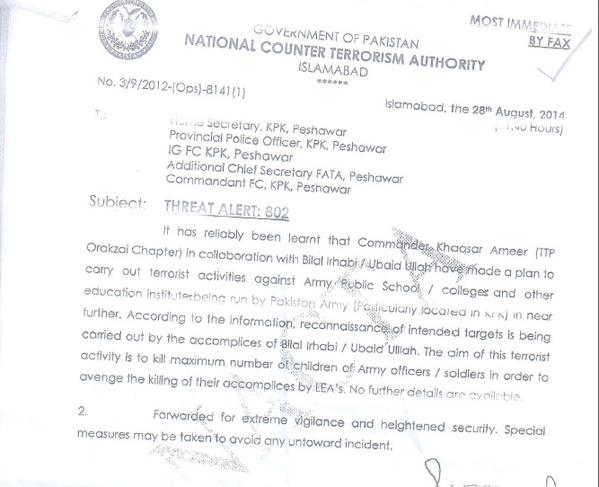
Official warning to KPK govt (Credit: hindu.com)
Peshawar, Dec 22: Khyber Pakhtunkhwa government departments had been warned of an imminent attack on the Army Public School months before the carnage unfolded in Peshawar.

A copy of the written warning issued on August 28 has been obtained by Geo News.

Alert No. 802 issued by the Khyber Pakhtunkhwa Home Ministry stated that the Taliban Orakzai Commander, Khaksar along with terrorists Bilal and Obaidullah had planned to carry out attacks at educational institutions under the army.

According to information, Bilal and Obaidullah with their accomplices had also conducted reconnaissance of the targets. The warning stated the intention of terrorists was revenge and they wanted to kill as many children of army officers as possible.

The written warning had called for security measures to be made in advance to avoid any untoward incident and copies were sent to Khyber Pakhtunkhwa Chief Minister, Home Minister and law enforcement agencies.

On December 16, terrorists carried out one of the most horrific attacks in the history of Pakistan. Tehreek-e-Taliban Pakistan (TTP) terrorists brutally killed over 140 people mostly children at the Army Public School.

Following the attack government and political parties expressed a renewed resolve to fight terrorism in the country. The prime minister also lifted the moratorium on the death penalty in terrorism cases.

Resuming executions not answer to Peshawar tragedy: Amnesty International

LONDON, Dec 18: The Pakistan government must resist giving in to fear and anger in the wake of the Peshawar school tragedy and maintain its moratorium on executions, Amnesty International has said after Prime Minister Nawaz Sharif decided to resume death penalty in terror-related cases.

“Tuesday’s attack was utterly reprehensible, and it is imperative that those responsible for this unimaginable tragedy are brought to justice. However, resorting to the death penalty is not the answer – it is never the answer,”said David Griffiths, Amnesty International’s Deputy Director for Asia-Pacific.

Sharif’s announcement came the day after at least 148 people – including 132 children – were killed by Taliban militants at an army-run school in the north-western city.

“Pakistan is understandably gripped by fear and anger in the wake of the attacks. However, lifting the moratorium on executions appears to be a knee-jerk reaction which does not get at the heart of the problem – namely the lack of effective protection for civilians in north-west Pakistan,” said Griffiths.

“This is where the government should focus its energies, rather than perpetuating the cycle of violence with the resumption of executions,” he said.

Amnesty International calls for those responsible for indiscriminate attacks and attacks against civilians, including the Peshawar attack, to face investigation and prosecution in proceedings that comply with international fair trial standards, but without resort to the death penalty.

“Capital punishment is not the answer to Pakistan’s law and order situation and would do nothing to tackle crime or militancy in the country,” the London-based rights body said.

Pakistan re-imposed a moratorium on executions in October 2013 and has not executed since the hanging of a soldier in November 2012, while the last civilian hanging was in late 2008.

There are currently dozens of people sentenced to death for terrorism-related offences in the country.

‘Kill and Dump’ in Sindh follows Balochistan pattern

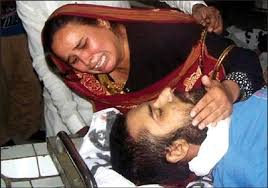
Grieving Sarwech mother (Credit: awamiawaz.com)
Sarwech Ali Pirzado’s grave stands out in the ancestral Pirzado graveyard in Balhreji, Larkana district. A red Jeay Sindh Muttahida Mahaz (JSMM) flag is spread over the grave. Another party flag flutters beside it. Known as ‘little Moscow’, Balhreji has seen many socialist and communist movements, evidence of which is found on the main entrance to the street where the graveyard is located. There is a plaque here in memory of “social reformer Muhib Hussain Pirzado”.

The area has been in the spotlight in recent weeks, as the venue where families from across Sindh receive the tortured bodies of their relatives — activists of Sindh’s nationalist parties who hailed largely from Larkana district.

Sitting on a charpoy in his modest home, Sarwech’s father Lutuf Pirzado wore an expression of resigned acceptance as he mentioned his son’s affiliation with the JSMM’s student wing, the Jeay Sindh Students Federation (JSSF). Himself an active member of the Movement for the Restoration of Democracy in the 1980s, Lutuf received 15 lashes in prison for wall-chalking and demanding the release of communist leader Jam Saqi.

“A month before his abduction, we had a family discussion. Both his mother and I asked him to stay away from some of his friends. Their activities seemed suspicious to us,” he said. The reason behind the discussion was the news of activists disappearing one by one in Karachi. Soon after, an announcement appeared in Daily Subh, a Sindhi-language newspaper, of Sarwech’s resignation from the JSMM and its student organisation.

The 22-year-old was working as a sales manager in Karachi when on Sept 11 he went missing, “somewhere in Saddar”, his father added.

The incident went unnoticed for over an hour until an employee of a courier service called his office around 6pm to inquire whether Sarwech would be picking up a letter he was supposed to. Search for Sarwech started soon after, with his father and brother going to Karachi, running from pillar to post to locate him. The police refused to register an FIR, so they went to the Sindh High Court.

While waiting for the hearing, they protested in front of the Karachi Press Club on Sept 23. In the meantime, a ‘well-wisher’ of the family sent a message to them through a relative that the young man had indeed been abducted by the security forces for a plot he was accused of hatching with his friends to target security installations. Sarwech’s brother Inayat Ali recalled, “He also asked us to relax, as the man told my cousin that Sarwech seemed like he belonged to a good family. And they might release him because of that. We continued hoping, waiting for his release.”

It took another few days to convince the authorities to register the FIR. But on Nov 30, they learned of his death. “One of our relatives heard it on TV and called from Karachi to inform us that two bodies had been found in Nooriabad, hands tied with gunshot wounds to the head,” said his mother Mehrunnisa, a lady health worker in Larkana district.

Her face remained emotionless as she narrated how she was the one who informed the police that her son might have been abducted due to his past affiliation with the JSMM. “They looked at me, surprised. Then hushed me up for saying the word ‘agency’ out loud. I just want to know whether by abducting these young men are they trying to finish off the movement or bolstering it?”

Many in Larkana do not consider the JSMM as truly representing the poor. Others say that the recent abductions were a result of the separatist movement, mostly underground, gaining strength in recent years. One of the reasons for the recent surge in the ‘kill-and-dump’ phenomenon, earlier associated only with Balochistan, is said to be the growing proximity between Baloch separatists and their counterparts in Sindh.

In 2011, a picture of Sirai Qurban Khuhawar, senior vice chairperson of the JSMM at the time, Ruplo Choliani, Noor ul Haq Tunio and Nadir Bugti, went viral among nationalist groups on Facebook. Soon after, Khuhawar and Choliani’s car was found torched near Sanghar. It was followed by a picture of Balaach Marri and the present JSMM leader Shafi Burfat on the internet. Locals say the proximity between JSMM and Baloch separatists continued till recently, resulting in enforced disappearances.

Another factor, pointed out by a former political activist of the Jeay Sindh Mahaz, Ustad Khalid Chandio, is that the JSMM is getting stronger even while being banned. “You must have heard people shrug off their cause saying their attacks are limited to ‘cracker blasts’. But has anyone thought how the material for making a ‘cracker bomb’ is available to them? How a mere cracker blows up five to six feet of solid steel railway tracks? At the same time, there’s some truth to reports about India’s interference in our region. We may ignore them but there’s some truth there. This nationalist movement is not all black and white; there are many shades of grey.”

Another factor he mentioned was that over the years, with the absence of governance, awami movements in Sindh were gradually being replaced by azadi movements. “Secularism is being wiped out in this country. Stoking a militant movement in Sindh is ideally a good shut-up call for the nationalists, good for creating conflict and confrontation amongst those seeking provincial autonomy and those seeking independence. All of this, in the end, is useful to justify torture against militant groups,” he added. At present there’s no ongoing strong movement for a ‘Sindhudesh’ in the province, Chandio argued, as was once imagined and explained in detail by G.M. Syed in his book about Sindhudesh.

When the question was put to the senior vice president of JSSF, Shehzad Manglo, whether there was a solution to the ongoing kill-and-dump policy in the province, he politely said “an independent Sindh”.

Published in Dawn, December 14th, 2014

The ‘Man from Mohenjodaro’ who never left Sindh passes away

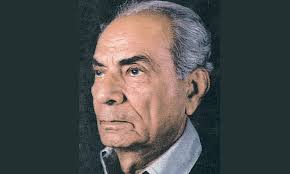
Sobho Gianchandani (Credit: dawn.com)

Sobho Gianchandani, one of Pakistan’s last leaders from its first generation of Marxists, has died at the age of 94.

He suffered a heart attack and was cremated in his native village near the southern city of Larkana on Tuesday.

Gianchandani was a member of the Communist Party of Pakistan and stayed active after it was banned in 1954.

He was one of the last remaining Pakistani students of Rabindranath Tagore, a literary figure and Nobel laureate from West Bengal in India.

Gianchandani’s death closes the chapter on a generation of leftist politicians who organised peasants and industrial workers during 1940s, 50s and 60s.

Analysts say it was this work that led to the 1970 election victory of the overtly socialist Pakistan Peoples Party in an otherwise conservative and religious country.

Gianchandani’s family said he had died in his chair after being served morning tea on Monday.

He had been suffering from cardiac problems complicated by a severe chest infection and had been in hospital twice in recent weeks.

Communist and Hindu

Gianchandani was born on 3 May 1920 to a Hindu family in Bundi village near the famous archaeological site of Mohenjo-Daro in Larkana district, Sindh province.

He went to school in Larkana and Karachi.

Later he studied fine arts at a university set up by Rabindranath Tagore at Shantiniketan, his native village in West Bengal.

In a subsequent interview, Gianchandani said he had espoused communism during his time at this university.

He said Tagore, who was then in his late 70s, used to call him “the man from Mohenjo-Daro”.

In 1942, Gianchandani participated in the Congress-led anti-British Quit India movement, and was arrested for the first time.

He was repeatedly jailed for his views and politics during a political career that lasted until the mid-1960s.

But he continued as an ideologue, intellectual and writer of several books.

In an interview in 2009, recalling the active period of his political life, he said he had become a “three-headed monster” for the Pakistani establishment.

“I am a communist, I am Hindu and I am Sindhi,” he said, light-heartedly referring to his minority identity within Pakistan


Disappearance & killing of Sindhi nationalists creating space for militants

Torture Victim Sarwech Pirzado (Credit: iaojwordpress.com)
PAKISTAN, Dec 3 : Disappearances and extra judicial killings of Sindhi nationalists continues unabated; in many cases disappearances have occurred following arrest by the police and at times by plain clothed persons, presumably from intelligence agencies; thereafter being taken into custody, most often tortured and ultimately their bodies are found dumped on the streets.

In the Sindh Province, the security forces have made secular and nationalist forces and activists their main target, in order to keep them in illegal detention centres, torture them and thereafter are extra judicially executed in an effort to eliminate any evidence of the disappearances. During the year 2014, more than 100 activists from nationalist groups particularly from the group ‘Jeay Sindh Muttahida Mahaz’ (JSMM), a banned organisation, have been arrested and are missing. On the other hand all the banned Muslim militant groups have made the Sindh Province their safe haven and hiding place.

Accusations are levelled by the nationalist groups that security forces are targeting nationalist forces to provide a space for religious militant groups and the Taliban, similar to what took place in the Baluchistan Province – where today as a result, the sectarian and militant groups are operating freely and every year they are involved in killing more than 1,000 persons in such sectarian violence.

In Sindh, the Jeay Sindh Muttahida Mahaz (JSMM) is the worst victim of the intelligence agencies in this regard. Although the members of the Jeay Sindh Qaumi Mahaz (JSQM), one of the major Sindhi nationalist parties, Jeay Sindh Tehrik (JST) and other parties have been facing no different situation, it’s worse for JSMM because they, unlike the other parties, openly support an armed movement for the freedom of Sindh.

On 15th August 2014, Mr. Asif Panhwar was arrested in a police raid at his friend’s house in Nasim Nagar, Hyderabad, in the Sindh Province and since then he has been missing. After 100 days of his disappearance his bullet riddled and torture marked body was found on the 25th of November this year. Asif Panhwar was a local leader of a banned secular nationalist organisation, the ‘Jeay Sindh Muttahida Mahaz’ (JSMM). Following his arrest and disappearance his brother filed a petition in the Sindh High Court for his recovery. As is the usual practice, the Sindh High Court did nothing, despite the appeals by his brother that Asif Panhwar might be killed in detention by the security agencies.

In another such incident on 15th October 2014, Paryal Shah, an activist of the JSMM was abducted by the Pakistan security agencies and since then he has been missing. His mutilated body was later found on 7th November 2014 with clearly visible marks of torture. His body was dumped near the city of Rahim Yar Khan in the Punjab Province where military is operating torture cells in their Cantonment area. Shah hosted the Baloch long march last year for the recovery of Baloch missing persons. Victim’s brother, Zamin Shah was also killed by the armed forces in fake encounter.

The bullet ridden body of Mr. Abdul Waheed Lashari, 37 years old, was found after his disappearance after 15 days after being arrested in the first week of November 2014 while he was travelling in a passenger bus. Mr. Lashari was affiliated with the Jeay Sindh Qaumi Mahaz (JSQM) Arisar group.

On 25th November 2014, a third-year student of Mehran University of Engineering and Technology, in the Sindh Province went missing from the Sindh University Housing Society, Jamshoro. Mr. Kamlesh Kumar was standing at a photocopy shop when two police mobile vans and a car approached them and dragged him in a police van. His only alleged crime was that he belongs to the Hindu community and he was participating in the protests against the persecution of religious minority groups. He was not affiliated with any political group. The family searched for Kamlesh at the police stations in Jamshoro and Hyderabad and to no avail.

Many such activists who stand up against the kidnapping of Hindu victims often go missing in the Sindh Province. The Chairman of Sindh Human Rights Organization (SHRO), Fayaz Shaikh was abducted from the city of Karachi. He has been organizing demonstrations on behalf of several Hindu girls who have been kidnapped in Pakistan. He has been abducted by unknown persons on 24th November 2014. His disappearance came on the eve of yet another demonstration he was supposed to organize under the auspices of the Sindh Human Rights Organization on behalf of the nine Hindu girls kidnapped by the Islamic seminaries in the Sindh Province. This is ironic since he was a leading voice who began a campaign to approach the United Nations Secretary General, Ban Ki-Moon, to take notice of the enforced disappearances of young Sindh activists and to call for an end to all such kidnappings and abductions of minorities and human rights activists there.

Another activist Mr. Rohel Laghari, 22 years old also belonging to the JSMM was abducted on the 1st April 2014 from Hyderabad and his whereabouts too are todate unknown.

Mr. Sarvech Pirzado who was yet another activist belonging to the group JSMM and an employee of a private medical company was abducted from the impress market in Karachi on 12th September 2014 by plain clothed persons and was later hurled into a four wheel type jeep. His family has filed a petition before the Sindh High Court for his recovery but as in all the other instances, to date no decision has been taken by the Court.

On October 11, the bullet riddled body of an activist of JSMM, Mr. Shakeel Konhari, was found dumped near the Malir Military Cantonment, Karachi. He was arrested from his house by the unknown persons.

The Asian Human Rights Commission urges the Government of Pakistan to stop the persecution of the Sindhi nationalists and halt once and for all these illegal and unconstitutional methods of enforced disappearances and extra judicial killings in Pakistan. If the law enforcement agencies have the evidences against the suspects and if there are criminal charges against them the government must bring them before the civil courts of law and tried.

The AHRC also urges the government to immediately ratify the International Convention for the Protection of All Persons from Enforced Disappearance and implement its provisions in law, policy and practice, and in particular include a new and separate crime of enforced disappearances in the penal code, as the government has already pledged before the United Nations visiting team, the working group of enforced and involuntary disappearances in 2012.

Imran’s Plan C: Paralyse major cities, paralyse Pakistan

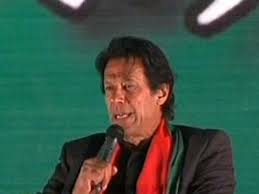
IK at Nov 30 rally (Credit: dawn.com)
ISLAMABAD, Nov 30: Pakistan Tehreek-i-Insaf (PTI) Chairman Imran Khan threw down yet another gauntlet for the PML-N led government on Sunday, announcing the party’s plan to paralyse major cities – and eventually “shut down” the entire country by December 16.
Addressing a crowd of thousands assembled at D-Chowk, Imran unveiled “Plan C”:

“On Thursday (December 4), I will go to Lahore and shut it down. On December 8 I will shut down Faisalabad; on December 12 I will go to Karachi and shut it down. By December 16 I will close down all of Pakistan.”

The PTI rally and the announcement of “Plan C” was a critical next-step for the party, which had lost political mileage and steam since the massive anti-government movement launched in August.

Reiterating demands for Prime Minister Nawaz Sharif’s resignation and a fair probe into alleged rigging of the 2013 elections, the PTI Chairman appeared confident that his new push for street agitation would succeed.

“I know the people of Lahore are ready… I know all of Faisalabad is ready… and Karachi, I know they are waiting for me,” he said.

Lambasting the ruling PML-N, Imran said a further “Plan D” would be revealed on Thursday.

“The ball is in your court, Nawaz Sharif — do your talks, do your investigations and solve the issue. We will close Pakistan down when December 16 comes, and what I do after that you will not be able to bear it…It has been 109 days and Naya Pakistan is waking up every day. We can all see it,” Imran said.

Maintaining an aggressive tone while addressing his opponents, the PTI Chairman reiterated claims that the PML-N and Pakistan Peoples Party (PPP) colluded to rig the 2013 elections.

“I am a Pakistani who can see my country going down, you [Nawaz] and Zardari both in the 2013 election fixed the match. Zardari says there was rigging in Punjab; Nawaz says [there was] rigging in Sindh, Fazlur Rehman also says there was rigging… Balochistan parties say there was rigging,” he said.

“I want to ask all lawyers and educated people — if all parties are saying there was rigging then why is only PTI and Imran Khan asking for an investigation this rigging?”
“Mian sahib, if a country progresses just based on new roads, then make Malik Riaz the prime minister — a country progresses when money is spent on the citizens for their betterment,” he said, referring to the prime minister’s announcement earlier this week of the government’s plans for improved infrastructure and roads across the country.

Shah Mehmood Qureshi speaks
Addressing the gathering, PTI Vice-President Shah Mehmood Qureshi said the time for speeches was over.

“Today we will not make decisions – you will make all the decisions. Do you have the courage to implement Imran Khan’s next big plan?” he asked.

“Should we quietly go home? If you don’t want to go back make a decision – are you ready for the next step?”

A police official estimated that nearly 100,000 people gathered at Parade Avenue.
Supporters had poured into the capital from all over the country to attend the rally, making it one of the largest turn-outs in Islamabad since the start of the sit-in in August.
Participants at the rally said Parade Avenue was full of PTI workers sitting atop containers set up by the government. Nearly 80 per cent of the crowd was reported to be 18 to 40 year olds.

Sheikh Rasheed breathes fire

Chief of Awami Muslim league Sheikh Rasheed on Sunday spoke ahead of the PTI Chairman, and reiterated the anti-government protesters’ demand that the government must go.

“When the time comes, Nawaz falls to his knees… when the time is up, he goes to Havelian,” Rasheed says, referring to the premier’s recent visit to Abbottabad where he lambasted the PTI.

“Imran Khan will finish the governance of tyranny,” Rasheed said, adding that if cases can be registered against a former army chief and prime minister, then there is basis to register a case against Nawaz Sharif for “changing the votes of the people.”

“I wanted to make a long speech but I am aware that every household is awaiting Imran’s speech,” Rasheed said.

Rasheed condemned the killing JUI-F leader Khalid Soomro, however, he added that JUI-F leader Maulana Fazlur Rehman’s attitude has ruined his party’s politics.

Capital, rally kept secure

Radio Pakistan reported that the government deployed thousands of security personnel for the PTI rally.
The report said the government deployed 15,000 security personnel to ensure security of the PTI rally, and the Red Zone in Islamabad. Special security arrangements were also made for public and private buildings in the area.

According to an Interior Ministry spokesperson, security forces including FC, Rangers and police, were placed in four cordons. The spokesman said containers had not been placed in the city, except the venue of the public meeting.

Human Development Declines Further in Pakistan – UNDP Report

The UNDP has released its flagship document Human Development Report 2014 entitled “sustaining human progress: reducing vulnerabilities and building resilience”. The annual report provides status of all countries against vital indicators of human development.

Pakistan, ranked at 146 out of 185 countries, has been bracketed among low human development countries. Pakistan barely maintained last year’s ranking when it shared 146th position with Bangladesh. However, Bangladesh this year moved four rungs up and stood at 142nd position. With such an ignominious ranking, a nuclear power, flaunting atom bomb has been outshined by all other SAARC countries except the war-ravaged Afghanistan. Even Afghanistan has improved its position from 175th in 2012 to 169th this year.

Interestingly, all SAARC countries have improved their ranking compared to the previous year except India and Pakistan who just maintained their ranking. Sri Lanka is the only SAARC country that has been grouped among high human development fraternity. It has taken enviable stride from 92nd number in 2012 to 73rd position this year.

A cursory glance at Pakistan’s ranking on various indicators narrates a sorry state of human development in the country. Except Afghanistan, all other countries have humbled Pakistan on most of the indicators. Pakistan has the second highest maternal mortality ratio in the region. 260 mothers die during 100,000 live births in the country. This ratio for Maldives is only 60 and just 35 in Sri Lanka.

Similarly, the country has second highest infant mortality rate (IMR) after Afghanistan. 60 children out of 1000 live births die before the age of one year. Comparatively, the infant mortality rate in India is 44, in Bangladesh 33 and in Nepal 34. Even African countries Rwanda, Cameroon and Sudan have lesser IMR i.e. 39, 61 and 49 respectively.

Similarly, 86 out of 1000 children die before their fifth birth anniversary in Pakistan. Barring Afghanistan with 99 such deaths, all other countries have much lesser child mortality rate. Maldives, Sri Lanka, Bhutan registered only 11, 10 and 45 deaths under five year age. Even war-torn Sudan performed better with 73 deaths of under-five infants.

Likewise, Pakistan has third highest child malnutrition only better than Afghanistan and India. Alarmingly, 43.7 per cent children below five-year age are stunted in Pakistan. Bhutan, Maldives and Sri Lanka have 33.5, 18.9 and 17 per cent of stunted children respectively. Sudan has lesser percentage i.e. 35 of stunted children.

Education is another area of inglorious performance of the country. Pakistan’s adult literacy rate 54.9 per cent is second lowest in the region after Bhutan. Maldives has an impressive adult literacy of 98.4 per cent followed by Sri Lanka with 91.2 per cent. African countries Cameroon (71.3) and Rwanda (71.3) have better adult literacy than Pakistan. Similarly, Pakistan has the lowest youth literacy rate. With 70.7 per cent youth literacy, the country is trailed behind by Bangladesh with 78.7 percent and India with 81 per cent.
Pakistan has also the lowest gross enrollment ratio (GER) of primary and secondary education. Afghanistan’s GER in primary education is 97 per cent compared to 93 per cent of Pakistan. Bhutan’s GER in secondary education is 74 per cent.

The UNDP report is in consonance with Pakistan’s status on Millennium Development Goals (MDGs). The government’s own report on status of MDGs in 2013 admits that out of 33 targets, Pakistan could achieve only 3 and the progress on 23 targets is off-track.

Being a chronic security state, the country drains much of its resources on traditional security measures. Contemporary concepts of human security are alien to the policy makers. Paranoia of internal and external threats has fettered human development since inception. Even war-torn countries are earmarking better resources on human development.

For instance, Pakistan spends only 0.6 per cent of GDP on health which is dwarfed by even highly unstable Afghanistan with 3.9 per cent. Pakistan spends only 2.4 per cent of GDP on education which is significantly lower than 5.8 per cent of Bhutan and 4.7 per cent of Nepal. Even Congo spends 6.2 per cent on this account.

Ignoring human security has devastating implications for society. In 2010, a UNICEF report made startling revelations by comparing the state of nutrition in Sindh with Chad and Niger. The report sends a wave of chill through spine by claiming that hundreds of thousands of children are at risk due to alarming malnutrition prevalent in the province. The malnutrition rate was reported as 23.1 per cent in north Sindh and 21.2 per cent in the South.

This scale of malnutrition has surpassed 15 per cent, the emergency threshold of World Health Organization and far exceeds the global average of 13.9 per cent in flood hit areas. The report also reveals that 11.2 per cent pregnant and lactating women were suffering from malnutrition in north Sindh and 10.2 per cent in the South.

The security mania has eclipsed the basic needs of citizens. It is an implausible idea to secure borders without securing basic human needs of citizens. According to a report of Social Policy and Development Centre “Social Impact of the Security Crisis”, allocation for health and nutrition in federal government’s public sector development program registered a marginal average annual increase of 0.4 per cent over the last five years. Whereas the security related expenditure during last ten years registered an average growth of 20.6 per cent. The figures speak volumes for our misplaced priorities.

Security across the world is biting human development needs and countries like Pakistan are a laboratory to gauge its social and political ramifications. In a country where “haves” and “have-nots” are multiplying exponentially, remiss of state to lifeline necessities of its subjects can culminate in a catastrophic socio-political vortex.

The ubiquitously prevalent felony has its roots in decades-long socioeconomic inequalities that kept diverging with every passing day. Emaciated social sector had not only been starving for resources, it was also pulverised by frequent natural disasters and multitude of conflicts. Elite political fabric coupled by over-centralised and unjust resource distribution has decimated weaker segments of society.

On external front, a trigger-happy foreign policy has been a causative factor to perpetuate border acrimonies. The security monster gobbled up the scant resources meant for development of millions of impoverished masses. Unremitting wars have created a black hole that continues to gulp down hard earned revenues.

It is an ignominious irony that we funnel our hard-earned resources in wars but ask tax payers of developed world to dole out coins to resuscitate our derelict education and health sectors. Basic social services are primary responsibility of the state, which has abdicated its role and tossed citizens at the mercy of a rudderless market. Boasting power to trounce every enemy, the state has kneeled before polio virus.

Pakistanis are the only creature required to show polio vaccination evidence at immigration desk for overseas travel. This year Pakistan has ashamed its own past record of polio cases by breaking psychological barrier of 200 cases in a year. Two other countries of the polio club Nigeria and Afghanistan have shown remarkable improvement to rein in polio, whereas we are on a polio proliferation spree. The world is watching us with trepidation to become the only polio sanctuary on earth.
We have a distinction of hosting more than 80 per cent polio cases in the world. More scandalous is the fact that polio virus with Pakistani provenance is now sneaking into polio-free countries prompting disconcerting travel embargoes. Dengue and malaria mosquitos deride our hubris of being a nuclear power. Terrorism, bad governance, corruption and failure on human development are some of the factors impinging on image of Pakistan.

Characterised as a security state, the country has developed an image of a problem child in the region. Enigmatically, the decision-makers are hardly sensitive to the faltering image of the country. Their unremitting obduracy and addiction to a confrontational approach is ostracising Pakistan in the world community.