Who’s Afraid of Nilofer?

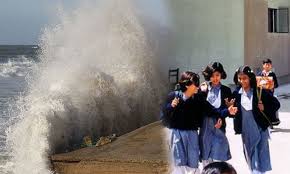
Cyclone Nilofer in Karachi (Credit: thenewstribe.com)
Cyclone Nilofer in Karachi
(Credit: thenewstribe.com)

KARACHI, Oct 30: The Sindh government has announced a holiday on Friday, declared emergency in the metropolis and four other districts and made arrangements for the board and lodging of coastal area residents being shifted to safe places in view of the cyclone that is heading towards the coast at a speed of 14 kilometres per hour.

Nilofar — the cyclone heading towards Sindh and Indian Gujarat — may slam the coastal areas here on Thursday afternoon with the possibility of heavy rains in the lower parts of Sindh over the next two days, a weather report indicated.

The Sindh government declared emergency in all the six districts of Karachi, besides Thatta, Badin, Sujawal and Tharparker, while it announced that all government offices and educational institutions would remain closed on Friday, said Sindh Information Minister Sharjeel Inam Memon while briefing media persons in his office in Clifton after attending the cabinet meeting held on Wednesday at the CM House.

The meeting, which was presided over by Chief Minister Syed Qaim Ali Shah and attended by ministers, bureaucrats and army and navy officers, discussed a cyclone, the drought in Tharparker and security situation in context of Muharram.

The minister said emergency centres had been set up in all the coastal areas, while appeals were being made to residents of the areas to shift for a few days to safe places within their district. He said Rs10 million was released to the district governments concerned to make proper arrangements to look after them.

He said the Sindh government had also made arrangements for the transportation of fishermen and others from all the coastal areas to safe places, where arrangements had been made for their free board and lodging.

He added that people had been asked to restrict their movement to escape accidents from gusty winds and heavy rains during the next two days.

In order to avoid loss of life, the government started removing large hoardings and also directed the owners to remove their billboards otherwise in case of losses they would be held responsible and action would be initiated against them, he added.

People have been advised not to come out from their homes, unless unavoidable, from Thursday noon until the cyclone threat was over, according to the minister.

However, he added, these measures were not aimed at creating fear and harassment among people but to take all precautionary measures.

In reply to a question, he said 80 per cent fishermen had already returned while remaining were also sent radio messages through coast guards, navy and maritime agencies and hoped that they would also return before the cyclone hit the coastal areas.

In reply to another question, Mr Memon said the Met Office had forecast 30 to 50-millimetre rainfall in Karachi while the coastal areas would receive over 100mm of rainfall and above.

Published in Dawn, October 30th, 2014

Prayer leaders booked to prevent sectarian clashes

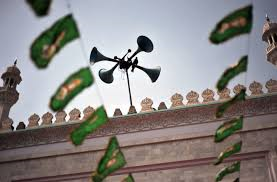
Moharram measures (Credit: dawn.com)
Moharram measures
(Credit: dawn.com)

ISLAMABAD, Oct 24: Prayer leaders (Khateebs) of 73 worship places in the city were booked for violating the ban on the use of loudspeaker during the Friday prayers.

A police officer said the use of amplifier for any speech except Azan was banned in the capital city. After a bloody clash between two religious groups in Rawalpindi on Ashura last year, the capital police have decided to implement the ban strictly.

He said the clash outside a worship place located on the Ashura route in Raja Bazaar last year was caused by the misuse of the loudspeaker.

“Last Friday, police officials met the Khateebs of all mosques and imambargahs in the capital city and asked them not to violate the ban,” he said. The Khateebs were further directed that their voice should remain confined to the premises of the worship places.

“In this regard, undertakings were also taken from them with the warning that legal action would be taken against them if the ban was violated.”


Violations were detected by police officials during Friday prayers


The officer added: “Today, a vigilance was mounted around all the worship places – 584 msoques and 30 imambargahs – in the city with the deployment of policemen in plain clothes to listen to the sermons of the Khateebs.

During the surveillance, the police officials found violations of the ban in the 73 worship places.

He said the khateebs of worship places belonging to the Deoband, Ahle Hadis, Barelvi and Shia sects found involved in the violation of the ban were booked under the amplifier act.

Nine cases were registered by the Sabzi Mandi police, six by Industrial Area, five each by the Aabpara, Bhara Kahu, Golra, Loi Bher, Nilor, Shahzad Town and Tarnol police. Four cases each were lodged with the Koral and Banigala police, two with the Secretariat and one case with the Ramna police.

There was no complaint about the violation of the ban in any worship place located in the jurisdiction of the Kohsar police.

However, the officer said the police deliberately delayed the arrest of the Khateebs. In the first step, the cases were registered against the violators for their refusal to follow the law.

There are over 600 worship places in the city and majority of them followed the law and did not commit any violation.

The police officer said arrests would be made if the Khateebs again violated the ban. Besides, their amplifier system would also be confiscated.

Senior Superintendent of Police (SSP) Asmatullah Junejo directed all the subdivisional police officers and the SHOs to ensure the implementation of the ban to maintain sectarian harmony and peace in the city.

Published in Dawn, October 25th , 2014

Balochistan Grows Poorer Sitting on Mounds of Gold

Reko Diq (Credit: thenewstribe.com)
Reko Diq
(Credit: thenewstribe.com)

QUETTA, Oct 25: The Balochistan government is under pressure to accept a negotiated settlement in a dispute with a company – Tethyan Copper Company (TCC), which was engaged in mining at Reko Diq Copper and Gold Project and which now seeks monetary compensation for federal and Balochistan governments’ ‘breaches of contract and treaty rights’ at an international court. 

During the recent two-week long hearing of the case, after which International Centre for Settlement of Investment Disputes (ICSID) in Paris reserved its judgment, the Pakistani legal team was also joined by political leadership – apparently for an out-of court settlement.

“Two committees were formed at federal and provincial level which went to Paris with a sole agenda—to have a negotiated deal with the TCC and out of court settlement,” an insider said on the condition of anonymity.

“The government committees had a separate briefing with the TCC and its parent companies – Antofagasta and Barrick Gold on Reko Diq project,” he said.

1

He said much before the hearing, the Attorney General of Pakistan had sent a letter to the Balochistan government, saying the case of Pakistan and Balochistan was weak and the latter was likely to lose out. “The AGP said the government would have to pay a fine of billions of dollars. So it was better to make an out-of-court settlement,” he said.

He said the Balochistan government was trapped now as it was trying to negotiate and also protect the interests of its people so that they would not be equally blamed for putting the invaluable resources on sale at throwaway prices.

Upon his return from Paris, Balochistan Chief Minister Dr Abdul Malik Baloch had said he would protect the interest of his people. He had not revealed anything about the possible deal but said he would take a decision in the best interest of Balochistan.

A government official said that Balochistan government is also trying to resolve the issue with the TCC before International court gives verdict.  The TCC has invested over 220 million US dollars in the project since 2006. “The company now claims around 12 billion US dollars in monetary damages,” a source told The Express Tribune.

Another government official said the TCC was not willing to work in Pakistan now. “Government is trying to resolve the issue because if the government is found guilty, then we have to pay billions of dollars in fine,” he said.

2

He said that since Balochistan did not have resources to pay such a huge amount, the federal government would pay the money from Balochistan government’s funds. Citing previous examples of federal government’s discriminatory policies, he said: “The federal government will pay the money from Balochistan’s National Finance Commission (NFC) Award or Federal Public Sector Development Programme (PSDP),” he added.

Sources in the provincial government said federal government did not care whether the contract was finalised with the TCC or a Chinese company and it only wanted to start the project to get maximum amount.

“Not a single person in Balochistan will agree to have a contract with Chinese mining companies,” an official said, adding that the companies involved in Saindak project at Chagai and Lead and Zinc Project in Dudar, Lesbela did nothing for the local communities or provincial economy ‘but ruthlessly exploited the resources.’

Published in The Express Tribune, October 25th, 2014.

Political debut for scion of Pakistan’s Bhutto dynasty

BILAWAL DEBUT (CREDIT: SBS.COM.AU)
BILAWAL DEBUT
(CREDIT: SBS.COM.AU)

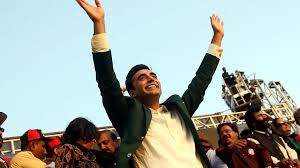
Islamabad, Oct 18 – ISLAMABADII The only son of Pakistan‘s assassinated Prime Minister Benazir Bhutto told hundreds of thousands of supporters on Saturday that he would fight for his party’s revival, in an appearance intended to mark the official launch of his political career.

“The fountainhead of our power is the people,” Bilawal Bhutto Zardari, 26, told the crowd in the port city of Karachi, Pakistan’s financial heart and home to 18 million people.

“If you want to save Pakistan, the only answer is Bhuttoism and the PPP,” he said, referring to his party’s acronym.

Police said 150,000 people attended the rally.

Symbolically, he stood on the roof of the same bus where his mother was assassinated exactly seven years ago in a gun and bomb attack after holding an election rally in the city of Rawalpindi in 2007. At least 180 people were killed that day.

The Bhutto dynasty has had a turbulent history, reflecting Pakistan’s own rises and falls in past decades. Bilawal’s grandfather, the founder of the Pakistan People’s Party (PPP), was hanged by a former military ruler in 1979.

The PPP ruled Pakistan from 2008 to 2013 until it was voted out in a landmark election that marked the first time in Pakistan’s military coup-prone history one elected civilian government replaced another.

The emergence of Bilawal Bhutto as an opposition figure is a worry for Prime Minister Nawaz Sharif, whose standing has been shaken by weeks of protests led by Imran Khan, a former cricket star, and Tahir ul-Qadri, a firebrand cleric.

The PPP’s five years in power, however, were marked by a series of confrontations with the powerful Supreme Court over a slew of corruption cases, and people gradually became disillusioned with its policies.

Bhutto, who bears a striking resemblance to his mother, was joined at Saturday’s rally by hundreds of high-ranking officials, including his father Asif Zardari, a former president and now co-chairman of the PPP.

Dozens of police, including female officers, stood guard near the stage as Bhutto and other senior leaders of the PPP delivered speeches.

POLITICAL REVIVAL?

Political observers say the election defeat last year has reduced the PPP to a provincial party with a vote bank only in Sindh province, its powerbase – a perception Bhutto will try to reverse.

Bhutto’s young age did not prevent huge crowds turning up for Saturday’s rally. He was not yet old enough to contest the 2008 elections as the minimum age is 25, but he will be old enough for the next vote in 2018.

Wearing a green blazer, the colour of the Pakistani national flag, he arrived by helicopter as thousands of supporters chanted “Prime Minister Bilawal Bhutto has arrived.”

Benazir Bhutto’s killer has never been caught and a U.N. inquiry found that Pakistani authorities had failed to protect her or properly investigate her death. The United Nations also said that high-ranking Pakistani officials had tried to block its investigation.

Benazir Bhutto has become a powerful symbol for the ruling party, which often refers to her as a martyr. The capital’s airport and a scheme to give cash to poor families have been named after her.

The Bhuttos have often championed the rights of the poor in a country where feudal landlords own vast tracts of land and agricultural workers often live in deep poverty. Many rally participants waved portraits of Benazir Bhutto wearing her trademark white headscarf.

Her husband Asif Ali Zardari, elected following her death and president of Pakistan until 2013, is less popular. Zardari was jailed on corruption charges from 1996 to 2004 that he says were politically motivated.

Pakistan’s Changing Political Landscape

AT the risk of gross generalisation, here is the takeaway from Multan’s by-election. One, ideological politics is dead. The left-right divide in terms of which we have analysed election prospects for the last four decades is no longer a useful analytical tool. Those whose political consciousness was shaped in the late ’60s and early ’70s by politics of left and right, liberalism and conservatism are now a minority. With an average national age of 23.5, the politicised youth of Pakistan that will decide the fortunes of political parties is non-ideological.

Two, the two-party system that emerged during the ’90s is undergoing a metamorphosis. PTI has emerged as the new mainstream party that is giving the traditional mainstream parties — PML-N and PPP — a run for their money. But the three-way contest in a non-ideological environment is more bad news for PPP than PML-N. The myth of the ’90s that the PPP voter stayed at home when unhappy as opposed to voting for another party stands busted. The PPP voter seems to be opting for PTI.

Three, in Punjab, PPP’s decline (or demise) has enhanced the number of floating votes. Not bound to the manifesto or ideology of a political party, this vote is portable. (This may also be because with no real difference between the socio-economic agendas of parties, the rhetoric in their manifestos is hardly distinguishable.) The floating voter makes snap choices. Absent ideology or competing reform agendas, such choice is influenced by tailwind built upon the credibility, rhetoric and charm of top leaders.


The Multan by-poll’s message is only indirectly for the PML-N and essentially for the PPP in Punjab.


Four, the average urban Punjabi voter seems to believe that the crisis of Pakistan has been caused by the absence of honest and capable leadership. The choice is thus not between PML-N and PTI, but between Nawaz Sharif and Imran Khan (which also partly explains the decline/demise of the Zardari-led PPP in Punjab). It might seem ironical that those who decry Sharif’s monarchical style believe that in replacing one man with another lies our panacea. For now the form of change that has captured public imagination is the reign of an untested ‘saviour’.

Five, because none of our mainstream parties have set out an agenda that carries mass appeal (such as Bhutto’s roti, kapra aur makan), the hope for change rests on the ability of a saviour to miraculously fix all things broken. The contemporary political conflict has come to be defined as one between incumbency and change. Imran Khan has built his brand as a system-outsider and change agent with Sharif as the status quo symbol. For Khan’s mesmerised supporters anyone backed by him becomes an agent of change by association.

Javed Hashmi was a change agent while on Khan’s right side and became part of the wicked old order as soon as he fell out with Khan. Are critics wrong to claim that PTI is selling old wine in a new bottle (with Shah Mehmood Qureshi and Amir Dogar representing change in Multan and Sheikh Rasheed in Rawalpindi)? In a political setting driven by individuals sans ideology, PTI is using Imran Khan’s oversight as the cleansing agent for ‘electables’ capable of managing elections locally, notwithstanding their past, and it seems to be working.

Bhutto could nominate a pole in the 1970 elections and it would win, so went the belief. It was Bhutto’s charisma combined with the promise of change backed by a reform agenda that led to the victory of nobodies nominated by PPP back then. The vote garnered by PTI in the 2013 elections established that Khan is now a vote puller. But his pull produced victories largely where it was complemented by the local candidate’s ability to manage the election. The message was reinforced when bad candidates cost PTI the seats its chief vacated in Peshawar and Mianwali.

The Multan by-election’s real message is only indirectly for PML-N and essentially for PPP in Punjab. That it is getting wiped out. What does this mean for political families and clans still associated with PPP (ie the likes of Amir Dogar, PPP’s ex-secretary general for southern Punjab)? And what happens if PTI manages to pull significant numbers in PPP’s heartland in Larkana to back its claim that its message is resonating across Pakistan?

If despite Yousuf Raza Gilani’s best efforts, PPP could only bag 6,000 votes in Multan (southern Punjab being PPP territory prior to 2013 and all) and is seen struggling to keep its support intact even in Sindh, the message heard in Punjab will be simple: the next electoral conflict will be between PML-N and PTI, with PPP being a sideshow. Post-Larkana, those PPP-ites interested in pursuing careers in Punjabi politics might be tempted to jump ship and join PTI while it is still in the business of whitewashing electable politicos from other parties.

What does this mean for the timing of change? Unfortunately for PTI, the mechanics of change haven’t changed. The Multan by-election reminds us that while rallies are important markers of public opinion, public mandate only flows out of elections. The two non-representative institutions with some ability to instigate mid-term polls are the army and the judiciary. When the khakis could have intervened during the recent stand-off on Constitution Avenue, the army chief said no thank you. He won’t retire till the end of 2016.

The post-Iftikhar Chaudhry judiciary also seems disinterested in playing a role in shaping the country’s political landscape and rightly so. No number of jalsas will cause Sharif to call an early election. Resignation from the 30-odd seats PTI has in parliament won’t trigger mid-term polls. PPP and MQM have no incentive to invite early elections through mass resignations; both parties might lose seats if an election is held today, and in a status quo vs change election they will both be pitted against PTI.

In a nutshell, PTI’s politics of street agitation might keep a dazed PML-N government rickety, but there presently exists no conceivable mechanism to bring it down. Whether PTI with its ongoing romance with expediency will be able to induce reformative change in Pakistan if voted into power is an entirely different question.

Rangers Foil TTP Affiliates Escape through Karachi Jail Tunnel

KCJ tunnel detected (Credit: dawn.com)
KCJ tunnel detected
(Credit: dawn.com)

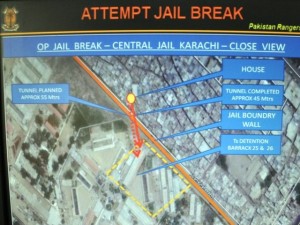
KARACHI, Oct 15: A 45-metre-long and 10-metre-deep tunnel being built just a few metres from the Karachi Central Jail to spring 100 ‘dangerous militants’ was discovered in a house situated in a neighbouring locality, an officer disclosed on Monday.

Several suspects belonging to a banned outfit were arrested when the house was raided this weekend, while five more suspects were later picked up on information provided by them during interrogation. The move was followed by a jail operation during which all prisoners were searched physically that led to the recovery of electric wires, scissors, radios, jihadi literature, knives, party flags and a modified ladder, said a Rangers spokesperson.

The house situated in Ghausia Colony, a shanty town close to the main penitentiary in Karachi, had been bought by the suspects some five months ago, said Col Tahir Mehmood of Pakistan Rangers, Sindh, while speaking at a press conference at the Rangers Headquarters.

“They were only 10 metres from their target when the raid was conducted,” the colonel said.


80pc digging work had been done when suspects caught


There’s an underground water tank in the house where the suspects had started tunnelling their way to the jail, the officer said. He explained that they were using ‘sophisticated equipment’ for digging, besides having arranged lights and some wooden stuff to keep the tunnel dry.

He added that the activity had been on for the past four and a half months.

“The suspects had dug up the tunnel up to 45 metres and they needed 10 metres more to reach their target” when the house was raided with the help of a national security institution on the night between Oct 11 and 12, he said.

Their intended target appeared to be a barrack unit housing around 100 ‘dangerous militants’ and they had planned to reach the target through a dry well, said the officer. Due to ‘groupings’ inside the jail, prisoners belonging to one school of thought were kept in same barracks, said a senior official of the home department. He added that 100 prisoners could be kept in a single barrack unit of the jail that housed over 5,000 prisoners.

While Col Tahir did not disclose the number of suspects picked up from the house and name of the militant group they belonged to, he did confirm that the suspects belong to ‘a banned outfit’ and that ‘five more suspects’ were rounded up on information provided by them.

Speaking about the location of the house, he said there was a road between the central prison and its adjacent neighbourhood Ghausia Colony. As it was an ‘unauthorised’ settlement, he added, the law-enforcers were investigating to ascertain the actual owner of the house.

However, provincial minister for prisons Manzoor Wasan, who along with the inspector general of prison Nusrat Mangan visited the house, told the media that its owner was a policeman who had sold it at a price four times its market price some months ago.

“The actual price of the house was Rs0.3 million but the policeman had sold it for Rs1.4 million,” said the minister. He said the police official whose name he did not disclose would also be interrogated.

To find out if the suspects had ‘inside help’, a committee led by the home secretary was constituted, said Mr Wasan.

In reply to a question, the minister for prisons said that security around the central jail was mainly the responsibility of Rangers, police and other institutions.

Asked about the dry well mentioned by the Rangers officer at the press conference, Mr Wasan made it clear that there was no dry well in the house. “Instead there was a gutter adjacent to a mosque, which leads to the prison,” he added.

Mr Wasan said the suspects had dug up tunnel up to 45 metres but they had not crossed the road yet.

High-security prison

Meanwhile, progress on a proposal for setting up a ‘high security prison’ in Nooriabad, where all ‘dangerous prisoners’ would he shifted, was reviewed at a meeting presided over by Sindh Chief Secretary Sajjad Saleem Hotiana.

The meeting was informed that the project would cost Rs1.5 billion.

The chief secretary directed the special secretary finance for early release of the fund.

Mr Hotiana said that a committee, led by DIG South Barrister Abdul Khalique Shaikh, was set up to probe the matter and submit its report within a week. Additional home secretary, representative of the jail administration and others would be part of the committee that the chief secretary said had been constituted with the approval of the chief minister.

The meeting also reviewed the security of prisons in Hyderabad, Sukkur and other areas.

Published in Dawn, October 14th, 2014

Balochistan Rights Violations Persist under New Government – HRCP

HRCP president, Zohra Yusuf (Credit: dawn.com)
HRCP president, Zohra Yusuf
(Credit: dawn.com)

QUETTA, Oct 12: The Human Rights Commission of Pakistan (HRCP) has expressed concern over rights violation in Balochistan, the country’s resource-rich but least developed province.

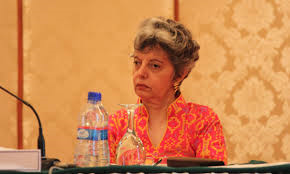
HRCP delegation, headed by chairperson Zohra Yusuf, held a series of meetings with journalists, lawyers, politicians and other members of civil society on Sunday.

Former president of the Supreme Court Bar Association (SCBA) Asma Jehangir was also part of the delegation that thoroughly discussed the prevailing situation in Balochistan with the intelligentsia and other stake holders.

Addressing a press conference at the Quetta Press Club later in the day, Yusuf stated that poverty was one of the underlying factors behind the increase in militancy and insurgency in the province.

She said the issue of missing persons and recovery of bodies in Balochistan continued to linger, adding that the nationalists led government in the province had not met the expectations of the people of Balochistan.

She said although the situation had improved in comparison with the past, a lot needed to be done to improve the situation in Balochistan.

Yusuf stated that it was a matter of serious concern that different communities were being targeted in Balochistan. “Minorities feel insecure here”, she added.


Also Read : HRCP for talks with Baloch insurgents


The HRCP prepared different recommendations with regard to improvement of the human rights situation in Balochistan, which would be presented before the federal and provincial governments to ensure durable peace in the restive province.


Also Read: HRCP demands release of Zahid Baloch


Commenting on the ongoing political crisis in the country, Asma Jahangir stated that the motive behind the sit-ins was common knowledge.

She added that the armed forces’ intervention in the affairs of the government would be dangerous for the country.

Rangers arrest over 2,000 politically patronized criminals in 1 yr

ISLAMABAD: Over two thousand criminals have been arrested since the start of the Rangers-led operation in Karachi, an official of the Sindh Rangers told the Senate Standing Committee on Interior Affairs on Monday.

During a meeting of the committee today, Colonel Tahir Mehmood of the Sindh Rangers submitted a report detailing the progress of the operation against criminal elements in the metropolis.

According to sources, the report claimed that suspects arrested included those belonging to the outlawed Tehreek-i-Taliban Pakistan (TTP), the banned People’s Amn Committee, the Muttahida Qaumi Movement (MQM), Awami National Party (ANP), and hundreds belonging to banned outfits.
The Rangers report claims that around 2,251 criminals were arrested during the operation, said sources.

373 raids were carried out on MQM offices in which 560 MQM workers were arrested and a large cache of weapons was recovered.
18 raids were carried out on offices of the ANP in which 40 people were arrested and 21 weapons were recovered, he said.

396 raids were carried out against the banned Amn Committee, in which 539 people were arrested and 591 weapons were recovered.

403 raids were conducted against the outlawed Tehreek-i-Taliban Pakistan (TTP), in which 760 alleged terrorists were arrested and a large cache of weapons and explosives was recovered.

159 raids were carried out against other banned outfits, in which 352 suspects were arrested and 463 weapons were recovered.

2347 other raids were conducted in which 4584 other suspects were arrested, said sources privy to the meeting.

When contacted by Dawn, spokesman for the Sindh Rangers Major Sibtain declined to comment on the numbers. He confirmed that a report had been submitted to the standing committee, but he was not authorised to share the details with the media.
According to sources, Colonel Tahir Mehmood told the committee that the suspects arrested during a raid on Sept 24 also included three notorious target killers.

Mehmood claimed that a search operation was recently carried out in Karachi’s Gulshan-i-Maymar area after security personnel were fired upon.

Mehmood said that 23 people were arrested, including three notorious target killers whose names are also mentioned in a list of 143 most wanted criminals submitted to Governor Sindh Dr Ishratul Ibad.

Mehmood further claimed that eight of the detainees were proclaimed offenders involved in several crimes and have been handed over to the police.

The Rangers official further said that 12 of the 23 detainees were handed over to MPA Faisal Sabzwari and Dr Sagheer Ahmed of the MQM, said the sources.

MQM chief Altaf Hussain has recently lashed out against the Sindh Rangers claiming that only his party is being subjected to raids and arrests when the Supreme Court has ruled that all political parties in Karachi have militant wings.
Speaking to Dawn.com today, MQM MPA Faisal Sabzwari pointed out that the report claims security forces have arrested only 60 suspected terrorists belonging to the TTP, while 560 MQM workers have been picked up. He said that the numbers raise the question of misplaced priorities of the security forces in the Rangers-led operation.

About the allegation of target killers being arrested in the Gulshan-i-Maymar raid, Sabzwari said that the MQM would contest these claims in court. “If the Rangers or police have evidence, then the MQM will never support any criminals. But workers have been picked up solely on the basis of their affiliation with the MQM,” he said.

Contradicting the numbers, the MQM leader said that at least 700 MQM workers have been sent to jail, while thousands of party workers have been detained since the start of the operation.

He added that the low number of arrests of government-backed groups and other terrorist outfits “contradicts the claims of neutrality and impartiality” by the security forces.
The MQM recently carried out a number of protest sit-ins in Karachi claiming that 41 party workers have been missing since the start of the operation. MQM further claims that several party workers picked up by the Rangers have been tortured to death.

New Chief of Spy Unit Is Appointed in Pakistan

ISI chief Rizwan Akhtar (Credit: tribune.com.pk)
ISI chief Rizwan Akhtar
(Credit: tribune.com.pk)

ISLAMABAD, Sept 22 — The Pakistani military chief, Gen. Raheel Sharif, on Monday appointed a close ally as head of the powerful Inter-Services Intelligence spy agency, consolidating his power at a time of sharp tension with the country’s civilian leaders and fluctuating policy toward the Taliban.

The new ISI chief, Lt. Gen. Rizwan Akhtar, had previously led the paramilitary Sindh Rangers based in Karachi. He will replace Lt. Gen. Zaheer ul-Islam, who has led the ISI since 2012 and is scheduled to step down on Nov. 7.

The army spokesman announced the promotion of General Akhtar, who was also promoted from the rank of major general, among a reshuffle of five major military posts. But it was the appointment of the ISI chief, considered the second most powerful position in the military, that attracted the most attention.

Always shrouded in controversy, the ISI has in recent months come under particularly sharp scrutiny amid accusations of political interference and brutal tactics to control the media.

Lt. Gen. Rizwan Akhtar Credit Pakistan Rangers, via Associated Press Under General Islam’s leadership, the spy agency was accused of trying to assassinate a senior journalist, Hamid Mir. And the military has been widely accused of supporting an opposition movement led by a former cricketer, Imran Khan, and a cleric, Muhammad Tahir-ul Qadri, that aimed to oust Prime Minister Nawaz Sharif. The military has publicly rejected both accusations.

Analysts said they expected that General Akhtar, who recently led a campaign against the Taliban in Karachi, was likely to shy away from such a prominent political role — at least initially. But there is little doubt that he inherits a strained relationship with the country’s civilian leadership, which was evident from the manner of his appointment.

Though the ISI chief theoretically answers to the prime minister, the fact that General Akhtar’s promotion was announced by the military was taken as a sign of the true line of authority.

Mutual paranoia is a central factor in poor relations among the military and civilian leaders, said Talat Masood, a retired general and commentator.

“The relationship has gone through a really bad patch, with all this speculation that elements in intelligence are supportive of Imran Khan and Qadri,” he added. “I think that will subside now.”

General Sharif and Mr. Sharif — they are not related — have been at odds over the fate of Geo, the television channel where Mr. Mir was the leading anchor before being attacked in April, and over street demonstrations.

Mr. Sharif’s supporters privately accuse the ISI of covertly playing a role in both dramas — possibly with a view to ousting Mr. Sharif, much as his last stint in power ended in 1999.

The ISI has a long history of undermining civilian governments in Pakistan. Although the previous army chief, Gen. Ashfaq Parvez Kayani, pledged to end the spy agency’s political role in 2008, it has continued to operate behind-the-scenes.

The ISI has also suffered several major embarrassments, including the American commando raid in May 2011 that killed Osama bin Laden near a major army training center in Abbottabad.

For American officials, though, General Akhtar may offer hope of an improved relationship. In a paper written during a period of study at the Army War College in Pennsylvania in 2008, he stressed the need to establish a stable democracy in Pakistan and to curb anti-Americanism in the country.

Later, he led anti-Taliban operations in the South Waziristan tribal agency, near the border with Afghanistan. In 2011, he became head of the Sindh Rangers, drawing praise from civilian leaders for his role in an operation against the Taliban and armed gangs linked to Karachi’s political parties.

“His role in maintaining peace in the city was remarkable,” said Sharfuddin Memon, an adviser to the home minister of Sindh Province. But human rights activists say the same period was marked by a rise in abuses by security forces, including abduction, torture and extrajudicial execution.

Declan Walsh contributed reporting from London.

The England That Is Forever Pakistan

London, Sept 15 — A man recently came to visit the member of Parliament for Rotherham, Yorkshire, and he had a question. Now in his late 50s, he had arrived from Pakistan three decades earlier. After a lifetime of hard work, he could not understand why his boys did not display the same Muslim values he had, why they did not show respect or want to work as hard as he did.

“I tried really hard to bring them up right,” the man told the M.P., “and I don’t know what has gone wrong.”

What has gone wrong in Rotherham, and what is wrong with its Pakistani community, are questions much asked in recent weeks: How could this small, run-down town in northern England have been the center of sexual abuse of children on such an epic and horrifying scale?

According to the official report published in August, there were an estimated 1,400 victims. And they were, in the main, poor and vulnerable white girls, while the great majority of perpetrators were men, mainly young men, from the town’s Pakistani community. Shaun Wright, the police commissioner who was responsible for children’s services in Rotherham, appeared before Parliament after his refusal to resign over the scandal. The scandal has cost both the chief executive and the leader of the council their jobs, and four Labour Party town councilors have been suspended.

A popular explanation for what Home Secretary Theresa May has described as “a complete dereliction of duty” by Rotherham’s public officials is that the Labour-controlled council was, for reasons of political expediency and ideology, unwilling to confront the fact that the abusers were of Pakistani heritage. Proper investigation, it is said, was obstructed by political correctness — or, in the words of a former local M.P., a culture of “not wanting to rock the multicultural boat.”

This, however, is only a partial explanation, and a partisan one. It fails to account for how a community once lionized as “more British than the British” — pious, unassuming and striving — is now condemned for harboring child abusers in its midst.

Pakistanis first came in significant numbers to Rotherham in the late 1950s and early ’60s, in the wave of immigration that brought men from the Indian subcontinent to Britain, largely to do work that the indigenous white working class no longer wanted. My father was part of this first wave. He worked on the production line of the Vauxhall car factory in Luton, an unlovely town north of London. In Rotherham, many Pakistani men ended up doing dirty, dusty work in the steel foundry.

The new immigrants were from rural villages, typically in Kashmir, the northern province bordering India; they were socially conservative and hard-working. When I was growing up in the ’80s, the stereotype of Pakistanis was that we were industrious and docile.

The Pakistani community in Rotherham, and elsewhere in Britain, has not followed the usual immigrant narrative arc of intermarriage and integration. The custom of first-cousin marriages to spouses from back home in Pakistan meant that the patriarchal village mentality was continually refreshed.

Continue reading the main story Continue reading the main story Britain’s Pakistani community often seems frozen in time; it has progressed little and remains strikingly impoverished. The unemployment rate for the least educated young Muslims is close to 40 percent, and more than two-thirds of Pakistani households are below the poverty line.

My early years in Luton were lived inside a Pakistani bubble. Everyone my family knew was Pakistani, and most of my fellow students at school were Pakistani. I can’t recall a white person ever visiting our home.

Rotherham has the third-most-segregated Muslim population in England: The majority of the Pakistani community, 82 percent, lives in just three of the town’s council electoral wards. Voter turnout can be as low as 30 percent, so seats can be won or lost by a handful of votes — a situation that easily leads to patronage and clientelism.

Rotherham is solidly Labour; the last Conservative M.P. lost his seat a month after Adolf Hitler was elected the chancellor of Germany. The Labour politicians who governed Rotherham in the last decade came into politics during the anti-racism movement of the ’70s and ’80s. Their political instinct — and self-interest — was not to confront or alienate their Pakistani voters. Far easier to ally themselves with socially conservative community leaders, who themselves held power by staying on the right side of the community.

These dynamics help explain why so few spoke out about the culture that produced the crimes — a culture of misogyny, which Baroness Sayeeda Warsi, a Conservative politician who was raised near Rotherham, criticized in 2012, saying that it permits some Pakistani men to consider young white women “fair game.” It would be a brave leader, Pakistani or otherwise, who would tell the Pakistani community that it needed to address such issues, or that the road to progress required Pakistani parents to relax their strictures and allow their sons and daughters to marry out.

If working-class British Pakistanis had been better represented in the groups that failed them — the political class, the police, the media and the child protection agencies — it is arguable that there would have been a less squeamish attitude toward the shibboleths of multiculturalism. British Pakistanis may be held back by racism and poverty, but by cleaving so firmly to outmoded prejudices and fearing so much of the mainstream culture that swirls around them, they segregate themselves.

I owe much to the fact that my family moved from a Pakistani monoculture in Luton to a neighborhood that was largely white, where I learned to challenge many of the attitudes and expectations my parents had instilled. An enlightening breeze of modernity needs to blow through those pockets of England that remain forever Pakistan.

The grim fact of child sex abuse is that it is not limited to any country, community or creed — witness the cases of leading white television stars who have been convicted of the crime in Britain, and the experience of the Catholic Church in Ireland and America. Most Pakistani men, in Rotherham or elsewhere, do not, of course, turn to criminality or become child abusers. But Rotherham’s abusers found that their ethnicity protected them because they belonged to a community few wished to challenge.

What may seem like a story about race and religion, however, is as much one about power, class and gender. The Pakistanis who raped and pimped got away with it because they targeted a community even more marginal and vulnerable than theirs, a community with little voice and less muscle: white working-class girls.

In the rush to denounce multiculturalism, it would be wise to consider not only what gave the perpetrators the license to abuse, but also to reflect on what led to the victims being so undervalued that their cries were ignored.

Sarfraz Manzoor is the author of the memoir “Greetings From Bury Park.”