Out and about: Jiyalas throng to welcome Zardari

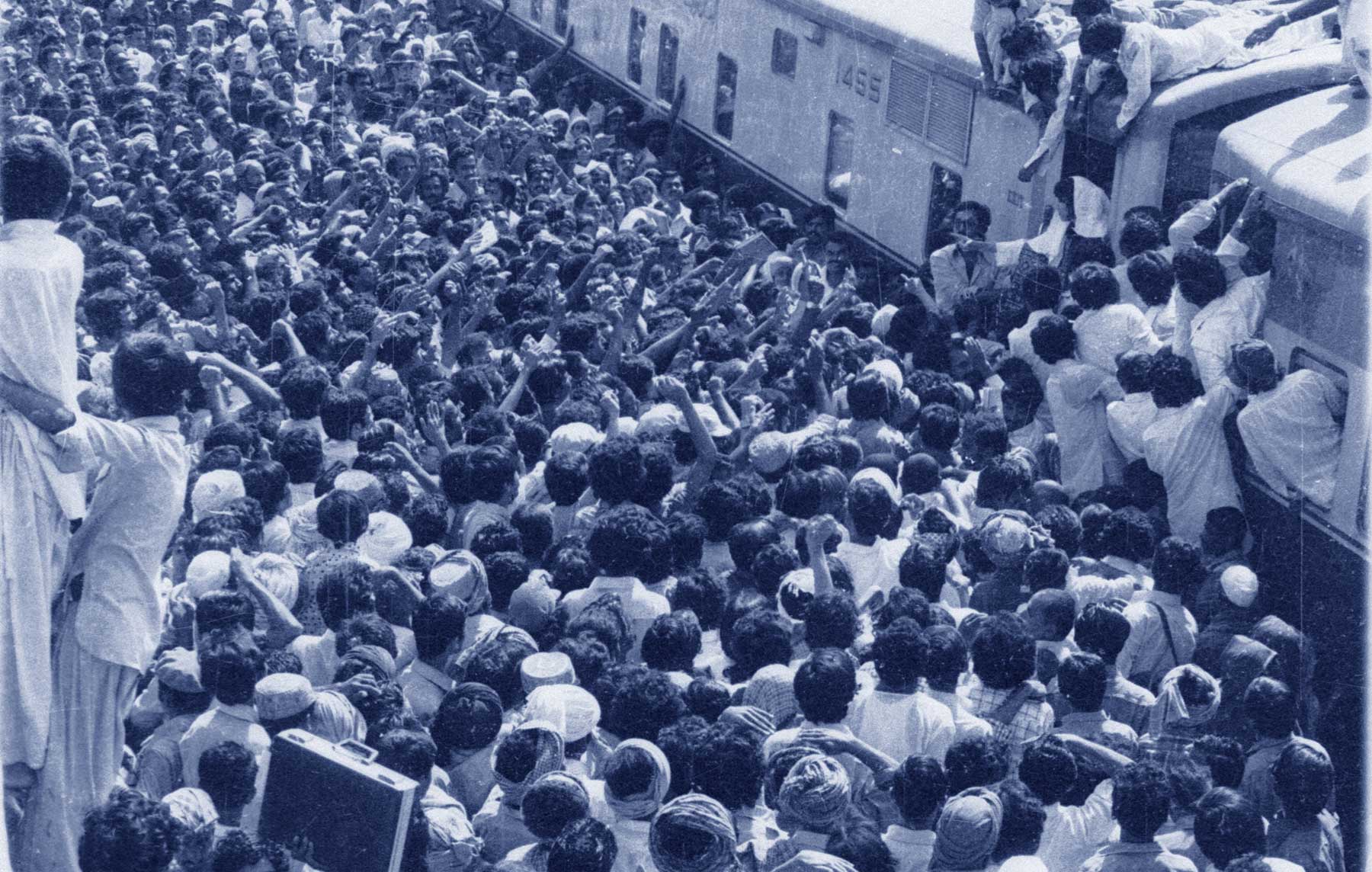
KARACHI, Dec 24: Like devotees walking to a pilgrimage, a large number of Pakistan Peoples Party (PPP) workers marched towards the old terminal of the Karachi airport from Star Gate to welcome their co-chairperson, Asif Ali Zardari, on Friday.

It appeared like a festival. People from all walks of life – from students and housewives to parliamentarians and corporate bosses – everyone who gathered, sported a smile alike, making victory signs to the cameras trying to focus on them.

“Bibi [slain former prime minister Benazir Bhutto] ka shohar, Bilawal ka baap aa raha hai. Khushi to bohat hai [The husband of Benazir Bhutto and the father of Bilawal is coming. It is immense happiness],” Kulsoom Baji, a jubilant worker of the party from its stronghold, Lyari, said, tailing her sentence with “Allah… “ as she clasped her hands together in a thanksgiving manner.

Slogans such as ‘Sub pay Bhari, Shairon ka Shikari, Phir agli Baari [Heavy on all, the hunter of lions, another turn for him]’ were raised with zeal. Nonetheless, the slogan of ‘Jiye Bhutto [Long Live Bhutto]’ maintained the ambience as workers religiously respond to it.

As the half of the nearly one-kilometre-long and 50-foot-wide Star Gate Road was allocated as Jalsa Gah, it was full to the brim with people at the peak time when Zardari spoke from behind a bullet-proof glass shield atop the same truck his slain wife used when she returned to the country.

Security was tightened around the premises since a day earlier. Public was allowed entry and exit from a single point. PPP leaders, including Chief Minister Murad Ali Shah, used the other road passing through the PIA engineering department building.

While a large number of people had gathered at the event, most of them appeared less interested in listening to the speech of their leader and were more engrossed in taking selfies. Nonetheless, some transmitted the speech and activities at the gathering live on social media through their smartphones.

Besides the workers, street vendors selling samosas, coconut pieces, paapar and other eatables made the most of the situation to boost their sales. They strolled about through the road, attracting customers with their unique calling.

As Zardari concluded his speech, the public walked back to the exit points all at once, resulting in a traffic mess on the road and the connecting Sharae Faisal. Traffic personnel were seen trying to handle the situation. However, most of the people seemed to be in a hurry as they had to catch a flight about to take off at the nearby Jinnah Terminal.

Traffic mess
Residents of Karachi faced immense difficulty in reaching the airport as the most important artery of the city got choked.

However, the Karachi traffic police had issued a diversion plan two days before Zardari’s arrival. During the procession, when thousands of PPP supporters had thronged the old terminal, Star Gate and Drigh Road got completely blocked due to parking of cars on the roads. People heading towards and leaving the airport also remained stuck at the Jinnah International Airport until the crowd dispersed.

No journalist murdered in Pakistan in 2016, says CPJ report

No journalist was murdered in Pakistan “in retaliation for their work” in 2016, a first since 2001, a recent study reported.

The Committee to Protect Journalists (CPJ), an independent organisation working to promote press freedom worldwide, in its special report launched on Monday said that it “did not identify anyone singled out for murder in Pakistan because of journalist work” — for the first time in 15 years.

The organisation classifies murder as “the targeted killing of a journalist, whether premeditated or spontaneous, in direct relation to the journalist’s work”.

At least 33 journalists have been targeted and killed “in retaliation for their work” since 1992, CPJ further said in its press statement.

However, many Pakistani journalists have resorted to self-censorship or have abandoned the profession altogether to avoid “grave risks”, CPJ added.

A report released by Pakistan Press Foundation (PPF) in November said, “Media houses and media persons are not only being targeted but threatened, pressurised, intimidated and harassed by the state and non-state elements.”
“Threats and violence have forced many journalists to move from these danger zones and to leave the profession or to resort to self-censorship, particularly in conflict areas,” it added.

Aside from murder and crossfire/combat, CPJ also records deaths of journalists who were killed while on a “dangerous assignment such as covering political unrest”.

According to CPJ, at least three journalists died while covering such assignments in 2016, two of whom were Pakistani. In August, DawnNews cameraman Mehmood Khan and Aaj TV cameraman Shehzad Ahmed were killed in a bomb blast at the Quetta Civil Hospital.

The slain crew members were in the hospital, covering a large group of lawyers mourning the murder of the president of the Balochistan Bar Association.

Read more: Remembering my fallen colleague Mehmood Khan, on his birthday

Terrorist groups have repeatedly launched secondary attacks targeting mourners or people rushing to the scene of a first attack, CPJ maintained.

“Such secondary attacks put journalists, who often cover the funerals and the aftermath of bombings, at special risk.”

CPJ said in the press release that its staff members independently investigate and verify the circumstances surrounding the death of a journalist.

“CPJ considers a case work-related only when its staff is reasonably certain that a journalist was killed in direct reprisal for his or her work; in combat-related crossfire; or while carrying out a dangerous assignment,” the statement added.

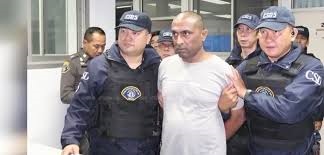
Prime accused in Baldia factory case brought to Karachi

KARACHI, Dec 13: Main accused of the Baldia factory fire was brought to Karachi from Bangkok here on Tuesday.
two-member Federal Investigation Agency�s team had gone to Bangkok after Bangkok police and Interpol arrested former Muttahida Qaumi Movement (MQM) Sector In-charge and main accused in the Baldia factory fire case.

According to the charge sheet of Baldia factory case, Abdul Rehman alias Bhola, alongwith other accused set a fire to garment factory after its owner refused to pay extortion to the chief of the MQM Tanzeemi Committee, Hammad Siddiqui. The incident, occurred on 11 September 2012, had taken lives of 258 innocent factory workers.

Abdul Rehman had been absconding with multiple non-bailable arrest warrants being issued by the court but he remained at large till the Bangkok police and Interpol arrested him from hotel in the Thailand capital. Abdul Rehman, 46, was detained at a hotel in the red light district Nana area of the capital on Friday evening, said Thailand’s Interpol chief. Addressing a news conference on Saturday the Bangkok Police Chief said Thailand had Zero tolerance for criminals. He said that Bhola will be handed over to Pakistan authorities upon their arrival into the Thai Capital.

According to reports, quoting Major General Apichart Suriboonya, the Thai Interpol tracked Bhola following an arrest warrant sought by the Pakistani authorities.

FIA deputed to officers, deputy director Badaruddin Baloch and Inspector Rehmatullah Dhomki, to bring back Bhola from Thailand. Sources said that Bhola, a close aide of former Tanzeemi Committee head Hammad Siddiqui, had joined the Mustafa Kamal led Pak Sarzameen Party. According to membership form, Abdul Rehman s/o of Abdul Sattar, age 45, is resident of Baldia Town and is government official in Karachi Metropolitan Corporation.

Pak Sarzameen Party (PSP) chief Mustafa Kamal A, while talking to media in Lahore denied that his party had any association with Abdul Rehman alias Bhola. Bhola was never a member of PSP, we categorically deny this claim. Anyone can download and fill the party form off the internet, Kamal told. The whatasapp group and social media website, especially Twitter, were flooded with Bhola family members being snapped with PSP leaders in Pakistan House.

Lt Gen Qamar Javed Bajwa chosen as new army chief

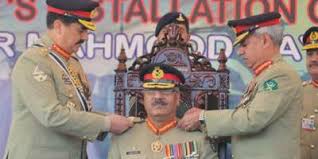
After weeks of intense speculation and rumours, Prime Minister Nawaz Sharif has finalised the selection of two senior army officers as Chief of Army Staff (COAS) and Chairman Joint Chief of Staff Committee (CJCSC), reported DawnNews.

A career infantry officer belonging to the Baloch Regiment, Lt Gen Qamar Javed Bajwa has been appointed as the new COAS, while Lt Gen Zubair Hayat has been appointed the CJCSC.

Lt Gen Qamar Javed Bajwa and Lt Gen Zubair Hayat will be promoted to the rank of four-star generals.

Both generals would take up their new posts from Tuesday, the day the current army chief Raheel Sharif retires.

Others in contention for the post of army chief were Bahawalpur Corps Commander Lt Gen Javed Iqbal Ramday and Multan Corps Commander Lt Gen Ishfaq Nadeem.
All four generals are from the PMA’s 62nd long course, but have had different career trajectories.

The formal process for nomination starts with the General Headquarters sending a list of the senior-most generals to the prime minister via the defence ministry, but without making any formal recommendations.

The PM then holds informal consultations with the outgoing army chief before announcing his decision.

Lt Gen Qamar Javed Bajwa

Lt Gen Qamar Javed Bajwa was something of a dark horse in this race for the post of COAS.

He is currently serving at the GHQ as Inspector General of Training and Evaluation — the position Gen Sharif held before becoming army chief — he has commanded the 10 Corps, the army’s largest, which is responsible for the area along the Line of Control (LoC).

Lt Gen Bajwa has extensive experience of handling affairs in Kashmir and the northern areas of the country. As a major general, he led the Force Command Northern Areas. He also served in the 10 Corps as lieutenant colonel, where he was GSO.

Despite his extensive involvement with Kashmir and northern areas, he is said to consider extremism a bigger threat for the country than India.

Lt Gen Bajwa has served with a UN mission in Congo as a brigade commander alongside former Indian army chief Gen Bikram Singh, who was also there as a division commander.
He has previously also remained the commandant of the Infantry School in Quetta.
His military colleagues say he is not attention-seeking and remains well-connected with his troops.

“He is extremely professional, but very easy-going and full of compassion,” an officer who had served under him said, adding that he was not protocol-minded either. Gen Bajwa is also said to be an apolitical person without any biases.

He is from the infantry’s Baloch Regiment, which has given three officers to the post of army chief — Gen Yahya Khan, Gen Aslam Beg and Gen Kayani.

Lt Gen Zubair Hayat
Lt Gen Zubair Hayat is from the artillery and the serving Chief of General Staff (CGS).

As a three-star general, he was previously posted as director general of the Strategic Plans Division (SPD), which is the secretariat of the NCA; and corps commander Bahawalpur. This makes him an ideal choice for the post of CJCSC, who has an almost exclusive jurisdiction over nuclear forces and assets.

His postings as CGS and DG SPD afforded him an opportunity to work very closely with PM Sharif and Finance Minister Ishaq Dar.

Pakistan Army Chief Raheel Sharif Starts Retirement Tour

ISLAMABAD, Pakistan—Pakistan’s army chief began a farewell tour ahead of his scheduled retirement, indicating he will become the first army chief in two decades to step down on time in a country usually fraught with tensions over the role of the powerful military.

Gen. Raheel Sharif, 60 years old, is credited with leading counterterrorism operations that significantly reduced militant activity across Pakistan during his three-year tenure. He is also seen as a driving force behind a crackdown on the militant wings of political parties in Karachi, which helped stabilize the country’s largest city and economic hub.

Gen. Sharif’s two predecessors both received term extensions. Some opposition politicians and media commentators in Pakistan had questioned whether Gen. Sharif would serve beyond his retirement date of Nov. 29. However, Pakistan’s military said as early as January that the general would retire on schedule.

The start of Gen. Sharif’s retirement tour on Monday, which the military spokesman announced, was taken as further evidence he intended to step down on time. Departing military chiefs traditionally tour bases across the country and hold farewell meetings with other officials.

Prime Minister Nawaz Sharif, who appointed the general to his post in 2013, sees a timely transition at the end of Gen. Sharif’s term as an important test of civilian rule in Pakistan’s long-running tug of war between elected officials and the military, according to the prime minister’s aides. The two Sharifs aren’t related.

Gen. Sharif’s successor is expected to be named in the coming days. The prime minister will choose from a list of candidates after consulting with Gen. Sharif and cabinet members, said defense minister Khawaja Muhammad Asif, who is a senior member of the ruling party.

The position of army chief is one of the most powerful offices in Pakistan. The country has a history of tensions between civilian governments and the military, including long periods of military rule. Gen. Sharif strengthened the military’s role in foreign and security matters during his term.

Hasan Askari Rizvi, an independent political analyst, said Gen. Sharif was probably looking to leave on a high note and avoid the turmoil that has plagued successors who sought term extensions. “He didn’t want to compromise his success in counterterrorism,” Mr. Rizvi said.
Ruling party aides said a punctual transition between army chiefs would mark a milestone for democracy in Pakistan.

“No other military in the world has achieved the kind of victories against terrorism like our army has under Gen. Sharif’s command,” said Mr. Asif, the defense minister. “Gen. Sharif is leaving behind a legacy that he and the armed forces can be proud of.”

“Accomplishment of peace and stability [is] no ordinary task. Our sacrifices and joint national resolve helped us in offsetting all odds against [the] country,” Gen. Sharif said during a farewell visit to soldiers in the eastern city of Lahore, according to military spokesman Lt. Gen. Asim Bajwa.

Imran Khan abandons Islamabad protest after inquiry into PM granted

Imran Khan has abandoned plans to bring Islamabad to a standstill after Pakistan’s highest court agreed to his petition to launch an inquiry into corruption allegations against the prime minister.

Khan, the leader of the Tehreek-e-Insaf party (PTI), had vowed to “lock down” Pakistan’s capital on Wednesday as part of his campaign against Nawaz Sharif after the leaking of the Panama Papers.

He says the prime minister must explain how his children became owners or trustees of offshore companies that own expensive London property.

The cricket star turned politician hopes the tax leaks will be the downfall of Pakistan’s prime minister. As he battles elitism, what does he make of his former brother-in-law Zac Goldsmith’s campaign to be London mayor?

With thousands of Khan’s supporters bearing down on the capital on Tuesday, the supreme court offered a way out of the crisis, saying the PTI and the governing Pakistan Muslim League (Nawaz) (PML-N) had until Thursday to agree terms of reference for the judge-led inquiry or the court would decide them.

Sharif and his children deny any wrongdoing, but Khan has suggested that the family’s offshore companies may have been used to hide “ill-gotten wealth” or avoid tax.

The imposing supreme court building was surrounded by heavy security for a hearing that attracted leading politicians from the government and the opposition.

Islamabad had been braced for the arrival of thousands of Khan’s supporters, in a repeat of the PTI’s 2014 street protests that lasted four months.

Fearing violent confrontations in the heart of the capital, the government had taken extraordinary steps to head off the protests, including placing shipping containers across some of the access roads into Islamabad and using colonial-era legislation to ban gatherings of more than four people in Punjab, Pakistan’s largest province.

The precautions led Amnesty International to say the government was using “unnecessary and excessive force”.

The PTI initially said that two of its supporters had died because of “excessive use of expired teargas shells” by police, but later withdrew the claim.

Speaking from his hilltop mansion on the outskirts of Islamabad, which has been surrounded by police and PTI supporters in recent days, Khan said the court decision was a victory “for the downtrodden classes of Pakistan”.

“This is what we wanted in Pakistan, to hold the powerful accountable, which has never happened in the history of our country,” he said.

Instead of a protest, he said his party would stage a “thanksgiving rally” on an officially designated parade ground some way from the sensitive government quarter that was the focus of the 2014 protests.

In response, the government ordered the removal of barricades blocking roads into the capital and began releasing detained PTI workers.

The impending protest had created a sense of crisis in Islamabad, where Sharif is embroiled in a poisonous row with Pakistan’s military, a powerful institution he had hoped to curb when he came to power in 2013.

Some of the prime minister’s aides feared violent clashes between government-controlled police and PTI workers would have provided a pretext for the army to force Sharif from power.

The right to protest: PTI challenges Section 144 in capital

ISLAMABAD, Nov 1: Prominent Pakistan Tehreek-e-Insaf (PTI) legislator Asad Umar filed a petition before the Islamabad High Court, challenging the imposition of Section 144 and the ban on loudspeakers in the federal capital. Simultaneously, he requested the court to remove police stationed outside the residence of Imran Khan.

He has made the federation a respondent through the Ministry of Interior, Islamabad Police inspector general, chief commissioner and deputy commissioner.

Umar said the respondents are forcing people to yield to government force and give up rights guaranteed by the Constitution. He said this was not only “illegal, but deprives citizens of the right to a free democracy and independent judiciary”.

He alleged notifications, just a few days prior to the protest, provided clear evidence of the politicisation of the respondents. Umar said that after government orders, the IGP passed verbal orders for the illegal arrest and detention of PTI workers, voters and supporters.

On October 27, the district magistrate issued two notifications, while exercising his powers under section 144 of the Criminal Procedure Code, thereby imposing a prohibition on the gathering of five people or more. Also banned within the federal capital for two months was the use of loudspeakers within the federal capital.

Umer stated in the petition that under the guise of the impugned notifications and orders of respondents, the capital’s police started harassing and illegally arresting and detaining workers, members, affiliates and leadership of the PTI.

Umar stated hundreds of workers, members and affiliates of Pakistan Tehreek-e-Insaf are currently in police custody following the notifications. He claimed fake FIRs were registered against them under Section 188 of the Pakistan Penal Code and other provisions of the law.

The PTI leader, through his counsel, maintained that a huge contingent of police and Frontier Constabulary were deployed at the residence of PTI Chairman Imran Khan’s residence in Bani Gala. He claimed Imran had been put under an unannounced and illegal ‘house arrest’, which was a violation of fundamental rights guaranteed by the Constitution.

He said the respondents are not dealing with the petitioner, party members and PTI leadership according to Article 4 (right of individuals to be dealt with in accordance with law) of the Constitution.

“Respondents are acting in excess of their lawful authority and causing unjustified, unreasonable agony to petitioner, workers, members, affiliates and leadership of the petitioner’s party,” he stated. He added these notifications were issued for politically-motivated purposes and the discretion afforded to the deputy commissioner was exercised wrongfully. He added workers, voters and supporters of PTI were being deliberately targeted and arrested from their homes, restaurants, hotels or while travelling to and from the PTI protest.

“In the present case, the attempt to arrest, harass and restrain [party] workers from attending the PTI protest amounts to the violation of the Constitution,” the petition read.

He asked the court to declare the notifications illegal and pass an order to quash all FIRs registered against the workers and others. Further, he requested the court to issue directions to remove the contingent of law enforcers from outside Imran’s residence.

Published in The Express Tribune, November 1st, 2016.

Rangers arrest MQM London leaders Dr Hasan Zafar Arif and Khalid Younus

Sindh Rangers on Saturday took Professor Dr Hasan Zafar Arif and Kunwar Khalid Yunus of the London-based Muttahida Qaumi Movement into custody from outside the Karachi Press Club, where they were due to address a press conference.

Before MQM London leaders arrived at the press club’s premises, large number of Rangers personnel had taken positions in the surrounding area and were checking the vehicles that were passing by.
Dr Arif was taken into custody before he could enter the press club. He was taken in a Rangers mobile van to an undisclosed location.

Kunwar Khalid Yunus was also taken into custody on his way to Karachi Press Club and shifted to an undisclosed location.

Following the arrests of the leaders, the London-based party decided to cancel the press conference.
In a tweet, MQM London’s Wasay Jalil said coordination committee members Dr. Arif and Kunwar Khalid Yunus were detained by members of the paramilitary force.

Both arrested are members of the new coordination committee which was constituted by the London-based MQM.
Later in the evening, Rangers also arrested newly joined MQM London leader Amjad Ullah from outside Karachi Press Club.

The 12-member interim coordination committee was formed by MQM’s London-based leadership in an attempt to regain organisational control of the party which it almost lost following the August 22 incendiary speech of party founder Altaf Hussain.

Dr Arif had recently joined the party along with four other members — Advocate Ishaq, former president of the National Students Federation Momin Khan Momin, Amjadullah Khan and Advocate Idrees Alvi — of the new coordination committee. He is a former faculty member of Karachi University’s philosophy department.

Today’s development comes a week after he addressed a press conference at the Karachi Press Club during which he demanded that the ongoing “anti-MQM” operation be called off forthwith.

The Oct 15 press conference was the first show of strength by Altaf Hussain against Dr Farooq Sattar-led MQM-Pakistan, which had sidelined and disowned him following his Aug 22 speech.

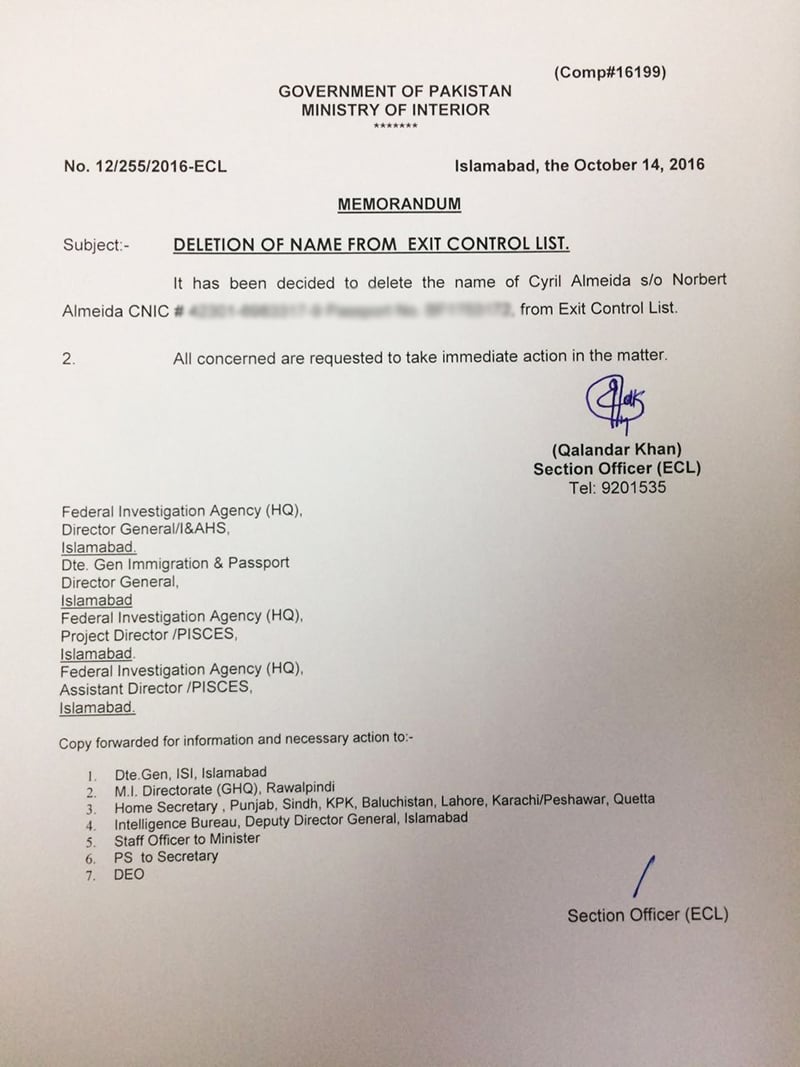
Govt Removes Cyril Almeida’s Name from ECL

The government on Friday removed the name of Dawn staffer Cyril Almeida from the Exit Control List (ECL), confirmed a notification issued from the Ministry of Interior.

Earlier today, Interior Minister Chaudhry Nisar Ali Khan assured the All Pakistan Newspapers Society (APNS) and the Council of Pakistan Newspaper Editors (CPNE) that Dawn staffer Cyril Almeida’s name would be removed from the ECL.
The interior minister provided the assurance during a meeting with APNS and CPNE officials in Islamabad.

However, he told participants that removal of the name would in no way affect the ongoing inquiry into the the matter and the inquiry would continue till its logical conclusion.

The interior minister reiterated during the meeting that the independent media must play its role not only towards safeguarding national interests and security but also counter negative propaganda by enemies of the state.

Almeida’s name was added to the Exit Control List – preventing travel abroad – on Monday after he wrote the news report “Act against militants or face international isolation, civilians tell military”. The Prime Minister’s Office rejected the story thrice since it was published on October 6.

In an Editor’s note, Dawn clarified its position and stated on the record that the story “was verified, cross-checked and fact-checked.”

The note further stated that “Many at the helm of affairs are aware of the senior officials, and participants of the meeting who were contacted by the newspaper for collecting information. Therefore, the elected government and state institutions should refrain from targeting the messenger, and scape-goating the country’s most respected newspaper in a malicious campaign.”

In the wake of the travel ban on Almeida, human rights and journalists’ organisations including the HRCP, PFUJ and CPNE protested and rallied in his support. Most TV news channels also ran reports and conducted programs criticising the government’s decision.

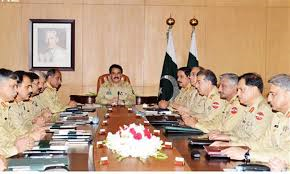
Corps commanders view leak from high-level meeting as breach of national security: ISPR

Participants of a Corps Commanders meeting at General Headquarters in Rawalpindi on Friday expressed serious concern over what they said was a leak from a security meeting which was reported by Dawn earlier this month.

In a statement issued by Inter-Services Public Relations (ISPR), participants of the meeting expressed serious concern over “feeding of false and fabricated story of an important security meeting held at PM House and viewed it as breach of national security.”

Chief of Army Staff (COAS) General Raheel Sharif presided over the meeting which was attended by all corps commanders and principal staff officers.

Almeida’s name was added to the Exit Control List – preventing travel abroad – on Monday after he wrote the news report “Act against militants or face international isolation, civilians tell military”. The Prime Minister Office rejected the story thrice since it was published on October 6.

In an Editor’s note, Dawn clarified its position and stated on the record that the story “was verified, cross-checked and fact-checked.”

The note further stated: “Many at the helm of affairs are aware of the senior officials, and participants of the meeting who were contacted by the newspaper for collecting information. Therefore, the elected government and state institutions should refrain from targeting the messenger, and scape-goating the country’s most respected newspaper in a malicious campaign.”

In the wake of the travel ban on Almeida, human rights and journalists’ organisations including the HRCP, PFUJ and CPNE protested and rallied in his support. Most TV news channels also ran reports and conducted programmes criticising the government’s decision.

The participants held a comprehensive review of the internal and external security situation with a particular focus on prevailing environment at the Line of Control (LoC) and the operational preparedness of the Pakistan Army.

Participants rejected the Indian claims of ‘hoax’ surgical strikes as an attempt to divert the world’s attention away from brutalities being committed by the Indian Army against Kashmiris in held Kashmir, ISPR said.

The forum resolved that any attempt of misadventurism and irresponsible act will be met with the most befitting response.
While expressing complete satisfaction over the operational preparedness of troops, the COAS reiterated the army’s resolve to defend Pakistan against a full spectrum of threat.

Recounting the successes of Operation Zarb-i-Azb and the resultant stability achieved, the COAS reiterated the need for sustained efforts on internal security to defeat all hostile attempts to reverse gains made.

The participants resolved to continue sustained and focused combing and intelligence-based operations across the length and breadth of the country to uproot terrorism, harmonising it with implementation of the National Action Plan to address extremism and other causes of terrorism, the ISPR said.