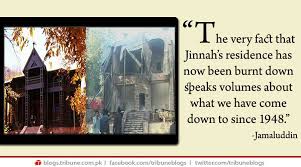
Jinnah’s Ziarat residence burnt (Credit: facebook.com) DAWN.COM | Syed Ali Shah
QUETTA/ISLAMABAD, June 15: At least 23 people, including 14 female students and the deputy commissioner Quetta, were killed Saturday in multiple bomb and gun attacks by militants in the capital of insurgency-hit Balochistan province.
Interior Minister Chaudhry Nisar Ali Khan told reporters at a press conference that several parts of the Bolan Medical Complex, taken under siege by terrorists, have now been cleared by security forces.
An operation was being carried out by security personnel to free the Bolan Medical Complex from heavily armed militants who had taken over parts of the hospital and were reported to have taken several people hostage.
A large number of patients and doctors were trapped inside the complex when heavily armed militants took the hospital under siege.
According to security forces, parts of the hospital have been cleared while four gunmen are still believed to be inside the complex.
Nisar confirmed that 35 hostages had now been freed by security forces.
“According to our official reports, four terrorists have been killed in the operation while one suspect has been arrested from outside the hospital,” said the interior minister.
The interior minister said further details of the ongoing operation to clear the hospital would be announced later.
Condemning the earlier attack on Ziarat Residency, he said that orders have been issued to re-build the historic monument of the country. Chaudhry Nisar also revealed that outlawed Balochistan Liberation Army (BLA) has claimed responsibility of the rocket attacks in Ziarat.
Nisar said the total death toll from the attacks in Quetta has now risen to 22, including four terrorists, four Frontier Corps personnel, Deputy Commissioner Quetta Abdul Mansoor Khan and 14 female students of the Sardar Bahadar Khan Women’s University.
The female students were killed earlier when an improvised explosive device ripped through a bus inside the university campus.
“The bomb exploded just when female teachers and students gathered inside the bus around 3 pm to proceed for Quetta city from the university,” CCPO Mir Zubair Mehmood said.
The CCPO said that most of the victims were female teachers and students. He said the bus caught fire after the powerful blast.
The injured were shifted to the Bolan Medical Complex, where half an hour later sounds of explosions and gunfire spread panic and chaos among the patients and doctors.
Several people were trapped inside the complex for hours as security personnel engaged in a grueling operation against the militants.
Security forces have now cleared most of the complex and evacuated the civilians, although CCPO Mir Zubair Mehmood said it might take another three hours to confirm that the hospital was clear of all terrorists.
Meanwhile, the Balochistan government has officially announced to observe a “day of mourning” on Sunday.
Earlier Saturday, militants attacked the Quaid-e-Azam residency in Ziarat with hand grenades, destroying the historical monument where the founder of Pakistan Mohammad Ali Jinnah spent his last days.
A policeman was killed in the attack on the Jinnah’s monumental residency.
Officials had confirmed that most of the old memorials inside the monument were destroyed, with historic photographs of the founder burnt to the ground in the resulting fire.
It was unclear if the attack on the Quaid’s residency in Ziarat was related to the later attacks in Quetta.
Federal Minister for Information and Broadcasting Senator Pervez Rashid assured full support to the Balochistan Government in the wake of the terrorist attacks in Balochistan.
Speaking to media representatives in Islamabad, Rashid strongly condemned the attacks. He said that those involved in these terrorist acts were the enemies of Pakistan and Balochistan.
He said that the entire nation was with the people of Balochistan at this critical juncture.
NSA Whistleblower Edward Snowden (Credit: businessinsider.com)LONDON, Jun 10: The United States National Security Agency (NSA) has intercepted 13.5 billion reports for intelligence purposes during a period of 30 days in March 2013 from Pakistan.
The UK’s Guardian newspaper has acquired top secret documents about the NSA data mining tool, called Boundless Informant, that details and even maps by country the voluminous amount of information it collects from computer and telephone networks.
Iran was the country where the largest amount of intelligence was gathered, with more than 14 billion reports in that period, followed by 13.5 billion from Pakistan. Jordan, one of America’s closest Arab allies, came third with 12.7 billion, Egypt fourth with 7.6 billion and India fifth with 6.3 billion.
The focus of the internal NSA intelligence agency tool is on counting and categorising the records of communications, known as metadata, rather than the content of an email or instant message.
The Boundless Informant documents show the agency collecting almost 3 billion pieces of intelligence from US computer networks over a 30-day period ending in March 2013. One document says it is designed to give NSA officials answers to questions like, “What type of coverage do we have on country X” in “near real-time by asking the SIGINT (signals intelligence) infrastructure.”
An NSA factsheet about the programme, acquired by the Guardian, says: “The tool allows users to select a country on a map and view the metadata volume and select details about the collections against that country.”
Under the heading “Sample use cases”, the factsheet also states the tool shows information including: “How many records (and what type) are collected against a particular country.” A snapshot of the Boundless Informant data, contained in a top secret NSA “global heat map” seen by the Guardian, shows that in March 2013 the agency collected 97bn pieces of intelligence from computer networks worldwide.
The disclosure of the internal Boundless Informant system comes amid a struggle between the NSA and its overseers in the Senate over whether it can track the intelligence it collects on American communications. The NSA’s position is that it is not technologically feasible to do so.
At a hearing of the Senate intelligence committee in March this year, Democratic Senator Ron Wyden asked James Clapper, the director of national intelligence: “Does the NSA collect any type of data at all on millions or hundreds of millions of Americans?”
“No sir,” replied Clapper. Judith Emmel, an NSA spokeswoman, told the Guardian in a response to the latest disclosures: “NSA has consistently reported — including to Congress — that we do not have the ability to determine with certainty the identity or location of all communicants within a given communication. That remains the case.”
Other documents seen by the Guardian further demonstrate that the NSA does in fact break down its surveillance intercepts which could allow the intelligence agency to determine how many of them are from the US. The level of detail includes individual IP addresses.
On Friday, in his first public response to the disclosures this week on NSA surveillance, Barack Obama said that that congressional oversight was the American peoples’ best guarantee that they were not being spied on.
“These are the folks you all vote for as your representatives in Congress and they are being fully briefed on these programmes,” he said. Obama also insisted that any surveillance was “very narrowly circumscribed”.
Emmel, the NSA spokeswoman, told the Guardian: “Current technology simply does not permit us to positively identify all of the persons or locations associated with a given communication (for example, it may be possible to say with certainty that a communication traversed a particular path within the internet. It is harder to know the ultimate source or destination, or more particularly the identity of the person represented by the TO:, FROM: or CC: field of an e-mail address or the abstraction of an IP address).
“Thus, we apply rigorous training and technological advancements to combine both our automated and manual (human) processes to characterise communications — ensuring protection of the privacy rights of the American people. This is not just our judgment, but that of the relevant inspectors general, who have also reported this.”
She added: “The continued publication of these allegations about highly classified issues, and other information taken out of context, makes it impossible to conduct a reasonable discussion on the merits of these programmes.”
WHEN people in Washington talk about shrinking the drone program, as President Obama promised to do last week, they are mostly concerned with placating Pakistan, where members of the newly elected government have vowed to end violations of the country’s sovereignty. But the drone war is alive and well in the remote corners of Pakistan where the strikes have caused the greatest and most lasting damage.
Drone strikes like Wednesday’s, in Waziristan, are destroying already weak tribal structures and throwing communities into disarray throughout Pakistan’s tribal belt along the border with Afghanistan. The chaos and rage they produce endangers the Pakistani government and fuels anti-Americanism. And the damage isn’t limited to Pakistan. Similar destruction is occurring in other traditional tribal societies like Afghanistan, Somalia and Yemen. The tribes on the periphery of these nations have long struggled for more autonomy from the central government, first under colonial rule and later against the modern state. The global war on terror has intensified that conflict.
These tribal societies are organized into clans defined by common descent; they maintain stability through similar structures of authority; and they have defined codes of honor revolving around hospitality to guests and revenge against enemies.
In recent decades, these societies have undergone huge disruptions as the traditional leadership has come under attack by violent groups like the Taliban, Al Qaeda in the Arabian Peninsula and Somalia’s Al Shabab, not to mention full-scale military invasions. America has deployed drones into these power vacuums, causing ferocious backlashes against central governments while destroying any positive image of the United States that may have once existed.
American precision-guided missiles launched into Pakistan’s Pashtun tribal areas aim to eliminate what are called, with marvelous imprecision, the “bad guys.” Several decades ago I, too, faced the problem of catching a notorious “bad guy” in Waziristan.
It was 1979. Safar Khan, a Pashtun outlaw, had over the years terrorized the region with raids and kidnappings. He was always one step ahead of the law, disappearing into the undemarcated international border between Afghanistan and Pakistan, the very area where Osama bin Laden would later find shelter.
I was then the political agent of South Waziristan, a government administrator in charge of the area. When Mr. Khan kidnapped a Pakistani soldier, the commanding general threatened to launch military operations. I told him to hold off his troops, and took direct responsibility for Mr. Khan’s capture.
I mobilized tribal elders and religious leaders to persuade Mr. Khan to surrender, promising him a fair trial by jirga, a council of elders, according to tribal custom. Working through the Pashtun code of honor, Mr. Khan eventually surrendered unconditionally and the writ of the state was restored. The general who had argued for using force was delighted.
We were able to get Mr. Khan without firing a single shot by relying on the three pillars of authority that have traditionally provided stability in Pashtun tribal society: elders, religious leaders and the central government.
Over the past few decades, these pillars have weakened. And in 2004, with the Pakistani army’s unprecedented assault and American drones’ targeting suspected supporters of Al Qaeda in Waziristan, the pillars of authority began to crumble.
In the vacuum that followed, the Tehrik-e-Taliban Pakistan, or Pakistani Taliban, emerged. Its first targets were tribal authorities. Approximately 400 elders have been killed in Waziristan alone, a near-decapitation of traditional society.
Large segments of the tribal population were displaced to shantytowns surrounding large cities, bringing with them traditional tribal feuds and a desire for revenge against those they saw as responsible for their desperate situation.
As the pace of the violence in the tribal areas increased, the Pakistani Taliban sought to strike the central government. They kidnapped Pakistan’s ambassador to Afghanistan, stormed Army General Headquarters in Rawalpindi, and assaulted a naval base in Karachi. In 2009, fighters attacked a military mosque, killing 36 people, including 17 children. Taking hold of children’s hair and shooting them point-blank, they yelled “Now you know how it feels when other people are killed.”
For the first time tribesmen resorted to suicide strikes — in mosques, bazaars and offices in which women and children were often the victims — something categorically rejected by both Islam and the Pashtun tribal code.
The tribesmen of Waziristan have for years seen the Pakistani government as colluding on drone strikes with the Americans, against whom their tribal kin are fighting across the border in Afghanistan. Therefore, they take revenge against the military and other government targets for those killed by drones.
Their suspicions of Pakistan complicity proved correct. Former President Pervez Musharraf admitted to CNN last month that his government had secretly given permission to the United States to operate drones inside Pakistan.
Drone strikes have made Waziristan’s already turbulent conflict with the central government worse. Almost 3,500 people have been killed by drones in Waziristan, including many innocent civilians.
Those at the receiving end of the strikes see them as unjust, immoral and dishonorable — killing innocent people who have never themselves harmed Americans while the drone operators sit safely halfway across the world, terrorizing and killing by remote control.
Mr. Obama should not assume that his pledge to scale back the drone war will have an appreciable impact on America’s image or Pakistan’s security unless the strikes stop and the old pillars of tribal authority can gradually be rebuilt.
Until then, American policy makers would do well to heed a Pashto proverb: “The Pashtun who took revenge after a hundred years said, I took it quickly.”
Akbar Ahmed, the Islamic Studies chair at American University and the former Pakistani high commissioner to Britain, is the author of “The Thistle and the Drone: How America’s War on Terror Became a Global War on Tribal Islam.”
At least six people were killed in a drone strike Wednesday in northwest Pakistan, reportedly including a top Pakistani Taliban official, in the first publicized US drone attack since President Barack Obama announced he was changing policy on such strikes.
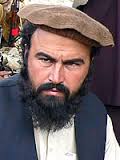
According to multiple reports, Wali-ur-Rehman, the second in command of the Tehreek-e-Taliban Pakistan, was killed in the attack in North Waziristan, a militant stronghold. The drone reportedly fired two missiles into a mud house in the village of Chashma, killing at least six and wounding four others. Reuters reports that Mr. Wali-ur-Rehman had been poised to succeed TTP leader Hakimullah Mehsud.
“This is a huge blow to militants and a win in the fight against insurgents,” one security official told Reuters, declining further comment.
The Pakistani Taliban are a separate entity allied to the Afghan Taliban. Known as the Tehreek-e-Taliban Pakistan (TTP), they have launched devastating attacks against the Pakistani military and civilians.
Reuters reports that the Pakistani Foreign Office expressed concern over the attack, stating that “Any drone strike is against the territorial integrity and sovereignty of Pakistan and we condemn it.” Reuters notes, however that the comment was made before Wali-ur-Rehman had been identified as a casualty.
Pakistani newspaper The News International reports that the TTP denied that Wali-ur-Rehman was killed.
The drone strike comes at a precarious time for both Washington and Islamabad. Last week, President Obama announced that the White House had codified new policy guidance on the use of lethal force against terrorists, including the use of drones, The Christian Science Monitor reported.
Generally speaking, the US government has to determine that a potential drone target poses a “continuing and imminent threat to the American people,” the president said.
Drones can be used only if the US can’t capture individual terrorists.
“Our preference is always to detain, interrogate, and prosecute them,” Obama said.
And finally, before any strike occurs, there must be “near certainty” that no civilians will be killed or injured, according to the president.
Experts note, however, that at least rhetorically, the president’s guidelines match what has been said before about US drone policies, and it is unclear whether this announcement marks a change in process – particularly as most of the relevant information on drone policy remains classified.
At the same time, Pakistan is in an interim period between its recent presidential election and the formation of a new government led by Nawaz Sharif, who “has made it very clear through the election campaign that he wants all drone strikes to stop all together,” reports the BBC’s Richard Galpin.
“The plain fact here is that the drone strikes are extremely unpopular, the vast majority of the population opposed to them – recent research showing two-thirds of them, of the population were opposed to them. Nawaz Sharif, I think is pretty much obliged to bring this issue up in negotiations with the American government to see if he can persuade them to stop the strikes.”
But at the same time, says the BBC’s M Ilyas Khan, “any strike against the Pakistan Taliban would be welcomed by the Pakistani authorities because the group has for several years been exclusively focused on pursuing Pakistani – rather than Afghan – military and civilian targets.”
Our correspondent says it comes on the same day that the newly-elected parliament of Khyber Pakhtunkhwa province – which adjoins North Waziristan – holds its first meeting.
The province is now being ruled by former cricketer Imran Khan’s PTI party, which has in recent months repeatedly spoken out against drone attacks, as has Prime Minister-elect Nawaz Sharif.
Zahra Shahid Hussain (Credit: thenews.com.pk)Islamabad, May 22: It was a cold, misty evening in Karachi some months ago. At a friend’s place, Zahra Shahid Hussain was trying to convince a motley group of PTI enthusiasts and critics from different social and professional backgrounds on why Imran Khan showed promise like no other political leader and why the PTI must be given a chance to run the country.
The criticism we offered was harsh at times. She took it with great poise and tried her best to answer the questions raised against the party, its politics and the choices made by her leader. She was receptive, gentle and accepting – qualities rarely found in PTI neo-converts. They usually neither take any criticism in good stride nor try to respond to your comments logically. They counter you with hate mails, write against you and snub you privately or publicly. Zahra Shahid Hussain was different – an elderly, mature, self-assured and polite woman. Her cold-blooded murder outside her residence in Karachi reflects the barbarity of the perpetrators and our growing insensitivity as a people towards such gruesome acts of violence. My heart goes out to her family and friends. May she rest in peace.
While the PTI leadership in Karachi was a little more cautious and asked for immediate investigation and demanded the killers be arrested, Imran Khan was swift in apportioning blame on the MQM chief Altaf Hussain. His justification was Hussain’s earlier threats to the PTI’s demonstrators who complained of rigging and asked for a fresh round of balloting in some polling stations in Karachi. Khan’s statement came on the eve of the re-election on a select number of polling stations in NA-250, the constituency where the polling process was challenged by his party. The MQM had already rejected the ECP’s decision and boycotted the re-polling while demanding that it should be done across the constituency. The PPP and the JI had also boycotted the process for different reasons.
The MQM leader was incensed after he was blamed for being responsible for Zahra’s murder. He was also unhappy with the local MQM leadership for letting that happen. As a consequence, the workers of the party roughed up the local leaders. The party then decided to hold protest demonstrations against Khan and the PTI. Tensions have escalated in Karachi and the two parties are at daggers drawn. The MQM says that the protests will be peaceful in nature. However, the politics of Karachi tells a different story if you take stock of what has happened on the streets and in the neighbourhoods of the city over the past 25 years. Since he is also a British citizen, British authorities had already received thousands of complaints about Altaf Hussain’s incitement to violence in a speech made just after the elections – even before the murder took place.
In fairness, no one can be charged of a crime unless proper investigation is carried out. However, there are lessons to be learnt by both the MQM and the PTI from the tragic murder of Zahra Shahid Hussain. The MQM is still perceived to be a party that takes to violence if its wish and will are not followed by all concerned. No doubt it has a popular base but the realisation has to come sooner than later that it is increasingly impossible to coerce the electorate, influence the electoral process by force or keep getting the number of seats that defy the changes that have taken place over the years in both demography and political opinion in Karachi and Hyderabad.
On top of that, the MQM chief makes indefensible statements from time to time and its second-tier leadership keeps busy for weeks in contextualising and clarifying what has been said. If there are no good or bad Taliban, there is no good or bad violence either. If violence in the name of faith or sect has to be rejected, violence in the name of ethnicity or political difference cannot be accepted either – even for short-term ideological or political gains.
Zahra Shahid Hussain could have been killed by a reckless criminal or any third force but the MQM has to reflect on why it has always been blamed for such acts by its political adversaries. The party has so much ammunition in stock and there is much circumstantial evidence from the past to support these assertions. The liberal, plural and inclusive politics of the MQM and the initiatives it has taken to serve its constituents suffer a huge setback by its political tactics rooted in the late 1980s and 1990s. It is time a party as big and influential as the MQM comes of age. It is time for its leadership to realise that their clout increases across Pakistan if their image changes. Their image changes if they change their old tactics.
For the PTI, the death of one of their veteran leaders, someone who believed in the party from day one and did not opt for it after being rejected by other political forces, or after the October 2011 public meeting in Lahore, is a great loss. She is the first victim of violence from among the PTI leadership. It is time that the party leadership, its workers and supporters understand what it means to be hit by death and violence.
For instance, in case of the ANP, rather than blaming the victims and holding them responsible for their own suffering, the PTI rank and file needs to realise what happened to Bashir Ahmed Bilour, Mian Iftikhar Hussain’s son and more than 700 party leaders and workers who were killed in the last five years, including more than 100 during the election campaign and on election day. Likewise, when Ali Haider Gilani, the former PPP prime minister’s son, was kidnapped and his two aides shot down in broad daylight just two days before the general elections, the response from PTI’s supporters on social media was callous, calling the entire incident a political stunt.
When Imran Khan said – before the elections – that militants should not kill political workers and bomb political rallies but wait for the PTI tsunami to come and sweep away the political forces they dislike, imagine how an ordinary worker belonging to the ANP or the PPP would have felt. If he had let out the statesman in him, Khan would have rather clearly said that all parties must get a level playing field and no party should be threatened and kept out of the campaigning race. Like the MQM condemns faith-based and sectarian oppression and persecution but does not shun its own coercive methods, the PTI has come down hard on the MQM while being soft and apologetic to the TTP.
Violence – religious or political, in any form or for any reason – has to be condemned. Violence begets violence and spares no one in the end. Those who think they can be saved live in a fool’s paradise. Here, I remember the famous lines of Martin Niemoller, the anti-Nazi German pastor and theologian:
“First they came for the communists/and I didn’t speak out because I wasn’t a communist/Then they came for the socialists/and I didn’t speak out because I wasn’t a socialist/Then they came for the trade unionists/and I didn’t speak out because I wasn’t a trade unionist/Then they came for the Jews/and I didn’t speak out because I wasn’t a Jew/Then they came for the Catholics/and I didn’t speak out because I wasn’t a Catholic/Then they came for me/and there was no one left to speak for me.”
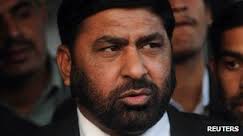
MULTAN, Pakistan, May 3 — Gunmen on Friday killed a Pakistani prosecutor who had been investigating the murder of former Prime Minister Benazir Bhutto and the 2008 Mumbai attacks.
Assailants opened fire on the prosecutor, Chaudhry Zulfikar Ali, as he drove to work from his home in a suburb of the capital, Islamabad, for a court hearing in which the former military leader, Pervez Musharraf, faces charges in relation to Ms. Bhutto’s death in 2007.
The police said that gunmen traveling by motorbike and in a taxi sprayed Mr. Ali’s car with bullets, lightly wounding his bodyguard and killing a woman who was passing by when his car veered out of control. Television footage from the scene showed a bullet-riddled vehicle crashed by the roadside.
Mr. Ali died before he reached a hospital in Islamabad, where a doctor said he had been shot 13 times. The police said that Mr. Ali’s bodyguard returned fire and managed to wound one of the attackers. The police are searching for the attackers, all of whom escaped.
There was no immediate claim of responsibility for the attack, and the police said it was too early to comment on a possible motive. But few doubted that it was linked to Mr. Ali’s work as a state prosecutor in some of the most sensitive cases in the country, and his death reinforced the vulnerability of senior government officials who challenge Islamist militants and other powerful interests.
Mr. Ali represented the Federal Investigation Agency, which has implicated Mr. Musharraf in the death of Ms. Bhutto, who was assassinated in December 2007, just before the last election.
After the previous hearing in the Bhutto case on April 30, Mr. Ali told reporters he had “solid evidence” that connected Mr. Musharraf with Ms. Bhutto’s death.
Prosecutors and Bhutto supporters accuse Mr. Musharraf of failing to provide adequate security to Ms. Bhutto after her return from exile in October 2007. Mr. Musharraf has denied those accusations.
Since Mr. Musharraf’s return from exile in March, investigators have questioned him about the security arrangements for Ms. Bhutto in 2007. He insisted that, as head of state, he was not involved in administrative matters such as security arrangements.
Mr. Ali was also involved in another sensitive case: the trial of seven people from the militant group Lashkar-e-Taiba charged with involvement in the attacks in Mumbai, India, in November 2008, which killed more than 160 people.
Seven Lashkar activists have been on trial since 2009, accused of orchestrating the slaughter from Pakistan, and one of the defendants is the group’s operational leader, Zaki ur-Rehman Lakhvi. But the hearings have been characterized by opacity and a lethargic pace.
The trial is taking place at Adila jail in Rawalpindi, ostensibly on security grounds, and the news media are barred from proceedings. Hearings have been repeatedly adjourned because of the absence of lawyers or the presiding judge.
Currently, defense lawyers are cross-examining the prosecution witnesses. Mr. Ali was scheduled to appear in court on Saturday in relation to the case.
Lashkar-e-Taiba was founded with help from the Inter-Services Intelligence Directorate, Pakistan’s spy agency, in the 1990s, and its presumed leader, Hafiz Muhammad Saeed, lives openly in the eastern city of Lahore. The spy agency says it has cut all links with the group.
Mr. Ali’s death comes at a sensitive time, with Pakistanis scheduled to go to the polls for a general election on May 11. Campaigning has been marred by widespread Taliban violence against candidates from secular parties.
In the latest attack, gunmen shot dead a candidate from the secular Awami National Party, which has borne the brunt of attacks, along with his 6-year-old son, in the port city of Karachi on Friday.
Although Islamabad suffered a number of militant attacks in 2008 and 2009, it has escaped major violence in recent years. But several prominent figures have been assassinated on its streets, including the former governor of Punjab Province, Salman Taseeer, and a minister for religious affairs.
Mir Hazar Khan Khoso, the interim prime minister, addressed the nation Friday evening and reiterated his government’s resolve to hold free, fair, transparent and peaceful elections, and he said a special security cell had been established in the Interior Ministry to coordinate with the national election commission.
“This cell will collect intelligence reports and share it with provincial government and law enforcing agencies, and this cell is also empowered to take decisions for timely action if needed,” Mr. Khoso said. “All resources will be used to improve security of the sensitive polling stations and their effective monitoring,” he added.
Mr. Musharraf returned from exile with a plan to run for Parliament in a general election. He faces charges in several cases related to his time in power, including the murder of Ms. Bhutto, the killing of a Baloch nationalist leader, and the firing of senior judges.
Mr. Musharraf, a retired general, has been disqualified from contesting the election, and this week a court banned him from politics for life. He also faces possible treason charges.
In the court hearing in nearby Rawalpindi, lawyers for Mr. Musharraf argued that he should be exempted from appearing in person in the case, Pakistani television stations reported. The hearing was adjourned until May 14.
Salman Masood contributed reporting from Islamabad, Pakistan.
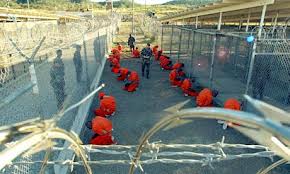
WASHINGTON — President Obama on Tuesday recommitted to his years-old vow to close the Guantánamo Bay prison following the arrival of “medical reinforcements” of nearly 40 Navy nurses, corpsmen and specialists amid a mass hunger strike by inmates who have been held for over a decade without trial.
“It’s not sustainable,” Mr. Obama said at a White House news conference. “The notion that we’re going to keep 100 individuals in no man’s land in perpetuity,” he added, made no sense. “All of us should reflect on why exactly are we doing this? Why are we doing this?”
Citing the high expense and the foreign policy costs of continuing to operate the prison, Mr. Obama said he would try again to persuade Congress to lift restrictions on transferring inmates to the federal court system. Mr. Obama was ambiguous, however, about the most difficult issue raised by the prospect of closing the prison: what to do with detainees who are deemed dangerous but could not be feasibly prosecuted.
Mr. Obama’s existing policy on that subject, which Congress has blocked, is to move detainees to maximum-security facilities inside the United States and continue holding them without trial as wartime prisoners; it is not clear whether such a change would ease the frustrations fueling the detainees’ hunger strike.
Yet at another point in the news conference, Mr. Obama appeared to question the policy of indefinite wartime detention at a time when the war in Iraq has ended, the one in Afghanistan is winding down and the original makeup of Al Qaeda has been decimated. “The idea that we would still maintain forever a group of individuals who have not been tried,” he said, “that is contrary to who we are, contrary to our interests, and it needs to stop.”
But in the short term, Mr. Obama indicated his support for the force-feeding of detainees who refused to eat.
“I don’t want these individuals to die,” he said.
As of Tuesday morning, 100 of the 166 prisoners at Guantánamo were officially deemed by the military to be participating in the hunger strike, with 21 “approved” to be fed the nutritional supplement Ensure through tubes inserted through their noses.
In a statement released earlier, a military spokesman said the deployment of additional medical personnel had been planned several weeks ago as more detainees joined the strike.
“We will not allow a detainee to starve themselves to death, and we will continue to treat each person humanely,” said Lt. Col. Samuel House, the prison spokesman.
The military’s response to the hunger strike has revived complaints by medical ethics groups that contend that doctors — and nurses under their direction — should not force-feed prisoners who are mentally competent to decide not to eat.
Last week, the president of the American Medical Association, Dr. Jeremy A. Lazarus, wrote a letter to Defense Secretary Chuck Hagel saying that any doctor who participated in forcing a prisoner to eat against his will was violating “core ethical values of the medical profession.”
“Every competent patient has the right to refuse medical intervention, including life-sustaining interventions,” Dr. Lazarus wrote.
He also noted that the A.M.A. endorses the World Medical Association’s Tokyo Declaration, a 1975 statement forbidding doctors to use their medical knowledge to facilitate torture. It says that if a prisoner makes “an unimpaired and rational judgment” to refuse nourishment, “he or she shall not be fed artificially.”
The military’s policy, however, is that it can and should preserve the life of a detainee by forcing him to eat if necessary.
“In the case of a hunger strike, attempted suicide or other attempted serious self-harm, medical treatment or intervention may be directed without the consent of the detainee to prevent death or serious harm,” a military policy directive says. “Such action must be based on a medical determination that immediate treatment or intervention is necessary to prevent death or serious harm and, in addition, must be approved by the commanding officer of the detention facility or other designated senior officer responsible for detainee operations.”
On Monday, Colonel House also said that some detainees on the “enteral feeding” list were drinking the supplement.
“Just because the detainees are approved for enteral feeding does not mean they don’t eat a regular meal,” he said. “Once the detainees leave their cell and are in the presence of medical personnel, most of the detainees who are approved for tube feeding will eat or drink without the peer pressure from inside the cellblock.”
Medical ethicists and the Pentagon also clashed during the Bush administration over hunger strikes at Guantánamo.
The current protest began in February and escalated after a raid this month in which guards confined protesting detainees to their cells. The impetus for it is disputed. The prisoners, through their lawyers, cite a search for contraband on Feb. 6, during which they say Korans were handled in a way they found offensive. The military says the Koran search followed routine procedures.
But both sides agree that the root cause is frustration over the collapse of President Obama’s effort to close the prison, which drew Congressional resistance, and the fact that no prisoners have been transferred because of restrictions on where they can be sent.
Congress has restricted the repatriation to countries with troubled security conditions, helping to jam up 86 low-level detainees who were designated for potential transfer three years ago; most are Yemeni. But since 2012, lawmakers have given the Pentagon the ability to waive most of those restrictions on a case-by-case basis, and it has not done so.
On Tuesday, Mr. Obama said he “I’ve asked my team to review everything that’s currently being done in Guantánamo, everything that we can do administratively.” It was not clear whether that was a signal that the administration may be considering using the waiver power to revive the transfer of low-level detainees.
Ramzi Kassem, a City University of New York law professor who represents several detainees, said he had talked to a Yemeni client, Moath Hamza Ahmed al-Alwi, who said a guard had shot him with rubber-coated pellets at close range during the raid. Since then, Mr. Kassem was told, the prisoners have been denied soap, toothbrushes, toothpaste and their legal papers.
Mr. Alwi said he had not eaten in 80 days and stopped drinking after the raid, Mr. Kassem said. He also said he was being force-fed twice a day after being tied to a restraint chair.
Mr. Kassem also quoted Mr. Alwi as saying: “I do not want to kill myself. My religion prohibits suicide. But I will not eat or drink until I die, if necessary, to protest the injustice of this place. We want to get out of this place. It is as though this government wishes to smother us in this injustice, to kill us slowly here, indirectly, without trying us or executing us.”
In his statement on Monday, Colonel House said the prisoners would not be allowed to die.
“Detainees have the right to peacefully protest, but we have the responsibility to ensure that they conduct their protest safely and humanely,” he said. “Detainees are given a choice: eat the hot meal, drink the supplement or be enteral fed.”
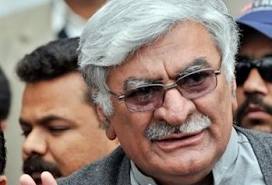
ANP president Asfandyar Wali Khan (Credit: pakistantoday.com.pk) The 2013 elections in Pakistan are critical for setting a clear goal post for the nation. However, the short time frame in which they are taking place has left the caretaker administration and security institutions scrambling to clean up a nation wracked by terrorism, poverty and inequality.
With the simmering insurgency on the Pak-Afghan border, the caretaker administration has tried to beef up security in the violence stricken areas of FATA, Khyber Pakhtunkhwa and Balochistan — as well as Karachi, where former incumbents from the secular PPP, ANP and MQM are under attack by a determined Taliban enemy.
But given that militants in Pakistan’s north have consistently targeted secular candidates, especially Awami National Party, while allowing rallies by Imran Khan’s Tehrik-i-Insaf, Jamiat-i-Ulema Islam (Fazlur Rehman group) and even the Pakistan Muslim League (N) — has led to questions about the outcome of the election.
In particular, civil society is questioning whether the relentlessness with which militants are killing secular incumbents and their supporters, while facilitating political parties who have a soft corner for them – will bring pro Taliban legislators into parliament.
In many areas of the KP and FATA, the poor security situation has already deprived incumbents from hoisting party flags or holding rallies. Apart from contesting as independents or putting up proxies, the ANP and PPP have not nominated candidates to many seats in Waziristan and the tribal belt bordering Afghanistan.
The anti US sentiment in Pakistan, accelerated by drone attacks and military operations… combined with increased poverty, income gap and poor governance, is a big factor that has caused the incumbents to lose ground among voters.
But the ANP – which lost many key leaders while stopping the onslaught of the Taliban in the last five years – has been worst hit. Its rallies have been repeatedly attacked and its rank and file killed and wounded across Pakistan. The party leadership has clearly spelled out the Tehrik-i-Taliban as the perpetrators. The TTP has also become the MQM’s worst enemy – kiling their candidates and attacking their election offices.
Time and again, the caretaker administration has taken note of the terrible security situation and beefed up security. The visible effects of greater law enforcement has been a drop off in mass terror attacks (like the one planned by the Lashkar-i-Jhangvi against Hazaras late April in Balochistan) and a slight drop off in violence in Karachi.
But it is a situation that has caused the PPP to hunker down and avoid public rallies. That is changing the face of the once populist party, which even refrained from kicking off its election campaign on April 4, the death anniversary of PPP founder, Prime Minister Zulfikar Ali Bhutto.
The election scenario does not look good for the Zardari led PPP, whose primary achievement seems to have been the completion of five years in power. To its detriment, the PPP government has left behind a nation that is hungrier, violent and more unstable — and still out of sync with the modern world.
Come May 11, voters across Pakistan will likely vote on the basis of feudal and tribal loyalties. Still, the government’s lack luster performance over the last five years is bound to cost them a big percentage of the votes.
This is bound to hurt the party even in its home turf in Sindh, where it is now pitted against all political forces that exercise influence in the province. The Pakistan Muslim League (N), joined by Pirs, tribal and feudal chiefs, religious parties and even nationalists have formed an anti PPP front that is almost reminiscent of the Islami Jamhoori Ittehad (IJI) — funded by the intelligence agencies in 1993 to prevent Benazir Bhutto from returning to power.
That is where the similarity ends.
Two decades ago, when Benazir led the PPP, her being a woman necessarily changed the party’s image. Keeping up the populism espoused by her father former Prime Minister Zulfikar Ali Bhutto, she led a party of the masses that touched on the promised goodness of the socialist rhetoric `roti, kapra, makan,’ (food, clothing and shelter) — even if it did not deliver. But the image of millions of people looking for change did not jive with the establishment — and contributed to her murder in 2007.
Thereafter, the default president, Asif Zardari — hands untied, amassed wealth and privileges for a coterie of supporters at the expense of the majority “have-nots.” He used the classic methods he knew of getting opponents out of the way — sweet talk and bribe.
The situation has not gone unnoticed by the Supreme Court, which recently moved against some of the political appointments made by the departing PPP government. The superior court has also moved against the “life time of perks and privileges” bestowed by the PPP’s departing prime minister to former government functionaries just before the National Assembly term concluded.
Come May 11, tribal loyalties and to some extent the background of the candidates will influence the results of elections in rural Sindh. In so doing, voters may still choose the lower middle class Sindhis from the PPP as opposed to larger feudals. Still, the situation remains dicey and not altogether in the PPP’s favor.
Midway between Karachi and Hyderabad, the coastal town of Thatta promises to be a test case in the electoral contest between the PPP – where the Shirazis and Malkanis (head of the tribal Jats) – have announced the withdrawal of support from the PPP to their own nominee. In so doing, they have put up their own candidate, Zardari’s nominee and a shadowy muscle man – Owais Muzzafar (Tappi) – accusing him of usurpation of lands and the promotion of a coastal town of Zulfikarabad, being opposed by the locals.
It has opened up the situation for an independent candidate for provincial assembly – Mohammed Ali Shah – to step into the election. Shah is president of the Pakistan Fisher folk Forum and espouses an idealistic program to fight for the rights of fisher folk as well as agricultural and livestock communities.
Shah, who opposes PPP’s Owais Muzzafar for provincial assembly, claims his candidature has caused the Thatta feudals to break away from their support for the PPP.
Whichever way the situation pans out, a sense of disillusionment with the incumbent parties as well as the existing culture of the provinces is bound to redraw its political scenario.
Till then, the candidates deserve a level playing field instead of the life and death threats they confront in their quest to represent the people.
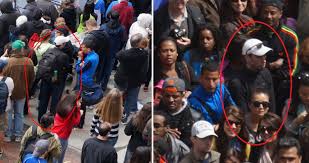
Chechen brothers identified in Boston massacre (Credit: sandrarose.com)
Boston, April 16: I WAS in the middle of having Chinese food with my wife and friends yesterday afternoon when we heard the dull and deathly reverb. The water in our plastic cups rippled. We looked at one another, and someone made a joke about that famous scene in “Jurassic Park.” We tried to drown the moment in humor. But then a rush of humanity descended upon us in the Prudential Center on Boylston Street, right across from where the second bomb blast had just occurred, near the marathon’s finish line.
People gushed across the hallway like fish in white water rapids. It was a blur of bright clothes and shiny sneakers, everyone dressed up for Patriot’s Day weekend on what was moments ago a beautiful spring day. Instantly, images of the shootings in Aurora, Colo., Newtown, Conn., and Tucson came to mind. I felt my thoughts reduced to singular flashes. My life, all of it, was the first. My wife, sitting across me, was the second. I yelled out to her to run, and we did, not knowing what had happened, only that it had to be something terrible.
We ran out of the food court and onto the terrace overlooking Boylston Street. We could see people fleeing from the finish line even as, in the distance, other weary marathoners kept running unknowingly toward the devastation. What was left of the food court was a land frozen in an innocent time, forks still stuck in half-eaten pieces of steak, belongings littered unattended. I felt fear beyond words.
This was not my first experience with terror, having grown up in Pakistan. But for some reason, I didn’t think back to those experiences. Looking onto to the smoked, chaotic Boylston Street, I forgot about cowering in my childhood bedroom as bombs and gunfire rained over the army headquarters in Rawalpindi, close to our house. My mind did not go back to when I stood on the roof of my dormitory in Karachi as the streets were overrun with burning buses and angry protesters after the assassination of Benazir Bhutto. None of the unfortunate experiences of growing up in the midst of thousands of victims of terror, personally knowing some of them, helped me in that moment. Nothing made it any easier.
Perhaps, if I had been thinking more clearly and hadn’t had my wife with me, I might have gone down to try to help the wounded. But at that moment all I could think about was getting us out of there. We lost our friends, then found them again. Our cellphones weren’t working. And then, as we worked our way through the dazed throngs in Back Bay, I realized that not only was I a victim of terror, but I was also a potential suspect.
As a 20-something Pakistani male with dark stubble (an ode more to my hectic schedule as a resident in the intensive-care unit than to any aesthetic or ideology), would I not fit the bill? I know I look like Hollywood’s favorite post-cold-war movie villain. I’ve had plenty of experience getting intimately frisked at airports. Was it advisable to go back to pick up my friend’s camera that he had forgotten in his child’s stroller in the mall? I remember feeling grateful that I wasn’t wearing a backpack, which I imagined might look suspicious. My mind wandered to when I would be working in the intensive care unit the next day, possibly taking care of victims of the blast. What would I tell them when they asked where I was from (a question I am often posed)? Wouldn’t it be easier to just tell people I was from India or Bangladesh?
As I walked down Commonwealth Avenue, I started receiving calls from family back home. They informed me about what was unfolding on television screens across the world. I was acutely conscious of what I spoke over the phone, feeling that someone was breathing over my shoulder, listening to every word I said. Careful to avoid Urdu, speaking exclusively in English, I relayed that I was safe, and all that I had seen. I continued to naïvely cling to the hope that it was a gas explosion, a subway accident, anything other than what it increasingly seemed to be: an act of brutality targeted at the highest density of both people and cameras.
The next step was to hope that the perpetrator was not a lunatic who would become the new face of a billion people. Not a murderer who would further fan the flames of Islamophobia. Not an animal who would obstruct the ability of thousands of students to complete their educations in the United States. Not an extremist who would maim and hurt the very people who were still recovering from the pain of Sept. 11. President Obama and Gov. Deval L. Patrick have shown great restraint in their words and have been careful not to accuse an entire people for what one madman may have done. But others might not be so kind.
Haider Javed Warraich is a resident in internal medicine at the Beth Israel Deaconess Medical Center.
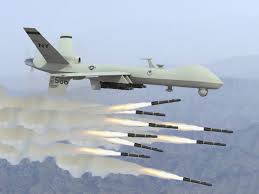
Drone strikes in Pakistan (Credit miskweenworld.blogspot.com)On a hot day in June 2004, the Pashtun tribesman was lounging inside a mud compound in South Waziristan, speaking by satellite phone to one of the many reporters who regularly interviewed him on how he had fought and humbled Pakistan’s army in the country’s western mountains. He asked one of his followers about the strange, metallic bird hovering above him.
Less than 24 hours later, a missile tore through the compound, severing Mr. Muhammad’s left leg and killing him and several others, including two boys, ages 10 and 16. A Pakistani military spokesman was quick to claim responsibility for the attack, saying that Pakistani forces had fired at the compound.
That was a lie.
Mr. Muhammad and his followers had been killed by the C.I.A., the first time it had deployed a Predator drone in Pakistan to carry out a “targeted killing.” The target was not a top operative of Al Qaeda, but a Pakistani ally of the Taliban who led a tribal rebellion and was marked by Pakistan as an enemy of the state. In a secret deal, the C.I.A. had agreed to kill him in exchange for access to airspace it had long sought so it could use drones to hunt down its own enemies.
That back-room bargain, described in detail for the first time in interviews with more than a dozen officials in Pakistan and the United States, is critical to understanding the origins of a covert drone war that began under the Bush administration, was embraced and expanded by President Obama, and is now the subject of fierce debate. The deal, a month after a blistering internal report about abuses in the C.I.A.’s network of secret prisons, paved the way for the C.I.A. to change its focus from capturing terrorists to killing them, and helped transform an agency that began as a cold war espionage service into a paramilitary organization.
The C.I.A. has since conducted hundreds of drone strikes in Pakistan that have killed thousands of people, Pakistanis and Arabs, militants and civilians alike. While it was not the first country where the United States used drones, it became the laboratory for the targeted killing operations that have come to define a new American way of fighting, blurring the line between soldiers and spies and short-circuiting the normal mechanisms by which the United States as a nation goes to war.
Neither American nor Pakistani officials have ever publicly acknowledged what really happened to Mr. Muhammad — details of the strike that killed him, along with those of other secret strikes, are still hidden in classified government databases. But in recent months, calls for transparency from members of Congress and critics on both the right and left have put pressure on Mr. Obama and his new C.I.A. director, John O. Brennan, to offer a fuller explanation of the goals and operation of the drone program, and of the agency’s role.
Mr. Brennan, who began his career at the C.I.A. and over the past four years oversaw an escalation of drone strikes from his office at the White House, has signaled that he hopes to return the agency to its traditional role of intelligence collection and analysis. But with a generation of C.I.A. officers now fully engaged in a new mission, it is an effort that could take years.
Today, even some of the people who were present at the creation of the drone program think the agency should have long given up targeted killings.
Ross Newland, who was a senior official at the C.I.A.’s headquarters in Langley, Va., when the agency was given the authority to kill Qaeda operatives, says he thinks that the agency had grown too comfortable with remote-control killing, and that drones have turned the C.I.A. into the villain in countries like Pakistan, where it should be nurturing relationships in order to gather intelligence.
As he puts it, “This is just not an intelligence mission.”
From Car Thief to Militant
By 2004, Mr. Muhammad had become the undisputed star of the tribal areas, the fierce mountain lands populated by the Wazirs, Mehsuds and other Pashtun tribes who for decades had lived independent of the writ of the central government in Islamabad. A brash member of the Wazir tribe, Mr. Muhammad had raised an army to fight government troops and had forced the government into negotiations. He saw no cause for loyalty to the Directorate of Inter-Services Intelligence, the Pakistani military spy service that had given an earlier generation of Pashtuns support during the war against the Soviets.
Many Pakistanis in the tribal areas viewed with disdain the alliance that President Pervez Musharraf had forged with the United States after the Sept. 11, 2001, attacks. They regarded the Pakistani military that had entered the tribal areas as no different from the Americans — who they believed had begun a war of aggression in Afghanistan, just as the Soviets had years earlier.
Born near Wana, the bustling market hub of South Waziristan, Mr. Muhammad spent his adolescent years as a petty car thief and shopkeeper in the city’s bazaar. He found his calling in 1993, around the age of 18, when he was recruited to fight with the Taliban in Afghanistan, and rose quickly through the group’s military hierarchy. He cut a striking figure on the battlefield with his long face and flowing jet black hair.
When the Americans invaded Afghanistan in 2001, he seized an opportunity to host the Arab and Chechen fighters from Al Qaeda who crossed into Pakistan to escape the American bombing.
For Mr. Muhammad, it was partly a way to make money, but he also saw another use for the arriving fighters. With their help, over the next two years he launched a string of attacks on Pakistani military installations and on American firebases in Afghanistan.
C.I.A. officers in Islamabad urged Pakistani spies to lean on the Waziri tribesman to hand over the foreign fighters, but under Pashtun tribal customs that would be treachery. Reluctantly, Mr. Musharraf ordered his troops into the forbidding mountains to deliver rough justice to Mr. Muhammad and his fighters, hoping the operation might put a stop to the attacks on Pakistani soil, including two attempts on his life in December 2003.
But it was only the beginning. In March 2004, Pakistani helicopter gunships and artillery pounded Wana and its surrounding villages. Government troops shelled pickup trucks that were carrying civilians away from the fighting and destroyed the compounds of tribesmen suspected of harboring foreign fighters. The Pakistani commander declared the operation an unqualified success, but for Islamabad, it had not been worth the cost in casualties.
A cease-fire was negotiated in April during a hastily arranged meeting in South Waziristan, during which a senior Pakistani commander hung a garland of bright flowers around Mr. Muhammad’s neck. The two men sat together and sipped tea as photographers and television cameras recorded the event.
Both sides spoke of peace, but there was little doubt who was negotiating from strength. Mr. Muhammad would later brag that the government had agreed to meet inside a religious madrasa rather than in a public location where tribal meetings are traditionally held. “I did not go to them; they came to my place,” he said. “That should make it clear who surrendered to whom.”
The peace arrangement propelled Mr. Muhammad to new fame, and the truce was soon exposed as a sham. He resumed attacks against Pakistani troops, and Mr. Musharraf ordered his army back on the offensive in South Waziristan.
Pakistani officials had, for several years, balked at the idea of allowing armed C.I.A. Predators to roam their skies. They considered drone flights a violation of sovereignty, and worried that they would invite further criticism of Mr. Musharraf as being Washington’s lackey. But Mr. Muhammad’s rise to power forced them to reconsider.
The C.I.A. had been monitoring the rise of Mr. Muhammad, but officials considered him to be more Pakistan’s problem than America’s. In Washington, officials were watching with growing alarm the gathering of Qaeda operatives in the tribal areas, and George J. Tenet, the C.I.A. director, authorized officers in the agency’s Islamabad station to push Pakistani officials to allow armed drones. Negotiations were handled primarily by the Islamabad station.
As the battles raged in South Waziristan, the station chief in Islamabad paid a visit to Gen. Ehsan ul Haq, the ISI chief, and made an offer: If the C.I.A. killed Mr. Muhammad, would the ISI allow regular armed drone flights over the tribal areas?
In secret negotiations, the terms of the bargain were set. Pakistani intelligence officials insisted that they be allowed to approve each drone strike, giving them tight control over the list of targets. And they insisted that drones fly only in narrow parts of the tribal areas — ensuring that they would not venture where Islamabad did not want the Americans going: Pakistan’s nuclear facilities, and the mountain camps where Kashmiri militants were trained for attacks in India.
The ISI and the C.I.A. agreed that all drone flights in Pakistan would operate under the C.I.A.’s covert action authority — meaning that the United States would never acknowledge the missile strikes and that Pakistan would either take credit for the individual killings or remain silent.
Mr. Musharraf did not think that it would be difficult to keep up the ruse. As he told one C.I.A. officer: “In Pakistan, things fall out of the sky all the time.”
A New Direction
As the negotiations were taking place, the C.I.A.’s inspector general, John L. Helgerson, had just finished a searing report about the abuse of detainees in the C.I.A.’s secret prisons. The report kicked out the foundation upon which the C.I.A. detention and interrogation program had rested. It was perhaps the single most important reason for the C.I.A.’s shift from capturing to killing terrorism suspects.
The greatest impact of Mr. Helgerson’s report was felt at the C.I.A.’s Counterterrorism Center, or CTC, which was at the vanguard of the agency’s global antiterrorism operation. The center had focused on capturing Qaeda operatives; questioning them in C.I.A. jails or outsourcing interrogations to the spy services of Pakistan, Jordan, Egypt and other nations; and then using the information to hunt more terrorism suspects.
Mr. Helgerson raised questions about whether C.I.A. officers might face criminal prosecution for the interrogations carried out in the secret prisons, and he suggested that interrogation methods like waterboarding, sleep deprivation and the exploiting of the phobias of prisoners — like confining them in a small box with live bugs — violated the United Nations Convention Against Torture.
“The agency faces potentially serious long-term political and legal challenges as a result of the CTC detention and interrogation program,” the report concluded, given the brutality of the interrogation techniques and the “inability of the U.S. government to decide what it will ultimately do with the terrorists detained by the agency.”
The report was the beginning of the end for the program. The prisons would stay open for several more years, and new detainees were occasionally picked up and taken to secret sites, but at Langley, senior C.I.A. officers began looking for an endgame to the prison program. One C.I.A. operative told Mr. Helgerson’s team that officers from the agency might one day wind up on a “wanted list” and be tried for war crimes in an international court.
The ground had shifted, and counterterrorism officials began to rethink the strategy for the secret war. Armed drones, and targeted killings in general, offered a new direction. Killing by remote control was the antithesis of the dirty, intimate work of interrogation. Targeted killings were cheered by Republicans and Democrats alike, and using drones flown by pilots who were stationed thousands of miles away made the whole strategy seem risk-free.
Before long the C.I.A. would go from being the long-term jailer of America’s enemies to a military organization that erased them.
Not long before, the agency had been deeply ambivalent about drone warfare.
The Predator had been considered a blunt and unsophisticated killing tool, and many at the C.I.A. were glad that the agency had gotten out of the assassination business long ago. Three years before Mr. Muhammad’s death, and one year before the C.I.A. carried out its first targeted killing outside a war zone — in Yemen in 2002 — a debate raged over the legality and morality of using drones to kill suspected terrorists.
A new generation of C.I.A. officers had ascended to leadership positions, having joined the agency after the 1975 Congressional committee led by Senator Frank Church, Democrat of Idaho, which revealed extensive C.I.A. plots to kill foreign leaders, and President Gerald Ford’s subsequent ban on assassinations. The rise to power of this post-Church generation had a direct impact on the type of clandestine operations the C.I.A. chose to conduct.
The debate pitted a group of senior officers at the Counterterrorism Center against James L. Pavitt, the head of the C.I.A.’s clandestine service, and others who worried about the repercussions of the agency’s getting back into assassinations. Mr. Tenet told the 9/11 commission that he was not sure that a spy agency should be flying armed drones.
John E. McLaughlin, then the C.I.A.’s deputy director, who the 9/11 commission reported had raised concerns about the C.I.A.’s being in charge of the Predator, said: “You can’t underestimate the cultural change that comes with gaining lethal authority.
“When people say to me, ‘It’s not a big deal,’ ” he said, “I say to them, ‘Have you ever killed anyone?’
“It is a big deal. You start thinking about things differently,” he added. But after the Sept. 11 attacks, these concerns about the use of the C.I.A. to kill were quickly swept side.
The Account at the Time
After Mr. Muhammad was killed, his dirt grave in South Waziristan became a site of pilgrimage. A Pakistani journalist, Zahid Hussain, visited it days after the drone strike and saw a makeshift sign displayed on the grave: “He lived and died like a true Pashtun.”
Maj. Gen. Shaukat Sultan, Pakistan’s top military spokesman, told reporters at the time that “Al Qaeda facilitator” Nek Muhammad and four other “militants” had been killed in a rocket attack by Pakistani troops.
Any suggestion that Mr. Muhammad was killed by the Americans, or with American assistance, he said, was “absolutely absurd.”
This article is adapted from “The Way of the Knife: The C.I.A., a Secret Army, and a War at the Ends of the Earth,” to be published by Penguin Press on Tuesday.