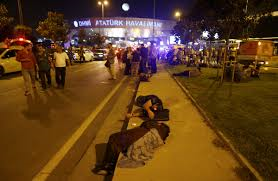
The attack on Istanbul airport by suspected Islamic State terrorists is a classic example of unintended consequences, or what the CIA calls blowback.
But having turned a blind eye to the menace of Islamic State across its southern border for strategic reasons, Turkey can hardly be surprised at what is now occurring.
Turkish Prime Minister Binali Yildirim says it is highly likely Islamic State is responsible.
If so, it will be the third terror attack committed by the group in Turkey this year.
Add in the gathering violence committed by Kurdish separatists and it is clear that Turkey, once described as the most cosmopolitan country in the Islamic world, now faces a worsening crisis of religious and political violence.
The problem has been incubated by Ankara’s policies. Since the war began Turkey has used Syria’s innumerable opposition groups as a foil against the Assad regime, Turkey’s enemy and rival in the region.
Under President Recep Tayyip Erdogan, Turkey has been increasingly supportive of Islamist movements across the region, including Egypt’s Muslim Brotherhood, which in 2013 was overthrown in a military coup.
But as the Americans discovered when they funded the Mujaheddin against the Soviets in Afghanistan in the 1980s, terror groups like Islamic State and al-Qa’ida are “cold monsters’’. They have their own agendas, which will never align with the secular, liberal and peaceful society most Turks aspire to create. They are not your allies.
As a NATO member, Turkey has been an ally in the coalition air campaign against Islamic State, but a deeply reluctant one. Late last year it finally began launching sorties against Islamic State targets inside Syria and northern Iraq after much international pressure and a suicide attack in the border town of Suruc, which killed 34.
Turkey has also been broadly supportive of Australia’s efforts to suppress Islamic State, catching, where it can, transiting Australian fighters and deepening its co-operation with our police and intelligences agencies.
But traditionally Ankara has shown more enthusiasm for bombing hostile Kurdish groups such as the PKK which have exploited the chaos in Syria and northern Iraq to establish a foothold on its border.
This has hindered the campaign against Islamic State as Kurdish fighting units are among the most effective troops in the Syrian-Iraq theatre.
Turkey has also allowed Islamist militants free reign at the border, both to smuggle foreign fighters into Syria and to move contraband, like oil, out of it. This has greatly contributed to Islamic State’s strength and wealth. But now, like spores to the wind, Islamic State’s attackers are spreading across the globe.
Yesterday’s attack was the third Islamic State assault in Turkey this year. It is unlikely to be the last.
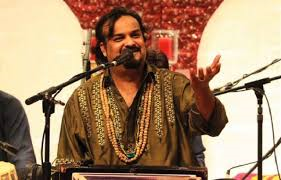
Amjad Sabri, a master of qawwali, the devotional music that is wildly popular across the Indian subcontinent and well beyond, was gunned down in Karachi, Pakistan. The man who spent his life singing the praises of the prophet Muhammad, continuing a centuries-long tradition of musical veneration, was accused of blaspheming the prophet, and he was executed for it.
During Ramadan.
That is so important, so painful and so hard to make sense of for the many Muslims — particularly for Pakistanis like me — because qawwali is part of our religion. At a time when Islam is reduced to warlike, uncivilized violence and portrayed as an angry, intolerant faith, qawwali is evidence of something different. The historic spread of Islam through much of what we call the Muslim world happened largely through architecture, calligraphy, poetry, but perhaps above all, music.
In South Asia, home to an astonishing one-third of the world’s Muslims, preachers and poets composed verse that survived for centuries, embedding Semitic values into local languages, a mix that was as intoxicating as it was unique. Qawwali is the soundtrack of that tradition.
The poetry, often Urdu or Punjabi, is set to music, usually in praise of God or the prophet Muhammad. A band of singers joins together to deliver songs that ecstatically convey the deep love of God, which classical Muslims expressed in secular metaphor: an intoxicating beloved, or an intoxicant itself.
Masters of qawwali, known as “qawwals,” are world famous. In fact, qawwali was the first concert I ever went to. His name was Nusrat Fateh Ali Khan, and only later would I know enough about who he was, and what he sang, that my mind could be fully blown.
When I entered graduate school, it was to study Islam in South Asia, which means the many ancestries —Punjabi and Urdu, Hindu and Muslim, Arab and Turkish, Eastern and Western —that gave birth to me. There was a lot there for me to try to make sense of, an attempt to grasp not just facts and figures, but emotions and feelings.
My parents were religious, and very much socially conservative, and taught us that we shouldn’t dance in public, and certainly never men with women. But when I was 11, Nusrat Fateh Ali Khan came to the University of Massachusetts at Amherst, where I was in grad school, and this very large man, cross-legged on a carpet spread out on the stage, joined by a team of musicians, began singing. Now, Nusrat was perhaps the greatest qawwal of all time; when I was growing up, the only names mentioned alongside him were the Sabri Brothers — one of whom was the father of Amjad Sabri.
There in that auditorium, I felt like a visitor on an alien planet, like someone who had seen the invasion of the body snatchers. My parents and their friends were up and dancing, and it wasn’t just that nobody cared; they loved it. They saw it as worship, probably.
History, heritage, theology, piety.
Qawwali emerges from the conviction that, before the majesty of God and the span of Creation, reason fails; only art, only music can possibly evoke the deepest feelings stirred in the human soul. So you have a musical form that reflects, in its very effect on you, the nature of faith as Muslims once believed it to be: A deep, romantic love, between a dependent human being, and an all-powerful Divine.
Here’s Nusrat performing “Allah Hu,” a simple, stunning song, whose very performance embodies the meaning of artistic endurance, which glorifies God by drawing attention to His utter otherworldliness, the translation of Islam’s radical monotheistic theology into rhyming verse: “when this land was not, when this sky was not, when this here was nowhere…. You, You….” Here’s a Pakistani rock band, Junoon — the name means ecstasy, passion, madness — performing the same song with a modern spin.
In the first moments of Junoon’s performance of “Allah Hu,” singer and guitarist Salman Ahmad announces, “The whole concept of a qawwali is not the performer performing, but the performer and the audience being in a spiritual bond.”
Maybe that’s why Sabri’s assassination hit so hard. Not just who we lost, or that we lost a piece of ourselves, but that many Muslims, especially Pakistanis and Indians, see qawwali as a bond between themselves and their history.
On Wednesday, I heard from many friends and colleagues, many but not all Pakistani, mourning Amjad Sabri’s death. One woman said she fought back tears the whole day.
Journalist Murtaza Hussain of the Intercept said it hit particularly close to home. “It was the music we grew up hearing around the house,” Hussain recalled. Not just Sabri, he meant, but all qawwali. “It was distinctively Pakistani and was our own unique expression of Islam. That’s why this killing really strikes at the heart and soul of Pakistan.”
“I don’t know if people outside the subcontinent can appreciate how much qawwali music is our own expression of religion,” Hussain said.
Sabri’s assassination happened in a Pakistan that itself would not exist without poetry — the great 20th century philosopher and poet, Muhammad Iqbal, might be said to have willed the Pakistan movement into existence. It was Iqbal’s poetry that roused the masses, that animated the idea of an Indo-Muslim homeland, that is read in every part of the Muslim world today. And that poetry is, as you would expect, also performed and sung.
But I don’t think it’s a time of mourning all the same, because I don’t think Sabri himself would have wanted us to see his death that way. The Sufis call the day of your death the wedding day, the day the lover leaves his temporary home to join his Beloved. It is a day for songs, for music, for crying out to God above and stamping your feet against the ground below, which is pretty much the best way I can think to describe our time here in this world, as long as it lasts.
It is with great regret that I must admit that I never had the chance to see Amjad Sabri in concert, but when I think about his passing, I keep remembering that Amherst auditorium.
Nusrat Fateh Ali Khan, a very large, very intense man, who seemed to be operating on a different plane of existence, who was among us, but not really with us. A hall where men and women, my aunties and uncles, as we addressed them, who always seemed so much older, so distant, so disconnected from the world I was born into, very soon jumped out of their seats and let loose, and turned round and round, laughing and dancing and clapping, ageless and joyous, as if they had, at last, come home. This was the music that connected generations of Muslims, that gave us a shared religious language.
I hardly understood a word out of his mouth, and yet I cannot forget it.
Kidnapped Owais Ali Shah (Credit: Indianexpress.com)
ISLAMABAD, June 26: Interior Minister Chaudhry Nisar Ali Khan on Saturday said that the assassination of renowned Qawwal Amjad Sabri and kidnapping of Owais Ali Shah, son of Chief Justice Sindh High Court Sajjad Ali Shah in Karachi, are aimed at creating panic in the port city.
Speaking to Geo News, Khan said that these two incidents did not raise question mark on Karachi operation.
Nisar said he was in touch with all the agencies for the recovery of Barrister Owais Ali Shah.
The minister strongly condemned the killing of Amjad Sabri and said the purpose of Qawwal’s killing was to create panic among the masses.
He was optimistic the security agencies would soon bring to book the murderers of Amjad Sabri.
Sabri was travelling with an associate when two gunmen on a motorcycle opened fire on his car on Wednesday.
He was shot multiple times and pronounced dead by medics at a local hospital where he was taken after the attack.
On Monday, The son of Justice Sajjad Ali Shah was kidnapped by unknown persons in Karachi and the law enforcement agencies seem to be clueless about his whereabouts.
This is not the first high-profile kidnapping in the country. In August 2011, slain governor Punjab’s son Shahbaz Taseer was kidnapped from Lahore by the Taliban. He returned home after four years of torture in captivity in March this year.
Former Prime Minister Yousuf Raza Gilani’s son Ali Haider Gilani was kidnapped from an election rally in Multan in May 2013. He was rescued in an operation in Afghanistan by American forces in May this year.
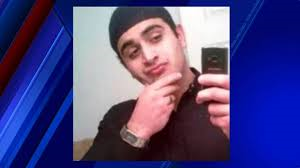
A mother accused of domestic abuse and described as “paranoid.” A father became a supporter of the Taliban. Parents who spent years in and out of courtrooms. That’s the family that gave rise to mass-murderer Omar Mateen, who killed 49 people in the Pulse gay nightclub in Orlando last Sunday.
As investigators continue to search for a motive in the largest mass-shooting in U.S. history, they are focused intensely on the three years prior to the attacks, including the period when Mateen, who worked as a private security guard, was on a terrorism watch list.
But a portrait of the killer’s upbringing also is beginning to emerge, through snapshots of a childhood marked by domestic strife, struggles in school, and outbursts of violence, which may yield some insights about why Mateen embarked on his murderous rampage.
Mateen grew up in a house of four children, where he was the only boy. School records obtained by The Daily Beast show that the New York-born Mateen struggled in school and stayed in English for Speakers of Other Languages classes through middle school. As he grew older, the bad grades became supplemented with violent outbursts, including at least two instances in which Mateen hit another child. One teacher noted that Mateen “lacks remorse.” When the family moved school districts in the eighth grade, he was suspended for 25 days from his new school. In his freshman year of high school, he was even sent to another school after fighting a student.
Between eighth and 10th grade, Mateen was suspended for 48 days for fighting and other behavioral issues. The final suspension recorded for Mateen came in the new school year, two days after the terrorist attacks of Sept. 11, 2001. Mateen, whose parents were born in Afghanistan, was given a five day in-school suspension at the alternative school for an “other disciplinary violation” on Sept. 13.
In school records, Mateen’s mother, Shahla, seemed largely absent from the discussion.
Official records suggest the couple had a history of marital problems. In 2002, when Mateen was 16, police came to the family house on Waterlily Place, in Martin County, Fla., and arrested Shahla on charges of beating her husband. According to a police report, the couple, then married for 20 years, had been arguing while their children slept. Seddique went to brush his teeth, and Shahla began cursing at him, and then pulled his hair and pinched him on the bicep hard enough to leave a red mark visible to police officers.
Shahla was carted off to the police station, where officers took her mug shot. Seddique asserted that his wife had threatened to hurt him in the future. “She said she knows what to do with him,” an officer reported. To the question, “Has the defendant previously assaulted or battered you,” Mateen answered, “Yes.”
Seddique didn’t press charges, and even posted his wife’s bail. There are no records of further domestic disturbances. But the incident would find disturbing echoes years later when Omar Mateen’s ex-wife accused him of beating her while they were married. (The allegations came to light after the shooting.)
The altercation between Seddique and Shahla wasn’t the couple’s only interaction with the legal system. They have been a party in at least eight civil lawsuits in St. Lucie and Martin counties since 1994, according to court records.
In at least three cases, the Mateens were dragged to court to settle an alleged debt; in five, they’ve been plaintiffs. In 1998, Seddique sued his employer, Equitable Life Insurance, saying they failed to make good on his own disability insurance policy after he became unable to work following an automobile accident and alleging they “harassed and intimidated” him while he sought payment.
In 2010, he sued Progressive Express Insurance Company; the case was dismissed in 2012.
The Mateens also sued two individuals: a couple in small claims court in 1996, and a woman in 2011 for auto negligence. The details of those cases weren’t immediately available. And in a handwritten letter to the Martin County court announcing his intent to sue his property owner’s association for what he said were unfair charges he refused to pay, Seddique scrawled, “I’m not a punching bag!”
Becky Diefendorf, 57, who worked with Shahla at two St. Lucie County Walgreens stores, told The Daily Beast she had several explosive run ins with her former co-worker, whom she described as “paranoid.”
Diefendorf, who said she left the chain in 2011, was a manager; Shahla worked the makeup counter. She said that Shahla had once accused her of throwing eggs at the family’s home and of slashing the tires on Shahla’s car.
Thank You!
You are now subscribed to the Daily Digest and Cheat Sheet. We will not share your email with anyone for any reason
“I would guess that [she could be violent],” Diefendorf said of Shahla Mateen’s arrest for domestic abuse. “My daughter had to come to the store one night to make sure I was okay. That was the night she accused me of doing that to her house. And I got so upset that I was crying…and then it just became a really big mess.”
Diefendorf said Mateen’s mother rarely mentioned her son at work, but that she often alluded vaguely to problems at home.
“I do remember her leaving because she had family problems,” Diefendorf said. “She would just come at me and say, ‘I have to go, family problem,’ and leave.”
A client of Mariam Seddique, one of the family’s three daughters, who managed a beauty salon, said she sometimes saw Shahla at the shop.
“These are nice people, these are nice, friendly people,” the client, who asked to remain anonymous, told The Daily Beast. “They’re generous, they’re lovely…. I mean, I’ve never gone to her salon, had my hair done, and not come away with a gift.”
But while Mariam spoke often of her sisters and parents, the client said she rarely mentioned her brother, Omar. “I don’t think she has the relationship with him that she has with the rest of her family,” the client said.
She told The Daily Beast that she and Mariam would often discuss the differences between Islam and Christianity, and that it seemed like Mariam was “searching.” Mariam even worked for a time as a secretary at a now-defunct church in town, the client said.
The client also attended Mariam’s wedding in 2015, which she described as “the United Nations,” because so many people from different backgrounds and walks of life came. The Mateen family has said that Mariam’s husband, Masood Khan, is from Dubai.
The client said that the Mateens never told her that they were from Afghanistan. “They said they were Persian,” she recalled.
Of all the Mateen family members, Seddique has been the most visible, outspoken both in his condemnation of his son’s actions and his insistence that he can find no explanation for what drove Omar to commit mass murder.
Over the years, the elder Mateen has worked mainly as an insurance salesman. But recently he has turned to politics and made it into a family business. He founded a non-profit organization whose sole purposes appears to be the promotion of TV and Internet broadcasts of a political talk show he hosts. His daughters Sabrina and Mary are listed as directors of the company, the Durand Jirga Inc.
Since at least 2011, Mateen has hosted the show, which airs on a station in California that’s predominately aimed at the Afghan diaspora in the U.S. and Europe. In the 100-plus videos of the show posted to his YouTube page, Mateen usually sits at a desk in front of a video backdrop of mountains or animated graphics. Occasionally he’s joined by a guest or a panel, and from time to time Mateen turns roving reporter and interviews people in the field.
The theme of the videos is consistent: Mateen is an unabashed Afghan nationalist with a visceral hatred of Pakistan. The so-called Durand Line, a 19th Century border between the two countries, is a subject of frequent, heated discussion. Mateen styles himself as a kind of peacemaker–in at least one video he offers up a detailed peace plan for the two rival nations.
But he can be wildly inconsistent, too, at one moment praising the Taliban–the militant group that sponsored al Qaeda before 9/11 and continues to attack U.S. forces–and then condemning them for their violent acts.
Lately, the videos have taken on a delusional tone. Mateen has appointed himself president of Afghanistan and has posted to his Facebook pages the names and photos of people he claims are serving as ministers in his cabinet. Recent videos on his Facebook timeline show Mateen wearing camouflage fatigues and saluting the camera.
Mateen has something of a following in Afghanistan, but probably not the kind he’d like. “Many Afghans on social media have circulated his videos just to laugh and write some funny comments,” said one person who translated some of the videos for The Daily Beast and asked to remain anonymous. “In his videos, he addresses Afghan people to raise against the government of Afghanistan and Pakistan to pave the way for him to come to Afghanistan. … He is known among Afghans because of his abnormal statements.”
Since the shooting at the Pulse nightclub, other commenters have left pornographic images in the comments of Mateen’s Facebook page, condemning his son for attacking LGBT people. But there’s nothing in the videos that suggest Mateen was a religious fundamentalist. His diatribes are more nationalist and engineered for self-aggrandizement and political effect.
In comments after his son was killed by police, Mateen made remarks that seemed to condemn homosexuality on religious grounds, but he subsequently tried to walk them back, suggesting that while he might not personally approve of homosexuality, it was no basis for his son to kill 49 people.
“He doesn’t have the right, nobody has the right to harm anything, anybody,” Mateen told CBS News. “What a person’s lifestyle is, is up to him. It’s a free country. Everybody has their own choice to live the way they want to live.”
And yet his support for the Taliban stands in stark contrast to such live-and-let-live attitudes. The group is notoriously homophobic and has murdered gay men.
Omar Mateen was surely aware of his father’s political views. And according to men who knew the son and said they had talked with him in gay clubs in Orlando, he complained about his strict father.
For his part, Seddique Mateen has insisted that he knows his son wasn’t gay. “He wasn’t gay. I know 90 percent, 95 percent,” Mateen told The Advocate, the influential LGBT news publication. Mateen doesn’t deny that Omar may have gone to gay clubs. “Based on what I’m thinking of, he must have gone scouting or something,” he said, in preparation for the attacks.
But in the interview, Mateen acknowledged that his son–whose childhood misbehaviors he had defended–clearly had hidden a lot about himself. The father said had thought the two were close. “But he fooled me,” Mateen said.
Federal investigators don’t seem convinced. On Friday, Mateen was placed on the federal no-fly list, along with Mateen’s widow, Noor Salman, who has given conflicting accounts about what she knew of Mateen’s plans before the attack. Prosecutors are reportedly bringing evidence to a grand jury, an indication that they intend to charge Salman.
ORLANDO, Fla. — A gunman who pledged allegiance to the Islamic State opened fire in a crowded gay nightclub here early Sunday in a shooting that left 50 dead and another 53 wounded. The gunman, identified as Omar Mateen, had been investigated twice by the F.B.I. for possible connections to terrorism, the bureau said, but no ties could be confirmed.
Mr. Mateen, 29, an American citizen whose parents were from Afghanistan, called 911 and talked about the Islamic State at the time of the massacre at the Pulse nightclub, the worst mass shooting in American history, Ronald Hopper, an assistant agent in charge of the F.B.I.’s Tampa Division, said at a news conference. Other federal officials said more explicitly that he had declared allegiance to the group.
“The F.B.I. first became aware of him in 2013 when he made inflammatory comments to co-workers alleging possible terrorist ties,” but could not find any incriminating evidence, Agent Hopper said.
Law enforcement officials said the suspect in the attack on an Orlando nightclub on Sunday had been monitored for possible terrorist ties, but was still legally able to buy guns.
In 2014, the bureau investigated Mr. Mateen again, for possible ties to Moner Mohammad Abusalha, an American who grew up in Florida but went to Syria to fight for an extremist group and detonated a suicide bomb. Agent Hopper said the bureau concluded that the contact between the two men had been minimal, and that Mr. Mateen “did not constitute a substantive threat at that time.”
The suspicions did not prevent Mr. Mateen, who lived in Fort Pierce, Fla., from working as a security guard, or from buying guns. The federal Bureau of Alcohol, Tobacco, Firearms and Explosives said Mr. Mateen legally bought a long gun and a pistol in the last week or two, though it was not clear whether those were the weapons used in the assault.
The gunman stormed the Pulse nightclub armed with an AR-15-style assault rifle and a handgun around 2 a.m., turning what had been a celebratory night of dancing to salsa and merengue music into a panicked scene of unimaginable slaughter, the floors slicked with blood, the dead and the injured piled atop one another.
Terrified people poured onto the darkened streets of the surrounding neighborhood, some carrying wounded and bleeding victims to safety; police vehicles were pressed into service as makeshift ambulances; and hundreds of people gathered at hospitals and on the fringes of the law enforcement cordon around the nightclub, hoping for some word on the fate of their relatives and friends.
“I saw bodies on the floor, people on the floor everywhere; it was a chaos, everybody trying to get out,” said Ray Rivera, a D.J. at the club who was playing reggae music on the patio area while Latin music played inside the building, when the shooting began. “I heard shots, so I lower the volume of the music to hear better because I wasn’t sure of what I just heard. I thought it was firecrackers, then I realized that someone is shooting at people in the club.”
Joel Figueroa and his friends “were dancing by the hip-hop area when I heard shots, bam, bam, bam, and the only thing I could think of was to duck, but I ran out instead,” he said. “Everybody was screaming and running toward the front door. I didn’t get to see the shooter.”
Some people who were trapped inside hid where they could, calling 911 or posting to social media, pleading for help. The club itself posted a stark message on its Facebook page: “Everyone get out of pulse and keep running.”
A three-hour standoff followed the initial assault, with people inside effectively held hostage until about 5 a.m., when law enforcement agencies led by a SWAT team raided the club in force, using armored vehicles and explosives designed to disorient and distract.
Hours after the attack, the Islamic State claimed responsibility in a statement released over an encrypted phone app used by the group. It stated that the attack “was carried out by an Islamic State fighter,” according to a transcript provided by the SITE Intelligence Group, which tracks jihadist propaganda.
But officials cautioned that even if Mr. Mateen, who court records show was born in New York and had been married and divorced, had been inspired by the group, there was no indication that it had trained or instructed him, or had any direct connection with him. The pair who killed 14 people in San Bernardino, Calif., in December also proclaimed allegiance to the Islamic State, but investigators do not believe they had any contact with the group.
“The F.B.I. is appropriately investigating this as an act of terror,” President Obama said from the White House. He said that the gunman clearly had been ”filled with hatred” and that investigators were seeking to determine any ties to overseas terrorist groups.
“In the face of hate and violence, we will love one another,” he said. “We will not give in to fear or turn against each other. Instead, we will stand united as Americans to protect our people and defend our nation, and to take action against those who threaten us.”
As he had after previous mass shootings, the president said the shooting demonstrated again the need for what he called “common sense” gun measures.
“This massacre is therefore a further reminder of how easy it is for someone to get their hands on a weapon that lets them shoot people in a school or a house of worship or a movie theater or a nightclub,” Mr. Obama said. “We have to decide if that’s the kind of country we want to be. To actively do nothing is a decision as well.”
The shooting was the worst terrorist attack on American soil since Sept. 11, 2001, and the deadliest attack in the nation’s history on a specifically gay gathering. The F.B.I. set up a hotline for tips.
Law enforcement officials increased security at gay pride events and gay landmarks in cities around the country, including Washington, New York and Chicago. Officials in Santa Monica, Calif., on Sunday confirmed the arrest of a heavily armed man who said he was in the area for West Hollywood’s gay pride parade. The authorities, however, said they did not know of any connection between the arrest and the Orlando shooting.
Some terrorist attacks, like the San Bernardino killings in December, have been carried out in the name of Islam by people, some of them born and raised in the West, who were “self-radicalized.”
The Islamic State in particular has encouraged “lone wolf” attacks in the West, a point reinforced recently by a spokesman for the group, Abu Muhammad al-Adnani, in his annual speech just before the holy month of Ramadan. In past years, the Islamic State and Al Qaeda ramped up attacks during Ramadan.
“Make it, Allah permitting, a month of hurt on the infidels everywhere,” Mr. Adnani said, according to a translation provided by the SITE Intelligence Group. Noting that some supporters have lamented that they cannot strike at military targets, he took pains to explain why killing civilians in the land of the infidel is not just permitted but encouraged.
Rasha Mubarak, the Orlando regional coordinator of the Council on American-Islamic Relations, released a statement saying: “We condemn this monstrous attack and offer our heartfelt condolences to the families and loved ones of all those killed or injured. The Muslim community joins our fellow Americans in repudiating anyone or any group that would claim to justify or excuse such an appalling act of violence.”
The toll of the dead and injured far exceeded those of the 2007 shooting at Virginia Tech, where 32 people were killed, and the 2012 shooting at an elementary school in Newtown, Conn., where 26 people were killed.
The club posted a message on its Facebook page about 3 a.m.: “Everyone get out of pulse and keep running.”
The Gay Lesbian, Bisexual, Transgender Community Center of Central Florida said it was offering grief counseling to victims and survivors.
Officials at Orlando Regional Medical Center asked members of the families of victims and missing people to gather at the north entrance, where they would be escorted inside.
The slaughter at Pulse occurred a day after the singer Christina Grimmie, a star of YouTube and the reality TV show “The Voice,” was shot down after a concert in Orlando. The police said she had been killed by a St. Petersburg, Fla., man who drove to Orlando with the specific intention to kill Ms. Grimmie. The man, Kevin James Loibl, killed himself moments later.
Chief Mina said Mr. Loibl had traveled to Orlando with two handguns, several loaded magazines and a hunting knife. Police officials were examining his telephone and computer to try to determine a motive.
Lizette Alvarez reported from Orlando, and Richard Pérez-Peña from New York. Reporting was contributed by Wendy Thompson and Les Neuhaus from Orlando; Alan Blinder in Fort Pierce, Fla.; Rukmini Callimachi from Paris; Eric Lichtblau and Eric Schmitt from Washington; and Steve Kenny, Richard A. Oppel Jr., Rick Rojas and Daniel Victor from New York
KARACHI, Pakistan — Five years after most senior al-Qaeda leaders are thought to have fled this port city, officials in Karachi worry that the organization is regrouping and finding new support here and in neighboring Afghanistan. They are especially concerned about the recruitment of potential foot soldiers for the next major terrorist attack.
The resurgence has been managed by a South Asian offshoot called al-Qaeda in the Indian Subcontinent (AQIS), created by al-Qaeda’s top leader, Ayman al-Zawahiri, in 2014 in order to slow advances by rival Islamic State militants in the region.
Initially, AQIS struggled to gain traction in Pakistan — it has been the principal target of President Obama’s drone-strike strategy in the country’s northwestern tribal belt. But AQIS is now finding its footing in southern Pakistan, powered by fresh recruits and budding alliances with other militant organizations.
“They are making a comeback of sorts,” said Saifullah Mehsud, executive director of the FATA Research Center, which monitors militant groups. “But it’s a different, more localized al-Qaeda.”
After the fall of Afghanistan’s Taliban government in 2001, many al-Qaeda leaders spilled into northwest Pakistan or attempted to blend in in Karachi, a bustling city of more than 20 million residents. A significant number of those core leaders were eventually killed or captured, or fled to the Middle East, officials said.
But the formation of AQIS is again allowing al-Qaeda to tap into Karachi’s wealth and network of madrassas in search of recruits and technical expertise — and sparking deadly clashes with Pakistani security forces.
“The core al-Qaeda, the thinkers and planners, are not coming to the front right now, but they are giving directions, and . . . the local boys are going in big numbers,” said one counterterrorism official in Karachi who asked to remain anonymous because he was not authorized to speak to the media.
While Pakistani officials remain confident that al-Qaeda probably can’t pull off another 9/11-style attack on the United States, there is concern that the group is, as one official put it, “planning something big.” The official added that it is unclear, however, whether such an attack would be aimed at Pakistan, another country in South Asia or the West.
Those concerns mirror assessments from U.S. commanders in Afghanistan, where there are also signs that elements of al-Qaeda are trying to come together. A 30-square-mile training camp was discovered in Kandahar province in October, and last month U.S. and Afghan special operations forces freed a kidnapped Pakistani from an al-Qaeda-linked camp in Paktia province.
“They are looking to nestle in with the Taliban so they have some level of sanctuary,” said Brig. Gen. Charles H. Cleveland, chief spokesman for the U.S.-led coalition in Afghanistan. “Ultimately, what we think al-Qaeda gets out of this relationship is, if the Taliban can provide them some ungoverned space, that allows al-Qaeda space to really conduct their global operations.”
In Pakistan, officials say al-Qaeda is also re-adapting through enhanced alliances with established militant groups, including the Sunni-dominated Pakistani Taliban and Lashkar-e-Jhangvi, a sectarian group that had been focused on attacking Shiite Muslims.
The coordination comes as Pakistan’s military has stepped up its operations against various militant groups, prompting them to seek out support from al-Qaeda “for survival,” said one Pakistani law enforcement official who also spoke on the condition of anonymity.
But officials say that the threat from al-Qaeda extends far beyond Sunni militant groups rebranding themselves. Instead, they say, al-Qaeda is finding new recruits from some unlikely Karachi neighborhoods.
Although ethnic Pashtuns and foreign fighters have historically formed the backbone of al-Qaeda in the Afghanistan-Pakistan region, some ethnic Bengalis and other Urdu-speaking Mohajirs — Muslims who migrated to Pakistan from India after the 1947 partition — are also being lured into the group, officials said.
“They are not into this factional fighting, or fighting with other sects or Shiites, but they will go for enforcement of sharia law overall” and be drawn to al-Qaeda sermons against the West, the official said.
Counterterrorism officials in Karachi have a list of several hundred active al-Qaeda members, which makes them assume there are at least a few thousand on the streets.
In Karachi, AQIS has divided itself into three operational segments — recruitment, financial and tactical — made up of four-to-six-person cells.
The recruitment cells work in madrassas and schools, casually preaching Islam before targeting certain students for potential recruitment, officials said.
“Nobody may even know it’s al-Qaeda operating,” said Saad Khan, a retired Pakistani intelligence officer.
Cells solicit local businesses for donations, often under the guise of supporting Islamic charities, officials said. Officials have no estimates for how much money al-Qaeda raises from relatively wealthy Karachi but said that militants are often found carrying hundreds of dollars in cash.
“They are being told they don’t need to do any job and they don’t need to indulge in petty crimes,” the counterterrorism official said. “But they are told they have to remain very discreet.”
Although such discretion complicates the work of counterterrorism officials, they think that the Karachi cells are just spokes in a broader operation centered near Pakistan’s southwestern border with Afghanistan or Iran.
From Karachi, AQIS tactical cells ferry money and messages to that general area, often moving through Quetta, which is also where part of the Afghan Taliban leadership resides, officials said. From Quetta, militants cross the border into Afghanistan but appear to have little knowledge about al-Qaeda’s broader ambitions or tactics in the region, intelligence officials said.
“The people we come into contact with say they go to Afghanistan but are put into a small corner and remain there and can’t go out,” the Pakistani counterterrorism official said. “Then they get direction from there, from another Pakistani, and return.”
In Pakistan, officials said AQIS has been linked to just one major attempted terrorist attack — an effort two years ago to hijack a Pakistani navy vessel from the port of Karachi.
The attack was foiled, but five Pakistani navy officers were convicted of helping to orchestrate the operation, according to media reports.
AQIS militants have also been linked to several recent police killings in Karachi. Officials say they are targeted revenge attacks or the early stages of a larger plot to try to weaken the morale of security forces.
“What still makes al-Qaeda different and more dangerous from other militant groups is a disciplined management system,” said Rahimullah Yusufzai, a Peshawar-based expert on militants. “Another dangerous thing is they are always looking to penetrate into the armed forces looking for sympathy.”
U.S. intelligence officials have worried for years about potential links between al-Qaeda and rogue Pakistani military officials. That Osama bin Laden was found hiding near a Pakistan military training academy did little to allay their suspicions.
Pakistani security and intelligence agencies, however, seem to have no tolerance for the modern-day al-Qaeda. “We don’t go for arrests,” the counterterrorism official said. “We just search through their computer, their things, and then neutralize them.”
Last month, police in Pakistan’s Punjab province reported killing 14 al-Qaeda militants, including the group’s leader there, over two days in “encounters” with police. Pakistan’s Dawn newspaper reported that the suspects had been in police custody for four months before they died.
Saad Muhammad, a retired Pakistani general, said Pakistan’s military is determined not to allow AQIS to jeopardize its recent gains against Islamist militant groups.
“You can’t say they will be totally naked, but they will not be able to gain strength in any significant way,” Muhammad said.
But Syed Tahir Hussain Mashhadi, a retired Pakistani army colonel and sitting senator, said the real concern remains how a city such as Karachi fits into al-Qaeda’s broader global ambitions. The answer to that, he said, remains murky.
“Al-Qaeda is just an umbrella, and the top of the pyramid is what is controlling and enduring,” he said. “They don’t have to put much effort into Pakistan because all they have to do is pick up all these existing, bloodthirsty splinter organizations and they have a ready-made killing machine.”
Nisar Mehdi in Karachi, Aamir Iqbal in Peshawar and Antonio Olivo in Kabul contributed to this report.
Saad Aziz (Credit: ISPR)It was a 9mm gun, probably a Stoeger. Before Saad Aziz got this “samaan” through an associate, by his own admission, he had already plotted a murder. On the evening of Friday, April 24, 2015, he met four other young men, all well-educated like him, somewhere on Karachi’s Tariq Road to finalise and carry out the plot. As dusk deepened into night, they set off towards Defence Housing Society Phase II Extension on three motorcycles. Their destination: a café-cum-communal space – The Second Floor or T2F – where an event, Unsilencing Balochistan: take two, was under way. Their target: Sabeen Mahmud, 40, the founder and director of T2F.
Two of Aziz’s associates, he says, “were just roaming around in the vicinity of T2F”. A third was keeping an eye on the street outside. Aziz himself was riding a motorcycle driven by one Aliur Rehman, also mentioned as Tony in the police record. When he received the message that Mahmud had left T2F, he says, he followed her. “Suzuki Swift, AWH 541,” he repeats her car’s make and registration number.
As the car stopped at a signal less than 500 metres to the north of T2F, “Tony rode up alongside it.” Mahmud was in the driving seat, Aziz says. “Next to her was her mother, I think. That is what we found out from the news later. There was a man sitting in the back. I fired the gun four or five times at her.”
“There wasn’t one particular reason to target her; she was generally promoting liberal, secular values. There were those campaigns of hers, the demonstration outside Lal Masjid [in Islamabad], Pyaar ho jaane do (let there be love) on Valentine’s Day and so on.”
Sitting in a sparsely furnished room within Karachi Police’s Crime Investigation Department (CID), Aziz appears at ease even in blindfold. Recounting the events of that evening, he never sounds hurried or under duress.
After shooting Mahmud, he says he and Tony turned left from the signal towards Punjab Chowrangi and reached Sharae-e-Faisal, crossing Teen Talwar in Clifton on their way. While still on the motorcycle, he messaged others to get back to Tariq Road. Once there, he just picked up his motorcycle and they all dispersed. “We only got confirmation of her death later from the news,” he says. “At that moment [of shooting], there is no way of confirming if the person is dead. You just do it and get out of there.”
It was on February 13, 2015, when he says he decided that Mahmud had to die. That evening, he was at T2F, attending an event, The Karachi “Situation”: Exploring Responses. “It was something she said during the talk,” he recalls. “That we shouldn’t be afraid of the Taliban, we should stand up to them, demonstrate against them, something like that. That is when we made up our minds.” Later in the conversation, though, he adds, “There wasn’t one particular reason to target her: she was generally promoting liberal, secular values. There were those campaigns of hers, the demonstration outside Lal Masjid [in Islamabad], Pyaar ho jaane do (let there be love) on Valentine’s Day and so on.” He laughs softly, almost bashfully, as he mentions the last.
Aziz remembers visiting The Karachi “Situation” seminar with Tony who, the police say, remains on the run. Pictures and video footage of the event show Aziz sitting at the end of a row, close to the entrance. Next to him is Tony, a round-faced young man with a dark complexion. The police say he is an engineering graduate from the National University of Sciences and Technology, Rawalpindi campus. “Tony had a Twitter account under a fake name and he used to follow Sabeen’s tweets very closely,” says Aziz. He also mentions another source of information. “About four weeks [after the discussion on Karachi], when I got emails about events being held there, I sent Tony there a few times to check if her car was there. It wasn’t.”
On April 24, 2015, Aziz says, he told Tony to go there again. “When he confirmed her car was there, we made the plan there and then.”
By that time, he confesses, he had taken part in 20 major and minor “operations” in Karachi. These include an attack – just eight days before Mahmud’s assassination – on American academic Debra Lobo, who taught at a college in Karachi, bank heists to put together money for their hit-and-run activities, multiple attempts to target the police and the Rangers and grenade attacks on co-education schools in Gulshan-e-Iqbal (on February 3, 2015) and North Nazimabad (on March 18, 2015).
Nineteen days after Mahmud’s murder, Aziz says he took part in an attack that elicited worldwide shock and condemnation: the assassination of 43 members of the Ismaili Shia community, including women and children, travelling in a bus in the Safoora Goth area on the outskirts of Karachi.
Aziz appears as a mild-mannered young man of medium height and build, with a trimmed beard. He makes a little joke about how he can instantly tell which law enforcement or intelligence agency the person asking him questions belongs to. “The first thing the ISI [Inter-Services Intelligence] want to know is whether there are any links with RAW [the Indian intelligence agency]; CID is interested in the funding aspect; and the police keep hammering on about what other wardaat (hits) we’ve been involved in.”
Aziz calls himself a Salafi, though his father says the family follows Sunni, not Salafi, Islam. When an interrogator asks him why he and his associates targeted Ismaili Shias, he cites their sectarian affiliation as the reason. “It is perfectly acceptable to take the lives of women and children for that reason.”
Aziz’s radicalisation began in 2009, following a visit to Saudi Arabia for umrah with his family. Upon his return to Pakistan, he decided to read translations of the Quran. “Until then I had only read it once in Arabic.” (One investigator, however, reports that Aziz could not recite certain Quranic verses that every practising Muslim recites at least once a day during Isha prayers.)
For a while, he joined the Tableeghi Jamaat. Then, he took to attending lectures by a scholar, Shaykh Kamaluddin Ahmed, a professor at the Lahore University of Management Sciences (Lums) at the time, whose Sufi interpretation of Islam is distinct from what the Tableeghi Jamaat stands for. “But neither [Ahmed] nor Tableeghi Jamaat even discussed jihad,” he says. “It was over time, primarily through reading the Quran, that I developed an inclination towards jihad.”
Aziz then met Tony, whom he suspected had contacts with militants. Tony made him wait for some time before introducing him to one Haris, an al-Qaeda operative. “[Haris] was heading al-Qaeda’s daawati (recruitment) wing for Pakistan at the time. I joined this wing at the end of 2010,” says Aziz.
In September 2013, Haris, whose real name is said to be Abu Zar, was arrested from a hostel of the Punjab University in Lahore, along with two others, for alleged links with al-Qaeda. In the last 22 months, the authorities have not produced him in any court of law for a trial. Police sources in Lahore say Haris and his associates are in ISI’s custody. This information, however, could not be confirmed through other sources.
In 2011, Aziz went to Waziristan for training where, he says, he was attached to a group headed by Ahmad Farooq, deputy head of al-Qaeda in the subcontinent and a former student of Punjab University. (Farooq was killed in an American drone strike in January 2015 in North Waziristan.)
By 2013, Aziz says he was disillusioned and frustrated. Instead of allowing him take part in terrorist operations, his handler Haris limited him to media duties — such as managing online jihadist publications. “In mid-2013, I met Haider Abbas,” says Aziz. Abbas introduced him to Tahir Minhas alias Saeen, identified by the police as a member of al-Qaeda.
As a senior, experienced commander, Minhas set the ground rules for the group that Aziz joined. “We all used aliases; I only know Tony by his real name,” says Aziz. He got his own alias — Tin Tin. “None of us would ask for the members’ real names, addresses or anything that could identify them in case one of us was arrested. That was on Minhas’s instructions.”
The cell had no designated ‘safe house’ to meet. Minhas often called its members for meetings to Jan Japan Motors, a car auction site on the Super Highway. He also selected the targets. The attack on Mahmud, though, was different. Aziz says it was on his own initiative. “Tahir wasn’t even there that day.”
In 2014, the sudden ascendancy of the Islamic State (IS) and its territorial gains in Iraq and Syria became a lightning rod for militants across the globe. In January this year, IS announced its expansion into Khorasan, a historical region comprising parts of present-day Pakistan, Afghanistan, Iran and some Central Asian countries. Several factions of the Tehreek-e-Taliban Pakistan (TTP) immediately joined it.
“We just finished a 16-day joint investigation but we have not established any direct or indirect link between him and Daesh. Al-Qaeda’s tentacles, however, touch him in multiple ways. We are sure he is with al-Qaeda.”
“Among my acquaintances there was already a lot of discussion about the merits of al-Qaeda and Daesh [the Arabic acronym for IS]. Many of us felt that al-Qaeda was reduced to mainly talk and little action,” Aziz says. “We were in Waziristan when the creation of the [IS’s] Khorasan [chapter] was announced, and we pledged loyalty to its emir, [former TTP commander] Hafiz Saeed Khan.” (A senior official of the Intelligence Bureau in Peshawar says Khan was “in Tor Dara area in Khyber Agency’s Tirah valley in January 2015”, the time period to which Aziz refers.)
Subsequently, he says, some of his associates did pro-IS wall chalking and left propaganda pamphlets in parts of Karachi, especially at the scenes of some of the attacks they carried out. Some of the people working with him, he claims, have gone to Syria as part of an effort to strengthen their connection with the IS leadership there.
Weeks after Mahmud’s murder, Jaadu, her white Persian cat, would sit expectantly by the door of her house for hours every evening, waiting for a familiar footfall on the steps outside. Inside, her mother, Mahenaz Mahmud, sits on a chair looking like her daughter might have 20 years in the future — had she had that much time. The mother also exudes the same warmth, intelligence and artlessness as the daughter — and, since Mahmud’s death, a stoicism that would move a stone to tears.
“On April 24, Sabeen made breakfast for us (Mahenaz and Mahenaz’s mother) as usual. That was her routine. She would switch on the kettle, run to her computer, then she would put the bread in the toaster,” Mahenaz recalls with a chuckle. “She didn’t want me to have a cold slice, so she would toast the second slice only after I had finished the first.” They would usually chat away during breakfasts. “We would talk about all kinds of things.” Sometimes, Mahmud would seek her mother’s advice. “She would ask me what I thought of something being done at T2F. Sometimes we would flog some philosophical concept. We would share articles, then discuss them… there was lots that we talked about.”
That day, though, Mahenaz sensed something unusual. “I don’t know whether it was anxiety but there was some element about this Baloch missing people event, especially because of the talk that was cancelled at LUMS [under orders from the ISI],” she says. Mahmud was not moderating the session; she hadn’t even organised it. “Someone else wanted to do it and she had agreed to provide the space,” says Mahenaz. “But she talked to some people about it and then said to me “It’ll be ok, Amma””.
After breakfast, the mother went to work – she is an academic programmes advisor at a teacher training institute – but planned to attend the talk on the Baloch missing persons. “I hadn’t been to any event for a long time because I get quite exhausted by the evening but that day I had a very strong feeling that I must be around her.”
Following the event, around 9pm, Mahmud was planning to drop her mother home, pick up a friend and go to another friend’s place for dinner. “When Sabeen came out [of T2F], I remember she was in a hurry, and she told the driver to sit in the back. I got in the seat next to her and we drove off.”
A short distance away, the Sunset Boulevard traffic signal turned red and their car came to a stop. “It is impossible for me to process those five, 10 seconds,” Mahenaz says quietly. “I was talking to Sabeen, and my face was turned towards her. She was looking in front. A motorcycle came up along the side she was sitting, much too close for comfort. My eyes became riveted on a gun in someone’s hand. I said to Sabeen, “What do you think he wants? He’s got a gun.” I thought it was a mugging. All this must have taken only three or four seconds. Then the window shattered, and Sabeen’s head just tilted to one side; her eyes were open. There was not a moan, not a groan, not a whimper. Then pandemonium broke out around us.”
Mahmud was shot five times. Her mother also took two bullets: one in her back and another that, after going through Mahmud’s body, went into her arm and out again. She says she remembers feeling there was something “happening with my body but I wasn’t sure what.” She was too focussed on her daughter to be sure of anything else. “I was saying ‘Sabeen talk to me, give me some indication that you can hear what I am saying.’ Even though I knew that she had gone, somewhere there was a glimmer of hope.”
She herself was taken to the Aga Khan University Hospital for treatment. “Next morning, I started demanding that I wanted to go home. I was told that Sabeen’s body was being kept in a morgue and I thought she should be put on the way to her last journey immediately.” With a bullet still lodged in her back, she left the hospital to bury her only child.
When Mahenaz Mahmud learnt that the police had arrested some educated young men for carrying out the murder, it was a shock to her, almost a betrayal of some of her most closely held convictions. “I felt terrified. I am a person who teaches my students that we all have our biases and that we put people into boxes because we don’t have time to find out about each and every person.”
In the third week of June, T2F organised a qawwali session to celebrate her daughter’s birthday posthumously. While observing the audience from the back of the room, she couldn’t shake off a nagging thought. “I was looking at the young boys in the audience and wondering, ‘So what are they thinking? What is really going on in their head?’ Normally I wouldn’t have thought that about young people. I would be happy that all kinds of young people come to T2F. Now I am really scared about how these young men’s minds can be messed with.”
The senselessness of the murder is difficult for her to process. “I want to ask them, why? What happened to you? What was it that bothered you about Sabeen? Was it something she stood for? Did you just want to make an example out of her? Did you think that taking a human life is such a small matter? But then I realise that these people think very differently. Their paradigms are different. Their schemas are different.”
In another part of Karachi, sitting in her home studio, architect Marvi Mazhar, one of Mahmud’s closest friends, says: “I always knew. I always thought that if someone gets to her, it’ll be someone educated. Sabeen had to deal with a lot of hate speech, and from people who were all educated. They used to write, they used to tweet, they were all very tech-savvy. Every time she’d complain that these young bachas, I wish I could have chai with them, talk to them.”
Mazhar recalls an incident from last November. At the Creative Karachi Festival organised by T2F, the azan went unnoticed for a few moments in the hubbub and a young man angrily demanded that the music be stopped instantly. “Sabeen went up to the guy, took him aside and spoke to him for a while; a little later, he actually brought flowers for her by way of apology. There was this strange magic about her,” she says with a wistful smile.
In the days leading up to her death, Mahmud was particularly restless, says Mazhar. On Tuesday, April 21, there was a get-together of friends at Mazhar’s place where Mahmud was “a little agitated”. Mazhar heard her saying to someone on the phone, “If we are not going to do it now, then we won’t do it because after that I am leaving for London and I don’t have time.” She assumes this was about the talk on Baloch missing persons. “Her heart was not into this talk, mainly because she had so much going on otherwise. She believed in it, she believed that the Baloch must be given a platform. But, I felt, judging from the conversations I have had with her, she was waiting for a signal, waiting for someone to tell her not to do this.”
A sturdy metal barrier bars entry into a rough stretch at the end of Beaumont Road in Karachi’s Civil Lines. Only a few street lights illuminate the area; that, along with the dilapidated condition of the road, is perhaps deliberate, designed to make things a little more difficult for terrorists looking to target the CID headquarters that looms up on the right, after the barrier. They did exactly that on November 10, 2010, killing at least 17 people and injuring over 100 in a massive truck bombing. Access inside the CID premises now lies behind a raft of concrete barriers, designed to minimise the possibility of another attack.
Raja Umar Khattab, Senior Superintendent Police, strides into his office at around 10.30pm after taraweeh prayers. A stocky, barrel-chested man, he is wearing a bright yellow T-shirt with khaki pants, rolled up at the bottom and rubber slippers. He speaks in rapid-fire sentences; names of terrorists roll off his tongue like those of old acquaintances. Several phone calls interrupt conversation; a senior official has misplaced his cell phone and Khattab is trying to get it traced. “Sir, don’t worry. I’ll make sure it is back with you soon,” he says reassuringly.
As the CID’s lead investigator, Khattab is flushed with pride over the recent arrest of what he calls a major terrorist cell. He has no doubt the police under him have the men who killed Mahmud and committed the Safoora Goth massacre, apart from various other crimes.
Khattab believes it was a failed romantic relationship that sowed the seed for Aziz’s radicalisation.
The Sindh Rangers, too, have made a separate claim of arresting a mastermind of the attack on Ismaili Shias. “He has nothing to do with Safoora Goth incident; he never did,” says Khattab, shaking his head vigorously, when asked about the man arrested by the Rangers and reportedly linked to the detained office-bearers of the Fishermen’s Co-Operative Society. “When you go to a court to seek remand, you put in extra things. Otherwise it can get difficult to get a remand,” is how he explains the reason for the claim made by the Rangers.
More importantly, Aziz’s claim about his allegiance with IS meets with a similarly dismissive response. “We just finished a 16-day joint investigation but we have not established any direct or indirect link between him and Daesh. Al-Qaeda’s tentacles, however, touch him in multiple ways. We are sure he is with al-Qaeda,” says Khattab.
“And why should it be so surprising that these terrorists are so educated? There were always educated people in al-Qaeda. Educated people don’t join TTP. It is the madrasa-educated ones who join TTP. They have the desire for jihad but these [educated jihadis] are ideologues. They envision grander things,” he adds. And for that reason, Khattab states, they are far more dangerous: They can be anywhere — the shopping mall, the university, saying their prayers beside you.
Khattab believes it was a failed romantic relationship that sowed the seed for Aziz’s radicalisation. “He became disillusioned with worldly pursuits,” says the police officer. “When he joined Unilever for an internship [in the second half of 2010], he met Aliur Rehman – alias Tony – who was also working there.” Tony, a member of Dr Israr Ahmed’s Lahore-based Islamic movement, Tanzeem-e-Islami, was to play a vital role in Aziz’s radicalisation, inspiring him to fight for a Muslim caliphate, says the police officer.
But it was Minhas, the police claim, who turned Aziz into what he has become. In Khattab’s words: “Saad says Tahir motivated him so much that he no longer has any fear of killing people. His role in targeted killings was that of the shooter; by my reckoning, he has killed about 20 people.”
CID officials maintain that the terrorist group of which Aziz was a member had split from a larger al-Qaeda formation eight to 10 months ago. “While Tahir is its askari (militant) commander, he in turn answers to Abdullah Yousuf, who is in Helmand, Afghanistan. The other group formed by this rupture is led by Haji Sahib, Ramzi Yousef’s older brother,” says Khattab. He believes the crime spree by Aziz’s group, which hadn’t yet given itself a name, was aimed at raising its profile within the terrorist fraternity so that someone “owned” it.
Tracking down the group, he says, was not easy. They operated under aliases, did not use mobile phones and, instead, employed a Wi-Fi-based application called Talkray to communicate. The CID first picked up their trail sometime in 2014 through some men who were in prison, Khattab says. Based on the information obtained from them – he does not quite elaborate how but only says “we did some working on them” – the police picked up two former Karachi University students who had joined al-Qaeda through contacts at the campus and whose job was to maintain the organisation’s website. “We soon figured out that there is a network of educated al-Qaeda members in Gulistan-e-Jauhar, Gulshan-e-Iqbal and other areas around Karachi University,” he says.
The clues led the police to a sports teacher at Sir Syed University of Engineering and Technology, who had set up a laboratory in his house in Gulshan-e-Iqbal where, along with his son and nephew, he used to teach young men to assemble Improvised Explosive Devices. The police also found a lot of written material that led them to conclude that a large al-Qaeda group was active in Karachi. “We found out it had two wings — one askari and one daawati.” The police do not divulge whether or not they have arrested and interrogated the teacher or, for that matter, any other details about his identity and whereabouts.
While investigating the people arrested earlier, the police learnt that Minhas was the group’s commander. Born in a village in the Jhelum district of Punjab, Minhas is a resident of Kotri, near Hyderabad, and has been in and out of police’s hands since 2007. According to an official source, one looking very closely into the massacre of Ismaili Shias, Minhas, (a matriculate, according to this source), had a thriving poultry business in Kotri at one point. He is also, says the same source, rabidly anti-Shia and has been a member of Lashkar-e-Jhangvi, a banned organisation involved in hundreds of acts of sectarian and religious terrorism.
Khattab and his team of investigators describe Minhas as a highly sophisticated militant, with his own signature style. They claim to have discovered important similarities in the terrorist activities he has carried out: in all of these, silencer-fitted imported Glock, Caracal and Stoeger pistols are used; he and his associates always hit their targets in the head. “By the time the Safoora Goth massacre happened, we had gathered lots of little clues,” says Khattab.
Some other clues materialised in September 2014 after a suspect named Amir Abbas managed to escape during an encounter with the police but his wife was injured and arrested. “We found plenty of incriminating material at his house and worked on it quietly from September [2014] to April [2015], matching and cross matching the evidence,” says Khattab.
This finally led to the arrest of Minhas and his associates, including Aziz. “When we recovered their laptops, their browsing history helped us connect them to other cases. “Had we been even one day late, all these boys would have left Karachi for Quetta, Waziristan etc.”
The CID officers also show what they call a hit list. These are A-4 size prints, carrying no information about their senders and receivers, but complete with photos and addresses of the targets, which include naval officers, intelligence agency personnel, police officers, showbiz personalities, journalists, workers of non-government organisations and three fashion designers. In some cases, the prints also carry details of the targets’ daily routine. When asked why the group wanted to target fashion designers, Aziz is quoted by Khattab to have said, “You kill three. No one will design sleeveless clothes again.”
At a distance from the police’s neatly tied narration, events take a rather mysterious turn. A former academic at the Institute of Business Administration (IBA) who once taught Aziz, and who has since moved to Europe, recalls his student as “being extremely close to [an intelligence agency]”. In April 2014, this academic needed a police clearance report for some work. Having tried unsuccessfully for a week to obtain it, he asked Aziz for help. “He told me it was no problem, and that he could get it for me in 10 minutes. He was wrong; it took him an hour.” This alleged link, however, could not be verified through any other source.
Aziz’s purported reasons for having targeted Mahmud are also rather mystifying. Many Pakistanis, weary of having their lives held to ransom by rampant militancy, make anti-Taliban statements the way she made at the talk on the Karachi situation. And on February 14 this year, Aziz’s restaurant had a promotional offer targeted at customers and their “loved ones” — complete with the image of two hearts placed right next to each other. Isn’t this just another way of saying pyaar ho jaane do? His account of planning her murder also mixes up a few details. He states that Tony was unable to spot Mahmud’s car outside T2F between the February 13 talk on Karachi and the April 24 discussion on Baloch missing persons. (Mahmud did leave Karachi on February 19 for an overseas trip and returned on March 5. She briefly went out of the country again from March 25 to April 5.) Between her arrival from abroad and her assassination, there were at least five events at T2F and she was also attending to her office work at T2F every day during this period. Can, then, her murder precisely on the day of Unsilencing Balochistan: Take Two be seen as purely a coincidence?
Whatever the motivation behind his actions – whether he is serving the ends of as-yet unknown masters or assuaging his own desire to ‘right’ society’s moral compass – his confession suggests that he is part of a cell carrying out orders issued by a central command structure. This is particularly evident in the Safoora Goth incident: an attack of that size and precision cannot be carried out by a motley group of like-minded individuals.
While Aziz has been singing in police custody, his confession may not stand the test of a trial in a court of law. Confessions before the police or a JIT, or any executive authority for that matter, have no legal standing. “[Only] a confession before a judicial magistrate has legal sanctity because a judge is an independent authority,” says Karachi-based lawyer Faisal Siddiqi. “A judge is not part of the investigation so he has no vested interest [in its outcome].”
Without independently verifiable evidence, it is virtually impossible to successfully prosecute any accused on the basis of their confessions alone. Ajmal Pahari, an alleged target killer, for instance, was acquitted in 2011 notwithstanding his on-camera confession of having committed over 100 murders. (He was soon re-arrested on additional murder charges, however, and is currently behind bars.) Aziz shows little concern about his trial and punishment when asked about his future. “What are my plans now?” he says completely unfazed, and laughing slowly. “We’ll go to prison, but we’ll break out of there. Then, we’ll make plans.”
A prominent Pakistani journalist and human rights activist, Khurram Zaki, has been shot dead in Karachi.
Mr Zaki was dining in a restaurant in the city’s north when suspects opened fire from motorbikes, reports say.
He was an editor of the website Let us Build Pakistan, which condemns sectarianism and is seen as promoting democratic and progressive values.
The spokesman for a splinter group of the Pakistani Taliban has said they were behind the shooting.
He said they killed him because of his recent campaign against a cleric of the Red Mosque in Islamabad.
Mr Zaki and other campaigners had filed a court case charging Abdul Aziz with incitement to hatred and violence against the Shia minority.
The case was brought in response to the cleric’s refusal to condemn attacks such as that on a school in Peshawar in 2014 in which 152 people, most of them schoolchildren, were killed.
Islamabad’s Red Mosque
Founded by Abdul Aziz’s father in 1965
Centre for hardline Islam in Pakistan since the 1990s
Attracts students from North-West Frontier Province and tribal areas where militant groups are strong
More than 100 killed as mosque raided by police in 2007 to dislodge heavily-armed militants sheltering there
Library named in honour of Osama Bin Laden
Video by female madrassah students in praise of so-called Islamic State
The school that says Bin Laden was a hero
Two other people were badly wounded in the Karachi attack, on Saturday night – a friend who Mr Zaki was dining with and a bystander.
Staff at the website paid tribute to their murdered colleague, and vowed to continue to stand up to militant groups.
Their statement said his contribution as a citizen journalist in supporting the rights of minority groups was “much bigger than [that of] all journalists combined in Pakistan”.
“His death is the grim reminder that whoever raises voice against Taliban [and other militant groups] in Pakistan will not be spared. And when they have to murder, they never fail.”
Ghulam Rasool & gang (Credit: pakistankakhudahafiz.com)Ghulam Rasool alias Chotoo, the ringleader of the Chotoo gang, against whom security forces have launched a major operation, worked as a security guard for MPA Atif Mazari for three to five years in Rojhan, according to police officials.
He also worked for the Punjab police as an informer till 2007 and used to inform police about gangs involved in robberies and kidnapping for ransom in Rajanpur and Muzaffargarh districts.
According to locals and police, Chotoo belongs to Bakrani clan of Mazari tribe of Rojhan area. He later developed differences with police over unknown reasons and established his own gang to carry out criminal activities.
Some small and prominent gangs operating in Rojhan, Dera Ghazi Khan and adjoining districts of Sindh and Balochistan also joined the Chotoo gang. They include Bilal alias Bilali Jaakha, Baba Long, Gumani Gopang, Sindhi group, Bosans of Muzaffargrah and Khalid Kajlani.
The Bilali Jaakha gang was formed by two brothers — Bilal Jaakha and Jugnu Jaakha. They are said to be implicated in a fake case for killing two sisters of Gopang tribe of Rajanpur. It is said the women were killed by their tribe but it implicated the Jaakha brothers in the case because of an old enmity.
The two brothers were reportedly acquitted of the murder charge by a court. During their time in jail they developed links with criminals and after their release killed their ‘enemies’ and joined the Chotoo gang.
The criminals who were declared proclaimed offenders in different areas of south Punjab and Sindh used to take shelter in localities under the control of Chotoo.
The small gangs, after kidnapping businessmen and professionals from areas as far as Karachi, Balochistan and Rahimyar Khan, sell them to Chotoo for Rs400,000 to Rs500,000. A former fugitive who had spent more than a year with the Chotoo gang said Chotoo got bigger ransom amount for their release.
The Punjab police have so far carried out six to seven operations against the Chotoo gang and lost at least 30 policemen. Some gangsters were also killed.
The riverine area of Kachi Jamal in Rajanpur, a stronghold of the Chotoo gang, has a population of more than 10,000 people living in small villages. They depend mostly on rearing animals and farming. Chotoo is known for helping the locals and never carried out any criminal activity in the area. But he made it a no-go area for police who found it almost impossible to get information about him from the locals.
Earlier, the Bosan gang headed by Zafar Bosan and Tariq Bosan were the uncrowned rulers of the area till 2003-04. They were later eliminated by police.
The biggest operation carried out by Rajanpur and Rahimyar Khan police against the Chotoo gang was in 2010 which continued for three months, but to no avail. The last operation was conducted in 2013.
During an operation in Kotla Mughlan area of Rajanpur some years ago, police, however, succeeded in recovering a doctor from the gang and killing a gangster.
CURRENT OPERATION: Local police wanted to carry out the operation against the Chotoo gang in a careful manner, cordoning off the area by setting up checkposts and bunkers nearby, slowly closing in on the outlaws.
But Punjab IG Mushtaq Sukhera was in a hurry.
According to a police officer who was onboard a boat which came under attack by the Chotoo gang on April 13, the local police opposed the way the IG wanted to carry out the operation.
They told him that the gang had more sophisticated weapons and capacity than police and only the army could counter them. But the IG said the Punjab government didn’t want to involve the army in the matter as it was against its policy.
The officer said that when the police refused to attack the gang without any proper planning and sought some time, the IG dared them, saying he would himself go to the riverine area if they didn’t.
At this, regional and district police officers begged their subordinates to save their prestige.
“Policemen in two boats moved into the area along both banks of the river. The boats came under attack. One of them was captured by the gangsters and the other in which I was got fired on,” the officer said, adding that police returned fire and killed two gangsters.
Four policemen were killed during the gunbattle, while another succumbed to his injuries in a hospital.
Surprisingly, the ground operation was being led by SHOs, though all senior officials, including DSPs, SPs, DPOs, RPOs and the IG, were present there.
When Chotoo came to know that an SHO was among the captured policemen, he separated him from other captives and shot him dead on the spot.
Due to haste and flawed planning of the IG, seven policemen have lost their lives while 27 others are still in captivity of the gangsters.
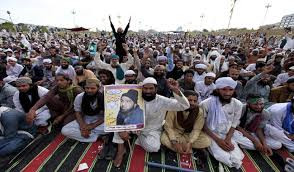
ISLAMABAD, March 30: Four days into their protest outside at D-Chowk, supporters of the former Punjab governor’s assassin have agreed to call off their sit-in and disperse following a ‘successful’ round of negotiations with the government, Express News reported on Wednesday.
According to sources, the government has agreed to some of the demands of pro-Mumtaz Qadri supporters, which include the release of non-violent protesters, no amendment in blasphemy laws, and withdrawal of cases against ulema to be considered, among others.
However, Interior Minister Chaudhry Nisar denied any written agreement with the demonstrators.
“No written agreement or otherwise was reached between the protesters’ leaders and the government, neither anyone from the government was mandated to do so,” he said while speaking at a news conference after successful negotiations with the representatives of some religious parties.
Several thousand protesters had marched in Islamabad Sunday, clashing with security forces before setting up camp outside key government buildings along the capital’s main Constitution Avenue.
No one will be allowed to hold protest at D-Chowk: Nisar
The interior minister said the government will not allow any person or party to hold political rallies or protests in the Red Zone area of Islamabad.
“I as an interior minister have decided it will be prohibited from now on to hold rally or political conferences at the D-Chowk area,” he said.
Talking about the protests, the country’s top security czar said a few violent people had used the situation to politicise the matter. “Some scholars had decided to mark the 40th day of Qadri’s execution peacefully, but miscreants took an advantage of the situation and started marching towards Red Zone.”
He went on to say, “Time has come that we decided people or party who threaten the state by occupying this area will not be allowed to do so.”
Commenting on those who have been arrested during the four-day protests, Nisar said whoever broke the law will be prosecuted accordingly.
“Every single person who broke the law, many of whom have been arrested, will be prosecuted. However, the bystanders or people who were not involved in breaking of law will be released soon,” he said.
Earlier during the day, protesters said they would not end their days-long sit-in and were “willing to die”, as armed security forces readied to clear the camp.
A police source said more than 7,000 security forces were poised to clear the sit-in, including the paramilitary Rangers and Frontier Corps with reinforcements from the Punjab Police.
Army troops had been standing guard at government buildings near the protest camp.
Qadri’s hanging, hailed as a “key moment” by analysts in country’s war on religious extremism, has become a flashpoint for the deep divisions in the conservative Muslim country.
His funeral earlier this month drew tens of thousands in an extremist show of force that alarmed moderate Muslims in the country, while the call to hang Bibi along with the Easter attack in Lahore has underscored a growing sense of insecurity for Pakistan’s minorities.
“It’s a sense of great grief, sorrow and fear,” Shamoon Gill, spokesperson for the All Pakistan Minorities Alliance, told AFP.
The Lahore blast had left Christians feeling that “no place is safe”, he said, while the “mob situation” in Islamabad was “dangerous”.
“They are a serious threat to Asia Bibi’s life… there is a chance the government could bow down to pressure on this issue,” he warned.