
Every woman has a story

Women driver in Saudi Arabia (Credit: saudiwomendriving.blogspot.com)

Islamabad, March 8 – Challenging male dominated politics in Jhang was not an easy step. Taking a lead role in a conservative Afghan society was not a bed of roses. Speaking against female genital mutilation was no simple task. Branding women’s transformed role through advertisements was not a welcome step. Putting women in active political roles in Sri Lanka was not entirely rewarding. Using music for social causes wasn’t a sweet song either.

Six women – from Pakistan, India, Afghanistan, Sri Lanka, Bangladesh and the US – shared their success stories, fraught with challenges but also with achievements, with a 300-strong audience at the International Women’s Empowerment Conference-15 in Islamabad on March 6 as part of Women’s Day celebrations.

As the panelists took turns, it emerged women’s oppression keep on changing its form with the change of places; the only thing that remained permanent was some women’s resilience and courage to fight back.
The panelists included former ambassador and minister Syeda Abida Husain, Scroll.in journalist from India Aarefa Johari, lecturer Tania Aria from Kabul University, attorney-in-law in Colombo Selyna Peiris, Sara Ali a businesswoman from Bangladesh and musician-cum-social activist from US Mary McBride.

Abida Husain started off her political career as a Member of the Provincial Assembly (MPA) in the 1970s. After Ziaul Haq’s martial law, she took part in local council polls and was elected ‘chairman’ of the Jhang District Council.

“Some people asked me to use ‘chairperson’ instead of ‘chairman’ and I told them that let me chair the men, not persons,” Abida said.
During her political career, she launched several development projects such as farm-to-market roads, schools and health facilities in rural areas, which ultimately brought about development and empowerment for women. But the more obvious and clear mark her politics left was a woman’s courage to come out for equal rights in a male-dominated society.

Aarefa Johari has taken it upon herself to raise awareness against female genital mutilation (FGM), a common, ancient and religious practice among her Dawoodi Bohra community in India and elsewhere.

In the community, every seven-year-old girl has borne this ritual, called khatna or circumcision. She said that like other girls, she had to undergo this ritual. With the passage of time, the pain and memory of the horrendous surgery faded, Aarefa said, adding that education helped her realise that the future generation must not go through the painful experience. She says women from her community have a strong belief that religion allows FGM which suppresses women’s sexual pleasure.
Aarefa says strangely most men are unaware of the practice as only clerics and women have carried the practice forward “to save their virtue”. She said the frustrating thing was that clerics have chosen not to respond to facts, which she says she and other people have started debating.

“The satisfactory part is that I’ve stirred a debate and people are listening to me, though in disbelief,” Aarefa said.

Selyna Peiris says she believes in women’s economic independence. She runs handlooms where 1,000 women are employed. She says she belonged to a privileged Sri Lankan family and at the age of 16 flew to Britain and returned after receiving a law degree.

After launching and succeeding in handloom products, Selyna decided to go and ask women what they needed.

“As the country was passing through a post-war era, I decided to take civic liberty causes and set up a legal aid centre for women,” she said.
Unlike Selyna, Tania Alia has seen displacement and migration from Afghanistan to Pakistan, the Taliban’s anti-women regime and education in schools which lacked in facilities from chairs to drinking water. Tania said she was only two when her parents decided to leave Afghanistan for Pakistan and returned to Kabul 13 years later. She remembers when she was traveling with her mother in a bus and a Taliban squad pulled in.
“A Taliban militant started beating a woman for not wearing her burqa properly,” said Tania.

Time went by, the Taliban regime fell and the new government took over. She said the initial days were hard when her family home had electricity for five hours a day after every two days. Tania attended university and completed her graduation after which she was offered a job as a lecturer at the same institution. With her ceaseless struggle, Tania has secured scholarships of prestige and has worked with Trade Accession and Facilitation for Afghanistan (USAID), International Relief Development (USAID) and Public Finance Management Reforms (World Bank). Her journey goes on.

Sara Ali, a Bengali businesswoman from the advertisement industry, went for social activism when she married a man who was not of her religion. After breaking the taboo, she decided to launch awareness among women to understand the issues of their own daughters.

Sara used social media as a tool to reach millions of women. “Female contraceptive was an untouchable subject, but not anymore,” she said, explaining how she used social media to help women improve their health through birth control.

Mary McBride, unlike most singers, talks at social fora and writes songs that incorporate social themes. Her band is on international tours most of the time during which she uses music to highlight issues confronting women.

Six women, six stories — but that is not the limit. Every woman has a story, of successes and failures, narrating a journey that documents her struggle to claim her space in a society which may have had little to offer her in the first place.
‘Nothing will stop us’: Afghan women cycling team pushes past roadblocks

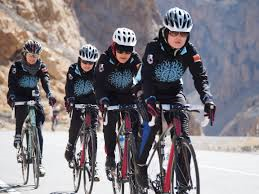
Afghan women cyclists (Credit: mountain2mountainwordpress.com)

Kabul, March 7: Malika Yousufi lined her bike up alongside her teammates on a lonely road outside the Afghan capital, getting ready for her weekly training ride away from the disapproving stares of Kabul.

Yousufi is part of Afghanistan’s Women’s National Cycling Team, a group that has been breaking new ground for women’s sports in Afghanistan and pushing the boundaries of what is — and is not — acceptable for young women in the conservative country.

Under the Taliban in the 1990s, women in Afghanistan were excluded from public life, banned from going to school or stepping outside their home without a male family member.

Women’s rights have made gains since the hardline group’s ouster in 2001, but observers worry that progress is at risk as violence against women persists and women remain under-represented in politics.

“We are resolved to keep our commitments to women and we will protect and reinforce our achievements,” President Ashraf Ghani’s office said in a statement released after the president made a speech ahead of International Women’s Day on March 8.

While Afghanistan’s national men’s cricket and football teams have enjoyed the spotlight, women’s sports have made more halting progress, with athletes facing family pressure and patchy public support. Last year, the women’s cricket team was quietly dissolved amid Taliban threats and a shortage of players.

The women’s cycling team is pushing ahead, despite not having been paid for several months, a problem for many Afghan athletes.

To clock the distances needed for training, team members pile their bikes in cars and drive outside the capital, where their uniform of loose-fitting tops and long pants won’t draw stares.

During the ride, the coach leads the pack in a car.

“The coach is like a shield for us,” Yousufi said. “If he wasn’t there, we couldn’t ride.”
Even so, drivers sometimes shout profanities at the riders, and their team captain grapples with a back injury from a crash after a man on a motorbike reached out to grab her.

Abdul Sadiq Sadiqi, the coach and president of the Afghan Cycling Federation, is not overly concerned.

“These are people who don’t let their children go to school,” Sadiqi said.
More than 40 women train with the group, and the core team has competed in several international competitions.

On a recent morning, team members leaned into the curves in the road, whizzing past a checkpoint where a group of soldiers watched them pass.
Yousufi said she was determined to become the first Afghan woman to compete in the Tour de France, a cycling race dominated by men since its first event in 1903.

“Nothing will stop us,” she said.

Outcry and fear as Pakistan builds new nuclear reactors in dangerous Karachi

KANUPP (Credit: Washingtonpost.com)

China joined the Nuclear Suppliers Group — whose members agree not to transfer to treaty non-signers any technology that could be used to develop a nuclear weapon — in 2004. But it claims that it had already promised to help Pakistan, allowing it to continue developing the reactors.

Beijing is helping Pakistan build reactors at the same time that the Obama administration is trying to implement a 2008 deal that would smooth the way for U.S. companies to invest in new nuclear power plants in India. India, which first tested a nuclear weapon in 1974 and remains Pakistan’s chief rival, has also balked at signing the nonproliferation treaty. Both President Obama and former president George W. Bush have sought an exception for India.

“China’s expanding civilian nuclear cooperation with Pakistan raises concerns and we urge China to be transparent regarding this cooperation,” the U.S. Embassy said in a statement Thursday.

Until now, Pakistani leaders have faced little public discontent over the country’s nuclear advances. After all, Pakistan celebrates a national holiday each May marking the anniversary of its first atomic weapons test in 1998. But the country’s progressive movement is evolving, sparking novel protests over environmental and public safety issues. And the prospect of 20-story reactors rising next to a public beach used for swimming, camel rides and picnics is a vivid illustration of what’s at stake.

Though international monitors generally give Pakistan satisfactory reviews for safeguarding nuclear materials, industrial accidents causing hundreds of fatalities remain common here. There are concerns that Pakistani technicians won’t be able to operate or maintain the Chinese nuclear technology.

Karamat Ali, chairman of the Pakistan Institute of Labor Education and Research, noted that the world has already experienced three major nuclear accidents — at Three Mile Island in the United States in 1979 and Chernobyl in the former Soviet Union in 1986, in addition to the Fukushima disaster.

“Those are three highly advanced countries,” Ali said. “This is Pakistan. We don’t live on technology and science. In fact, we are quite allergic to that.”

Of particular concern is the threat of terrorism, especially considering Karachi’s long history of head-scratching security lapses­.

Terrorists overran a Pakistani naval base in Karachi in 2011, killing five people and setting several aircraft on fire. A similar attack occurred in June, but this time Pakistan Taliban militants stormed a section of Karachi International Airport, killing about two dozen people. And in September, al-Qaeda militants, perhaps with help from renegade sailors, attempted to hijack a heavily armed Pakistan navy frigate docked in Karachi’s port. It took hours for security forces­ to repel the assault.

If a major attack or accident were to occur at a nuclear power plant, activists say there would be unimaginable chaos.

Karachi, whose population has doubled in just the past two decades, includes vast, packed slums, as well as districts under the thumb of criminal gangs and Islamic militants. And with more than 2.7 million registered cars, buses, rickshaws and motorcycles, it can take hours to cross the city.

“You couldn’t even dream of evacuating Karachi,” said Hoodbhoy, the physicist. “The minute an alarm was sounded, everything would be choked up. There would be murder and mayhem because people would be trying to flee. Others would be trying to take over their homes and cars.”

But Azfar Minhaj, general manager of Karachi’s reactor project, said Pakistan sought the ACP-1000 reactor because it makes a radiation leak far less likely. Each reactor will have a double containment structure capable of withstanding the impact of a commercial airliner, he said, adding that there is also an elaborate filtration system and that the reactor will be able to cool itself for 72 hours without power.

“If a new car comes with an air bag, would you start thinking, ‘This is a new feature, it’s never been tested in Pakistan, never built in Pakistan. Should we use it or not?’ ” Minhaj asked.

Because of the enhanced safety features, Minhaj said, authorities are planning for an impact zone no greater than three miles in the event of a worst-case accident. Most of the affected residents would be asked to shelter in place, not evacuate, he said. Hoodbhoy points out that even today, the no-go zones around the Chernobyl and Fukushima plants are 18 and 12 miles, respectively.

Minhaj said concerns about the effect of a tsunami are also overblown because the new reactors are being built on a rock ledge about 39 feet above sea level. Pakistan’s meteorological office recently concluded that Karachi could face a tsunami of up to 23 feet in the event of a 9.0-magnitude earthquake in the region.

Mark Hibbs, a senior associate at the Carnegie Endowment for International Peace, said he suspects that the new Chinese design is indeed less prone to accidents. But he noted that most poorer countries have shied from developing a nuclear energy footprint since Fukushima.

“If there was a lesson we learned from the Fukushima accident, it’s that, if you are going to get into the nuclear business, and if you don’t have world-class technology, good logistics, enough personnel, a lot of money and experience managing crisis situations, then you are not going to be able to manage a severe accident,” Hibbs said.

Zia Mian, a Pakistani physicist at the Program on Science and Global Security at Princeton University who is also fighting the project, notes that the existing Canadian reactor was designed in the 1960s to generate just 100 megawatts of electricity. The new reactors will produce 22 times that amount and use a combined 40 to 60 tons of enriched-uranium fuel each, he said. And each year, one-third of that spent fuel will also be removed from the core and stored in large containment pools at the plant, Mian said.

“You put all of that together, and the hazards are unimaginably larger,” he said.

After Sharif showed up in Karachi in December 2013 to break ground on the new reactors, Pirzada and other activists began organizing against it on Facebook. Last summer, they filed a lawsuit against the Pakistan Atomic Energy Commission and the Pakistan Nuclear Regulatory Authority alleging that construction began without a proper environmental impact study.

In December, a court halted vertical construction — but allowed excavation work to continue — until a new environmental assessment is completed, about a month from now. If major construction is then allowed to resume, the reactors will have an expected life span of at least 60 years.

“Of course, we need electricity, but we don’t need electricity to commit suicide,” Ali said.

Musadaq Malik, a Sharif adviser on energy issues, counters that a country that trusts its military to possess nuclear weapons can also trust its government to maintain a Chinese nuclear power plant.

“We may look irresponsible, but we are not that irresponsible,” Malik said. “We have engineers, we have scientists, we have our security apparatus. . . . Like other nations, we have done all of this before, reasonably well.”

Islamic University Islamabad: My education in a Saudi funded university

Whenever I hear these empty notions of ‘No Space for Extremism Left’ so confidently floated in wake of Peshawar Attack, I remain unconvinced.

My doubts about these ‘Anti-terrorism’ measures strengthen when I give a cursory look at the present unchecked activities of International Islamic University Islamabad (IIUI).

The national consensus against extremism means nothing when you know that Saudi’s takfiri ideology is being expanded every day, inch by inch, into small towns of KPK and Punjab with the launch of IIUI Schools & Colleges.

I studied Environmental science in IIUI. Among the 46 courses that I took over the period of 4 years, I also had to study Arabic, Sharia and Law, Pakistan studies, and Islamic studies. Environmental economic teacher used to patiently wait outside our class; he would cough and clear his throat loudly and wait until our Class Representative (CR) would come out and assure him that every girl in the class had their ‘nangey sar’ covered with dupatta.

Pakistan studies teacher used to write the contact number of Al-Huda in addition to writing Hadiths and Quranic verses on white broad whenever she took the class. Class discussions in Social Studies would invariably divert to state of Islam and purdah in Pakistan.

Chemistry teacher would start talking about water cycle and move swiftly to discussing the scientific miracles of Quran and the number of times water cycle is mentioned in Quran. Because chemistry in Quran was a miracle, so we were to memorize the ‘facts’ of both the world and incorporate them into one single comprehensible answer in order to get credit hours for that course.

Ecology teacher talking about human population curves and population boom would dutifully remind us that we are Muslim so there is NO concept in Islam about population control, and some ‘Islamic scholars’ even consider use of contraceptives haram- “No wonder that there are going to be more women burning in fiery depth of hell”- she would laughingly chirp later as an afterthought.

Burqa catwalk was a real event. Notice boards were sometimes liberally used as JI and Al-Huda activity promotion board. Canteen walls were amply plastered with warnings and premonition of hell for those who were not careful enough and brought Shezan juice.

In the morning, when university buses poured-in from all parts of twin cities, the campus entrance would often be dotted with burqa cladded women distributing pamphlets. No one was missed; everyone got a copy of her Al-Huda course announcement advertisement paper, or a pamphlet bemoaning the cruelty of state against the innocent students of Lal Masjid.

Pamphlets that cursed America and wanted Afia Sadiiqa back and pamphlets warning bey-purdha immodest women about fiery depths of hell were also shoved into hands.

Pamphlets told us every day that Blasphemous cartoon makers should be killed. All blasphemers should be killed. Salman Taseer should be killed.

Some papers demanded justice for students who were arrested form hostels in ‘alleged’ connection with the terrorists.

Piety came before curiosity. That was the lesson overriding all other lessons. Learning did not mean that one had to abandon moderate behavior.

Women campus and Men campus might have been a separate universe, but news often came floating one way or other. Women campus once held a festival, ferris wheel and merry-go-rounds were installed, students shrieked in excitement as the amusement ride caught speed. But then sounds waves could not be contained and males who existed beyond the barbed wires of female campus heard the shrieks.

Modesty came under a threat instantly. JI came into action and women happy shrieks potentially became a means of sexual arousal for some males.

Sickness of thought came over everyone, everyone was ashamed. The rides had to be dismantled. Modesty had to be restored. So the festival was cut-short and modest Islam reigned again.

If you wanted your transcripts on emergency basis then you were in for a churning that would take every ounce of your best temperament.

It took me almost three weeks to sort-out office formalities and get my transcripts, after the sum total of getting four page fees clearance documents signed.

Why? Because it was the Holy month of Ramzan, and the holiest of the places, i.e. an education institution was under siege by holy men and women, not doing their duty but attending Quran and Hadith dars, all in Al-Huda and Tableeghi style.

During those three weeks I would come to the university, and would often go back, without moving an inch forward in my desperate efforts to get my degrees and transcripts. Upon reaching the administration office, I would find offices desks and chairs stacked neatly close to the wall- making a space in the middle of the office hall room- white chadder laid out and all women employees sitting on floor, with one pious lady giving them dars and educating them about the fazaail of prayer in Ramzan.

Some were listening silently and some women were crying (may be out of sheer exhaustion and hunger) but none were found at their desks doing their job.

I don’t know if those women found blessing of Ramzan, but I was certainly showered with all the blessing of the holy-month that one could hope for.

Not to mention that these employees were sure to draw their halaal salary that month.

Conspiracy was juicy. Conspiracy gave legitimacy to claims that IIUI is serving Islam and is under attack by liberal forces all the time. Any change in the faculty was taken a conspiracy against Islam.

Once a teacher was inducted in Sharia and Law department, nothing unusual about hiring a teacher. No one would have known that the newly inducted teacher was slightly liberal until a spat with Sharia students got intensified and one day that poor ‘liberal’ teacher was thrown down stairs for being part of an Amereekan conspiracy.

So I could totally understand the fears of one visiting faculty teacher who taught us Globalization and Foreign Policy, as he often used to stop him-self short during a lecture and would say that he cannot carry-on the discussion further because his opinions on politics should remain outside the boundary of this Fort of Islam i.e International Islamic University Islamabad.

If Pakistanis are really serious about eradicating extremism and terrorism, this University (IIUI) and the likes of it should sever ALL links with Saudi Arabia.

The administration of IIUI must go directly under the authority of government of Pakistan.

A foreign Arabic speaking Saudi national should not be the overseer i.e. Pro-chancellor of this university.

The funding of this university has to be checked. The spread of extremist ideology under the cover of promoting ‘modern’ education needs to be checked by HEC. The course contents should be standardized and modernized.

But of course we are busy fighting a war on extremism, and all our fights will be fought on wrong fronts.

We are a poor country, we need money. So let the money pour in from all shady sources and let us produce a brainwashed educated middle class that likes to sit on the fringes and silently watch Taliban wreak havoc in Pakistan.

Afghan refugee on 1984 National Geographic cover embroiled in ID row

 Sharbat Bibi (Credit: tribune.com.pk)
Sharbat Bibi (Credit: tribune.com.pk)

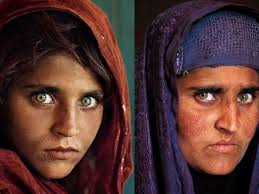
Islamabad, Feb 25 – The image of Sharbat Gula that featured on the cover of National Geographic magazine in 1984. In 1984 a photo of a green-eyed girl staring out of the front cover of National Geographic became an icon of the plight of Afghan refugees forced by war into Pakistani refugee camps.

Three decades on and a new picture of Sharbat Gula, this time a cheap mugshot of a middle-aged woman, has come to symbolise the hostility many Pakistanis feel towards people they believe have outstayed their welcome.

On Tuesday the national media published the photograph from Gula’s computerised national identity card (CNIC), a vital document that she should not have been able to acquire as a foreign national.

That one of the most famous of the nearly 3 million Afghan refugees living in Pakistan should have been able to get the card underlined for many the corruption that riddles much of government.

© National Database and Registration Authority Sharbat Gula’s photograph on her Pakistani national ID card. As an Afghan refugee she is officially not entitled to hold such a document. Afghans can only buy property, open a bank account and be confident they will be able to remain indefinitely in a country that wants rid of its refugee population by having a CNIC, usually acquired with fake documents and bribes.

Faik Ali Chachar, a spokesman for the national database and registration authority (NADRA), said Gula’s card had been detected and blocked in August and that four officials had been suspended for their suspected involvement.

He said the agency has so far found more than 22,000 cards illegally held by Afghans.

That two men said to be her sons were also able to get CNICs further highlighted the deep roots Afghans have put down in Pakistan, where many have established businesses and families.

Afghans first began moving to Pakistan following the Soviet invasion of their country in 1979, and generations have grown up without ever having visited their ancestral homeland.

The refugee population continued to grow after the withdrawal of Russian troops in 1989 as Afghanistan descended into civil war.

Millions of Afghans have returned to their homeland since the international community uprooted the Taliban regime in 2001, but more than 2.5 million are thought to remain – the second largest refugee population in the world.

They have long been unpopular, with many Pakistanis blaming them for crime and terrorism.

“We need them to leave Pakistan because we are badly suffering,” said Hamid-ul-Haq, an MP who represents Peshawar, the north-western city where many Afghans are settled. “All our streets, mosques, schools are overloaded because of them. It is time for them to leave Pakistan honourably.”

There have been several half-hearted attempts to force more of them to quit the country, including a threat to cancel their refugee status, but official deadlines have repeatedly been ignored or allowed to slip.

The government has also attempted to clear slums in Islamabad that are populated by Afghans.

Action against Afghan refugees has intensified following last December’s attack by the Pakistani Taliban on the army public school in Peshawar, in which more than 130 schoolboys were killed.

In the month after the attack more than 33,000 undocumented Afghans flocked across the border according to the International Organisation for Migration – double the figure for the whole of 2014.

Those arriving in Afghanistan have claimed to have been beaten by police, arrested and evicted from their houses.

Human Rights Watch (HRW) this week called on Pakistan to stop trying to coerce refugees to return.

“Pakistan’s government is tarnishing the country’s well-deserved reputation for hospitality toward refugees by tolerating the punitive and potentially unlawful coercive repatriation of Afghan refugees,” said HRW’s deputy Asia director, Phelim Kine.

Gulzar Khan, a politician and former commissioner for Afghan refugees, said Pakistan could not expect such a large number of people to leave overnight.

“The current Afghan government is in a very vulnerable situation both economically and politically. If roughly two millions refugees are pushed back the Afghan government will have a major crisis on its hands,” he said.

Talks could begin between Taliban and Afghan government after 13 years of war

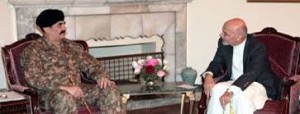
Pak Army chief with Afghan president, Feb 17 (Credit: aajtv)

Islamabad/Kabul, Feb 19  – After more than a decade of war, formal talks between the Afghan government and the Taliban will begin in the coming weeks, the country’s president has told key aides.

According to a senior government official, the president, Ashraf Ghani, believes meetings could begin in early March after Pakistan signalled its support for the move.

Previous western-sponsored attempts to get Afghan government and Taliban representatives around the same table failed under Ghani’s predecessor, Hamid Karzai.

Although the Afghan Taliban’s spokesman denied there were any plans for talks, hopes are rising following Pakistan’s decision to pressurise the insurgent leadership.

On Tuesday, Gen Raheel Sharif, Pakistan’s powerful military chief, travelled to Kabul to tell Ghani the Taliban were increasingly amenable to discussions.

Pakistan has considerable influence over the Taliban, a movement that was supported by Islamabad in the 1990s and which since 2001 has been free to use Pakistani territory to launch attacks against the western-backed government in Kabul.

Since becoming president last year, Ghani has worked assiduously to secure Pakistan’s help in bringing the Taliban to the negotiating table by addressing Pakistani fears that Afghanistan is a base for its enemies.

Ghani has won plaudits from Islamabad by putting on a hold an arms deal with Pakistan’s arch-rival India and by deploying troops against anti-Pakistan militants based in Afghan territory.

In return Ghani expects Pakistan to tell the Taliban to enter negotiations and drastically reduce the surge in militant attacks inside Afghanistan.

Sartaj Aziz, the foreign affairs adviser to Pakistan’s prime minister, said reports of an immediate breakthrough were premature but that progress had been made amid the “quite unprecedented” improvement in relations between Afghanistan and Pakistan.

“These things have been going on for the last few weeks,” he said, referring to contacts between Taliban and the Afghan government. “We suggest the right kind of people to talk to and that kind of thing, but this is an Afghan-led process.”

Pakistan has also been pressured to bring the Taliban to the negotiating table by powerful ally China, which is alarmed by the overspill of militancy in the region into western China.

Previous attempts to find a political solution to the 13-year war in Afghanistan came to nothing. In 2013, the Taliban was allowed to open an “office” in Doha, the capital of the Gulf state of Qatar, where talks could be held.

But the process collapsed before it could begin after the Afghan government reacted furiously to the Taliban being allowed to raise their flag over the building as if it was the embassy of a sovereign power.

On Thursday, the US embassy in Kabul denied reported claims by Afghan Taliban sources that insurgent leaders would hold an initial round of talks with US officials as early as Thursday.

“There is no truth to the reports of US involvement in direct talks with the Taliban,” a US diplomat said.

Ajmal Obaid Abidy, spokesman for Ghani, said the international community had accepted demands that peace talks be conducted between the Afghan government and the Taliban, not with outside actors. So the reports of directs talks between the US and the Taliban, Abidy said, “are only rumours”.

Michael Semple, one of the world’s experts on the movement, said Doha was the most likely site of any talks as the Taliban’s “political commission” is already based there.

But he warned there was no guarantee talks would succeed given the Taliban have ramped up attacks in recent months.

“I don’t think we’ve seen the signs on the Taliban side that they are preparing to end the war,” he said. “Maybe there will be a round of talks, but the real test will be whether there will be another spring military campaign.”

Afghan analysts say Ghani will not be able to sustain his tilt towards Pakistan, which is proving unpopular with sections of the public, unless he is rewarded with a sharp decline in violence.

This week Ghani attempted to sooth the concerns of powerbrokers, including former president Hamid Karzai, who was famously distrustful of Pakistan.

“Ghani’s biggest challenge is if the coffins keep coming,” said Bilal Sarwary, one of the country’s top journalists. “But the Taliban have only been preparing to fight.”

Afghans arrested Chinese Uighurs to aid Taliban talks bid: officials

Afghans arrest Uighurs (Credit: thediplomat.com)
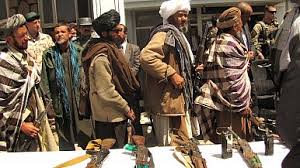
Kabul, Feb 20 – Afghanistan arrested and handed over several Muslim Uighur militants from China’s west in an effort to persuade China to use its influence with Pakistan to help start negotiations with the Taliban, Afghan security officials said on Friday.

The deal sheds light on China’s increasing importance in Afghanistan and Pakistan, with its involvement in efforts to end the war with Taliban, who have been fighting since 2001 to re-establish Islamist rule in Afghanistan.
Hopes for a peace process were raised on Thursday when Pakistani and Afghan officials said members of the Taliban leadership had signaled they were willing to begin talks as soon as next month.

The apparent Taliban change of position was said to have been made under pressure from Pakistan, although the official Taliban spokesman denied any move toward negotiations with the Afghan government.
Pakistan has been under pressure from China, which is concerned about Islamists among its Muslim minority, to step up pressure against militants. Three senior Afghan police and intelligence officials described the operation last month to capture ethnic Uighur militants, members of a separatist movement opposed to Beijing’s rule over the Xinjiang region, which is home to the Turkic-speaking, mostly Muslim Uighurs.

“We offered our hand in cooperation with China and in return we asked them to pressure Pakistan to stop supporting the Taliban or at least bring them to the negotiating table,” said one of the security officials, who attended a meeting with Chinese officials to arrange transfer of the prisoners.

Chinese officials in Beijing and at the embassy in Kabul did not respond to requests for comment.

The Uighurs, who the Afghan officials said had trained in militant camps across the border in Pakistan, were handed over to Chinese officials last month.

A second security official said a total of 15 Uighurs were arrested – three in the capital, Kabul, and 12 later in the eastern province of Kunar bordering Pakistan.

They had been in contact with al Qaeda and other militants operating in Pakistan, according to a member of Afghanistan’s intelligence agency.

A Pakistani Taliban commander in the border area said by telephone that a group of Uighurs had been based in the Pakistani border region of North Waziristan but left when the Pakistani army launched an offensive there last year.

“They have shifted to Afghanistan,” he said.

‘PLAYING ITS ROLE’
China has increasingly been concerned about activists from Xinjiang getting militant training in Pakistan. It says Uighur militants were behind attacks in Xinjiang and other parts of the country in recent years in which hundreds have been killed.

Exiled Uighur groups and human rights activists, however, say repressive government policies in Xinjiang, including controls on Islam and on Uighur culture, have provoked unrest.

China’s concerns have led it to engage in the so far fruitless effort to negotiate an end to the Afghan war, said Barnett Rubin, a former State Department official who is now a senior fellow at the Center on International Cooperation.

In particular, China is believed to have used its influence with Pakistan to persuade it that it was not in Pakistan’s interests to turn a blind eye to the Afghan Taliban and other militants operating along its border.

“Pakistan’s attitude to militant groups fighting in Afghanistan has evolved … China has played a role in Pakistan’s evolution because China is very concerned about militants from Xinjiang province receiving training in Pakistan,” Rubin said.

China is likely to have played a significant role in moves toward starting talks with the Taliban, he said.

“I’m sure they have weighed in quite decisively, quietly.”

Pakistan is seen as having other reasons for pushing the Afghan Taliban to talk to Kabul, in particular the hope of Afghan help in tackling Pakistani Taliban hiding in east Afghanistan and launching attacks in Pakistan, including the massacre of 153 people at an army-run school in December.
Pakistan has long seen the Afghan Taliban as a tool if old rival India were to become too influential in a hostile Afghanistan.

But Afghan President Ashraf Ghani, who took office last year, has made improving relations with both Pakistan and China a cornerstone of his administration.

Ghani’s first foreign visit was to Beijing in October when he assured Chinese President Xi Jinping of Afghanistan’s help in fighting militants.
Last week in Pakistan, visiting Chinese Foreign Minister Wang Yi said China would help mediate in efforts to engage the Afghan Taliban in negotiations.

A week later, Pakistan’s powerful army chief visited Afghanistan with a message for Ghani that Taliban leaders had signaled they were open to talks.

It is not clear how significant Afghanistan’s arrest of the Uighurs was in the push for negotiations. A Pakistani military officer said China was “playing its role” in the effort.

Pakistani Foreign Office spokeswoman Tasnim Aslam said it was unfair to suggest that China or any other outsider was behind Pakistan’s involvement in pushing for talks.

“Peace and stability in Afghanistan are in Pakistan’s interest,” she said.

(Additional reporting by Katharine Houreld and Mehreen Zahra-Malik in Islamabad and Saud Mehsud in Dera Ismail Khan, Pakistan; Writing by Kay Johnson; Editing by Robert Birsel)

Delhi Wakes Up to an Air Pollution Problem It Cannot Ignore

Pollution on Indo Pak border (Credit: darkroomindopakborder.com)

NEW DELHI, India, Feb 14  — For years, this sprawling city on the Yamuna River had the dirtiest air in the world, but few who lived here seemed conscious of the problem or worried about its consequences.

Now, suddenly, that has begun to change. Some among New Delhi’s Indian and foreign elites have started to wear the white surgical masks so common in Beijing. The United States Embassy purchased 1,800 high-end air purifiers in recent months for staff members’ homes, with many other major embassies following suit.

Some embassies, including Norway’s, have begun telling diplomats with children to reconsider moving to the city, and officials have quietly reported a surge in diplomats choosing to curtail their tours. Indian companies have begun ordering filtration systems for their office buildings.

“My business has just taken off,” said Barun Aggarwal, director of BreatheEasy, a Delhi-based air filtration company. “It started in the diplomatic community, but it’s spread to the high-level Indian community, too.”


The Delhi skyline is hidden on a November morning. A study will look at reducing exhaust from trucks, a major source of pollution. Credit Prakash Singh/Agence France-Presse — Getty Images

The increased awareness of the depth of India’s air problems even led Indian diplomats, who had long expressed little interest in climate and pollution discussions with United States officials, to suddenly ask the Americans for help in cleaning India’s air late last year, according to participants in the talks. So when President Obama left Delhi after a visit last month, he could point to a series of pollution agreements, including one to bring the United States system for measuring pollution levels to many Indian cities and another to help study ways to reduce exhaust from trucks, a major source of urban pollution.

One driver for the change is a deluge of stories in Indian and international news outlets over the last year about Delhi’s air problems. Those articles, once rare, now appear almost daily, reporting such news as spikes in hospital visits for asthma and related illnesses. One article about Mr. Obama’s visit focused on how, by one scientist’s account, he might have lost six hours from his expected life span after spending three days in Delhi.

“We felt this was an issue we should take up, and we have taken it up,” said Arindam Sengupta, executive editor of The Times of India, whose campaign against air pollution has helped give prominence to the problem.

But Nicholas Dawes, a top editor at The Hindustan Times, said the media coverage was just one reason for the attitude shift. “I think the people of Delhi are increasingly unwilling to tolerate tough circumstances,” he said.

At least so far, that has not translated into much meaningful action by the government. In fact, the problem is likely to get worse as the government of Prime Minister Narendra Modi works to reboot the economy. His government recently promised to double its use of coal over the next five years.

But Dr. Joshua S. Apte, an assistant professor of environmental engineering at the University of Texas at Austin, who has studied Delhi’s air pollution since 2007, said recognition was a start. “The thing that gives me greatest hope is the huge increase in awareness that I’ve seen in Delhi just in the past year,” he said.

Delhi’s air is the world’s most toxic in part because of high concentrations of PM2.5, particulate matter less than 2.5 micrometers in diameter that is believed to pose the greatest health risk because it penetrates deeply into lungs. While Beijing’s air quality has generated more headlines worldwide, scientists say New Delhi’s air is often significantly worse, especially during the winter, when choking smog often settles over the sprawling city.

Four city monitors found an average PM2.5 level of 226 micrograms per cubic meter between Dec. 1 and Jan. 30 — a level the United States Environmental Protection Agency calls “very unhealthy” and during which children should avoid outdoor activity. The average in Beijing for the period was 95, according to the United States Embassy monitor there.

Indeed, there has not been a single 30-day period in Beijing over the past two years during which the average PM2.5 level was as bad as it was in December and January in Delhi.

Worse yet, the numbers tell only half the story because Delhi’s PM2.5 particles are far more dangerous than those from many other locales because of the widespread burning of garbage, coal and diesel fuel that results in high quantities of toxins such as sulfur, dioxins and other carcinogenic compounds, said Dr. Sarath Guttikunda, director of Urban Emissions, an independent research group based in Delhi.

“Delhi’s air is just incredibly toxic,” said Dr. Guttikunda, who recently moved to Goa to protect his two young children from Delhi’s air. “People in Delhi are increasingly aware that the air is bad, but they have no idea just how catastrophically bad it really is.”

Already, an estimated 1.5 million people die annually in India, about one-sixth of all Indian deaths, as a result of both outdoor and the indoor air pollution, a problem caused in part by the widespread use of cow dung as cooking fuel. The country has the world’s highest death rate from chronic respiratory diseases, and more deaths from asthma than any other nation, according to the World Health Organization. Air pollution also contributes to both chronic and acute heart disease, the leading cause of death in India.

Delhi residents attribute their longtime stoicism about the city’s pollution to a combination of fatalism, loyalty to their city and a sense of immunity.

Veena Dogra, 65, notices that family members who visit from abroad snuffle and sneeze, and she is aware that her usual black nasal discharge stops when she leaves India, and returns when she does. But she said she eventually forgets the contrast between Delhi and everywhere else, which is why she resists her daughters’ suggestions that she buy air purifiers or wear masks.

“Am I going to shut myself into just one room in my house?” Ms. Dogra asked. “You have to be tough to live in Delhi. If you’re not, you should leave. And I have too much family here to think about doing that.”

Dr. Anupama Hooda Nehra, director of medical oncology at Max Cancer Center in New Delhi, said she joined a morning cancer fund-raising walk this month even though she ended her own morning walks last year because she decided they were doing more harm than good and could encourage a cancer’s growth. “But I had to go to the fund-raiser because it was supported by my hospital,” she said. “And I worried that if I wore a mask, I would scare everyone since I’m an oncologist. It’s hard to know what to do.”


Dr. Nehra said her greatest worry is that her daughters, ages 14 and 8, will suffer lifelong effects from living in Delhi, a concern that has increasingly spooked Delhi’s expatriate community.

After Dr. Apte gave a presentation about Delhi’s air pollution to a hall packed with anxious parents recently at the American Embassy School, the administration invested in indoor air filters and increasingly restricts children’s outdoor activities when pollution levels are especially high. Even so, the sidelines during school soccer games are lined with players’ medicinal inhalers.

“I’m surprised kids there can even play soccer,” said Dr. James Gauderman, a professor of preventive medicine at the University of Southern California and an author of a landmark 2004 study on the effects of air pollution on children’s lungs.

In his study, Dr. Gauderman found that children raised in towns with PM2.5 levels of 30 had substantial reductions in lung function compared with those raised in towns with levels of 5. In the decade since his study was published, “we don’t see any evidence that functional loss is reversed,” Dr. Gauderman said. “The deficit appears to be permanent. I can’t imagine what that deficit would be with pollution levels almost 10 times higher. No one has studied that.”


Suicide Attackers Kill 19 in Assault on a Shiite Mosque in Pakistan

Peshawar Shia mosque blast (Credit: ibtimes.com)

PESHAWAR, Pakistan — Heavily armed militants killed at least 19 people and wounded more than 40 after they stormed into a Shiite mosque during Friday Prayer in a suburb of Peshawar, the main city in northwestern Pakistan, doctors and officials said.

The assault was the most fearsome show of violence in the Peshawar area since a Taliban attack on a school in December that killed about 150 people, and it offered a chilling reminder of the continuing threat from militants in Pakistan despite a concerted crackdown by the security forces.

The police said that at least four gunmen wearing vests rigged with explosives and lobbing grenades entered the crowded Imamia Mosque in Hayatabad, an upscale suburb that is adjacent to the Khyber tribal district, a notorious militant sanctuary.

Security guards at the mosque shot and killed one attacker, but three others made it into the main hall. They fired guns and flung grenades into a crowd of worshipers before detonating their vests, the provincial police chief, Nasir Khan Durrani, told reporters at the scene.

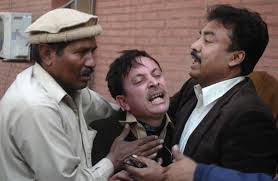
Policemen surveyed the scene after Taliban suicide bombers attacked a Shiite mosque in Peshawar, Pakistan, while victims were rushed to the hospital.

The number of casualties would have been higher if several grenades had not failed to explode, Mr. Durrani said.

A United Nations employee was among the dead. In a statement, the United Nations coordinator in Pakistan, Timo Pakkala, condemned the attack, saying, “Any violent act targeting minorities is totally unacceptable.” He also called on the government to foster tolerance in the country as it fights Islamist militancy.

Some witnesses said the attackers were wearing black police uniforms. Outside the mosque stood the charred remains of a vehicle they had used to reach the area and had set on fire moments before the assault.

The Pakistani Taliban claimed responsibility for the attack through a spokesman who said it was in revenge for the execution of a convicted militant known as Dr. Usman, who was hanged on Dec. 19. “This is a continuation of blood for blood,” he said in a statement emailed to journalists. “The government should expect further, and stronger, reaction.”

In a video sent from the same email address, a Taliban commander identified as Omar Mansoor, who also claimed responsibility for the Peshawar school attack in December, issued further warnings to the government. “Either Pakistan will become your graveyard, or God’s law, Shariah, will be implemented,” he said.

Government officials have blamed a Taliban-affiliated group for a suicide bomb attack on Jan. 30 at a Shiite mosque in Shikarpur, in the southern province of Sindh, that killed 61 people.

That attack was Pakistan’s deadliest sectarian assault since February 2013, when a bombing at a market in Quetta, the capital of the western province of Baluchistan, killed 89 people.

But government officials at the scene of Friday’s attack described it as a likely response to continuing Pakistani military operations in the nearby tribal belt, which have been stepped up since the assault at the Peshawar school in December.

Pakistan’s Parliament has also empowered the army to start trying Taliban suspects in military courts.

The government lifted a moratorium on executions in the wake of the Peshawar attack and on Friday hanged two convicted prisoners, bringing the number of executions since mid-December to 24.

Unlike those executed earlier, the two men hanged on Friday had not been convicted under Pakistan’s terrorism laws, a fact that Amnesty International criticized as a dangerous escalation by the country’s authorities.

“The death penalty is always a human rights violation, but the serious fair trial concerns in Pakistan make its use even more troubling,” the group said in a statement.

On Thursday, Pakistan’s military spokesman told reporters that the security forces had arrested 12 militants linked to the school attack but that six others, including the Taliban leader Maulana Fazlullah, remained at large.

Pakistani officials have said they believe Mr. Fazlullah is hiding in the mountains of eastern Afghanistan, but they have credited Afghan officials with helping pursue him, in a sign of thawing relations between the two countries.

Declan Walsh contributed reporting from London.

Starved for Energy, Pakistan Braces for a Water Crisis

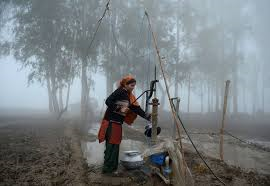
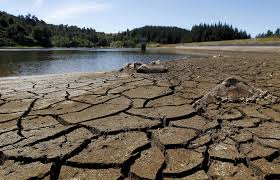
Water conservation failure leads to desertification (Credit: rendezvous.blog.nytimes.com)

ISLAMABAD, Feb 14 — Energy-starved Pakistanis, their economy battered by chronic fuel and electricity shortages, may soon have to contend with a new resource crisis: major water shortages, the Pakistani government warned this week.

A combination of global climate change and local waste and mismanagement have led to an alarmingly rapid depletion of Pakistan’s water supply, said the minister for water and energy, Khawaja Muhammad Asif.

“Under the present situation, in the next six to seven years, Pakistan can be a water-starved country,” Mr. Asif said in an interview, echoing a warning that he first issued at a news conference in Lahore this week.

The prospect of a major water crisis in Pakistan, even if several years distant, offers a stark reminder of a growing challenge in other poor and densely populated countries that are vulnerable to global climate change.

In the interview, Mr. Asif said the government had started to bring the electricity crisis under control, and predicted a return to a normal supply by 2017. But energy experts are less confident that such a turnaround is possible, given how long and complex the problem has proved to be.

Now the country’s water supply looms as a resource challenge, intensified by Pakistan’s enduring infrastructure and management problems.

Agriculture is a cornerstone of the Pakistani economy. The 2,000-mile-long Indus River, which rises in the Himalayas and spans the country, feeds a vast network of irrigation canals that line fields producing wheat, vegetables and cotton, all major sources of foreign currency. In the north, hydroelectric power stations are a cornerstone of the creaking power system.

A combination of melting glaciers, decreasing rainfall and chronic mismanagement by successive governments has put that water supply in danger, experts say.

In a report published in 2013, the Asian Development Bank described Pakistan as one of the most “water-stressed” countries in the world, with a water availability of 1,000 cubic meters per person per year — a fivefold drop since independence in 1947, and about the same level as drought-stricken Ethiopia.

“It is a very serious situation,” said Pervaiz Amir, country director for the Pakistan Water Partnership. “I feel it is going to be more serious than the recent oil shortages.”

Shortages of resources have climbed to the top of the political agenda in recent years. Fuel shortages last month, for which government officials blamed mismanagement by the national oil company, caused lengthy lines outside fuel stations that embarrassed the government at a time of low global oil prices.

Mr. Sharif’s government was already grappling with the seemingly intractable electricity crisis, which regularly causes blackouts of 10 hours a day even in major cities. And Mr. Sharif has been visibly distracted by grueling political duels, with the opposition politician Imran Khan, who accuses him of stealing the 2013 election, and with powerful military leaders who have undermined his authority in key areas.

Mr. Asif, the water and energy minister, said the government had started to turn the corner. But he acknowledged that the country’s resource problems were, to a large degree, endemic. “There is a national habit of extravagance,” he said, noting that it extended across resource areas, whether gas, electricity or water.

“I will be very careful not to use the word ‘drought,’ but we are water stressed right now, and slowly, we are moving to be a water-starved country,” he said.

Evidence of chronic water shortages have been painfully evident in some parts of Pakistan in recent years. A drought caused by erratic rainfall in Tharparkar, a desert area in southern Sindh Province, caused a humanitarian emergency in the region last year.

“The frequency of monsoon rains has decreased but their intensity has increased,” said Mr. Amir of the Pakistan Water Partnership. “That means more water stress, particularly in winters.”

Water is also tied to nationalist, even jihadist, politics in Pakistan. For years, religious conservatives and Islamist militants have accused rival India, where the Indus River system rises, of constricting Pakistan’s water supply.

Hafiz Saeed, the leader of the militant group that carried out the 2008 attacks in Mumbai, India, Lashkar-e-Taiba, regularly rails against Indian “water terrorism” during public rallies.

Mr. Asif said that contrary to such claims, India was not building reservoirs on rivers that flow into Pakistan. “We will never let it happen,” he said, citing the Indus Water Treaty, an agreement between the two countries that was brokered by the World Bank and signed in the 1960s.

One major culprit in Pakistan’s looming water crisis, experts say, is the country’s inadequate water storage facilities. In India, about one-third of the water supply is stored in reservoirs, compared with just 9 percent in Pakistan, Mr. Amir said.

“We built our last dam 46 years ago,” he said. “India has built 4,000 dams, with another 150 in the pipeline.”

Experts say the country’s chaotic policies are hurting its image in the eyes of Western donors who could help alleviate the mounting resource crises.

“The biggest looming crisis is of governance, not water — which could make this country unlivable in the next few years,” said Arshad H. Abbasi, a water and energy expert with the Sustainable Development and Policy Institute, a research group based in Islamabad.