Dangerous Moment’ for Europe, as Fear and Resentment Grow

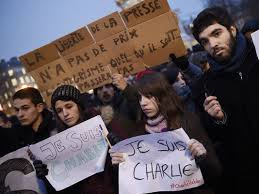
Placards say 'I am Charlie' (Credit: usa.com)
Placards say ‘I am Charlie’ (Credit: usa.com)
LONDON, Jan 7 — The sophisticated, military-style strike Wednesday on a French newspaper known for satirizing Islam staggered a continent already seething with anti-immigrant sentiments in some quarters, feeding far-right nationalist parties like France’s National Front.

“This is a dangerous moment for European societies,” said Peter Neumann, director of the International Center for the Study of Radicalization at King’s College London. “With increasing radicalization among supporters of jihadist organizations and the white working class increasingly feeling disenfranchised and uncoupled from elites, things are coming to a head.”

Olivier Roy, a French scholar of Islam and radicalism, called the Paris assault — the most deadly terrorist attack on French soil since the Algerian war ended in the early 1960s — “a quantitative and therefore qualitative turning point,” noting the target and the number of victims. “This was a maximum-impact attack,” he said. “They did this to shock the public, and in that sense they succeeded.”

Anti-immigrant attitudes have been on the rise in recent years in Europe, propelled in part by a moribund economy and high unemployment, as well as increasing immigration and more porous borders. The growing resentments have lifted the fortunes of established parties like the U.K. Independence Party in Britain and the National Front, as well as lesser-known groups like Patriotic Europeans Against Islamization of the West, which assembled 18,000 marchers in Dresden, Germany, on Monday.

In Sweden, where there have been three recent attacks on mosques, the anti-immigrant, anti-Islamist Sweden Democrats Party has been getting about 15 percent support in recent public opinion polls.

Paris was traumatized by the attack, with widespread fears of another. “We feel less and less safe,” said Didier Cantat, 34, standing outside the police barriers at the scene. “If it happened today, it will happen again, maybe even worse.”

Mr. Cantat spoke for many when he said the attacks could fuel greater anti-immigrant sentiment. “We are told Islam is for God, for peace,” he said. “But when you see this other Islam, with the jihadists, I don’t see peace, I see hatred. So people can’t tell which is the real Islam.”

The newspaper, Charlie Hebdo, in its raucous, vulgar and sometimes commercially driven effort to offend every Islamic piety, including the figure of the Prophet Muhammad, became a symbol of an aggressive French secularism that saw its truest enemy in the rise of conservative Islam in France, which is estimated to have the largest Muslim population in Europe.

The mood among Parisians near the scene of the attack Wednesday on the newspaper Charlie Hebdo was apprehensive and angry. “There’s no respect for human life,” said Annette Gerhard.

On Wednesday, Islamic radicals struck back. “This secular atheism is an act of war in this context,” said Andrew Hussey, a Paris-based professor of postcolonial studies. Professor Hussey is the author of “The French Intifada,” which describes the tangled relations between France and its Muslims, still marked by colonialism and the Algerian war.

“Politically, the official left in France has been in denial of the conflict between France and the Arab world,” Professor Hussey said. “But the French in general sense it.”

The attack left some Muslims fearing a backlash. “Some people when they think terrorism, think Muslims,” said Arnaud N’Goma, 26, as he took a cigarette break outside the bank where he works.

Samir Elatrassi, 27, concurred, saying that “Islamophobia is going to increase more and more.”

“When some people see these kinds of terrorists, they conflate them with other Muslims,” he said. “And it’s the extreme right that’s going to benefit from this.”

In reaction to the deadly attack on the French satirical newspaper Charlie Hebdo, President Obama said the United States would provide France with “every bit of assistance” in fighting terrorism.

The German interior minister, Thomas de Mazière, told reporters on Wednesday: “The situation is serious. There is reason for worry, and for precautions, but not for panic.”

With each terrorist attack, however, the acceptability of anti-immigrant policies seems to reach deeper into the mainstream. In Britain, for example, which also has a large Muslim population, the U.K. Independence Party has called for a British exit from the European Union and sharp controls on immigration, emphasizing what it sees as dangers to British values and identity. The mainstream parties have competed in promising more controls on immigration, too.

“Large parts of the European public are latently anti-Muslim, and increasing mobilization of these forces is now reaching into the center of society,” Mr. Neumann said. “If we see more of these incidents, and I think we will, we will see a further polarization of these European societies in the years to come.”

Those who will suffer the most from such a backlash, he said, are the Muslim populations of Europe, “the ordinary normal Muslims who are trying to live their lives in Europe.”

Nowhere in Europe are the tensions greater than in constitutionally secular France, with as many as six million Muslims, a painful colonial history in Algeria, Syria and North Africa, and a militarily bold foreign policy. That history has been aggravated by a period of governmental and economic weakness, when France seems incapable of serious structural, social and economic reform.

Several videos showing the gunmen outside the office of Charlie Hebdo, a satirical newspaper, have surfaced online. The footage includes scenes of graphic violence.

The mood of failure and paralysis is widespread in France. The Charlie Hebdo attack came on the publication day of a contentious new novel, “Submission,” by Michel Houellebecq, which describes the victory of Islam in France and the gradual collaboration of the society with its new rulers from within. Mr. Houellebecq, like the well-known caricaturists and editors who were killed at Charlie Hebdo, has been a symbol of French artistic liberty and license, and his publishers, Flammarion, were reported to be concerned that he and they could be another target.

But the atmosphere has been heightened by the rise of the National Front and its leader, Marine Le Pen, who runs ahead of the Socialist Party in the polls, campaigning on the threat Islam poses to French values and nationhood.

There was much recent attention to another best-selling book by a conservative social critic, Éric Zemmour, called “The French Suicide,” attacking the left and the state for being powerless to defend France against Americanization, globalization, immigration and, of course, Islam. Another new novel, by another well-known French writer, Jean Rolin, called “The Events,” envisions a broken France policed by a United Nations peacekeeping force after a civil war.

“This attack is double honey for the National Front,” said Camille Grand, director of the French Foundation for Strategic Research. “Le Pen says everywhere that Islam is a massive threat, and that France should not support attacks in Iraq and instead defend the homeland and not create threats by going abroad, so they can naturally take advantage of it.”

The military-style attack on Wednesday creates major security questions for France, said a senior French official who spoke on the condition of anonymity because he was not authorized to speak publicly on such a delicate matter. “We knew this would happen,” he said. “But we didn’t know how efficient it would be.”

Speaking in both English and French, Secretary of State John Kerry expressed solidarity with France against an attack on the French satirical newspaper Charlie Hebdo that killed 12 people.

After a series of three apparently lone-wolf attacks on crowds around Christmas in France, and other attacks in Ottawa and in Sydney, Australia, there was speculation that this attack might also be a response to the September call of a spokesman of the Islamic State, Abu Muhammad al-Adnani, for supporters to strike at domestic targets of the countries attacking the Islamic State.

Mr. Grand noted that at least 2,000 young French citizens have traveled to fight with the militants in Iraq and Syria. “So how do we manage our Muslim population?” he asked. “This kind of attack is very difficult to detect or prevent,” he said, adding that the state must not overreact, which is what the radicals want.

Still, he said, even given that the number of radical Muslims is a tiny minority in France, “there are definitely more than 50 crazy guys,” so it will be important to know whether the attackers had been to Syria or “wanted to go and did this instead.”

François Heisbourg, a defense analyst and special adviser to the Foundation for Strategic Research, in Paris, said that the professional military acumen of the attack reminded him of the commandos who invaded Mumbai, India, in July 2011. “This is much closer to a military operation than anything we’ve experienced in France, and that may limit the political impact,” he said.

“Between this attack and whatever real societal problems we have in France, there is a great gap,” Mr. Heisbourg said. “These were not corner-shop guys from the suburbs.”

The mood in Paris, near the scene of the attack, was both apprehensive and angry. Ilhem Bonik, 38, said that she had lived in Paris for 14 years and had never been so afraid. “I am Arab, Tunisian, Muslim, and I support the families, the journalists and all the people involved,” she said. “This is against Islam.”

When journalists are killed for expressing their views, it is one step away from burning books, said Annette Gerhard, 60. “It’s like Kristallnacht,” Ms. Gerhard said, noting that her family had died in Nazi deportations. “There’s no respect for human life.”

Rachel Donadio and Aurelien Breeden contributed reporting from Paris, and Alison Smale from Berlin.
US Plagued by Doubts as it Exits Afghan War

WASHINGTON: After 13 years, the United States is winding down its war in Afghanistan, plagued by doubts about what was accomplished at such a high cost.

Instead of a sense of triumph at the close of the longest conflict in America’s history, there is mostly regret and fatigue over a war that claimed the lives of more than 2,300 American troops and cost more than a trillion dollars.

US commanders insist the Afghan security forces will hold the line in a stalemate with the Taliban. But some officials fear a repeat of Iraq, in which an American-trained army virtually collapsed in the face of an extremist onslaught.

A large majority of Americans now say the war was not worth it, and only 23 per cent of US soldiers believe the mission has been a success, according to recent polls.

But when it began, the war enjoyed overwhelming support and victory seemed within reach.

Less than a month after Al Qaeda’s attacks of September 11, 2001, president George W. Bush captured the nation’s sense of righteous anger as he announced military action in Afghanistan in a televised address in October.

The goal was to “disrupt the use of Afghanistan as a terrorist base of operations,” Bush said, and to attack the Taliban regime that had hosted Al Qaeda and refused to hand over its leaders.

Toppling the Taliban
US objectives were met with stunning speed. Al Qaeda training camps were wiped out and Northern Alliance fighters — backed by US-led air strikes and a small number of American special forces — toppled the Taliban regime within a month.

For the United States, the war seemed all but over. But the Taliban eventually regrouped from safe havens, even as Washington’s attention shifted to a new war in Iraq.
The Taliban grew into a virulent insurgency that exploited resentment of a corrupt, ineffective government in Kabul.

The United States formed the backbone of an international force that found itself in a protracted fight with insurgents.

The US-led contingent steadily expanded — while the goals of the war became increasingly ambitious as well.

Washington and its allies embraced the lofty ideals of nation-building, vowing to fight corruption, foster economic development, and forge a “stable, democratic state” in an impoverished land mired in war for decades.

The results were often disappointing. International aid helped build roads and schools, but it also was blamed for fuelling rampant corruption, with some of the money ending up with the insurgents.

Attempts to broker peace talks with the Taliban in recent years came to nothing. Critics say Washington missed a chance at cutting a deal early in the war, when the insurgents were on the retreat.

Fighting the elusive Taliban, with their homemade bombs and Pakistani sanctuaries, proved frustrating for Western troops, who struggled to grasp the language and tribal rivalries of an alien culture.

Commanders appealed for more troops. And Washington kept sending forces “in the vain hope that something might somehow improve”, wrote retired general Daniel Bolger, author of “Why We Lost”.

Having reached a peak of more than 100,000 US forces, the American presence is down to about 11,000 troops, now that Nato’s combat mission is over.

‘Big test’
The balance sheet for the campaign is decidedly mixed.
The intervention deprived Al Qaeda of a sanctuary, ousted the Taliban from power, eased the repression of women and created an Afghan army that could make it difficult for the insurgents to return to their once dominant role, analysts said.

But Al Qaeda — even after its leader Osama bin Laden was killed by US commandos — has spawned cells elsewhere and inspired new extremists in Syria and Iraq, while women’s advances are fragile and could easily unravel.

The Taliban may no longer run ministries but they are far from defeated and could yet turn the tide against the Kabul government’s army, which has suffered unsustainably high casualties and desertions.

“The Taliban have nowhere near the power they did in 2001, but they are certainly not finished,” said Vanda Felbab-Brown, a senior fellow at the Brookings Institution think tank.

US officials hope a huge investment in the Afghan security forces will pay off, but already the insurgents have clawed back control in some areas in the south where American troops have pulled out.

The newly created security force, riddled with ethnic divisions, remains “a question mark”, Felbab-Brown said.

“Next year is a big test for them,” said Carter Malkasian, author of a book on the war who worked as a US diplomat for two years in southern Helmand province.

“If they lose ground, that’s an indication that this war is going to keep going,” he told AFP.

“If that happens, the Taliban are going to get bolder, because the Taliban are not going to see a reason to negotiate.”

Untrained CIA Agents Were Just Making Up Torture Methods As They Went Along

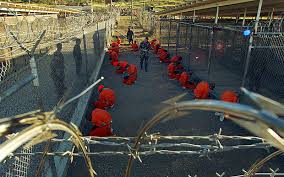
Guantanamo Bay (Credit: telegraph.co.uk)

On Tuesday morning, the Senate intelligence committee released an executive summary [1] of its five-year investigation into the CIA’s interrogation and detention program. (Read the executive summary here. [2])

Among the report’s most striking revelations is that CIA interrogators were often untrained and in some instances made up torturous techniques as they went along.

The CIA was “unprepared” to begin the enhanced interrogation program, the Senate report concluded. The agency sent untrained, inexperienced people into the field to interrogate Abu Zubaydah, the first important Al Qaeda suspect the US captured.

Within weeks of Zubaydah’s arrival, while he was still in the hospital recovering from a gunshot wound, CIA headquarters was planning to throw him in all-white room with no natural lighting, blast rock music 24/7, strip him of his clothes, and keep him awake all day. They did. Extreme interrogations like these, identified as “enhanced interrogation techniques,” went on for more than three months before CIA officers received any sort of training in the new techniques from anyone.

As the overall detention and interrogation program proceeded, many untrained CIA personnel continued to do whatever they wanted, without authorization or supervision. At one facility in 2002, code-named COBALT, “untrained CIA officers…conducted frequent, unauthorized, and unsupervised interrogations of detainees using harsh physical interrogation techniques that were not—and never became—part of the CIA’s formal ‘enhanced’ interrogation program,” the report found. COBALT is reportedly [9] a prison in Afghanistan the agency nicknamed “the Salt Pit.” In one example identified by the report, an interrogator left a COBALT detainee chained naked to the concrete floor. The detainee later died of suspected hypothermia.

The CIA also put a junior official with absolutely no relevant experience in charge of this entire facility. Later, when the CIA’s inspector general investigated COBALT, the CIA said it knew little about what happened there. Several interrogators at the site became uncomfortable with their coworkers’ methods, not sure that they were safe or effective. According to John Helgeron, the CIA inspector general who conducted a formal review of the agency’s detention and interrogation program, CIA interrogators at COBALT had zero training guidelines before December 2002. The report claims, quoting Helgeron: “Interrogators, some with little or no training, were ‘left to their own devices in working with detainees.'”

In 2004, the CIA chief at another detention site, code-named BLACK, penned a long email about his disillusionment with the program, especially deficiencies in training:

And in one particularly heinous example, the CIA headquarters sent an untrained interrogator to question Abd al-Rahim al-Nashiri, a man the CIA claimed was an Al Qaeda “terrorist operations planner” involved in several bombings. One senior CIA official had reservations about sending the untrained interrogator, noting that he heard the man was “too confident, had a temper, and had some security issues.” But the man got sent anyway.

While there, the interrogator allegedly forced Nashiri to stand with his hands over his head for two and a half days, blindfolded him, pushed a pistol up against his head, and revved up a cordless drill close to his body. When this produced no new information, the interrogator slapped the detainee repeatedly on the back of the head, told him he’d sexually assault his mother in front of him, blew cigar smoke in his face, and made him sit in such stressful positions that a medical officer was concerned the detainee’s shoulders would be dislocated.

The CIA base chief let this happen because he thought this interrogator was sent to “fix” the problem of an uncooperative detainee and had permission from headquarters to take such extreme steps. Both men were later reprimanded, according to the report.

The problem of untrained amateurs questioning and torturing of detainees wasn’t unique to the CIA. In 2008, Mother Jones explored [8] the world of untrained interrogators with testimony from Ben Allbright—a soldier who recalls using harsh interrogation techniques while serving as a military guard at a small Iraqi prison called Tiger in Western Iraq:

Ben was not a “bad apple,” and he didn’t make up these treatments. He was following standard operating procedure as ordered by military-intelligence officers. The MI guys didn’t make up the techniques either; they have a long international history as effective torture methods. Though generally referred to by circumlocutions such as “harsh techniques,” “softening up,” and “enhanced interrogation,” they have been medically shown to have the same effects as other forms of torture. Forced standing, for example, causes ankles to swell to twice their size within 24 hours, making walking excruciating and potentially causing kidney failure.

The Senate intelligence committee did not address allegations of torture or abuse by the US military. In fact, when members of the US military stopped by COBALT, they decided it was too risky for them to be involved at all.

In July 2002, CIA headquarters recommended that a group of interrogators, “none of whom had been trained in the use of the CIA’s enhanced interrogation techniques,” try to “break” a detainee named Ridha al-Najjar, who was arrested in Pakistan and identified as a former bodyguard for Osama bin Laden.

When officers from the US military arrived for a debriefing, the military’s legal adviser took note of the extreme techniques being used. The interrogators left Najjar hanging handcuffed to an overhead bar for 22-hour periods. He was left in total darkness and cold temperatures, hooded and shackled. They forced him to wear a diaper and didn’t provide a bathroom. And on top of that, the US military officer claimed that the warden in charge “[had] little to no experience with interrogating or handling prisoners.”

At the end of the visit, the legal adviser concluded that the treatment of the prisoner and the concealment of the facility were too big a liability for the military to get involved. But even then, Najjar’s treatment became a “model” for future interrogations, according to the report.

Pakistan Military Kills Al-Qaeda Leader WANTED in US

Adnan Shukrijumah (Credit: newsasiaone.com
WANA, Pakistan — Pakistani helicopter gunships swooped on a militant hideout in a predawn raid on Saturday and shot dead a top al-Qaeda operative who was wanted in the United States for planning to bomb the New York subway system, the military said.

The Federal Bureau of Investigation had offered a $5 million reward for the capture of Saudi national Adnan el-Shukrijumah, 39, who it said was believed to be al-Qaeda’s external operations chief at one time.

Shukrijumah, a Saudi Arabian native with a Guyanese passport, is the most senior al-Qaeda member ever killed by the Pakistani military.

“In an intelligence borne operation, top al-Qaeda leader Adnan el Shukrijumah was killed by (the) Pakistan Army in an early morning raid in Shinwarsak, South Waziristan today,” the military statement said. The remote region borders Afghanistan.

“His accomplice and local facilitator were also killed in the raid,” the statement said.

The military said that Shukrijumah had recently been forced to move by a Pakistani military operation in neighboring North Waziristan.

The region was the Taliban’s key stronghold in Pakistan and a hotbed of militancy until the military launched an offensive to retake the territory on June 15.

PREDAWN RAID

In Wana, the capital of South Waziristan, all phone lines and mobile phone signals were shut down overnight and the roads were blocked, a Reuters reporter there said.

Residents awoke just before dawn to the thudding of helicopter gunships and the growl of convoys of military vehicles approaching from several directions.

They were heading to a small house on a main road less than five kilometers from the main market on the outskirts of town, a witness said. Residents say the neighborhood is known to be sympathetic to the Taliban and the house had been used to shelter Afghan Taliban fighters for years.

One military official said security forces first heard that Chinese hostages were held at that location and then learned about Shukrijumah’s presence and planned a large operation, the officer said.

Two intelligence officers said the militants opened fire on the Pakistani military and Shukrijumah, who one described as “an Arab national,” was killed in the ensuing gun battle. One soldier was killed and another wounded, the military said.

A military official said five other militants were taken into custody during the raid, but intelligence officials said they were Shukrijumah’s wife and four children.

Shukrijumah is wanted in the United States for conspiracy to use weapons of mass destruction and to commit murder in a foreign country.

“The charges reveal that the plot against New York City’s subway system, uncovered in September of 2009, was directed by senior Al-Qaeda leadership in Pakistan,” the FBI website said.

The subway plot was described by prosecutors at the time as described as the most serious threat to New York since the September 11, 2001 attacks.

Shukrijumah was also linked by U.S. authorities to other suspects, including a group of men accused of planning to bomb fuel pipelines at New York’s John F. Kennedy International Airport.

(Additional reporting by Saud Mehsud in Dera Ismail Khan, Jibran Ahmad in Peshawar and Katharine Houreld in Islamabad; Writing by Katharine Houreld; Editing by Tom Heneghan)

Some people don’t want to be Americans anymore

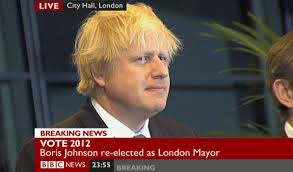
London Mayor Boris Johnson (Credit: lcc.org.uk)

Boris Johnson’s has the unique ability to be ridiculous and charming at the same time. The London mayor and his inexplicable haircut can offend entire cities, get stuck on zip lines in front of crowds of journalists and be sacked from government for lying about an affair (“an inverted pyramid of piffle,” he claimed), yet still somehow end up one of Britain’s most important and beloved politicians. Many think he will be prime minister sooner or later.

However, Johnson’s charm may well fall flat with one organization: The U.S. Internal Revenue Service.

The mayor’s dispute with American tax-collectors was brought to light recently when he traveled to the United States and did a blitz of interviews with the American news media. While talking to WAMU’s Diane Rehm Show, Johnson explained that the U.S. government was forcing him to pay the capital gains tax on the sale of his Islington home. “Can you believe it?” he exclaimed. When asked by Rehm if he intended to pay the bill, he said that he would not. “I think it’s absolutely outrageous,” he added.

Johnson’s problem comes down to one important factor: His dual-citizenship. Despite being very, very British, Johnson was born in New York and lived in the United States until he was 5, hence becoming a natural born citizen. And despite some threats to renounce his citizenship (“After 42 happy years I am getting a divorce from America,” he wrote in 2006 after a spat with a U.S. immigration officer), he renewed his U.S. passport just two years ago.

It’s certainly tempting to dismiss Johnson’s dilemma as the simple case of a very rich man attempting to float the law (“Come on, Boris!,” the New York Times’s Roger Cohen wrote this week. “Give us a break.”) but there is a degree of sympathy to be found here: American citizenship carries with it a uniquely vexing taxation problem. The United States is one of only two countries where taxation is based on citizenship rather than residence (Eritrea is the other). If Johnson lived in the United States, for instance, he would not have to file a British tax return.

The unusual U.S. policy dates back to the Civil War and the Revenue Act of 1862, which called for the taxing of American citizens abroad, in part to punish men who fled the country to avoid joining the Union army.

In practice, this is usually often just an annoying bit of paperwork for foreigners — while the average citizen would have to file a tax return, it’s unlikely they’ll have to pay anything. However, it can become expensive for higher earners, especially when tax laws don’t line up. As Lisa Pollack, an American expat herself, explains for the Financial Times, this is what appears to have happened for poor old Boris:

In the U.K., gain on the sale of one’s home is not subject to tax. In the U.S., a gain above $250,000 (for a single filer) is subject to capital gains tax. Also in the US, home ownership is subsidised by a deduction against income of mortgage interest. In short, the countries have different tax breaks on housing.

Johnson’s U.S. tax bill for the sale of his home in London is thought to be in six figures. Given that the home is in the country he lives and works in, and he has not lived in the U.S. since he was 5, you can see why he thinks it’s “outrageous.”

Johnson does have the option of giving up his citizenship. If he did so, he would be joining a growing number of Americans: Last year 2,999 people renounced their American citizenship or green card status, the largest number ever revealed by the U.S. government, and its thought that number may end up being higher this year. The United States recently increased the administrative fee for renouncing one’s citizenship from $450 to $2,350, in what is unlikely to be a coincidence.

Experts believe that the increasing number of Americans renouncing their citizenship is due to a 2010 law called the Foreign Account Tax Compliance Act (FATC), which forced foreign banks to help claim back tax money from U.S. citizens living abroad. FATC has become a deeply unpopular with American expatriates. So far, it’s thought that the campaign has netted the U.S. Treasury $6 billion, the Wall Street Journal reports.

There are significant upsides to being a U.S. citizen, of course, and if Johnson wants to keep his passport, perhaps he could kick up a fuss. He might point toward the fact that the U.S. Embassy in London owes more than $10 million in fines related to the city’s congestion charge. He could also side with the legal battle being started by other expats against America’s taxation policies and the foreign governments that work with them.

Better still, he could put his very expensive citizenship to use: As an American citizen who was born in the United States, Johnson could one day run for president. His absurd charm could well win over American voters, too.

Afghanistan: what will happen when the troops – and their dollars – depart

Taliban killing on rise (Credit: seattlepi.com)

It would be a challenge for any leader: balance the books after years of systemic corruption, battle a resurgent rebellion and form a government despite entrenched ethnic divisions. But Afghan’s new president, Ashraf Ghani, must do all this as thousands of foreign troops pull out, taking their services, experience, hardware and dollars with them.

Ghani’s most pressing task at a summit with international donors in London on 3-4 December may be to make sure the world does not forget Afghanistan once foreign soldiers are no longer fighting on its soil.

Nato troops are due to withdraw from Afghanistan by 31 December. From a peak of around 140,000 in 2011, the force will shrink to 12,000 soldiers, who will stay mainly to train Afghan security forces.

The withdrawal leaves Afghanistan more vulnerable to Taliban insurgents, who have been gaining ground this year, and deprives the economy of the benefits of having tens of thousands of foreign troops stationed in the country.

“The Afghan economy is a war bubble and we are seeing it slowly deflate,” says Graeme Smith, senior analyst at International Crisis Group. He says the budget deficit was $300m-750m, with security costs eating up around $650m of the government’s meagre funds.

“If the Afghans were not paying that … to fight the war which, to be frank, we started, then most of these budgetary pressures would disappear overnight,” he says. “While we’re putting Afghanistan through these shocking political and military transitions, it behoves us to try to ease the economic transition, to smooth the way with some cash.”

However, many international partners are disillusioned after 13 years of rampant administrative corruption. Although Ghani represents a new start after Hamid Karzai’s discredited presidency, it is not clear yet whether this will be enough to guarantee continued, long-term financial support.

At the London conference, Afghanistan and its international partners are meant to review progress against the 2012 Tokyo mutual accountability framework, which includes commitments on governance, democracy, finance and rights.

Omar Samad, a former Afghan ambassador to France and Canada, says Ghani may want to recast some of these commitments to try to make aid more effective and accountable.

“This is going to be seen by the new Afghan government as an occasion to renew ties with the international community and to receive strong political and … development support for [its] agenda,” Samad says.“It’s a very critical moment because the glass is seen as half-full from the Afghan side. We need to solidify the gains of the last 13 years but we also need to enhance and … grow in a sustainable manner.”

There is real fear of gains being lost in the sphere of women’s rights, with activists warning that women could be excluded from future peace talks with the Taliban, endangering their status and protection. Peace talks are seen as inevitable despite a decade of failed negotiations with the insurgents, who are partly funded by profits from the illegal opium trade, which fuels corruption and subverts the legal economy.

Aid groups have urged British and Afghan authorities to make it clear in London that women’s rights are non-negotiable. The main conference meeting on 4 December will be preceded by a civil society event – the Ayenda conference, which means “future” in Dari – on 3 December. Britain’s Department for International Development said it expects women to be actively involved throughout the two days.

The withdrawal of most Nato troops has triggered soul-searching about the achievements of a military mission that cost billions of dollars and thousands of lives, including 2,210 American and 453 British soldiers.

Ghani, too, may be reassessing his options, with some signs that he may turn increasingly to China, which has signalled willingness to take a more active role in Afghanistan, with which it shares a narrow, mostly impassable, border.

“Ghani is making a very rational move by reaching out to China, not only because China has legitimate economic interests in Afghanistan and Afghanistan desperately needs new economic partners, but also because of China’s significant sway over Islamabad, and Islamabad’s very significant influence over the [Taliban] insurgency,” Smith says.

An Afghan woman buys silk yarn for weaving from a shop in Herat. Photograph: Aref Karimi/AFP/Getty Images

Samad says the greatest gains since 2001 include the creation of greater political, economic and social spaces, especially for women and young people. But governance and rule of law are still lacking, infrastructure projects are not well thought out, and there is a middle-management skills gap.

The troop withdrawal will affect every aspect of life: Smith says there will no longer be demand for armies of trucks to carry gravel, diesel or other inputs to military bases, and construction activity is expected to slow.

David Haines, country director for Mercy Corps, says employment rates among people who have completed the aid group’s vocational training in Helmand province have already dropped significantly for men and dramatically for women this year as fighting raged and business slowed.

He hopes the London conference will underline international support for Ghani to allow him “to get his house in order” over the next few years. “If he has to try and negotiate peace with the Taliban, deal with a massive falling economy, deal with corruption and a lack of accountability of public servants … it’s an impossible task to ask of anybody,” he says.

Smith says history has shown that when troops pull out of a country, funds tend to follow. “When you don’t have fresh-faced British soldiers whose lives are at risk, it’s much easier to turn off the tap. And that’s the real danger now for Afghanistan: that the world will forget.”

‘Robin Raphael Convinced Benazir to Support the Taliban’ – US Embassy

FBI probes Raphael (Credit: rediff.com)

New Delhi, Nov. 8: A tip from Indian soil which shed new light on how US diplomat Robin Raphel empowered the Taliban may have hastened her downfall in Washington.

Accounts from Raisina Hill, the seat of government in New Delhi and from Chanakyapuri, the capital’s diplomatic enclave, however, indicated that India’s official apparatus was not involved in the tip. The US embassy was behind relaying the information, albeit in the course of routine transmission of material.

The long-running counter-intelligence probe of Raphel, who began her American civil service career with the CIA, appears to have taken a critical turn when Hamid Mir, executive editor of Pakistan’s Geo TV, made credible revelations about her nearly two-decade-old support for the Taliban to senior editorial staff of The Indian Express in the third week of October.

Mir, along with Shafqat Mahmood, a leader of Imran Khan’s Tehrik-e-Insaf, said in the course of an exchange on India-Pakistan relations with the editors in New Delhi that Raphel had weighed heavily on then Pakistan Prime Minister Benazir Bhutto in 1995 to throw Islamabad’s weight behind the Taliban. At that time, the world viewed the Taliban as a curiosity and it was mistaken by many countries as a nascent student movement for reforming Afghanistan and getting rid of its endemic corruption and war-lordism.

Raphel was then the assistant secretary of state for South Asia, a new entity created with much fanfare in the state department. A middle-ranking diplomat at the US embassy in Chankayapuri, Raphel was catapulted to head the new bureau over several others her senior because she was an “FoB,” Friend of Bill.

Like Strobe Talbott, another FoB who became deputy secretary of state as a political appointee, Bill Clinton brought in a number of his old friends from his Oxford and London years into his administration. Of all of them, Raphel is the one who did maximum damage to America, albeit in retrospect.

She had no excuse for confusing the Taliban for an innocent student movement. She was already an expert on Pakistan and had her resourceful CIA experience behind her. Raphel’s husband (they were divorced by then) gave up his life travelling with General Zia-ul-Haq on their fatal flight in Bahawalpur in 1988.

Here is what Mir said on the record in the third week of October: “The Taliban movement emerged in Afghanistan in 1994. In 1995, I was travelling with then Prime Minister Benazir Bhutto to the US. Bhutto met ambassador Robin Raphel in New York. We came to know that Raphel had asked Bhutto to announce her support to the Taliban. It was very disturbing. I wrote in my column from New York that here is the first elected woman Prime Minister in the whole Muslim world, the Taliban are imposing a ban on girls’ education (in Afghanistan) and she had been asked by Robin Raphel, another woman, to announce her support for the Taliban.”

Benazir did not take kindly to Mir and other journalists getting wind of what had transpired at the meeting with Raphel and she was even less kindly to Mir for writing a column revealing Raphel’s advice.

Here is Mir again in his own words: “When we were coming (back home) from New York, the Prime Minister met me on the plane and said, ‘You are criticising me’. I replied, ‘Yes, this is democracy, I don’t like the Taliban and you are supporting the Taliban at the behest of Raphel’. So she instructed her interior minister to brief me why the Taliban are good for Pakistan.”

A few days passed. “The interior minister organised a briefing for me and Nusrat Javed, a colleague, and explained that we (Pakistan) were using the Taliban as the ‘pipeline police’. We wanted a gas pipeline from Uzbekistan to Pakistan and there was nobody who could protect it because the government in Kabul, the Northern Alliance, was supported by the Indians and the Iranians and they might destroy the gas pipeline.”

Now Mir demanded his price for changing course. “I said OK, I would like to meet Mullah Omar (the Taliban chief). The interior minister said ‘OK’. I met Mullah Omar in Kandahar…. I was astonished he was not aware Raphel was American.”

With Mir’s talk of the pipeline stake, there may be wheels within wheels in the raid on Raphel by the FBI. Not that the investigating agencies did not know. But Mir’s account is confirmation of what the FBI may have long suspected.

Three days after Mir spoke to the editors in New Delhi, Raphel lost her security clearance. This week’s developments, including the sealing of her state department office and a search of her residence, are a follow-up to the revocation of her security clearance.

US embassies across the world routinely send to the state department material such as Mir’s statements that are in the public domain. Sometimes, as in Raphel’s case, they have rare and unexpected consequences.

It was well-known in South Block in the 1990s, the period under review, that the Americans were willing to overlook ideological anathema, including Islamic extremism, for the sake of energy and mineral resources in Central Asia and Afghanistan.

Those who approached India as lobbyists on behalf of US oil companies during those years include some big names: Condoleezza Rice, who later became US national security adviser and secretary of state; and Zalmay Khalilzad, an Afghan American who was later US ambassador to Afghanistan and Iraq, and whom the US unsuccessfully tried to foist on Kabul as President in succession to Hamid Karzai.

When the Taliban took power in Kabul in December 1996, Raphel was the assistant secretary of state in charge of South Asia. At her persuasion, the US extended recognition to the Taliban, only to withdraw it 10 minutes later.

Even though Raphel left her post a year after the Taliban takeover of Kabul, the US continued her policy of mollycoddling the Taliban, nurturing a monster that would devour the US in association with al Qaida on September 11, 2001.

That policy was abandoned only in August 1998 after two US embassies in east Africa were bombed by terrorists.

During the George W. Bush and Barack Obama years, Raphel held the purse strings to US aid to Pakistan and she shuttled between Islamabad and Washington, residing alternately in both of her favourite cities.

It is not known if the latest FBI probe covers the huge amount of money she disbursed and whether it went into the hands of those who are a threat to America, like the Taliban.

British Tabloid’s ‘Fake Sheikh’ Faces a Real Backlash

Mazhar Mahmood (Credit: bbc.com)
Mazhar Mahmood
(Credit: bbc.com)

LONDON, Nov 19 — Mazher Mahmood was 21 when he first posed as a wealthy sheikh. A reporter from Birmingham, England, intent on exposing a prostitution ring at a local hotel, he donned a white robe he had bought for 12 pounds at an Islamic bookshop, checked into the hotel, the Metropole, and persuaded the concierge to send women to his room.

Three decades later, Mr. Mahmood owns at least a dozen sheikh outfits and a Rolex costing 5,000 pounds to perfect his disguise. With an entourage of pretend bodyguards, assistants and even three stand-in sheikhs, the man known here as “the fake sheikh” has exposed drug deals, immigration fraud and, four years ago, one of the biggest match-fixing scandals in the history of cricket.

But he has also targeted second-tier celebrities, embarrassed royalty and baited a politician with anti-Semitic jokes. Under investigation for perjury after a judge accused him of lying in court, Mr. Mahmood was suspended in July from the newspaper The Sun on Sunday.

He now faces the sort of public embarassment that some of his targets once faced: Last week, the BBC aired a 30-minute documentary that included interviews with some of his former targets and assistants and, for the first time, high-definition footage of Mr. Mahmood himself.

Photo


Mazher Mahmood in a screen grab from a BBC documentary, which was posted on YouTube after a judge refused to block it. Credit BBC Panorama, ‘The Fake Sheikh Exposed’

In one instance highlighted in the documentary, he flew a 24-year-old model to the Canary Islands in 1996, promised her a lucrative modeling contract in the Middle East and then encouraged her to buy him cocaine from a dealer he had specially hired for that purpose. His story in the now-defunct tabloid The News of the World branded her “a mob-connected drugs pusher.”

In Britain’s pantheon of notorious tabloid reporters, the “fake sheikh” is among the most notorious. Long a star in Rupert Murdoch’s British tabloid stable, Mr. Mahmood has become a symbol of the excesses of British journalism at a time when the country is still reeling from the fallout of the newspaper phone hacking scandal.

Since the scandal broke in 2011, more than 200 people have been arrested, among them private investigators, police officers and about 60 journalists. Rebekah Brooks, the head of Mr. Murdoch’s British newspaper business until 2011 and onetime editor of The News of The World, was acquitted this year. But her successor as editor, Andy Coulson, was convicted, along with five others who had pleaded guilty. Last month, Ian Edmondson, a former news editor at the tabloid, was sent to jail for eight months. More cases are pending, including several concerning the bribery of public officials..

“The big picture here is that the commercial pressure to deliver stories that will sell the paper and make more money is an irresistible force in those newsrooms,” said Nick Davies of The Guardian and author of “Hack Attack,” about the scandal. “What it translates into is reporters being told, ‘Do whatever you need to do, and if that involves breaking the law, that’s O.K.’  ″

“Mazher Mahmood is part of that culture of ruthlessness,” Mr. Davies added. “He was given free rein. He was given vast amounts of money to protect his identity as a fake sheikh. But often he is simply exposing people he has manipulated into doing something wrong.″

In 1997, Mr. Mahmood put on his sheikh costume and offered a popular television actor film roles alongside Robert De Niro and Al Pacino. Footage from a meeting at the Savoy Hotel in London, obtained by the BBC, shows the actor John Alford nervously decline both alcohol and drugs. But pressed to buy drugs for the sheikh, he eventually delivered a small amount of marijuana and cocaine and ended up in jail for nine months.

“I lost my house, I lost my career,” Mr. Alford told the BBC. “I’m lucky to be here. There were times when I’ve really thought of ending it. For the last 18 years, I’ve been through hell.”

More than 90 people have served jail time as a result of Mr. Mahmood’s reporting.

Now 51, Mr. Mahmood has denied any wrongdoing, saying that he used legitimate investigative methods. His lawyer, Angus McBride, called the BBC program “deeply misleading and inaccurate,” and said it was not representative of his client’s work and should not have been allowed to air while he is under police investigation.

Mr. Mahmood tried to stop the BBC from revealing his identity, claiming that his life would be at risk. Twice, the program was delayed. But a judge ruled that there was not enough evidence to support this claim, pointing out that Mr. Mahmood had written his autobiography, “Confessions of a Fake Sheik,” under his real name. It was published in 2008 with photographs of the author that merely concealed his eyes with a thin black strip.

Others have tried to blow his cover: George Galloway, a left-wing British politician and supporter of the Palestinian cause, published Mr. Mahmood’s photo on his website in 2006 and accused Mr. Mahmood of disguising himself as an Arab businessman and trying to entice him to make anti-Semitic comments over lunch.

Besides the infamous sheikh, British tabloid journalism has featured Benji the Binman, who scavenged through celebrity trash cans, and Ms. Brooks, who once dressed as a cleaner and sneaked into the building of a rival newspaper to snatch a paper off the presses and match an exclusive report on the royal family.

But Mr. Mahmood was a legend — and for the most part a respected one. He counted 500 exclusives at The News of the World, where he worked for two decades, and won Reporter of the Year at the 1998 British Press Awards. His former editor at The News of the World, Phil Hall, called him “the most diligent reporter we had.” After Mr. Murdoch shut the tabloid in 2011, a consequence of the scandal, Mr. Mahmood was hired by The Sun on Sunday, which was started a year later.

But since the phone hacking scandal, the tabloid atmosphere has changed.

Last year, Mr. Mahmood dressed up again, this time as a wealthy Indian film mogul. He flew the singer Tulisa Contostavlos and two of her friends to Las Vegas first class and offered her a £3 million film contract for a role alongside Leonardo DiCaprio. Mr. Mahmood then pressed her to buy him cocaine. When she did, he wrote a front page “world exclusive” in The Sun on Sunday: “X Factor star caught setting up secret deal with drugs pal.”

But Ms. Contostavlos fought back and won. Dismissing the case in July, Judge Alistair McCreath said there were strong grounds to believe Mr. Mahmood had told him “lies” and had been “manipulating the evidence” in the case against Ms. Contostavlos. Since then, prosecutors have dropped a number of pending cases that relied on his evidence, and some of his former targets are planning to sue. Mr. Mahmood has been questioned by the police, his lawyer said.

“The actions of the fake sheikh are more far reaching than phone hacking,” Mark Lewis, a lawyer representing some of Mr. Mahmood’s targets, said in an email message. “People’s lives have been ruined. People have been sent to prison for committing crimes solicited by Mazher Mahmood.”

Mr. Lewis has called for an investigation into the role of law enforcement officials. He said the BBC program, watched by 2.5 million people last Wednesday, had made litigation inevitable.

“There will be some very worried people in the police, prosecution and at News Corp.,” he said. “Maybe one day we will have a free press in U.K. telling us what really happened.”

Edgeware Road – Melting Pot or Salad Bowl?

Edgeware road (Credit: mideastposts.com)

When I first moved to London, an Italian colleague at the American law firm where I then worked told me that “in Central London, the Americans live in Chelsea, the Italians in Knightsbridge, the French in South Kensington, the Australians in Earl’s Court, and the Arabs in Mayfair.”

“Where then do the English live?” I had asked.

“Zone 3 and beyond,” he responded, referring to the London underground tube map, where stops in zone 1 represent the most central locations, followed by zone 2, and so on.

Of course, his description of central London was a bit of an exaggeration but there is little doubt that recent immigrants make up an increasingly large proportion of London’s cosmopolitan centre.

Within this amalgam of cultural diversity, one street stands out more than any other.

Edgware Road – home to a myriad of Lebanese restaurants, doner kebab outlets, shawarma stands and halal butchers on every corner – is the focal point for much of central London’s Muslim population (which stands at 12.4 per cent as of the 2011 census).

Although Edgware Road is located in the borough of Westminster which is the only borough of London’s 33 boroughs where Arabic is the most commonly spoken language other than English; walk up and down the street and you are as likely to hear Kurdish, Farsi, Urdu, Pashto and Punjabi.

There may be nothing unusual about immigrant communities concentrating in certain areas of today’s global cities, enhancing them with diverse cuisine and culture. But what is unique about Edgware Road is that it is located so close to the heart of London, smack-dab in the centre, intersecting the iconic Marble Arch and famous Oxford Street, and simply moments away from Buckingham Palace.

If one were to compare, perhaps, Chinatown in San Francisco may have a similarly prominent location but other ethnically-rich and diverse areas in the West often tend to be further away from city-centres.

Certainly, this takes a fair bit of tolerance from the indigenous population, permitting a cultural take-over of sorts, of prized central real estate, as it’s not just exotic food that is enriching Britain via Edgware Road, but also impromptu Quran recitations freely broadcast in some of the stores and Ashura processions mandating traffic diversions on the 10th of Muharram.

But, perhaps, such is the beauty of a liberal democracy coupled with a free-market economy.

The makeup of Edgware Road and its impact on central London could not have been feasible without the international jet-setters who were able to buy several properties in this key location and give it the cultural feel that they desired. Nor could it have been possible without the working immigrants who toil at the grocery stores, butchers, and restaurants that make this truly international experience possible.

This is not to suggest that there is no resentment on the part of the locals.

I was once told that properties adjacent to “Downtown Dubai” (as Edgware Road is derisively called sometimes) would only attract a certain kind of buyer, suggesting the well-heeled gora, or perhaps also his wannabe desi counterpart, who would never contemplate living in the vicinity.

The politically-charged religious fervour at times also leads to reactions as during Ramazan, while the Pakistani restaurants went into over-drive advertising iftaar sherbets and some Arab ones put up “Free Gaza” placards, a group of locals regularly lined the street to distribute free Bibles in Arabic. Nevertheless, this freedom of expression has not as yet resulted in any significant clash.

To the contrary, Edgware Road delights tourists and locals of all colours, particularly on summer nights, when the street truly comes alive.

Unlike Paris, Rome, Madrid, New York or Los Angeles, London, apart from its busy clubbing scene and the drunks loitering about in Leicester Square, tends to shut down early. Except Edgware Road, where even the pharmacies are open till midnight.

The overwhelming Muslim population that frequents Edgware Road ironically likes to party as much as it likes to pray.

And thus a post-dinner walk down Edgware Road provides good entertainment for those of us who grew up in warmer climates and feel more alive once the sun sets.

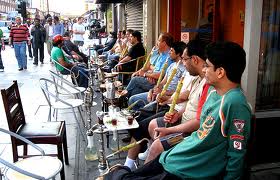
With Arabic music blaring from an assortment of over-priced pedicabs, fully hijabed passengers dancing to disco-like beats, roadside cafes and sheesha bars full of people-watchers and families out and about well past midnight, comfortable in the knowledge that they are more or less secure on this street.

It is a nostalgic, if unfortunate, scene that depicts what tourists from Egypt, Nigeria, Pakistan, Saudi Arabia or Algeria love about Edgware Road. It provides them with a cultural ease, coupled with the freedom to exercise simple pleasures which, for different reasons, have become unthinkable in their home countries.

In Secret, Obama Extends U.S. Role in Afghan Combat

WASHINGTON, Nov 21 — President Obama signed a secret order in recent weeks authorizing a more expansive mission for the military in Afghanistan in 2015 than originally planned, a move that ensures American troops will have a direct role in fighting in the war-ravaged country for at least another year.

Mr. Obama’s order allows American forces to carry out missions against the Taliban and other militant groups threatening American troops or the Afghan government, a broader mission than the president described to the public earlier this year, according to several administration, military and congressional officials with knowledge of the decision. The new authorization also allows American jets, bombers and drones to support Afghan troops on combat missions.

In an announcement in the White House Rose Garden in May, Mr. Obama said that the American military would have no combat role in Afghanistan next year, and that the missions for the 9,800 troops remaining in the country would be limited to training Afghan forces and to hunting the “remnants of Al Qaeda.”

The decision to change that mission was the result of a lengthy and heated debate that laid bare the tension inside the Obama administration between two often-competing imperatives: the promise Mr. Obama made to end the war in Afghanistan, versus the demands of the Pentagon that American troops be able to successfully fulfill their remaining missions in the country.

The internal discussion took place against the backdrop of this year’s collapse of Iraqi security forces in the face of the advance of the Islamic State as well as the mistrust between the Pentagon and the White House that still lingers since Mr. Obama’s 2009 decision to “surge” 30,000 American troops to Afghanistan. Some of the president’s civilian advisers believe that decision was made only because of excessive Pentagon pressure, and some military officials believe it was half-baked and made with an eye to domestic politics.

Mr. Obama’s decision, made during a White House meeting in recent weeks with his senior national security advisers, came over the objection of some of his top civilian aides, who argued that American lives should not be put at risk next year in any operations against the Taliban — and that they should have only a narrow counterterrorism mission against Al Qaeda.

Continue reading the main story

But the military pushed back, and generals both at the Pentagon and Afghanistan urged Mr. Obama to define the mission more broadly to allow American troops to attack the Taliban, the Haqqani network and other militants if intelligence revealed that the extremists were threatening American forces in the country.

The president’s order under certain circumstances would also authorize American airstrikes to support Afghan military operations in the country and ground troops to occasionally accompany Afghan troops on operations against the Taliban.

“There was a school of thought that wanted the mission to be very limited, focused solely on Al Qaeda,” one American official said.

Continue reading the main story

But, the official said, “the military pretty much got what it wanted.”

On Friday evening, a senior administration official insisted that American forces would not carry out regular patrols or conduct offensive missions against the Taliban next year.

“We will no longer target belligerents solely because they are members of the Taliban,” the official said. “To the extent that Taliban members directly threaten the United States and coalition forces in Afghanistan or provide direct support to Al Qaeda, however, we will take appropriate measures to keep Americans safe.”

In effect, Mr. Obama’s decision largely extends the current American military role for another year. Mr. Obama and his aides were forced to make a decision because the 13-year old mission, Operation Enduring Freedom, is set to end on Dec. 31.

The matter of the military’s role in Afghanistan in 2015 has “been a really, really contentious issue for a long time, even more contentious than troop numbers,” said Vikram Singh, who worked on Afghanistan policy both at the State Department and the Pentagon during the Obama administration and is now at the Center for American Progress in Washington.

American officials said that while the debate over the nature of the American military’s role beginning in 2015 has lasted for years, two issues in particular have shifted the debate in recent months.

The first is the advance of Islamic State forces across northern Iraq and the collapse of the Iraqi Army, which has led to criticism of Mr. Obama for a military pullout of Iraq that left Iraqi troops ill-prepared to protect their soil.

This has intensified criticism of Mr. Obama’s Afghanistan strategy, which Republican and even some Democratic lawmakers have said adheres to an overly compressed timeline that would hamper efforts to train and advise Afghan security forces — potentially leaving the them vulnerable to attack from Taliban fighters and other extremists in the meantime.

This new arrangement could blunt some of that criticism, although it is also likely to be criticized by some Democratic lawmakers who will say that Mr. Obama allowed the military to dictate the terms of the endgame in Afghanistan.

The second factor is the transfer of power in Afghanistan to President Ashraf Ghani, who has been far more accepting of an expansive American military mission in his country than his predecessor, Hamid Karzai.

According to a senior Afghan official and a former Afghan official who maintains close ties to his former colleagues, in recent weeks both Mr. Ghani and his new national security adviser, Hanif Atmar, have requested that the United States continue to fight Taliban forces in 2015 — as opposed to being strictly limited to operations against Al Qaeda. Mr. Ghani also recently lifted the limits on American airstrikes and joint raids that Mr. Karzai had put in place, the Afghan officials said.

The new Afghan president has already developed a close working relationship with Gen. John F. Campbell, the allied commander in Afghanistan.

Continue reading the main story Continue reading the main story

Continue reading the main story

“The difference is night and day,” General Campbell said in an email about the distinction between dealing with Mr. Ghani and Mr. Karzai. “President Ghani has reached out and embraced the international community. We have a strategic opportunity we haven’t had previously with President Karzai.”

American military officials saw the easing of the limits on airstrikes imposed by Mr. Karzai as especially significant, even if the restrictions were not always honored. During the summer, Afghan generals occasionally ignored Mr. Karzai’s directive and requested American air support when their forces encountered trouble.

Now it appears such requests will no longer have to be kept secret.

One senior American military officer said that in light of Mr. Obama’s decision, the Air Force expects to use F-16 fighters, B-1B bombers and Predator and Reaper drones to go after the Taliban in 2015.

“Our plans are to maintain an offensive capability in Afghanistan,” he said.

The officer said he expected the Pentagon to issue an order in the next several weeks detailing the military’s role in Afghanistan in 2015 under Operation Resolute Support, which will become the new name for the Afghanistan war.

The Pentagon plans to take the lead role in advising and training Afghan forces in southern and eastern Afghanistan, with Italy also operating in the east, Germany in the north and Turkey in Kabul.

But by the end of next year, half of the 9,800 American troops would leave Afghanistan. The rest would be consolidated in Kabul and Bagram, and then leave by the end of 2016, allowing Mr. Obama to say he ended the Afghan war before leaving office.

America’s NATO allies are expected to keep about 4,000 troops of their own in Afghanistan in 2015. The allies are expected to follow the American lead in consolidating and withdrawing their troops.

The United States could still have military advisers in Kabul after 2016 who would work out of an office of security cooperation at the United States Embassy. But the administration has not said how large that contingent might be and what its exact mission would be.

And it remains unclear how the continuing chaos in Iraq — and Mr. Obama’s decision to send troops back there — will affect the administration’s plans for an Afghanistan exit.

As the president said in the Rose Garden in May, “I think Americans have learned that it’s harder to end wars than it is to begin them.”