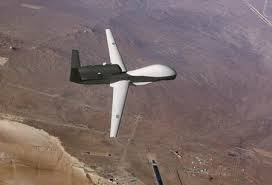
Drones hit Taliban hideouts in ‘joint Pakistan-U.S.’ raid, say officials

Drones in N. Waziristan (Credit: epakistan.com)
Drones in N. Waziristan
(Credit: epakistan.com)

ISLAMABAD/MIRANSHAH  June 12 – U.S. drones fired missiles at Taliban hideouts in Pakistan killing at least 10 militants in response to a deadly attack on Karachi airport, officials said on Thursday, in the first such raids by unmanned CIA aircraft in six months.

Two top government officials said Islamabad had given the Americans “express approval” for the strikes – the first time Pakistan has admitted to such cooperation.

Underlining Pakistan’s alarm over the brazen Taliban attack on the airport, just weeks after peace talks with the Islamist militants stalled, the officials told Reuters a “joint Pakistan-U.S. operation” had been ordered to hit the insurgents.

Another official said Pakistan had asked the United States for help after the attack on the country’s busiest airport on Sunday, and would be intensifying air strikes on militant hideouts in coming days.

Pakistan publicly opposes U.S. drone strikes, saying they kill too many civilians and violate its sovereignty, although in private officials have admitted the government supports them.

“The attacks were launched with the express approval of the Pakistan government and army,” said a top government official, requesting not to be named as he was not authorised to discuss the issue with the media.

“It is now policy that the Americans will not use drones without permission from the security establishment here. There will be complete coordination and Pakistan will be in the loop.

We understand that drones will be an important part of our fight against the Taliban now,” the official added.

The strikes were the first in the nuclear-armed South Asian nation since an attack in December last year in which three suspected militants were killed. The CIA conducts covert drone operations against terrorism suspects.

Speculation has been rising that Pakistan is preparing for a full-scale military operation in North Waziristan, a scenario Prime Minister Nawaz Sharif has resisted for months in favour of a negotiated end to the insurgency.

But talks with the Taliban have collapsed many times since Sharif announced his plan in February and set up a committee of negotiators, mainly over Taliban demands that the government withdraw all troops from tribal areas and impose Sharia law.

AFGHANISTAN CONNECTION

Pakistan military sources said six militants including four Uzbeks were killed in the first strike on Wednesday around five km (three miles) north of Miranshah, the capital of the North Waziristan tribal region where Taliban insurgents are holed up.

The second attack killed four militants in the same area around 2 a.m. on Thursday.

Another source, a senior member of the Afghan Taliban, put the death toll at 16, with 10 killed in the second strike.

A senior member of the Afghan Taliban said all the 10 militants killed in the second strike were affiliated with the feared Haqqani network that regularly launches attacks on Western forces in Afghanistan and which until last month held U.S. soldier Bowe Bergdahl.

“The drones targeted two mini vans which were carrying Taliban fighters associated with the Haqqani network to Afghanistan for an attack,” the Taliban commander said.

The twin drone strikes came after at least 38 people, including 10 insurgents, were killed when militants raided Karachi airport on Sunday night. The Pakistani Taliban are allied with the Afghan militants of the same name and share a similar jihadist ideology.

But they operate as a separate entity, focused entirely on toppling the Pakistani state and establishing strict Islamic rule, whereas the Afghan Taliban are united by their campaign against invading foreign forces.

Sunday’s assault destroyed prospects for peace talks between the Taliban and Sharif’s government, after months of failed attempts to engage the al Qaeda-linked militants in dialogue on how to end years of violence.

The Pakistan government officially condemned the latest strikes and said such attacks “have a negative impact on the government’s efforts to bring peace and stability in Pakistan and the region”. But top officials privately admit the Pakistani government is weighing all options after the Karachi attack.

(Additional reporting by Asim Tanveer in Multan and Jibran Ahmed in Peshawar; Editing by Maria Golovnina and Jeremy Laurence)
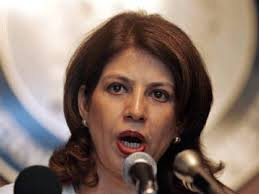
Pakistan Condemns Drone Attacks in N. Waziristan

FO spokeswoman (Credit: pakistantribe.com)
FO spokeswoman
(Credit: pakistantribe.com)

ISLAMABAD, June 19: The government of Pakistan condemned the two incidents of US drone strikes that took place near Miramshah, North Waziristan during the early hours of Wednesday.

According to a statement from the Ministry of Foreign Affairs on Wednesday, where they termed the strikes as a “violation of its sovereignty and territorial integrity.”

“These strikes have a negative impact on the government’s efforts to bring peace and stability in Pakistan and the region.”

Wednesday’s strikes killed at least six people. On June 11, two successive drone strikes reportedly killed around 16 people and injured few others.

There have been three drone strikes this year, killing around 20 people.

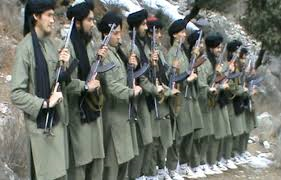
TTP’s Uzbek Allies Killed after Claiming Karachi Airport attack

Islamic Movement of Uzbekistan (Credit: bbc.co.uk)
Islamic Movement of Uzbekistan
(Credit: bbc.co.uk)

The first U.S. drone strikes in Pakistan in almost six months targeted militants from Afghanistan’s Haqqani network, killing one of the insurgent group’s senior commanders, Pakistani intelligence officials said on Thursday.

Drones struck two locations in Pakistan’s North Waziristan tribal region, near the border with Afghanistan, killing at least 11 suspected militants on Wednesday, these officials added. The second strike, at around 2:30 a.m. local time on Thursday, hit a Haqqani network compound near Miranshah, North Waziristan’s capital, killing at least eight.

Among those eight was Haji Gul, described by Pakistani intelligence officials and local militants as a senior Haqqani field commander whose advice was regularly sought by the group’s leadership.

The Haqqani network is part of the Afghan Taliban but operates autonomously, mostly in eastern Afghanistan. Its main base is in North Waziristan.

A vehicle, rigged for use in a suicide attack, was also destroyed in the attack, Pakistani officials said. They said the militants were preparing for a mission across the border in Afghanistan.

The Haqqani network has carried out a series of high-profile attacks in Afghanistan against Western targets, including the Sept. 13, 2011, assault on the U.S. Embassy in Kabul.

The U.S. Department of State formally designated it a terrorist organization in 2012.

Several U.S. officials have accused Pakistan’s Inter-Services Intelligence agency of backing the Haqqanis, a charge the ISI denied. In 2011, then-chairman of the Joint Chiefs of Staff Adm. Mike Mullen described the group as a “veritable arm” of the ISI.

The U.S. has long been asking Pakistan to go after militant groups in North Waziristan. Pakistan so far hasn’t launched a full-scale military offensive in the region, where several militant groups, including al Qaeda and the Pakistani Taliban, operate. However, it has regularly carried out airstrikes and limited ground operations against the Pakistani Taliban in North Waziristan.

In the first drone strike, which broke the near-six-month lull around 8:30 p.m. on Wednesday, Uzbek and ethnic Punjabi militants were targeted. At least three were killed.

The Pakistani Taliban and its ally, the Islamic Movement of Uzbekistan, separately claimed responsibility for Sunday’s attack on Karachi’s Jinnah International Airport, in which at least 35 people were killed, including 10 attackers.

There is widespread opposition among Pakistanis to U.S. drones, and the government officially condemns the strikes as violations of Pakistan’s sovereignty and calls them counterproductive to peace and stabilization efforts. The Pakistani government on Thursday condemned the two North Waziristan drone strikes.

“These strikes are a violation of Pakistan’s sovereignty and territorial integrity,” the Ministry of Foreign Affairs said. “Additionally, these strikes have a negative impact on the government’s efforts to bring peace and stability in Pakistan and the region.”

Prime Minister Nawaz Sharif’s government began a tentative peace process with the Pakistani Taliban in January, which led to a cease-fire in March. There was little progress, however, and the cease-fire ended in April.

Islamabad hasn’t formally abandoned peace efforts, but talks have hit a deadlock and officials say an operation against militants in North Waziristan is being considered.

Maulana Sami-ul-Haq, a prominent cleric nominated by the Pakistani Taliban to negotiate with the government, told reporters on Thursday that negotiations are the only way to end the conflict with the Taliban. “Drone strikes kill innocent people, and they have started because the negotiations have stopped,” Mr. Haq said.

How an arrest in London sparked chaos in Karachi

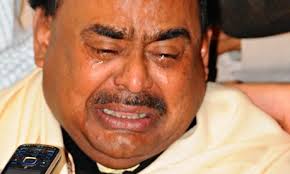
Altaf Hussain after Imran Farooq murder (Credit: theguardian.com)
Altaf Hussain after Imran Farooq murder
(Credit: theguardian.com)

London, June 3: On Tuesday, police in London arrested a man on suspicion of money laundering. Thousands of miles away in Karachi, Pakistan’s turbulent coastal metropolis, traffic snarled, shops shuttered, trains stopped, embassies closed and millions braced for further havoc. (As of Tuesday evening, there were reports of gunfire and 12 vehicles set aflame, but no casualties.)

The man taken in by Scotland Yard is Altaf Hussain, leader of Muttahida Qaumi Movement (MQM), the dominant political party in Karachi. Despite living in self-imposed exile in Britain for more than two decades out of fear for his life, Hussain has remained a kingpin in this megacity of nearly 20 million, depending on how you count it. He casts a long, dark shadow over the city, notorious for its gangland violence and volatile political divisions.

The MQM draws support from Karachi’s large population of mohajirs, the descendants of those who migrated to Pakistan from what is now India in 1947, when colonial India was cleaved in two by the departing British. The party commands a crucial bloc of seats in Parliament, almost all of which are concentrated around Karachi in southern Sindh province.

The city’s ethnic polarization — it’s also home to huge ethnic Pashtun and Sindhi populations — has led to years of sectarian tensions, punctuated by attacks and street battles. The MQM’s vast political machinery is complemented by brass knuckles. A leaked 2008 U.S. diplomatic cable, citing local police, claimed that the party maintained its own parallel militia of as many as 10,000 active fighters, with 25,000 in reserve.

British authorities have been investigating Hussain, 60, since the 2010 assassination in London of a MQM official, Imran Farooq, who had grown estranged from the party. Last week, they froze Hussain’s bank accounts. MQM officials said today that he was brought in only for questioning, but it seems clear that he is under arrest.

Hussain is considered a charismatic, larger-than-life figure. Ensconced in his compound in northwest London, he would coordinate the operations of his party via teleconference and get beamed over satellite to address mass gatherings and rallies.

While the MQM has staunch middle-class backing and is credited with running Karachi efficiently, it is thought to benefit from a whole slew of underworld activities, including extortion and targeted attacks on opponents. MQM officials routinely deny any connection to such wrongdoing.

Hussain himself has earned notoriety for his incendiary rhetoric — once telling an aggressive journalist that he had “his body bag ready” and, in another instance, warning critics to end their “false allegations” against him. “Don’t blame me, Altaf Hussain, or the MQM,” he said, “if you get killed by any of my millions of supporters.”

Scotland Yard may struggle to charge him with incitement to violence or prove a direct link to Farooq’s death. So it appears its most solid case surrounds Hussain’s funds and their use in Britain. Earlier raids on Hussain’s house led to the impounding of about $600,000 in cash.

Meanwhile, in Karachi, MQM officials have called for calm, sending out mass text messages throughout the city advising residents to ignore rumors that could cause further disruption or violence. Like many political parties in South Asia, the MQM’s cohesion depends greatly upon the presence of its towering founding figure. The doubts and fears in Karachi are as much about what happens at home as they are about what happens in a British courtroom far away

Obama Outlines Plan on Ending Longest War in US History
`Its harder to end wars than to begin them’ – US president

Afghan transition (Credit: downwardtrend.com)
Afghan transition
(Credit: downwardtrend.com)

WASHINGTON, May 27- U.S. President Barack Obama on Tuesday outlined a plan to withdraw all but 9,800 American troops from Afghanistan by the end of the year and pull out the rest by the end of 2016, ending more than a decade of military engagement triggered by the Sept. 11 attacks on the United States.

The decision means that Obama will leave office in early 2017 having extricated the country from the longest war in U.S. history. He ended Washington’s combat presence in Iraq in 2011.

Obama’s White House Rose Garden announcement prompted criticism from Republicans that the hard-fought gains made against the Taliban could be lost in much the same way that sectarian violence returned to Iraq after the U.S. withdrawal.

Obama, who made a whirlwind visit to U.S. troops in Afghanistan over the weekend before American combat operations conclude at the end of 2014, appeared to anticipate concerns that he is abandoning Afghanistan. He said it is time for Afghans to secure their country.

“We have to recognize that Afghanistan will not be a perfect place, and it is not America’s responsibility to make it one,” Obama said.

Under his plan, 9,800 U.S. troops would remain behind into next year. By the end of 2015, that number would be reduced by roughly half.

By the end of 2016, the U.S. presence would be cut to a normal embassy presence with a security assistance office in Kabul, as was done in Iraq.

The 9,800 troops would take an advisory role backing up Afghan forces. They would train Afghan troops and help guide missions to rout out remaining al Qaeda targets.

Any U.S. military presence beyond 2014 is contingent on Afghanistan’s government signing a bilateral security agreement with the United States.

Outgoing Afghan President Hamid Karzai has refused to sign it. But U.S. officials were encouraged that the two leading candidates in Afghanistan’s presidential race, Abdullah Abdullah and Ashraf Ghani, have both pledged to sign quickly should they be elected in the second round of voting set for June 14.

Obama said the lengthy U.S. presence in Afghanistan is proof that “it’s harder to end wars than it is to begin them.”

“But this is how wars end in the 21st century: not through signing ceremonies but through decisive blows against our adversaries, transitions to elected governments, security forces who are trained to take the lead and ultimately full responsibility,” he said.

While Americans have long since grown weary of a conflict in which nearly 2,200 U.S. troops have been killed, some Republicans greeted the news with skepticism.

They continued a drumbeat of criticism of the president’s handling of foreign policy and national security ahead of a speech on the subject Obama is to give on Wednesday at the U.S. Military Academy in West Point, New York.

“The president’s decision to set an arbitrary date for the full withdrawal of U.S. troops in Afghanistan is a monumental mistake and a triumph of politics over strategy,” Republican Senators John McCain and Lindsey Graham said in a statement.

A senior Obama administration official bristled at the notion that the United States would be leaving Afghan forces to do battle against the Taliban alone.

“We never signed up to be the permanent security force in Afghanistan to fight against the Taliban,” the official, speaking on condition of anonymity, told reporters.

The United States now has about 32,000 troops in Afghanistan. U.S. military leaders had pushed for a force of at least around 10,000, saying it was the minimum required.

Remaining U.S. and NATO forces will advise Afghan forces, focusing on functions such as budgeting, logistics, and support for security institutions.

NATO countries have helped build Afghanistan’s military and other forces from scratch since 2001. While Afghan forces have grown more independent, they lack key skills such as intelligence collection and air power.

As part of the post-2014 force, a small number of U.S. soldiers is expected to conduct counterterrorism operations against al Qaeda and other hardline militants, located mainly in remote areas along Afghanistan’s eastern border with Pakistan.

(Additional reporting by Phil Stewart, Missy Ryan, David Alexander, Patricia Zengerle, Jeff Mason and Roberta Rampton; Editing by David Storey and Jonathan Oatis)

Taliban’s Mullah Omar Celebrates Prisoner Swap for Bergdhal

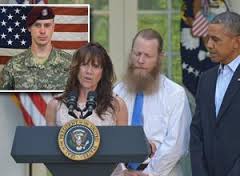
Bergdhal (inset) with parents & Obama (Credit: nydailynews.com)
Bergdhal (inset) with
parents & Obama
(Credit: nydailynews.com)

Afghan Taliban leader Mullah Mohammad Omar has issued a rare public statement hailing the exchange of five Guantanamo Bay detainees for a Taliban-held US soldier as a “big victory”.

Sgt Bowe Bergdahl, 28, was handed to US forces in Afghanistan on Saturday.

US Defence Secretary Chuck Hagel has defended the exchange amid criticism Congress was not given 30 days’ notice before the detainees were released.

He said the US had to act quickly to save the soldier’s life.

Mullah Omar, who has made no public appearances or speeches since fleeing Afghanistan in 2001 when US-led forces toppled the Taliban after the 9/11 attacks in the US, said: “I extend my heartfelt congratulations to the entire Afghan Muslim nation.”

The Afghan government, which was not informed of the deal until after the exchange had taken place, has condemned it as a breach of international law.

Sgt Bergdahl, who is said to be in good condition and has been flown to Germany for more treatment, was the only US soldier being held by the Taliban in Afghanistan.

The five senior Afghan detainees are thought to be the most senior Afghans held at the US detention facility in Cuba, having been captured during America’s military campaign in 2001.

Republican opponents have criticised the Pentagon for not giving Congress the required 30-day notification before releasing the five.

But Mr Hagel, who reportedly met some of the special forces team involved in the operation on a visit to Afghanistan on Sunday, said the military believed the soldier was in danger, and had to act quickly “essentially to save his life”.

US National Security Adviser Susan Rice told US television there had been extensive consultations with Congress in the past about getting Sgt Bergdahl back, and lawmakers knew about the idea of trading detainees.

Mohammad Fazl served as the Taliban’s deputy defence minister during America’s military campaign in 2001. Accused of possible war crimes, including the murder of thousands of Shia Muslims.

Khirullah Khairkhwa was a senior Taliban official serving as interior minister and governor of Herat, Afghanistan’s third largest city. Alleged to have had direct links to Osama Bin Laden.

Abdul Haq Wasiq was the Taliban’s deputy minister of intelligence. Said to have been central in forming alliances with other Islamist groups to fight against US and coalition forces.

Mullah Norullah Noori was a senior Taliban military commander and a governor. Also accused of being involved in the mass killings of Shia Muslims.

Mohammad Nabi Omari held multiple Taliban leadership roles, including chief of security. Alleged to have been involved in attacks against US and coalition forces.

While hopeful the prisoner exchange could lead to a breakthrough in negotiations with the Taliban, Mr Hagel said getting Sgt Bergdahl back had been the priority.

Afghan President Hamid Karzai was informed of the prisoner-swap “after the fact”, he added.

In a statement, the Afghan ministry of foreign affairs insisted that “handing over prisoners to a third country is a breach of international law”.

It added: “We are strongly opposed to it. We want Qatar and the US government to let the men go free.”

Parents Robert and Jani Bergdahl said they were “joyful and relieved” to hear of their son’s release, adding that he was having trouble speaking English due to his long captivity.

The US president, who was joined at the White House by Sgt Bergdahl’s parents, Robert and Jani, said ”he was never forgotten”

President Obama said on Saturday that he had received security guarantees from Qatar – which mediated the deal and where the five Afghan men have been flown – “that it will put in place measures to protect our national security”.

Under the deal, they will be banned from leaving Qatar for at least a year.

A video grab image from 2010 showed Sgt Bergdahl in captivity

The soldier, of Hailey, Idaho, was serving with an infantry regiment in Paktika province near the Pakistani border and went missing on 30 June 2009, months after being deployed to Afghanistan.

The circumstances of his capture remain unclear, with speculation he may have walked away from his base out of disillusionment with the US campaign.

US officials say any decision over possible desertion charges will be made by the army, but there is a feeling the soldier has suffered enough.

Throughout his captivity, the soldier’s hometown had continued to remember him with special events and yellow ribbons tied to trees

Pakistani Taliban Faction Condemns Violence, Breaks Away

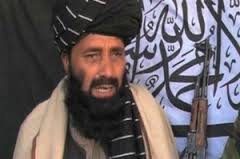
TTP's Azam Tariq (Credit: geotv)
TTP’s Azam Tariq
(Credit: geotv)

LAHORE, May 28—A major faction of the Pakistani Taliban broke away and condemned violence on Wednesday, weakening the militant group allied with al Qaeda that seeks to overthrow the Pakistani state.

The split in the Pakistani Taliban, known formally as Tehreek-e-Taliban Pakistan, comes after months of attempted peace negotiations between the government of Prime Minister Nawaz Sharif and the militant organization. It also followed weeks of bloody infighting within the TTP.

The move could push Pakistan closer to an army operation against the remainder of the TTP, an offensive that Washington has long wanted.

Although the stated aim of the talks was to forge a peace deal with the whole TTP, Pakistani officials had privately said the realistic goal was to see which factions were amenable to peace and which were irreconcilable. An operation planned by the army was put on hold when Mr. Sharif launched peace talks in late January.

The breakaway faction is led by a warlord named Sajna who is also known as Khan Said or Khalid Mehsud, announced a “complete separation from the current organization that has lost its way.”

Sajna represents most of the militants from the fierce Mehsud tribe, who made up much of the TTP. His faction, now calling itself Tehreek-e-Taliban Pakistan Mehsud group, accused the rest of the TTP of criminality.

The breakaway group, if it goes on to agree to a peace deal with the government, could now join the ranks of the so-called good Taliban—jihadist groups that don’t fight within Pakistan such as an outfit led by Gul Bahadur, which is active in Afghanistan.

“We consider kidnapping for ransom, extortion, damage to public facilities and bombings to be un-Islamic,” said a statement from the breakaway faction.

“Tehreek-e-Taliban Mehsud group believes in stopping the oppressor from cruelty, and supporting the oppressed.”

The breakaway group was originally led by a commander named Waliur Rehman, who was killed in a U.S. drone strike last year.

It was always considered relatively moderate, It was involved in many of the activities it now condemns and is likely responsible for the deaths of thousands of Pakistanis, analysts said.

The TTP, which works independently of the Afghan Taliban, was formed in 2007 in the lawless tribal areas under the influence of al Qaeda to target Pakistan.

The breakaway group pledged allegiance to the Afghan Taliban.

“We have the deepest respect for jihadist organizations of the right beliefs fighting against evil powers,” the group said.

The rest of the TTP is still led by Mullah Fazlullah, a militant from the Swat district outside the tribal areas who isn’t a Mehsud.

The leadership of the TTP passed outside the Mehsuds for the first time when Mr. Fazlullah was made chief in November after the previous leader, Hakimullah Mehsud, was killed in a U.S. drone stroke.

Many from the Mehsud clan never accepted the new leader.

Rahimullah Yusufzai, a veteran journalist who was formerly part of the government’s negotiating committee for the peace talks, said he expected some other factions of the TTP from the tribal areas to join the breakaway faction.

Parts of the so-called Punjabi Taliban—militants from the country’s most populous Punjab province—could also possibly join.

“Now you will have one less enemy,” Mr. Yusufzai said.

“The Mehsuds have always been the backbone of the TTP. I expect Fazlullah will become weaker, day by day.”

Pakistan’s national-security adviser, Sartaj Aziz, and the Interior Ministry, which is handling the peace talks, both declined to comment on the latest development.

Mr. Fazlullah is believed to be based in eastern Afghanistan, putting him beyond the reach of Pakistan’s armed forces.

A relatively small group of the Mehsud clan militants, led by a commander named Shehryar, remains loyal to Mr. Fazlullah. . Fighting between the Sajna and Shehryar factions has left dozens of militants dead in recent weeks.

Parts of the TTP allegedly have support from Afghan intelligence, a connection made public last year when a TTP commander was snatched from Afghan custody by U.S. forces in Afghanistan.

The breakaway faction said that “using the TTP platform, people in the current organization are tools of secret agencies.”

The Afghan government denies it supports the TTP, and didn’t immediately comment on Sajna’s defection.

Pakistan’s military is thought to be getting impatient for military action against the TTP, one of the sources of its tension with the civilian government.

Following a visit to troops in the tribal areas Tuesday, the army chief, Gen. Raheel Sharif, said: “Together the whole nation has rejected the misplaced ideology of the terrorists, who have clearly lost their cause already and are being marginalized.”

Rifaat Hussain, a security analyst based in Islamabad, said airstrikes by the Pakistani military in recent weeks, along with limited ground action, pointed toward a coming offensive that would target the Fazlullah-led group.

“The army has declared its intention very clearly to launch an operation,” said Mr. Hussain. “The military sees this as an opportunity to finally break the stranglehold of the TTP on the tribal areas.”

The TTP has tentacles across the country and has a major presence in Pakistan’s largest city, Karachi, where they dominate areas around the periphery of the city and, according to police, use it to raise funds through extortion and other criminality.

Saifullah Mahsud, director of the FATA Research Center, an independent think tank in Islamabad, said that Sajna group had emerged as the dominant TTP faction in Karachi, so his departure from the TTP and his pledge against violence could help the law and order situation in Karachi.

“This is a change in strategy for the Sajna people and it helps Pakistan keep its options open,” he said.

— Safdar Dawar and Qasim Nauman contributed to this article.

Pak Army’s Child Returns to Direct Tehrik-i-Taliban Pakistan

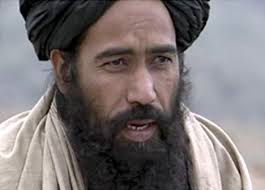
Mullah Omar (Credit: pakistantoday.pk.com)
Mullah Omar
(Credit: pakistantoday.pk.com)

MIRAMSHAH, April 15: Taliban supreme leader Mullah Mohammad Omar has called for seeking guidance from Holy Quran to resolve differences between two rival factions of the outlawed Tehreek-i-Taliban Pakistan amid reports of rifts widening between the groups.

A pamphlet in Pashto carrying the name of Mullah Omar issued in Miramshah (North Waziristan) on Monday said there were serious differences among Mujahideen of Mehsud tribe in South Waziristan and asked them to recite verses from Quran to end hostilities.

“There are none worthy of worship besides You (God). Glorified are You. Surely I am from among the wrongdoers,” say the verses quoted in the pamphlet.

Mullah Omar said it was binding upon every Muslim to recite these verses 100 times a day.

Clashes between the Khan Said and Sheheryar groups leave a large number of militants dead and injured.

They are fighting to capture TTP leadership in South Waziristan.

Sheheryar has refused to accept Khan Said alias Sajna as chief of TTP’s Mehsud militants and declared himself as their leader.

Commander Daud of the Sheheryar group accused Khan Said of trying to occupy the top TTP post in South Waziristan. To end the crisis, he said, both the factions should end the fighting and allow a neutral group chosen by the Taliban leadership to lead Mehsud militants.

Daud said fighting would not end the crisis, adding that his group would accept any decision taken by TTP chief Maulvi Fazlullah.

Pakistan warns Afghan Taliban and Haqqani Network

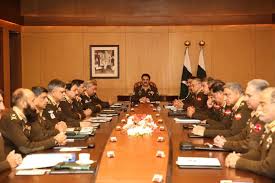
Pak army meeting (Credit: pakistansoldiers.com)
Pak army meeting
(Credit: pakistansoldiers.com)

ISLAMABAD, April 17: The Pakistani establishment has made it clear to the Afghan Taliban and the Haqqani Network that the time has come for them to choose between the Tehreek-e-Taliban Pakistan and the state of Pakistan, if they want to stay friends with Islamabad.

The unprecedented warning from the Pakistani establishment has come at a crucial time when the Pakistani Taliban are holding peace talks with the government in Islamabad, amidst demands to release over 800 Taliban prisoners and to set up a free peace zone in Waziristan.

According to well-informed sources, the warning from the establishment was prompted by the growing cooperation among the Afghan Taliban, the Haqqani Network and the Pakistani Taliban, which has reinforced the martial power of TTP in its current conflict with the security forces of Pakistan.

The TTP spokesman, Shahidullah Shahid, already admitted on October 6, 2013 in an interview that the Afghan Taliban were financially supporting the Pakistani Taliban besides providing them sanctuary in Afghanistan.

The fugitive TTP Ameer, Mullah Fazlullah, who had claimed responsibility last year for killing GOC Swat Major General Sanaullah Niazi is also being sheltered by the Afghan Taliban in the Kunar Province.

However, what seemed to have angered the Pakistani establishment the most were the allegations coming from the Afghan and the Pakistani Taliban, blaming the Inter-Services Intelligence (ISI) for the November 11, 2013 mystery murder [in Islamabad] of Dr Nasiruddin Haqqani, the top fundraiser and organiser of Haqqani Network as well as its liaison man with the Pakistani security establishment.

Dr Nasiruddin, the real brother of Sirajuddin Haqqani, was killed by unknown gunmen in the federal capital 10 days after the November 1, 2013 killing of the TTPAmeer in a US drone attack in North Waziristan. Both were laid to rest in the Dandey Darapa Khel area of North Waziristan which also headquarters the Haqqani Network as well as the TTP.

The decades-old cozy ties between the Pakistani establishment and the Haqqanis were shattered with the mystery murder of Dr Nasiruddin when a spokesman of Haqqani network (Najeebullah) immediately blamed the Pakistani intelligence agencies.

He said: “Dr Nasiruddin had been mediating between a powerful intelligence agency and the Pakistani Taliban for peace talks. But he had refused to mediate further following Hakimullah’s death and the subsequent announcement of TTP not to hold peace talks with the government.

Nasiruddin’s reluctance to mediate anymore after Hakimullah’s killing must have annoyed the agency which decided to eliminate him physically,” the Haqqanis’ spokesman was quoted by the media as saying.

On his part, the TTP spokesman, Shahidullah Shahid, also blamed a Pakistani intelligence agency for the murder, vowing to take revenge. “Nasiruddin Haqqani has been martyred by none other than the ISI.

He was killed because he had bravely backed our Ameer Hakimullah Mehsud,” Shahidullah told AFP when asked about possible killers.

However, on their part, the ISI circles had refuted the allegations of involvement in the murder, saying Dr Nasiruddin Haqqani was either killed by the TTP or by the Afghan National Directorate of Security.

The allegations leveled by the Afghan Taliban and the Haqqani Network were followed by Pakistani intelligence reports that both the groups were supporting and financing the TTP in its terror spree against the khakis and the civilians alike.

Indeed, the Pakistani and the Afghan Taliban are closely allied and both aim to impose a strict version of Islamic laws or Shariah on their societies. However, their leadership and targets differ with each other.

While the Pakistani Taliban mostly focus their terrorist attacks in Pakistan against the security forces which they think are an American ally, the Afghan Taliban target the Afghan and the Allied forces.

Defence Minister Khawaja Asif recently told Reuters in an interview that the Pakistan government was worried about the possibility of increasing convergence between the Pakistani and the Afghan Taliban. “Then the Pakistani Taliban will have a powerhouse behind them,” Khawaja Asif had said.

Analysts believe that these concerns might have prompted the Pakistani security establishment to warn the Haqqanis and the Afghan Taliban against backing the TTP.

However, the close nature of ties between the Afghan and the Pakistani Taliban can be gauged from the fact that the central Shura of TTP has already referred their internal differences to the Afghan Taliban while asking Mullah Omar to intervene and send a delegation to resolve the tiff between two major factions of Mehsud militants from South Waziristan.

A senior TTP commander has been quoted in the media as saying that the Shura thought that the intra-TTP tussle was too serious and critical for them and, therefore, they decided to approach the Islamic Emirate of Afghanistan, a term usually referred to the Afghan Taliban.

There are already reports that the Ameer of the Afghan Taliban is persuading the Pakistani Taliban to end their infighting in South Waziristan as he wants to secure their support against the foreign troops in Afghanistan to launch the annual spring offensive.

Analysts believe the Pakistani security establishment’s warning was meant to dissuade the Haqqanis and the Afghan Taliban from siding with the Pakistani Taliban in their conflict with the state of Pakistan at a time when the Allied forces are set to withdraw from Afghanistan and both the Afghan militia groups would require the crucial support of Islamabad to stage a comeback in Kabul.

In fact, the ultimate agenda of the Pakistani Taliban is the establishment of their own state — the Islamic Emirate of Waziristan [on the pattern of Mullah Omar’s Islamic Emirate of Afghanistan] in Fata where they can impose the Islamic Shariah. On the other hand, the ultimate agenda of the Afghan Taliban is the revival of the lost Islamic Emirate of Afghanistan.

Therefore, following the Pakistani establishment’s warning, Mullah Omar will have to decide whether to befriend the Pakistani Taliban or the state of Pakistan.

Commander Sirajuddin Haqqani of the Haqqani Network is bound to follow suit being a disciple of Mullah Omar just like the Pakistani and the Afghan Taliban. Well informed sources in the establishment say logically speaking Mullah Omar would like to remain a friend of Pakistan instead of inviting its wrath by befriending the TTP.

However, there are those in the Taliban circles who believe that if the Afghan Taliban succeed in regaining power in Kabul after the withdrawal of the Allied troops, there would be greater chances of their joining hands with the Pakistani Taliban whose aims and objectives and those of the Ameerul Momineen are the same.

However, the establishment circles say, in such an eventuality, the Afghan Taliban and the Haqqani Network must know that “strategic depth” would no longer be a consideration of the establishment if the Pakistan government finally orders a military action in North Waziristan after the failure of the talks with the TTP.

Relief in Afghanistan after largely peaceful landmark election

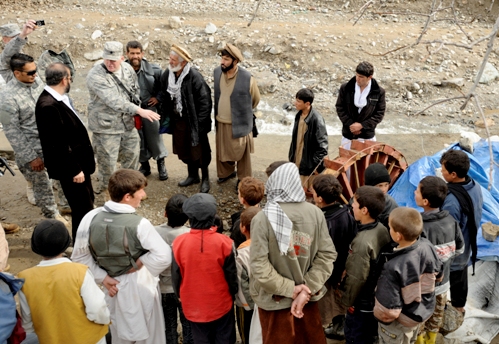
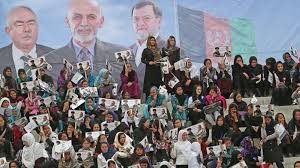
Afghan elections (Credit: abcnews.com)
Afghan elections
(Credit: abcnews.com)

KABUL/KANDAHAR, April 5 (Reuters) – Afghanistan’s presidential election closed on Saturday amid relief that attacks by Taliban fighters were fewer than feared for a vote that will bring the first-ever democratic transfer of power in a country plagued by conflict for decades.

It will take six weeks for results to come in from across Afghanistan’s rugged terrain and a final result to be declared in the race to succeed President Hamid Karzai.

This could be the beginning of a potentially dangerous period for Afghanistan at a time when the war-ravaged country desperately needs a leader to stem rising violence as foreign troops prepare to leave.

“Today we proved to the world that this is a people driven country,” Karzai, wearing his trademark green robe and a lambskin hat, told his nation in televised remarks.

“On behalf of the people, I thank the security forces, election commission and people who exercised democracy and … turned another page in the glorious history of Afghanistan.”

One of the eight candidates will have to score over 50 percent of the vote to avoid a run-off with his nearest rival.

The Taliban threat to wreck the vote through bombings and assassination failed to materialize, and violent incidents were on a far smaller scale than feared.

Turnout was seven million out of 12 million eligible voters, or about 58 percent, according to preliminary estimates, election commission chief Ahmad Yousuf Nuristani told reporters.

That was well above the 4.5 million who voted at the last election in 2009 which was marred by widespread fraud.

“I am here to vote and I am not afraid of any attacks,” said Haji Ramazan as he stood in line at a polling station in rain-drenched Kabul. “This is my right, and no one can stop me.”

In Washington, President Barack Obama congratulated the Afghan people on the elections.

“We commend the Afghan people, security forces, and elections officials on the turnout for today’s vote – which is in keeping with the spirited and positive debate among candidates and their supporters in the run-up to the election,” Obama said in a statement.

“These elections are critical to securing Afghanistan’s democratic future, as well as continued international support, and we look to the Afghan electoral bodies to carry out their duties in the coming weeks to adjudicate the results – knowing that the most critical voices on the outcome are those of Afghans themselves,” Obama said.

The United States could point to the advance of democracy in one of the world’s most violent countries as a success as it prepares to withdraw the bulk of its troops this year.

It has spent $90 billion on aid and security training since helping Afghan forces to topple a strict Islamist Taliban regime in 2001, but U.S. support for Afghanistan’s fight against the Taliban has faded.

As U.S. troops get ready to go home, the Taliban threat and uncertainty over neighbor Pakistan’s intentions leave the worry that Afghanistan could enter a fresh cycle of violence, and once again become a haven for groups like al Qaeda.

The United States has been at odds with Karzai who has refused U.S. entreaties to sign a bilateral security agreement that would permit about 8,000 U.S. troops to remain in the country after the formal U.S. withdrawal at the end of the year.

U.S. officials are keeping open the option of leaving behind a troop contingent for training Afghan forces and for a counter-terrorism mission if an agreement can be signed later this year by Karzai’s successor.

“The United States remains ready to work with the next president of Afghanistan. We will continue to stand with the people of Afghanistan as they work to build a democratic future,” U.S. Secretary of State John Kerry said in a statement.

During Saturday’s election, there were dozens of reports of minor roadside bombs, attacks on polling stations, police and voters. In the eastern province of Kunar alone, two voters died and 14 were wounded, while 14 Taliban militants were killed.

Interior Minister Umer Daudzai said nine policemen, seven soldiers, 89 Taliban fighters were killed in the past 24 hours across the country, adding that four civilians were also killed.

Dozens died in a spate of attacks in the preceding weeks. A veteran Associated Press photographer was killed and a senior correspondent of the same news agency was wounded on Friday when a policeman opened fire on the two women in the east as they reported on preparations for the poll.

KABUL SEALED OFF

Most people had expected the election to be better run than the chaotic 2009 vote that handed Karzai a second term.

The constitution barred Karzai from seeking another term. But, after 12 years in power, he is widely expected to retain influence through politicians loyal to him.

Former foreign ministers Abdullah Abdullah and Zalmay Rassoul, and former finance minister Ashraf Ghani were regarded as the favorites to succeed Karzai.

More than 350,000 Afghan troops were deployed, guarding against attacks on polling stations and voters. The capital, Kabul, was sealed off by rings of roadblocks and checkpoints.

In the city of Kandahar, cradle of the Taliban insurgency, the mood was tense. Vehicles were not allowed to move on the roads and checkpoints were set up at every intersection.

Hamida, a 20-year-old teacher working at a Kandahar polling station, said more than a dozen women turned up in the first two hours of voting and added that she expected more to come despite the threat of an attack by the Taliban.

“We are trying not to think about it,” she said, only her honey-brown eyes visible through her black niqab.

Raising questions about the legitimacy of the vote even before it began, the election commission announced that at least 10 percent of polling stations were expected to be shut due to security threats, and most foreign observers left Afghanistan in the wake of a deadly attack on a hotel in Kabul last month.

In some areas of the country voters complained that polling stations had run out of ballot papers. The interior ministry said six officials – including an intelligence agent – were detained for trying to rig the vote, and elsewhere several people were arrested for trying to use fake voter cards.

RISK OF DELAY

If there is no outright winner, the two frontrunners would go into a run-off on May 28, spinning out the process into the holy month of Ramadan when life slows to a crawl.

A long delay would leave little time to complete a pact between Kabul and Washington to keep up to 10,000 U.S. troops in the country beyond 2014.

Karzai has rejected the pact, but the three frontrunners have pledged to sign it. Without the pact, far weaker Afghan forces would be left on their own to fight the Taliban.

The election is a landmark after 13 years of struggle that has killed at least 16,000 Afghan civilians and thousands more soldiers. Nearly 3,500 members of the U.S.-led coalition force have died since deployment in the country over a decade ago.

Karzai’s relations with the United States became increasingly strained as Afghan casualties mounted. He also voiced frustration with Washington over a lack of pressure on Pakistan to do more to stop the Taliban based in the borderlands.

Although his departure marks a turning point, none of his would-be successors would bring radical change, diplomats say.

“Whether the election will be the great transformative event that everybody expects is, I think, delusional.” Sarah Chayes, a South Asia expert at the Carnegie Endowment for International Peace told a media briefing on the eve of the vote.

(Additional reporting by Hamid Shalizi in KABUL; Sarwar Amani in KANDAHAR, Steve Holland and Arshad Mohammed in WASHINGTON; Writing by John Chalmers and Maria Golovnina; Editing by Simon Cameron-Moore and Gunna Dickson)