PESHAWAR, Jan 19: A bombing, targeting a security forces convoy, killed 20 people and injured 30 others near Razmak gate in Cantt area of Khyber Pakhtunkhwa’s Bannu district on Sunday. The Pakistani Taliban claimed the attack.
An ISPR spokesman said that in the attack, 20 security personnel were killed and 30 were injured.
Speaking to CNN, Shahidullah Shahid, spokesman for the proscribed Tehrik-i-Taliban Pakistan (TTP) claimed that the militant organisation was responsible for the attack and said that their attacks on security forces would continue.
On the other hand, intelligence sources say that a convoy, comprising military and civilian vehicles, was ready to move towards Miramshah in the North Waziristan tribal region from a ground near Razmak Gate in Cantt area of Bannu when the explosion occurred in one of the coaches.
The sources added that the explosives were planted in one of the vehicles hired from a private party.
Federal Interior Minister Chaudhry Nisar Ali Khan condemning the incident has sought a report from the Inspector General of Frontier Corps with the details related to the hiring of the private vehicles for transportation.
Emergency and security forces reached the attack site and shifted the victims to a nearby hospital. Those killed in the attack included civilians and security forces personnel.
Moreover, security forces cordoned off the area as a probe into the incident went underway.
Within hours of the attack, the TTP spokesman said that the Taliban were ready for meaningful dialogue, however, the government should show its sincerity.
The northwestern town of Bannu, which stands at the gateway to the semi-autonomous Waziristan tribal region, is 150 kilometres southwest of Peshawar, the capital of KP.
The town has witnessed a number of attacks and was the scene of a massive jail break in April 2012 during which 384 prisoners escaped from its central prison.
KARACHI, Jan 18: Gunmen riding on motorcycles shot dead three Express News workers on Friday after ambushing a stationary DSNG van in a busy neighbourhood of Karachi.
This was the third and most lethal strike on Express Media Group and its staff in the space of five months. In two previous attacks, the main offices of Express Media Group, were targeted.
Friday’s ambush took the lives of a technician, security guard and a driver, all of whom were seated in the front of the van.
The Tehreek-e-Taliban Pakistan (TTP) claimed responsibility for the latest attack in a live telephone call from Afghanistan to Express News anchor Javed Chaudhry.
“We accept responsibility. I would like to present some of its reasons: At present, Pakistani media is playing the role of (enemies and spread) venomous propaganda against Tehreek-e-Taliban. They have assumed the (role of) opposition. We had intimated the media earlier and warn it once again that (they must) side with us in this venomous propaganda,” TTP spokesman Ehsanullah Ehsan told Express News.
“We have warned Express News a number of times. I have contacted Express News myself and conveyed to them our grievances,” he added.
Driver Khalid, technician Waqas and security guard Ashraf – died within moments of the incident.
“The three victims were shot multiple times from close range,” said the medico-legal officer at the hospital. “They died due to excessive bleeding,” he added.
Law enforcers found at least 17 shell casings from 9mm and 32-bore pistols at the crime scene. These were sent to the forensic division.
Investigators believe that a single group is behind all three attacks on Express Media Group.
“I am 100% certain this is a targeted attack,” said District West police chief Javed Odho. He said the terrorists who carried out the attack had been identified as Taliban.
“An investigation team has been constituted… the team will also collect the details of police officers who investigated the previous attacks on Express Media Group,” he said.
According to eyewitness accounts, the assailants were at least four in number.
“They were clad in shalwar kameez and approached the van on motorcycles,” one witness said. “After carrying out the attack, they fled in the direction of the Banaras locality,” he added.
Interestingly, a Rangers picket was set up at walking distance from the van. Some policemen were deployed near the scene of the crime as well, witnesses said.
“Still, the Rangers and police did not even think to rush towards the crime scene and rush the victims to the hospital,” a witness said.
All five cameras installed near the crime scene were also reportedly out of order.
Catalogue of terror
In the first attack on August 16, 2013, unidentified gunmen opened fire on the group’s office in Karachi, injuring one female staffer and a security guard. In the second attack, on December 2, 2013, at least four armed assailants opened fire and tossed homemade bombs at the same office, injuring a guard in the process.
Despite visiting the Express Media office in Karachi twice and constituting investigation teams to probe the two incidents, law enforcement agencies have been unable to arrest even a single perpetrator.
“The attacks [on Express Media Group] are acts of terrorism… It is not the job of the local police to deal with terrorism… responsibility for that rests with intelligence agencies and specialised units,” said District West police chief Javed Odho in response to a query by The Express Tribune.
“Despite all this, policemen are working against terrorism in Karachi,” he added.
Odho defended the police force against the charge of negligence, saying no policemen were available in the area at the time of the attack.
According to Express Media Group Coordinator Muhammad Ali, the DSNG was stationed at a routine spot. “We moved the van at around 7 in the evening to the location, as was our routine,” he said. “The staffers did not even get to eat… for them it was duty first,” he said.
The deceased Express staffers had been associated with the group for the past one-and-a-half year. As news of their killings spread, their families and relatives reached Abbasi Shaheed Hospital.
“We are poor people… We never wronged anyone,” lamented a relative of one of the deceased. “They were martyred in a cowardly act of terrorism,” he said.
Express News bureau chief Aslam Khan also condemned the attack.
“Until and unless the government and law enforcers conduct a full-fledged operation against terrorists, it will hard to stop such attacks,” he said. “One of the main reasons behind this third attack was that the law enforcers did not take the previous ones seriously.”
The inspector general of police in Sindh called for an immediate report on the attack. He also directed the Karachi police chief to look into claims of police ‘slackness and irresponsibility’ and take appropriate action — if reports were verified.
‘War of ideologies’
The TTP spokesman explained that “this is a war of ideologies and whosoever will oppose us in this war of ideologies, will play the role of enemy and we will also attack them.”
“They were killed because they were a part of the propaganda against us. I also want to tell them that they should not work at the media channels, whose names we have also mentioned. Secondly, we have sacrificed to achieve our goal,” he told Express News.
“We fight for the establishment of Islamic system in this country. To kill certain people is not our aim. We are fighting to achieve our goal. And the people who oppose us, we will fight with them. We have no personal feud with anyone,” he added.
According to Ehsanullah Ehsan, the media must “mend its behaviour” and do balanced reporting, which is impartial, which is transparent and not (tainted with propaganda) then “we will not attack anyone, neither we want to kill anyone”.
“I promise you that if Pakistani media comes out of this war and limits itself to its journalistic role, then we will not carry out any attack on them. We value journalists and I myself belong to the field of journalism. It is our desire (not) to kill any innocent person or any such person.
‘But the people who oppose us then we are compelled to do (this). I completely agree that if the media gives us proper coverage and (does not spread) what is venomous propaganda and the war of ideologies which harm our ideology, the ideology of the whole Pakistan and the ideology of Muslims, and desist from spreading nudity and obscenity then we have no war against anyone. We do not want to fight with people on a personal basis. We fight for war and we will not be strict on those who leave opposing Islam.”
The TTP spokesman said his group would “keep fighting all those who oppose Islam and Muslims, harm the ideology of Pakistan, (spread) obscenity and nudity and destroy the real face of Islam.” “And (this is) our mission and we will continue to sacrifice our lives for it.”
Published in The Express Tribune, January 18th, 2014.
BEIRUT, Lebanon — The images of recent days have an eerie familiarity, as if the horrors of the past decade were being played back: masked gunmen recapturing the Iraqi cities of Falluja and Ramadi, where so many American soldiers died fighting them. Car bombs exploding amid the elegance of downtown Beirut. The charnel house of Syria’s worsening civil war.
But for all its echoes, the bloodshed that has engulfed Iraq, Lebanon and Syria in the past two weeks exposes something new and destabilizing: the emergence of a post-American Middle East in which no broker has the power, or the will, to contain the region’s sectarian hatreds.
Amid this vacuum, fanatical Islamists have flourished in both Iraq and Syria under the banner of Al Qaeda, as the two countries’ conflicts amplify each other and foster ever-deeper radicalism. Behind much of it is the bitter rivalry of two great oil powers, Iran and Saudi Arabia, whose rulers — claiming to represent Shiite and Sunni Islam, respectively — cynically deploy a sectarian agenda that makes almost any sort of accommodation a heresy.
“I think we are witnessing a turning point, and it could be one of the worst in all our history,” said Elias Khoury, a Lebanese novelist and critic who lived through his own country’s 15-year civil war. “The West is not there, and we are in the hands of two regional powers, the Saudis and Iranians, each of which is fanatical in its own way. I don’t see how they can reach any entente, any rational solution.”
The drumbeat of violence in recent weeks threatens to bring back the worst of the Iraqi civil war that the United States touched off with an invasion and then spent billions of dollars and thousands of soldiers’ lives to overcome.
With the possible withdrawal of American forces in Afghanistan looming later this year, many fear that an insurgency will unravel that country, too, leaving another American nation-building effort in ashes.
The Obama administration defends its record of engagement in the region, pointing to its efforts to resolve the Iranian nuclear crisis and the Palestinian dispute, but acknowledges that there are limits. “It’s not in America’s interests to have troops in the middle of every conflict in the Middle East, or to be permanently involved in open-ended wars in the Middle East,” Benjamin J. Rhodes, a White House deputy national security adviser, said in an email on Saturday.
For the first time since the American troop withdrawal of 2011, fighters from a Qaeda affiliate have recaptured Iraqi territory. In the past few days they have seized parts of the two biggest cities in Anbar Province, where the government, which the fighters revile as a tool of Shiite Iran, struggles to maintain a semblance of authority.
Lebanon has seen two deadly car bombs, including one that killed a senior political figure and American ally.
In Syria, the tempo of violence has increased, with hundreds of civilians killed by bombs dropped indiscriminately on houses and markets.
Linking all this mayhem is an increasingly naked appeal to the atavistic loyalties of clan and sect. Foreign powers’ imposing agendas on the region, and the police-state tactics of Arab despots, had never allowed communities to work out their long-simmering enmities. But these divides, largely benign during times of peace, have grown steadily more toxic since the Iranian revolution of 1979. The events of recent years have accelerated the trend, as foreign invasions and the recent round of Arab uprisings left the state weak, borders blurred, and people resorting to older loyalties for safety.
Arab leaders are moving more aggressively to fill the vacuum left by the United States and other Western powers as they line up by sect and perceived interest. The Saudi government’s pledge last week of $3 billion to the Lebanese Army is a strikingly bold bid to reassert influence in a country where Iran has long played a dominant proxy role through Hezbollah, the Shiite movement it finances and arms.
That Saudi pledge came just after the assassination of Mohamad B. Chatah, a prominent political figure allied with the Saudis, in a downtown car bombing that is widely believed to have been the work of the Syrian government or its Iranian or Lebanese allies, who are all fighting on the same side in the civil war.
Iran and Saudi Arabia have increased their efforts to arm and recruit fighters in the civil war in Syria, which top officials in both countries portray as an existential struggle. Sunni Muslims from Egypt, Libya, Tunisia, Saudi Arabia and elsewhere have joined the rebels, many fighting alongside affiliates of Al Qaeda. And Shiites from Bahrain, Lebanon, Yemen and even Africa are fighting with pro-government militias, fearing that a defeat for Bashar al-Assad, Syria’s president, would endanger their Shiite brethren everywhere.
“Everyone fighting in Syria is fighting for his own purpose, not only to protect Bashar al-Assad and his regime,” said an Iraqi Shiite fighter who gave his name as Abu Karrar. He spoke near the Shiite shrine of Sayida Zeinab near Damascus, where hundreds of Shiite fighters from around the region, including trained Hezbollah commandos, have streamed to defend a symbol of their faith.
Some Shiite fighters are trained in Iran or Lebanon before being sent to Syria, and many receive salaries and free room and board, paid for by donations from Shiite communities outside of Syria, Abu Karrar said.
Although the Saudi government waged a bitter struggle with Al Qaeda on its own soil a decade ago, the kingdom now supports Islamist rebels in Syria who often fight alongside Qaeda groups like the Nusra Front. The Saudis say they have little choice: having lobbied unsuccessfully for a decisive American intervention in Syria, they believe they must now back whoever can help them defeat Mr. Assad’s forces and his Iranian allies.
For all the attention paid to Syria over the past three years, Iraq’s slow disintegration also offers a vivid glimpse of the region’s bloody sectarian dynamic. In March 2012, Anthony Blinken, who is now President Obama’s deputy national security adviser, gave a speech echoing the White House’s rosy view of Iraq’s prospects after the withdrawal of American forces.
Iraq, Mr. Blinken said, was “less violent, more democratic and more prosperous” than “at any time in recent history.”
But the Iraqi prime minister, Nuri Kamal al-Maliki, was already pursuing an aggressive campaign against Sunni political figures that infuriated Iraq’s Sunni minority. Those sectarian policies and the absence of American ground and air forces gave Al Qaeda in Iraq, a local Sunni insurgency that had become a spent force, a golden opportunity to rebuild its reputation as a champion of the Sunnis both in Iraq and in neighboring Syria. Violence in Iraq grew steadily over the following year.
Rebranding itself as the Islamic State in Iraq and Syria, or ISIS, the group seized territory in rebel-held parts of Syria, where it now aspires to erase the border between the two countries and carve out a haven for its transnational, jihadist project. Sending 30 to 40 suicide bombers a month to Iraq from Syria, it has mounted a campaign of violence that led to the deaths of more than 8,000 Iraqis in 2013, according to the United Nations, the highest level of violence there since 2008.
In recent days, after ISIS fighters rode into the cities of Falluja and Ramadi, they fought gun battles with Sunni tribal fighters backed by the Iraqi government, illustrating that the battle lines in the Middle East are about far more than just sect. Yet the tribal fighters see the government as the lesser of two evils, and their loyalty is likely to be temporary and conditional.
As the United States rushed weapons to Mr. Maliki’s government late last year to help him fight off the jihadis, some analysts said American officials had not pushed the Iraqi prime minister hard enough to be more inclusive. “Maliki has done everything he could to deepen the sectarian divide over the past year and a half, and he still enjoys unconditional American support,” said Peter Harling, a senior analyst at the International Crisis Group. “The pretext is always the same: They don’t want to rock the boat. How is this not rocking the boat?”
The worsening violence in Iraq and Syria has spread into Lebanon, where a local Qaeda affiliate conducted a suicide bombing of the Iranian Embassy in Beirut in November, in an attack meant as revenge for Iran’s support of Mr. Assad.
More bombings followed, including one in a Hezbollah stronghold on Thursday, one day after the authorities announced the arrest of a senior Saudi-born Qaeda leader.
“All these countries are suffering the consequences of a state that’s no longer sovereign,” said Paul Salem, vice president of the Middle East Institute in Washington. “On the sectarian question, much depends on the Saudi-Iranian rivalry. Will these two powers accommodate each other or continue to wage proxy war?”
For the fighters on the ground, that question comes far too late. Amjad al-Ahmed, a Shiite fighter with a pro-government militia, said by phone from the Syrian city of Homs, “There is no such thing as coexistence between us and the Sunnis because they are killing my people here and in Lebanon.”
Ben Hubbard reported from Beirut, Robert F. Worth from Washington, and Michael R. Gordon from Jerusalem. Peter Baker contributed reporting from Washington.
This article has been revised to reflect the following correction:
Correction: January 5, 2014
An earlier version of this article misstated the year in which, according to the United Nations, more than 8,000 Iraqis died in a campaign of violence by the Islamic State in Iraq and Syria, a Sunni insurgency that had been known as Al Qaeda in Iraq, which sent more than 30 to 40 suicide bombers a month to Iraq from Syria. It was 2013, not this year
Karachi, Dec 31: Pakistan’s truck artists, who transform ugly lorries into flamboyant moving works of art, fear boom times for their trade could be at an end as NATO winds down its mission in Afghanistan.
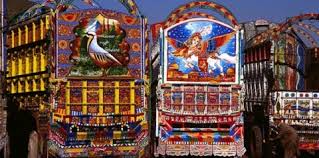
The workhorses of the Pakistani haulage industry are often ageing, patched-up Bedford and Dodge models, but almost without exception they are lavishly decorated.
Elaborate colourful designs, calligraphy, portraits of heroes and singers, mirrors and jingling tassels are skilfully worked onto the trucks by artists such as Haider Ali.
In his open-air workshop in the heart of Karachi, a goat or two browsing the dusty ground, Ali sketches out a design for a boat.
Others include horses, partridges, tigers, the faces of former prime minister Benazir Bhutto or singer Attaullah Khan Esakhelvi.
“The design depends on the owner of the truck. Everyone wants his truck to be different from everyone else’s,” Ali, who left school to follow his father Mohammad into the truck art business, told AFP.
Truck art has become one of Pakistan’s most distinctive cultural exports in recent years, but it is still not highly regarded at home.
“The higher echelons of society don’t call it art but craft — or anything else, just not art,” said Ali.
Call it what you will, decorating trucks is big business — haulage firms and lorry owners shell out $5,000, even $10,000 a time to have their vehicles adorned.
It can take a team of half a dozen artists nearly six weeks to decorate a truck, not just painting but working up intricate arabesque collages of laminated stickers.
Jamal Elias, a truck art expert from Penn State university in the United States, said it represents the largest art sector of the Pakistani economy.
“You can’t say the gallery world or textile design begins to compare in size,” he told AFP.
But in Pakistan, he said, the artists “are never going to be treated as real artists as long as the social structure remains the way it is”.
For the past decade, hauliers in Pakistan have been making money by ferrying supplies for the NATO mission in neighbouring, landlocked Afghanistan from the port of Karachi.
Profits from this work have meant they have been happy to spend on decorating their vehicles, but with NATO withdrawing from Afghanistan by the end of 2014, the artists fear the good times could be over.
“There was a great deal of demand because of NATO trucking, and everyone was trying to get the work, but the decline has already started,” said Ali.
Noor Hussain, 76, who has been painting trucks in the garrison city of Rawalpindi, next to Islamabad, for 65 years, shares his fears.
“We’re afraid that because of the decrease in trucks circulating, people will lose their jobs in our business,” he told AFP.
“Because if there are fewer lorries in circulation, we will have fewer to decorate.”
Mumtaz Ahmed, another Karachi artist, said business surged under the rule of former army dictator Pervez Musharraf, who gave Pakistan’s support to the US-led invasion of Afghanistan after the 9/11 attacks.
A foretaste of what might happen came in late 2011 and 2012, when the Pakistan government shut NATO’s supply routes through its territory for several months in protest at a botched US air raid that killed 24 soldiers at a border post.
“We felt a real slowdown when there was the ban on NATO supplies,” said Ahmed.
“Things are just getting better now. NATO has meant a good boom for us.”
But in a country with a stagnant economy and galloping inflation, why bother spending so much just to decorate a lorry?
“It shows our pride, our love for our job and also that our trucks are in good condition and attractive,” said Mir Hussain, who was about to spend a small fortune repairing and redecorating a truck.
The more a lorry grabs the attention with its beauty, the better its owner thinks it will attract clients, though most contracts are granted without regard to looks.
Perhaps the real reason behind the slightly shaky logic is the simple love of man for his machine.
“His wife may be dying of hunger at home in the village, but the driver will still go ahead and have his truck decorated,” said mechanic Sajid Mahmood.
A U.S. government contractor kidnapped by al-Qaeda militants in Pakistan in 2011 has recorded a video message calling on the Obama administration to negotiate with his captors, saying he feels “totally abandoned and forgotten.”
Warren Weinstein looked ashen and sounded lethargic as he pleaded for renewed interest in his case and asked the U.S. government to consider releasing
al-Qaeda militants in its custody. The 72-year-old development expert from Rockville, Md., began his address by urging President Obama to step up efforts to get him released.
“You are now in your second term as president of the United States and that means that you can take hard decisions without worrying about reelection,” said Weinstein, who was recorded sitting against a white wall wearing a gray tracksuit top and a black woolen hat. No one else appeared in the video.
The video, which included the yellow logo of As-Sahab, al-Qaeda’s media production outlet, was sent in an anonymous e-mail to several journalists who have reported from Afghanistan. Included were links to a handwritten note that purports to be from Weinstein, saying “Letter to Media” at the top. The note is dated Oct. 3. It is not clear when the video was made.
A State Department spokeswoman and a member of Weinstein’s family said Wednesday night that they had not independently received the note or video. The Washington Post provided a copy to both of them.
State Department spokeswoman Marie Harf later said that U.S. officials were “working hard to authenticate” the contents of the message.
“We reiterate our call that Warren Weinstein be released and returned to his family,” she said in a statement. “Particularly during this holiday season — another one away from his family — our hopes and prayers are with him and those who love and miss him.”
Al-Qaeda leader Ayman
al-Zawahri said in a statement issued in December 2011 that Weinstein would be freed if Washington stopped launching air strikes in Pakistan, Afghanistan, Somalia and Yemen. He also demanded the release of all imprisoned members of al-Qaeda and the Taliban. The following year, Zawahri urged followers to kidnap Westerners to gain more leverage in al-Qaeda’s bid to get prominent jihadists freed from U.S. custody. Among the top priorities for the group is the release of Sheikh Omar Abdel-Rahman, a blind Egyptian who was convicted of orchestrating the 1993 World Trade Center bombing.
The Obama administration has said it will not negotiate with al-Qaeda for Weinstein’s release. The United States as a matter of policy generally does not negotiate with kidnappers, but the government devotes resources to finding Americans kidnapped overseas.
The new video appeared to be the captive’s first proof of life since a video statement released in September 2012. In that statement, Weinstein appealed to Israel’s prime minister “as one Jew to another,” asking him to help build support to meet al-Qaeda’s demands for his release.
Weinstein did not say what specific steps the Obama administration could take to secure his release. He did say, however, that his captors have agreed to arrange for relatives to visit him in custody if the United States releases unspecified prisoners as part of a “quid pro quo.”
Weinstein also addressed Secretary of State John F. Kerry, telling him his captors have kept him abreast of peace deals that the top U.S. diplomat has sought to broker. Weinstein said a “first step” to getting him released would require taking “action with respect to their people who are being held as prisoners.”
“If anyone in the Obama government can understand my predicament it is yourself,” Weinstein said. “I hope that one day soon I will be able to meet you as a free man and thank you for your efforts.”
Weinstein appeared troubled that the media have not covered his case more extensively. The handwritten note pleaded with journalists to keep his case in the news, to ensure “that I am not forgotten and just become another statistic.”
At the end of the video, he addressed his relatives, saying: “I would like them to know I love them very much and I think about each and every one of them every moment of every day.”
Weinstein was the Pakistan director of J.E. Austin Associates, a USAID contractor, when he was taken hostage in Lahore, Pakistan, on Aug. 13, 2011.
Weinstein said in the video that he is suffering from a heart condition and acute asthma.
WASHINGTON, Dec 19: US officials, frustrated that hundreds of military shipments heading out of Afghanistan have been stopped on the land route through Pakistan because of anti-American protests, face the possibility of flying out equipment at an additional cost of $1 billion.
More than a week after Pakistani officials promised Defense Secretary Chuck Hagel that they would take ”immediate action” to resolve the problem, dozens of protesters are still gathering on the busy overland route, posing a security threat to convoys carrying US military equipment out of the war zone before combat ends a year from now.
US officials said Wednesday they have seen no effort by the Pakistanis to stop the protests, which prompted the US three weeks ago to halt Nato cargo shipments going through the Torkham border crossing and toward the port city of Karachi.
A Pakistani official says the government is looking for a peaceful settlement but notes that citizens have the right to protest as long as they are not violent.
The officials, speaking on condition of anonymity because they were not authorised to speak publicly about the planning, said flying the military equipment out of Afghanistan to a port will cost five to seven times as much as it does to truck it through Pakistan.
About a hundred trucks are stacked up at the border, and hundreds more are loaded and stalled in compounds, waiting to leave Afghanistan.
The shipments consist largely of military equipment that is no longer needed now that the Afghan war is ending.
Sending the cargo out through the normal Pakistan routes will cost about $5 billion through the end of next year, said a defense official.
Flying the heavy equipment, including armored vehicles, out of Afghanistan to ports in the Middle East, where it would be loaded onto ships, would cost about $6 billion if it continued through next year, said the official.
A northern supply route, which runs through Uzbekistan and up to Russia, was used for about seven months last year when Pakistan shut down the southern passages after US airstrikes accidentally killed 24 Pakistani soldiers at two border posts.
That northern route, however, was used primarily to bring shipments into Afghanistan, and is much longer, more costly and often requires cargo to be transferred from trucks to rail.
The deadlock, if not resolved, could also be costly for Pakistan.
In private meetings in Islamabad early last week, Hagel warned Pakistani leaders that unless the military shipments resumed, political support could erode in Washington for an aid program that sends them billions of dollars.
Hagel received assurances from Pakistan leaders during the meetings that they would resolve the problem, but no progress has been made.
Pentagon spokesman Adm. John Kirby said Hagel is concerned about the issue and has talked with his top commanders in the region about it. ”He knows they (the commanders) are working the issue very hard,” Kirby said.
But Marine Gen. Joseph Dunford, the top US commander in Afghanistan, was in Pakistan on Monday for a meeting with Pakistan’s new Army chief, and it wasn’t clear if he broached the issue with him.
The protesters are demonstrating against the CIA’s drone program, which has targeted and killed many terrorists but has also caused civilian casualties.
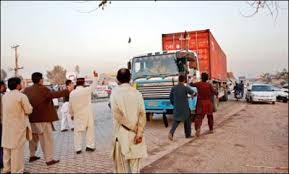
The group gathers daily at a toll booth on the outskirts of the provincial capital of Peshawar, in Pakistan’s northern Khyber Paktunkhwa province.
All traffic going into the tribal areas and on to the Torkham crossing must pass through the toll booth.
Earlier this week, a group of about 40 protesters were at the toll booth, including about 10 who were waving flags as vehicles and trucks drove past.
A makeshift enclosure was set up on the side of the road, complete with chairs arranged under a tent encircled by barbed wire to keep the protest from spilling into traffic.
A few police officers stood nearby, with orders to allow the protests to go on but ensure that no one got unruly or attacked the drivers.
”We will continue this sit-in until there is a good decision on the drones,” said Fayaz Ahmed Khalid, a political organiser with the Pakistan Tehrik-i-Insaf party.
”It’s for ourselves, for our country.” He said the group has been stopping container trucks going into Afghanistan and looking at their papers to determine whether they are carrying cargo bound for Nato troops.
If so, the protesters force the trucks to turn around.
Khalid said the group got instructions not to stop trucks coming out of Afghanistan into Pakistan, and added that they’ve also noticed there has been little traffic coming from Karachi and heading into Afghanistan.
Companies know, he said, that they will be turned back at the checkpoint. He said it has been about a week since the protesters encountered a truck carrying Nato goods.
The protesters, however, appear to be in this for the long haul — Khalid had a schedule listing who would be manning the sit-in each day through mid-January.
December dusts searing past to remind a reality that was preposterously denied for a quarter century and was recognized only after leaving an indelible trail of blood. While creation of Bangladesh entails a petrifying human catastrophe and an everlasting reference to state-perpetrated fratricide, it also trivialised a waffle narrative of Islamic-nationhood.
The episode reiterated that a multi-nation federation can only exist with socio-political justice, absence of which derides all ideological conjectures. Creation of Bangladesh reinforced the fact that Pakistan was not a creation of any Islamic ideology but was in fact a derivative of an ominous political alienation of Muslims in India. For Bengalis, Pakistan turned out to be a mere perpetuation of the same alienation. Flippant negation of their culture, abominable economic exploitation and brazen denial of their right to rule culminated into the birth of Bangladesh on December 16, 1971.
Undeniably, the social fabric and political configuration of East and West Pakistan were diametrically opposite to each other. While West Pakistani politics and society was yanked by a myopic feudal oligarchy, East Pakistan inherited a much refined middle-class lead socio-political ambiance. After 1857 insurgency, Bengal became the first province under British democracy. It was the first regulation province of India under the jurisdiction of a high court. Society and politics in Bengal was erected on starkly different building blocks and it did not chime-in with the other provinces of Pakistan where British rule clamped typical colonial structures.Snobbish civil and military leadership grossly underestimated the powder keg of East Pakistan that left deep scars of embarrassment in the national history. While language and culture are central to most of the ethno-national movements, economic and political marginalisation are key triggers to stoke irreversible hatred.
Landed aristocracy that shaped today’s Pakistan was trounced in Bengal in 1950 with the introduction of “East Bengal Estate Acquisition and Tenancy Act”. It effectively routed the landlordism in Bengal by fixing individual holding at only 3.3 acres per head or 33.3 acres of land per family whichever was less. Agriculture census of 1963-64 shows that out of 6.2 million farms some 6 million were of less than 12.5 acres size and 50 per cent of them were only 2.5 acres or less.
On the contrary, West Pakistan was marked by large landholdings specially in Punjab and Sindh provinces. For example, 30 per cent of the land in Sindh in 1952 was owned by only one per cent of the owners and the average holding was above 500 acres. In Punjab, 50 per cent of the land was under the control of Zamindars. This sufficiently indicates the distinct social and political milieu of the two wings. Since West Pakistan held hegemony over the decision making, the vibrant middle class-led East Pakistan often loathed the policies manufactured and imposed by the landed aristocracy of West Pakistan.
Resource hemorrhage and discrimination in pecuniary matters against East Pakistan was the key cause of conflict. In 1948-50 when East Pakistan had a net balance of payment surplus of Rs622 million, West Pakistan had a net deficit of Rs912 million. Similarly, the foreign and inter-wing trade balance of the two wings from 1949-50 to 1957-58 shows East Pakistan having a surplus of Rs3,636 million as balance of trade with foreign countries against the net deficit of Rs3,047 million of West Pakistan on the same account. The trend remained consistent during the first and second five years plans when East Pakistan had net surplus and West Pakistan had net deficit in foreign trade and the surplus of East Pakistan was used to offset the deficit. This prompted Shaikh Mujib to demand for two separate currencies for the two wings under his popular six-point formula.
Conflict on resource sharing could have been assuaged had avaricious establishment of West Pakistan maintained a judicious balance in benefit sharing. What irked Bengalis was relentless discrimination in development opportunities. For example, GDP growth in East Pakistan during the period was 2.2 per cent against the heavily skewed 3.1 per cent of West Pakistan. During the same period per capita income in East Pakistan dwindled to -0.1 per cent against +0.8 per cent increase in the West Pakistan. Likewise during five years from 1954-55 to 1959-60, GDP growth in East Pakistan was only 1.6 per cent i.e. half of the West Pakistan’s 3.2 per cent. Per capita income in East Pakistan plummeted to -0.7 per cent against +1.2 per cent in the West Pakistan.
East Pakistan having almost 54 per cent population was also discriminated in public sector development. During the first five year plan, total revenue expenditure in East Pakistan was Rs2,540 million which was less than one third of the Rs8,980 of the West Pakistan. It was marginally jacked-up in the second five-year plan from 1960-61 to 1964-65 when East Pakistan received Rs6,254 million under public sector development programme against Rs7,696 million of the West Pakistan, yet it was still 19 per cent less.
Not only that East Pakistan was kept economically deprived and politically suppressed, it was also under represented in the state structure. Share of Bengalis in senior level civil services was also flagrantly violated. During the first five years of the country, senior cadres of several departments were completely bereft of Bengalis. There were no Bengalis on any senior positions in the Departments of Commerce, Intelligence& Statistics, Supply & Development, Petroleum, Paper & Stationery Wing, Inspection Wing, General Concession Wing, Central Engineering Authority, Coal Commissioner and Textiles.
Apart from economic exploitation, West Pakistani leadership always demeaned and demonised Bengalis. General Ayub rabidly detested Bengalis. He once vented his spleen by saying that “I am surprised by Bengali outlook. They have cut themselves off from Muslim culture through abhorrence of the Urdu language…..making themselves vulnerable to Hindu culture.” On 7th September 1967, he wrote “God has been very unkind to us in giving the sort of neighbours [India] and compatriots [Bengalis]. We could not think of a worst combination. Hindus and Bengalis…. If worst comes to the worst, we shall not hesitate to fight a relentless battle against the disruptionists in East Pakistan. Rivers of blood will flow if need be, unhappily. We will arise to save our crores of Muslims from Hindu slavery”.
Gen. Ayub was no exception in his fulmination against Bengalis. Major General Khadim Hussain Raja, the then GOC, who threatened to “raze Dhakah to the ground” if Shaikh Mujib proclaimed independence during his speech at Race Course ground on 7th March 1971, has made startling revelations about moral bankruptcy of military leadership. In his recently published book “a stranger in my own country”, he has quoted nauseating turpitude of General Niazi during a debriefing meeting. He writes “Niazi became abusive and started raving. Breaking into Urdu he said: ‘Main is haramzadi qaum ki nasal badal doon ga. Yeh mujhey kiya samjhtey hain’. He threatened that he would let his soldiers loose on their womenfolk. There was pin-drop silence at these remarks. Officers looked at each other in silence, taken aback by his vulgarity. The meeting dispersed on this unhappy note with sullen faces. The next morning, we were given sad news. A Bengali Office, Major Mushtaq, who had served under me in Jessore, went into a bathroom at the Command Headquarter and shot himself in head. He died instantaneously.”
What happened in 1971 was certainly worse, yet the worst is the unremitting obnoxious intransigence of the unfazed perpetrators. Fundamental rights are denied with same zeal, forced disappearance, dumping of corpses in the name of national interest continues with alarming madness and natural endowment of federating units are being exploited ruthlessly. Oppressed segments who demand their rights are inexorably construed as traitors. What prevails in Pakistan today can potentially repeat what happened yesterday.
ISLAMABAD, Dec 13: The European Parliament has allowed duty free access to Islamabad in a move that will augment its exports by $1 billion annually amid calls to implement international conventions on human rights, good governance, labour and environmental standards.
The EU Parliament approved the Generalised System of Preference, known as GSP Plus status, with 409 to 182 votes for 10 developing countries including Pakistan, according to a statement issued by the EU’s Embassy in Islamabad.
The GSP Plus status means there will be zero duties on over 90% of all products that Islamabad exports to the bloc of 27 nations.
The EU is Pakistan’s largest trading partner. The GSP Plus status will become effective from January 1, 2014.
“The award of GSP Plus status shows confidence of the international markets on the excellent quality of Pakistani products,” said Prime Minister Nawaz Sharif in his written statement. He congratulated the nation for the achievement.
The premier said that gaining access to European markets was the top-most priority of the government as part of the economic development agenda. The status would enable Pakistan to export more than $1 billion worth of products to the international markets each year.
“The textile industry [alone] would earn profits of more than Rs100 billion per year,” said the prime minister. He said the increase in exports would resultantly facilitate economic growth and help in the generation of additional employment.
Pakistan has been suffering from huge losses after it became the frontline state in the global war on terrorism. Finance Minister Ishaq Dar said on Thursday that the country suffered over $100 billion in direct and indirect losses due to the war.
The European Commission’s preliminary assessment is that Pakistani exports, including textiles but also other products, such as leather, would increase by 574 million euros annually, said the EU Embassy. The Pakistani textile industry estimates that exports of textiles to the EU alone under GSP Plus will increase by $650 million in the first year, it added.
“While there is every reason to celebrate this milestone in EU-Pakistan relations, the GSP Plus regime calls for Pakistan to fully implement its commitments under 27 international conventions on human rights, good governance, labour and environmental standards,” said the EU’s Ambassador to Pakistan, Lars-Gunnar Wigemark.
He said the grant of GSP Plus shows the importance the European Union attaches to its relations with Pakistan. “We have listened to Pakistan’s plea for more trade and not just aid,” Wigemark added.
The business community can play a significant role, for instance by ensuring labour rights, employing more women in workplace and making sure that there is no exploitation of child labour. “Improving human rights, including labour standards, is win-win situation for Pakistan and the EU,” the ambassador said.
However, he stressed that there is a need to improve the business climate in Pakistan, including access to energy.
The Nawaz Sharif government – perhaps because of its history of emerging from the womb of the army – is eliminating ‘bad Taliban’ much more covertly than its predecessors.
Behind the angry posturing of Pakistan Muslim League (N) interior minister Chaudhry Nisar Ali Khan and a coterie of politicians publicly denouncing the US for `sending a drone through peace talks,’ the US and Pakistan are coordinating against Taliban militants who threaten Western interests and attack inside Pakistan.
The discrepancy between what Pakistan says and does, came to light on Oct 23, when prime minister Nawaz Sharif met US President Barak Obama and denounced drone attacks. Around the same time, victims of drone strikes in Pakistan testified in the Capitol against the killing of innocent people in the tribal areas.
But US House of Representatives Foreign Affairs Committee member, Alan Grayson gave food for thought when he told the media: “With all due respects to an ally, it is well within Pakistan’s capability to end those drone strikes tomorrow.” He called Pakistan’s air force “very powerful,” – with the capability of controlling its own air space.
So long as the US calls the shots and gives aid to Pakistan, the government uses its officials to counter public anger. While the interior minister Chaudhry Nisar is the “bad cop,” who spews anger at the US for “violating Pakistan’s sovereignty,” the prime minister’s advisor, Sartaj Aziz is the “good cop,” promising the US will halt strikes during talks with the Tehrik-i-Taliban Pakistan.
It is an old military strategy with a new set of characters. Mark Mazetti, author of the `Way of the Knife,’ writes that Pakistan asked the US to launch its first predator drone strike in 2004 to eliminate tribal leader, Nek Mohammed, after he led a rebellion against the state. Afterwards, Pakistan claimed it had fired the missile that killed the tribal leader who it had once patronized.
Apparently, like his predecessors, Nek Mohammed and Baitullah Mehsud, the Tehrik-i-Taliban Pakistan (TTP) commander – Hakeemullah Mehsud – killed in a drone strike on Nov 1 – had become dispensable. The US offered $5 million for his capture after Hakeemullah coordinated with a Jordanian agent in December 2009 – and wiped out a sizeable staff of CIA employees stationed in Khost, Afghanistan. Pakistan too put PKR 50 million head money on him for his lethal attacks against the state.
Before the drone was lobbed against Hakeemullah, the government let the garrulous media chatter about its plan to engage with its Taliban militants. It simultaneously took JUI (F) chief Maulana Fazlur Rehman into confidence about arranging a “peace meeting” with the Taliban in North Waziristan.
But as events unfolded, Sharif’s visit to Washington.. followed by his announcement from London, Oct 31 that “peace talks with the Taliban have begun,” .. were met by puzzled silence in Pakistan. The TTP spokesman, Shahidullah Shahid told journalists the same day that they were unaware of any talks. And, parliamentary leaders publicly complained that they had been kept in the dark.
Still in North Waziristan, months of friendly communiqués between the government apparently put militants at ease. The administration’s imposition of curfew added to the impression that it was for upcoming TTP-government talks. On Nov. 1, the Taliban gathered in a mosque near Hakeemullah’s sprawling farm house – bought by his cousin, Latifullah Mehsud – for a meeting on whether to talk to the government.
The US had set the ball rolling to nab Hakeemullah shortly after NATO troops snatched Latifullah in early October from the custody of Afghan intelligence officials – and interrogated him at Bagram base. Latifullah was a key link between the Taliban groups in Pakistan and Afghanistan. The Karzai government had planned to use him as an interlocutor in “peace talks” with the Taliban, despite the TTP’s known role of attacking state institutions inside Pakistan.
These increased cross border attacks have in recent months caused Pakistan’s Foreign Office to complain that Afghanistan is being used as a safe haven for TTP militants.
For two days, US drones fired missiles into North Waziristan.. searching for their target. The second attack on Nov 1 was successful. Hakeemullah and his two companions were killed outside his $120,000 farm house, after the TTP returned from the mosque meeting. Neighbors reported surprise at seeing the Taliban commander before his vehicle was struck. Hakeemullah was understandably a rarity here, being on the run from drone attacks that occur mostly in this Pak-Afghan border area.
With the assassination of the TTP chief, and his replacement by Mulla Fazlullah – who escaped the 2009 military operation against him in Swat – an enraged Taliban pledged attacks on the military and senior government officials in the Punjab for being a “slave” of the US.
But, Islamabad says it will continue to pursue peace talks with its Taliban. In so doing it has found Pakistan Tehrik-i-Insaf chief Imran Khan’s reactions especially useful to soak up the anger. Khan’s visible shock at Hakeemullah’s assassination – and angry moves by the PTI and religious parties toward stopping NATO convoys to Afghanistan has served to deflect attention and let off steam.
It is the same strategy that Gen. Musharraf used after 9/11 -when public anger at the US invasion of Afghanistan helped propel the coalition of Islamic parties, Mutehidda Majlis-i-Amal in the border areas. Then too, the US was allowed to become the favorite whipping boy of the masses.
But as the US prepares for withdrawal of its troops from Afghanistan in 2014, it is less interested in Pakistan’s domestic politics and more in achieving its aims. Only a day after Sartaj Aziz said that drone attacks would be temporarily halted while it talks to the TTP, the US lobbed a drone missile over a madressah in the settled Hangu area and killed members of the Haqqani network. These Afghan Taliban were instrumental on attacks on NATO troops in Afghanistan.
The killing of Afghan Taliban financier, Naseerullah Haqqani in Islamabad also indicates cross intelligence agencies at work… and a falling out between multiple Taliban groups, once loosely commandeered by Hakeemullah Mehsud.
Meanwhile, the federal government – which earlier found Imran Khan’s anger “useful,” is less amused that he is carrying out his threat to block NATO supplies as a lever to stop drone attacks. That is being treated as an attempt to disrupt law and order.
As a dozen years of war has revealed, the younger generation of Taliban is angrier and less controllable than the militants trained by Pakistan in the 1990s to take over Afghanistan. Indeed, there is a shortage of “good Taliban,” like Mullah Omar, Mullah Baradar and the Haqqani network.. taking refuge in Pakistan.. who merely attack NATO troops in Afghanistan and don’t attack state interests within Pakistan.
Instead, the Taliban today fight the US, Afghanistan and Pakistan.. even as they forge bonds across the Durand Line. This so called border between Afghanistan and Pakistan is ignored from Pashtuns from both sides, at the cost of growing militancy in the region.
Inside Pakistan, the failure to tell the truth to nearly180 million people fuels the conspiracy theories being regurgitated in the media. While the Western world acts out of their own interest, officially naming it as the scapegoat has only served to spew venom and hatred toward outsiders.
In this complex scenario, how Pakistan gets rid of its ‘bad Taliban,’ while deflecting anger away from it.. and simultaneously gains a foothold in Afghanistan.. will be a high wire act worth watching.
Islamabad, Nov 11: One of the most senior leaders of the Haqqani militant network has been shot dead near the Pakistani capital, Islamabad, reports say.
Nasiruddin Haqqani, who was in his early 30s, was the group’s financier and a son of its founder Jalaluddin.
Reports say his body has been taken for burial to the North Waziristan tribal area near the Afghan border.
It is not clear who shot him or why. Nasiruddin Haqqani was on a US list of global terrorists.
The details of his death are still unclear, but reports say he was killed in a shooting incident in the city of Rawalpindi, next to Islamabad, on Sunday night.
Another Haqqani brother, Badruddin, who had been the group’s operational commander, was killed in a drone strike in August last year.
Nasiruddin’s elder brother, Sirajuddin Haqqani, now leads the group, while Jalaluddin remains its figurehead.
As the group’s main fundraiser, Nasiruddin frequently travelled to the oil-rich sheikhdoms of the Middle East to solicit donations.
Jalaluddin Haqqani (right) is seen here as Taliban minister of tribal affairs in 2001
He represented the Haqqani network in last year’s efforts to set up a Taliban office in Doha for peace talks with the United States.
He was also the group’s main contact person for pro-Taliban elements in Pakistan, as well as its representative with the Afghan Taliban.
‘Well-dressed networker’
Unlike his father and many of his brothers, Nasiruddin Haqqani and two of his uncles did not to live in Miran Shah in North Waziristan. He chose to base himself near Islamabad, from where he made his many journeys abroad to secure funds.
Some sources said he had major business interests in the Gulf, including a transport company.
Nasiruddin is not thought to have been publicly photographed.
Those who have met him describe a tall, educated, well-dressed man who travelled in expensive cars and networked an extensive list of contacts all the time.
They say his appearance gave no clue to his militant connections. His code name was “the doctor”, possibly because of a degree that he had studied for.
His death, if confirmed, will be a major blow to the Haqqanis, who will need to find someone else to spearhead their efforts to secure financing.
BBC correspondents say the killing will pile pressure on the Pakistani government because Nasiruddin’s death is reported to have happened on Pakistani soil.
Afghan authorities will be angry that someone who had been working to facilitate peace moves with the Afghan Taliban has been removed from the picture.
His death comes just 10 days after a US drone killed Pakistani Taliban leader Hakimullah Mehsud, who was also reported to be on the verge of entering peace talks with the government in Islamabad.
Those moves towards talks are now over, and he has been replaced by the more hardline Mullah Fazlullah, who swiftly ruled out any negotiations.
Attempts to begin talks between the US, the Afghan Taliban and the government in Kabul have been stalled since June.