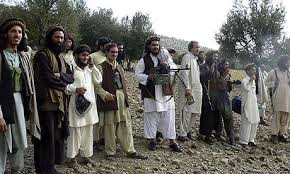
MIRAMSHAH: With marble floors, lush green lawns and a towering minaret, the $120,000 farm where feared Pakistani Taliban leader Hakimullah Mehsud died in a US drone strike was no grubby mountain cave.
Mehsud spent his days skipping around Pakistan’s rugged tribal areas to avoid the attentions of US drones.
But his family, including two wives, had the use of an eight-roomed farmhouse set amid lawns and orchards growing apples, oranges, grapes and pomegranates.
As well as the single-storey house, the compound in Dandey Darpakhel village, five kilometres north of Miramshah, was adorned with a tall minaret, purely for decorative purposes.
Militant sources said the property in the North Waziristan tribal area was bought for Mehsud nearly a year ago for $120,000, a huge sum by Pakistani standards, by close aide Latif Mehsud, who was captured by the US in Afghanistan last month.
An AFP journalist visited the property several times when the previous owner, a wealthy landlord, lived there.
With the Pakistan army headquarters for restive North Waziristan just a kilometre away, locals thought of Mehsud’s compound as the “safest” place in a dangerous area.
Its proximity to a major military base recalls the hideout of Osama bin Laden in the town of Abbottabad, on the doorstep of Pakistan’s elite military academy.
“I saw a convoy of vehicles two or three times in this street but I never thought Hakimullah would have been living here. It was the safest place for us before this strike,” local shopkeeper Akhter Khan told AFP.
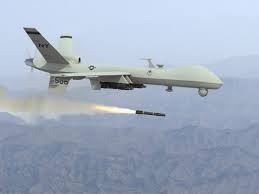
This illusion of safety was shattered on Friday when a US drone fired at least two missiles at Mehsud’s vehicle as it stood at the compound gate waiting to enter, killing the Pakistani Taliban chief and four cadres.
The area around Dandey Darpakhel is known as a hub for the Haqqani network, a militant faction blamed for some of the most high-profile attacks in Afghanistan in recent years.
Many left the area during the Taliban’s rule in Afghanistan, coming back after the US-led invasion following the 9/11 attacks.
Samiullah Wazir, a shopkeeper in the area, told AFP he would regularly see a convoy of four or five SUVs with blacked-out windows leave the compound early in the morning and return after sunset.
“We thought that somebody very important must be living in this house,”Wazir said.
“One day, I saw a man wearing a white shawl entering the house and I thought he looked like Hakimullah, but I thought ‘How can he live here because he could be easily hit by a drone strike?’” But Hakimullah it was and on Friday he returned to his compound for the final time.
“We were closing the shop when his vehicle came and was about to enter the house when a missile struck it,” Wazir said.
“Moments later, an army of Taliban came and they cordoned off the area.”
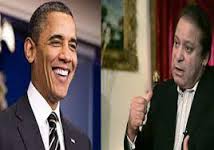
ISLAMABAD, Oct 25: While any mention of the drone issue was conspicuously missing in their joint statement, US President Barack Obama has privately assured Prime Minister Nawaz Sharif that the controversial programme will end soon, according to a senior Pakistani official.
The official, who was accompanying the prime minister on his just-concluded visit to Washington, told The Express Tribune that ‘significant progress’ has been made on the drone issue.
Speaking on condition of anonymity because of the sensitivity of the matter, he said Washington was considering ending the drone campaign once the “few remaining targets” had been eliminated from Pakistan’s tribal belt. According to the official, President Obama told Prime Minister Nawaz that the CIA had already eliminated most of the high-value targets (HVTs) from the region.
Although the American president did not give a timeline for halting the drone campaign, Islamabad expects the unilateral strikes will end in a matter of months, he said.
Another source, meanwhile, pointed out that, unlike previous assessments, the Obama administration informed the new government that the drone programme would not continue beyond 2014.
Nawaz Sharif, who was on a first bilateral trip to US since his party swept to power following the May 11 elections, raised the issue of drone strikes in his meeting with Obama. But the US president remained silent on the matter at the joint news conference at the Oval Office in the White House.
Behind closed doors, however, Obama assured Premier Nawaz that drone strikes would only be used as a last option, claimed the senior official. He said the US president also said that he had directed the CIA to ensure greater transparency in conducting the strikes and avoiding collateral damage while eliminating the remaining HVTs.
The Express Tribune has also learnt that the US may temporarily suspend drone strikes in the tribal areas in an effort to allow the government to conduct peace talks with the Taliban.
Prime Minister Nawaz himself hinted on Thursday that the drone issue would “settle down somehow.”
“Hopefully, the drone issue will be resolved according to the wishes of the Pakistani people soon… There was definitely some progress on the matter [during the meetings] and I think this issue will now settle down somehow,” he said while talking to reporters during a brief stopover in London on his return to Pakistan.
Earlier, Prime Minister’s Adviser on National Security and Foreign Affairs Sartaj Aziz had also hinted at a possible end to drone attacks.
In an interview with Al Jazeera, Aziz claimed that the US administration had given assurances to consider Islamabad’s request on drone attacks behind the scenes. He did not give further details, however.
The US considers the drone programme as crucial to eradicate high value targets associated with al Qaeda and the Taliban from the tribal areas.
Pakistan has publicly condemned such strikes and in recent years has been more vocal against the CIA-led campaign.
Published in The Express Tribune, October 25th, 2013.
WASHINGTON, Oct 23 — Pakistani Prime Minister Nawaz Sharif said he’d told President Barack Obama on Wednesday that U.S. drone strikes in his country needed to end.
The remarks came as the two leaders met in person for more than two hours in high-level talks aimed at beginning to mend a historically troubled relationship.
Sharif, who described the Oval Office talks as “cordial and comprehensive,” said Pakistan and the U.S. had agreed to cooperate further on counterterrorism measures, but he nevertheless said he’d raised the issue of drone strikes with Obama, “emphasizing the need for an end to such strikes.”
His visit came a day after the White House defended the drone program as it disputed claims by two human rights groups that its targeted-killing program violates international law and often has killed civilians, including a grandmother in Pakistan.
Obama didn’t mention the controversial targeted-killing program, but he did say the two leaders had talked about the need to work together to curb terrorism and extremism – in ways that “respect Pakistan’s sovereignty” and address both countries’ concerns.
“I’m optimistic that we can continue to make important strides in moving forward,” the president said, noting that terrorist attacks have affected both countries. “It’s a challenge. It’s not easy, but we committed to working together and making sure that rather than this being a source of tension between our two countries that it can be a source of strength.”
Obama said the U.S. considered Pakistan “a very important strategic partner” and thought “that if Pakistan is secure and peaceful and prosperous, that’s not only good for Pakistan, it’s good for the region and it’s good for the world.”
The president said the two had “spent a lot of time” talking about Pakistan’s economy and that the U.S. would look to boost trade opportunities with the country.
They also discussed Afghanistan, and Obama said he’d pledged to “fully brief” Sharif on the Afghan elections and “long-term strategy for stability in the region.” Sharif said Pakistan was committed to a “peaceful and stable Afghanistan.”
The president said he was encouraged by Sharif’s recent meeting with the Indian prime minister, Manmohan Singh, on the sidelines of the United Nations General Assembly in New York last month.
“I think he is taking a very wise path and exploring how the tension between India and Pakistan could be reduced,” Obama said, adding that Sharif had pointed out that billions of dollars had been spent on an arms race in response to the discord.
Obama also was expected to raise the case of Shakil Afridi, a Pakistani doctor who was sentenced last year to 33 years in prison for treason after helping the CIA hunt for Osama bin Laden in Pakistan.
The U.S. thinks Afridi’s treatment has been “unjust and unwarranted” and that he should be released, White House Press Secretary Jay Carney said. He said before the meeting that bringing bin Laden to justice “was clearly in Pakistan’s interest, and the prosecution and conviction of Dr. Afridi sends exactly the wrong message about the importance of this shared interest.”
Neither leader mentioned Afridi in his remarks.
Outside the gates of the White House, supporters of Pakistani former military dictator Pervez Musharraf protested his arrest in the December 2007 assassination of former Prime Minister Benazir Bhutto.
Musharraf ruled Pakistan from 1999 to 2008 after leading an October 1999 coup d’etat against Sharif, who was then in his second term as prime minister and is now back in the office after his party won elections in May.
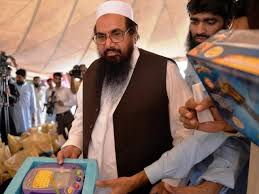
ISLAMABAD: The chief of the Jamaat-ud-Dawa (JuD), Hafiz Mohammad Saeed, on Monday accused the US and India of trying to hamper efforts to help victims of Pakistan’s earthquake.
Saeed’s statement comes a day after the US and India agreed to step up cooperation and prevent financing of “extremist groups”, including the Lashkar-e-Taiba (LeT) and Jamaat-ud-Dawa (JuD).
In annual talks between top economic officials, India and the US spoke of “expanding cooperation on countering illicit financing, including targeting the financial networks and fund-raising activities of terrorist organisations,” Indian Economic Affairs Secretary Arvind Mayaram said Sunday.
Saeed, however, once again denied accusations of any involvement in terrorism of the Jamaat-ud-Dawa, which is known in Pakistan for its relief work after natural disasters, particularly the 2005 Kashmir earthquake and 2010 floods.
“Their aim is to hamper the relief work of our charity Falah-e-Insaniyat foundation in the earthquake hit Balochistan, that’s why they are trying to stop our funding,” Saeed told reporters.
A 7.7-magnitude quake shook the southwestern province of Balochistan on Sep 24, killing more than 370 people and leaving more than 100,000 homeless.
Indian accuses JuD of being a front organisation for Laskhar-e-Taiba, which investigators blame for the three-day carnage in Mumbai that killed 166 people in 2008.
KABUL, Oct 4— The United States and Afghanistan have reached an impasse in their talks over the role that American forces will play here beyond next year, officials from both countries say, raising the distinct possibility of a total withdrawal — an outcome that the Pentagon’s top military commanders dismissed just months ago.
American officials say they are preparing to suspend negotiations absent a breakthrough in the coming weeks, and a senior administration official said talk of resuming them with President Hamid Karzai’s successor, who will be chosen in elections set for next April, is, “frankly, not very likely.”
“The time to conclude for us is now,” the administration official said on Friday. In the absence of a deal, “this fall, we are going to have to make plans for the future accordingly.”
The impasse, after a year of talks, has increased the prospect of what the Americans call the zero option — complete withdrawal — when the NATO combat mission concludes at the end of 2014. That is precisely the outcome they hoped to avoid in Afghanistan, after having engaged in a similarly problematic withdrawal from Iraq two years ago.
Moreover, a complete withdrawal from Afghanistan could be far costlier than it was in Iraq. It would force European powers to pull their forces as well, risking a dangerous collapse in confidence among Afghans and giving a boost to the Taliban, which remain a potent threat.
It could also jeopardize vital aid commitments. Afghanistan is decades away from self-sufficiency — it currently covers only about 20 percent of its own bills, with the rest paid by the United States and its allies.
“It is a practical truth,” the administration official said, that without a deal, “our Congress would not likely follow through on the assistance promises we’ve made, nor would other partners.”
Many contentious matters in the talks have already been settled, like legal immunity for American troops, which is what scuttled the Iraq deal, Afghan and American officials said. Yet officials on both sides say two seemingly intractable issues remain.
The first is Afghanistan’s insistence that the United States guarantee its security, much like any NATO ally, and the second is Mr. Karzai’s refusal to allow American forces to keep searching in Afghanistan for operatives of Al Qaeda. Instead, he has proposed that the United States give its intelligence information to Afghan forces and let them do the searching, said Aimal Faizi, a spokesman for the president.
American officials have rejected both Afghan proposals. The security pact is especially problematic, they say, because it could legally compel American forces to cross the border into Pakistan, resulting in an armed confrontation with an ally — and a nuclear-armed power.
“The deal is like 95 percent done,” said another American official in Washington, “and both sides are holding out.”
President Obama, in an interview with The Associated Press published Saturday, made what appeared to be a reference to the impasse in the talks, saying that he would consider keeping troops in Afghanistan “if in fact we can get an agreement that makes sure that U.S. troops are protected, makes sure that we can operate in a way that is good for our national security.”
“If we can’t, we will continue to make sure that all the gains we’ve made in going after Al Qaeda we accomplish, even if we don’t have any U.S. military on Afghan soil,” Mr. Obama said in the interview, which was conducted Friday.
Mr. Faizi said Mr. Karzai was now taking a lead role in the talks. But, he cautioned, the Afghan leader could not agree to a deal that allowed American forces to raid Afghan villages and not at the same time go after militant havens in Pakistan.
“Killing people in homes and killing people in villages is bringing the war on terror to Afghans,” Mr. Faizi said in an interview. “This is not focusing on the root and support systems behind the terror.”
Only months ago, top American generals, including Gen. Martin E. Dempsey, the chairman of the Joint Chiefs of Staff, dismissed the possibility that negotiations could falter. The Obama administration has been far more ambiguous. Over the summer White House officials began to seriously weigh the zero option.
The officials say they, too, would prefer that American troops stay in Afghanistan. But “at the right price,” said a senior European diplomat familiar with the American position. “The price that Mr. Karzai is asking is too high for Obama.”
The administration has instructed the lead American negotiator, Ambassador James B. Cunningham, to make one more push this month to bring Mr. Karzai around, officials said. It may consider letting the talks go into November, if necessary. But officials are loath to see the talks become an issue in the Afghan presidential campaign.
This week, the administration also considered sending Secretary of State John Kerry, who has a good relationship with Mr. Karzai, to personally intervene in the talks, American and Afghan officials said. But in a reflection of the administration’s deepening pessimism — and its preoccupation with other priorities — officials decided Mr. Kerry’s time was better spent on an Asian trip that Mr. Obama canceled because of the government shutdown, according to another American official, although that could change if there was movement in the talks in Kabul.
So for now, it is up to Mr. Cunningham, who has told his Afghan counterparts that talks would be suspended until after Afghanistan’s presidential election if no progress was made soon, according to Mr. Faizi and other Afghan and American officials.
Assuming the election takes place on time, it would still push talks to the middle of next year, and many Western officials in Kabul say the election could be delayed until the summer. In the estimation of many Western officials in Kabul and Washington, that is perilously close to the drop-dead date of Dec. 31, 2014. Mr. Karzai, who has served two terms, cannot run for a third.
Adm. James G. Stavridis, who retired in May as NATO’s military commander, said the logistics of organizing a post-2014 force could prove daunting if a deal was not struck soon. Each of the allies has separate logistics, training, supply and transportation requirements, and “we are getting close to the red line for people to be able to put those forces together,” Admiral Stavridis said Friday at a forum in Washington sponsored by the Fletcher School of Law and Diplomacy, where he is now dean.
The impasse in the talks has been apparent to negotiators since late summer, according to Afghan and Western officials. But both sides had kept the divisions quiet until this week, when the presidential palace issued a statement saying Mr. Karzai had told a gathering of tribal elders that he would not allow American military raids to continue after next year.
American officials have not issued any formal response to the palace’s statement. Officials said they did not want Afghans to see the deadline as a ploy. They discussed the talks only under the condition of anonymity.
Afghan officials, however, said they believed the deadline and the leaks were solely about pressuring them into signing a deal.
Mr. Faizi said the Afghan government had no deadline, and Mr. Karzai would rather wait to get “the right deal.”
The differences between the two sides are as much about perspectives as they are about the legalities of raids and bases and security arrangements. Afghanistan believes the threat posed by the Taliban is largely driven from Pakistan. In the American view, the Pakistani havens are but one facet of a conflict that is mainly internal.
It is a subtle difference, but one that informs diverging approaches to combating the Afghan insurgency, which remains a threat despite the American-led efforts to quash it that began with the invasion after the Sept. 11, 2001, attacks.
American officials have said they have no intention of fighting the Taliban after 2014. The bulk of the forces left in Afghanistan — administration officials have said they would total 9,000 or less — would train Afghan forces, which are already doing most of the fighting here.
But the United States wants to keep using Special Operations forces to target the roughly 75 operatives that American commanders estimate remain in Afghanistan.
“President Karzai says that has been happening for 12 years, and how come we cannot find them?” Mr. Faizi said. “How much longer will it continue? One year? Five years? Ten years?”
Ultimately, though, the issue is one of sovereignty, Mr. Faizi said. American-led forces have killed civilians in dozens of attacks, he said, and Afghanistan has concluded that foreigners cannot be trusted with the lives of innocent Afghans.
“After 2014, will any foreign military be free to go where it pleases and operate the way it pleases in Afghanistan?” Mr. Faizi said. “The answer is no.”
Eric Schmitt, Thom Shanker and Michael R. Gordon contributed reporting from Washington.
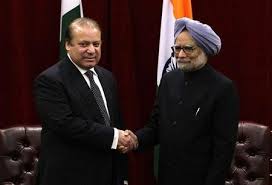
Nawaz Sharif & Manmohan Singh at UN (Credit: yahoo.com)
LONDON, Sept 27 — The leaders of Pakistan and India held their first official meeting in New York on Sunday, leaving with renewed promises of mutual restraint in Kashmir but little real hope for a fresh start in relations.
Prime Minister Manmohan Singh of India and Prime Minister Nawaz Sharif of Pakistan shook hands for the cameras at the Plaza Hotel in Manhattan before their long-anticipated meeting on the sidelines of the United Nations General Assembly. But despite the smiles, violence back home formed the backdrop to the encounter.
A series of cross-border artillery exchanges in the disputed territory of Kashmir over the past two months has led to the death of at least eight soldiers on both sides, and plunged diplomatic relations to their lowest ebb in years. In the latest episode, on Thursday, a militant raid on an Indian Army base in Indian-controlled Kashmir resulted in the deaths of at least 10 people, causing an outcry in India.
India’s national security adviser, Shivshankar Menon, said that Mr. Singh and Mr. Sharif agreed during their meeting on Sunday to dial back tensions in Kashmir, the disputed territory that has triggered three wars between Pakistan and India since 1947.
The leaders pledged to push senior military officers to find “effective means” of restoring a 2003 cease-fire in Kashmir, Mr. Menon said.
Both Mr. Singh and Mr. Sharif personally favor normalizing relations, but both are hamstrung by domestic considerations — especially hard-line elements in their respective military and political establishments — that drastically limit their room to maneuver.
Mr. Singh’s party faces an electoral challenge early next year against Hindu parties that have called for a tougher stance against Pakistan. Under fire at home for meeting with Mr. Sharif, he established a tough tone in an address to the United Nations on Saturday in which he called Pakistan the “epicenter of terrorism” in South Asia.
For any progress to occur, he said, Pakistan has to first ensure that the “terrorist machine” operating from its soil is shut down. That was a reference to Lashkar-e-Taiba, the militant group that was responsible for the 2008 Mumbai terrorist attacks, in which 166 people were killed, and whose leadership still enjoys free movement within Pakistan.
Mr. Sharif, 63, was more optimistic, telling the United Nations on Friday that he wanted “a new beginning” with India, and deploring the resources both countries have spent on their nuclear-arms race — a pointed statement given that it was Mr. Sharif who ordered Pakistan’s first nuclear test during his last stint in power in the late 1990s.
Mr. Sharif’s push for a new peace initiative can be seen in part as an attempt to continue the business of that previous term, in which he staked much on reaching out to India in a process that was derailed by a nuclear crisis and a military coup in 1999. Now, as then, he has framed better relations with India as an economic necessity for both countries.
“We stand ready to re-engage with India in a substantive and purposeful dialogue,” he said during his speech to the United Nations General Assembly on Friday.
For Mr. Singh, 81, whose lack of personal political power has made him a deeply cautious prime minister, meeting with Mr. Sharif was a bold move.
On Sunday at a large rally in New Delhi, Narendra Modi, who is the opposition Bharatiya Janata Party’s prime ministerial candidate, questioned Mr. Singh’s ability to undertake the meeting effectively.
“I wonder if he will meet the Pakistan P.M. confidently today?” Mr. Modi asked. “Will he be able to ask him when Pakistan will stop aiding terrorism? Will he be able to question Nawaz Sharif on the Indian soldiers who were brutally killed?”
Analysts said Sunday’s meeting met its low expectations, and could at best stabilize relations until the political climate in both countries improved.
“This can help border incidents from escalating until India’s election season is over and more serious business can be transacted between the two countries,” said Maleeha Lodhi, a former Pakistani ambassador to the United States.
Stephen P. Cohen, an American academic who recently published a book on the India-Pakistan conflict, said the leaders appeared as “two men with tired ideas and constraints that they cannot overcome, afraid to take the bold measures that could liberate them.”
But even with the best intentions, Pakistani and Indian leaders have frequently found their efforts at diplomacy undone by the spoiling tactics of hard-liners.
In 1999, Mr. Sharif made impressive strides toward peace with Atal Bihari Vajpayee, India’s prime minister. Months later, the Pakistani military carried out a covert operation in the disputed territory of Kashmir that spectacularly upended the peace drive and, for a brief period, edged the two countries toward a nuclear conflict. A coup deposed Mr. Sharif soon afterward.
In November 2008, Pakistan’s president, Asif Ali Zardari, told an Indian conference that Pakistan was ready for a more moderate nuclear weapons policy, and called for closer economic ties between the countries. Days later came the militants’ coordinated attacks in Mumbai.
The long conflict between India and Pakistan has become a major preoccupation of the security establishment in both countries, and has found expression through proxy forces in third countries like Afghanistan.
Indian officials have for years demanded that Pakistan take action against Lashkar-e-Taiba and its founder, Hafiz Muhammad Saeed, who lives openly in Lahore. Mr. Menon, the Indian security adviser, said in New York that Mr. Sharif had promised to take action against those responsible for the 2008 Mumbai attacks.
Mr. Menon said the tone of the talks was friendly, but added: “As for how useful and productive the meeting was, I think the only proof will be in the months to come.”
Gardiner Harris contributed reporting from New Delhi, and Somini Sengupta from New York.
LONDON, Sept 12 — For two decades, Altaf Hussain has run his brutal Pakistani political empire by remote control, shrouded in luxurious exile in London and long beyond the reach of the law.
He follows events through satellite televisions in his walled-off home, manages millions of dollars in assets and issues decrees in ranting teleconferences that last for hours — all to command a network of influence and intimidation that stretches from North America to South Africa.
This global system serves a very localized goal: perpetuating Mr. Hussain’s reign as the political king of Karachi, the brooding port city of 20 million people at the heart of Pakistan’s economy.
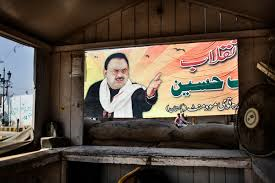
“Distance does not matter,” reads the inscription on a monument near Mr. Hussain’s deserted former house in Karachi, where his name evokes both fear and favor.
Now, though, his painstakingly constructed web is fraying.
A British murder investigation has been closing in on Mr. Hussain, 59, and his party, the Muttahida Qaumi Movement. His London home and offices have been raided, and the police have opened new investigations into accusations of money laundering and inciting violence in Pakistan.
The scrutiny has visibly rattled Mr. Hussain, who recently warned supporters that his arrest may be imminent. And in Karachi, it has raised a previously unthinkable question: Is the end near for the untouchable political machine that has been the city’s linchpin for three decades?
“This is a major crisis,” said Irfan Husain, the author of “Fatal Faultlines,” a book about Pakistan’s relationship with the United States. “The party has been weakened, and Altaf Hussain is being criticized like never before.”
Mr. Hussain’s rise offers a striking illustration of the political melee in Pakistan.
His support stems from the Mohajirs, Urdu-speaking Muslims whose families moved to Pakistan after the partition from India in 1947, and who make up about half of Karachi’s population. Since the 1980s, the Muttahida Qaumi Movement has fiercely defended Mohajir interests, and in turn it has been carried to victory in almost every election and to an enduring place in national coalition governments as well.
Mr. Hussain fled to London in 1992, when the movement was engaged in a vicious street battle with the central government for supremacy in Karachi. The British government granted him political asylum and, 10 years later, a British passport.
London has long been the antechamber of Pakistani politics, where self-exiled leaders take refuge until they can return. The former military ruler Pervez Musharraf lived here until recently, and the current prime minister, Nawaz Sharif, lived here until 2007.
Mr. Hussain, however, shows no sign of going back. The Muttahida Qaumi Movement has an office in Edgware, in northwest London. But these days Mr. Hussain is mostly at home, in a redbrick suburban house protected by raised walls, security cameras and a contingent of former British soldiers he has hired as bodyguards.
From there, he holds court, addressing his faraway followers in a vigorous, sometimes maniacal style, punctuated by jabbing gestures and hectoring outbursts. Occasionally he bursts into song, or tears. Yet, on the other end of the line, it is not unusual to find tens of thousands of people crowded into a Karachi street, listening raptly before an empty stage containing Mr. Hussain’s portrait, as his disembodied voice booms from speakers.
“The cult of personality surrounding Altaf Hussain is quite extraordinary,” said Farzana Shaikh, an academic and the author of “Making Sense of Pakistan.” “He is immensely charismatic, in the way one thinks of the great fascist leaders of the 20th century.”
In Karachi, his overwhelmingly middle-class party is fronted by sharply dressed, well-spoken men — and a good number of women — and it has won a reputation for efficient city administration. But beneath the surface, its mandate is backed by armed gangs involved in racketeering, abduction and the targeted killings of ethnic and political rivals, the police and diplomats say.
Other major Pakistani parties indulge in similar behavior, but the Muttahida Qaumi Movement frequently brings the most muscle to the fight. An American diplomatic cable from 2008 titled “Gangs of Karachi,” which was published by WikiLeaks, cited estimates that the party had an active militia of 10,000 gunmen, with an additional 25,000 in reserve — a larger force, the dispatch notes, than the city police.
Many journalists who have criticized the party have been beaten, or worse, driving most of the news media in Karachi to tread lightly. In June, the Committee to Protect Journalists, a lobbying group based in New York, accused the party of organizing the killing of Wali Khan Babar, a television reporter.
In the West, the party has avoided critical attention partly because it has cast itself as an enemy of Islamist militancy. In 2001, Mr. Hussain wrote a letter to Prime Minister Tony Blair of Britain, offering to help Britain set up a spy network against the Taliban.
Critics of the party have frequently questioned the role of British officials in facilitating its unusual system of governance. Pakistani exiles from Baluchistan, also accused of fomenting violence, have faced criminal prosecution. But Britain is not the only node of Mr. Hussain’s international support network.
Through the Pakistani diaspora, the Muttahida Qaumi Movement has active branches as far afield as the United States, Canada and even South Africa, which has become an important financial hub and a haven for the group’s enforcers, Pakistani investigators say.
Two police interrogation reports obtained by The New York Times cite militants from the movement who say they traveled to South Africa in between carrying out political assassinations in Karachi. One of those men, Teddy Qamar, confessed to 58 killings between 2006 and 2012, the police say. In an interview, Anis Hasan, the party’s joint organizer for South Africa, denied any link to organized violence.
But if Mr. Hussain seemed immune to scrutiny at his London stronghold, his luck started to turn in September 2010 after Imran Farooq, a once-influential leader in the movement who had split from the party, was stabbed to death near his house in Edgware.
Soon after, Mr. Hussain appeared on television, mourning Mr. Farooq with a flood of tears. But over the past year, the police investigation has turned sharply in his direction.
In December, officers from Scotland Yard’s Counter Terrorism Command searched the movement’s London office. Then in June they went to Mr. Hussain’s home and arrested Ishtiaq Hussain, his cousin and personal assistant, who is now out on bail. The police impounded $600,000 in cash and some jewelry under laws that target the proceeds of crime.
Mr. Hussain was not available for an interview, his party said. But a senior party official, Nadeem Nusrat, speaking at the movement’s London office, denied any link to Mr. Farooq’s killing. “Our conscience is clear,” Mr. Nusrat said. “We have nothing to do with it.”
Mr. Nusrat said the impounded money had come from political donations. And he rejected accusations, also the subject of a police inquiry, that Mr. Hussain has directly threatened political rivals, in some instances by warning that he would arrange for their “body bags.”
“It’s all taken out of context,” Mr. Nusrat said.
Mr. Hussain has receded from public view during the recent furor. There have been rumors about mounting health problems, which Mr. Hussain’s aides deny. But he cannot return to Pakistan, they say, because the Taliban could kill him. “In Pakistan,” said Muhammad Anwar, a longtime aide, “nobody can guarantee your life.”
Then there are the legal threats: over the years, dozens of murder charges have been lodged against Mr. Hussain in Pakistan, although some have been quashed in court. A more pressing question, perhaps, concerns the impact on the streets of Karachi if Mr. Hussain is forced to step down.
Some fear that without his guiding hand, tensions within the movement could split it into hostile factions — a frightening prospect in a city where political violence already claims hundreds of lives a year.
“However viciously the party conducts itself, there is an order within the apparent disorder,” said Ms. Shaikh, the academic.
Even if the British government wished to crack down on Mr. Hussain, she added, it might find itself subject to appeals from the Pakistani authorities. “The fear of Karachi going up in flames is so great,” Ms. Shaikh said, “that no government can take that risk, as long as Altaf Hussain is alive.”
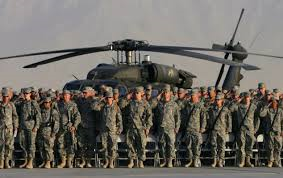
US preparing for withdrawal from Afghanistan (Credit: businessinsider.com)WASHINGTON, Sept 13: Pentagon officials are holding talks in Afghanistan on the withdrawal of US military equipment from the country, officials said Friday, as Washington hopes to lower the cost of the massive operation.
American forces are having to fly out large amounts of gear at great expense but defense officials would like to move more vehicles and equipment over cheaper land routes through Pakistan, officials said.
With the US military’s drawdown underway and set to finish by the end of 2014, about 20 percent of the cargo is currently being withdrawn through the overland route across the Pakistan border.
But officials say they would prefer to have 60 percent of all materiel move over land instead of by air.
Deputy Defense Secretary Ash Carter and other senior officials arrived in Kabul earlier Friday and the equipment withdrawal, or “retrograde,” will feature prominently in their discussions, officials said.
Carter will seek to “assess the continued progress on retrograde efforts,” a defense official said.
The Afghan government shut the border earlier this year in a dispute over what the US military should pay for withdrawing its gear, with Kabul insisting the Americans owed up to $70 million in customs fines.
Washington has maintained the military equipment came into the country legally and refused to pay the fees. Afghan authorities eventually reopened the border.
Asked about the dispute, a senior Pentagon official told reporters: “We think we’ve resolved that.”
The official, who spoke on condition of anonymity, said the Pentagon was pleased with the pace of movement on the Pakistan route since April and hoped that the share of cargo moving on the supply line would expand soon from 20 to 30 percent.
Unlike the American departure from Iraq, the withdrawal of US military equipment from Afghanistan represents a daunting logistical problem in a landlocked nation with unreliable roads and mountainous terrain.
By 2015, the United States must remove about 24,000 vehicles and the equivalent of roughly 20,000 shipping containers.
Other equipment deemed not to be worth taking out is being donated to the Afghan government, passed on to NATO allies willing to cover the transport costs, or destroyed.
The cost of the effort is estimated to range from $5 billion to $7 billion, but how much of the gear is ferried out by land will affect the final price tag, officials said.
Since April, about half of all cargo has been taken out by aircraft to ports in the Middle East, and then shipped back to the United States. And roughly 28 percent of the equipment is flown all the way from Afghanistan to the United States.
Weapons and other sensitive items have to be ferried by air, but the percentage moving over land could increase if “administrative” procedures were cleared up on the Afghan side of the border, officials said.
The United States has 55,000 troops in Afghanistan and plans to withdraw the bulk of combat forces by the end of 2014. US officials are negotiating an agreement with Kabul to keep a smaller force in place beyond 2014.)
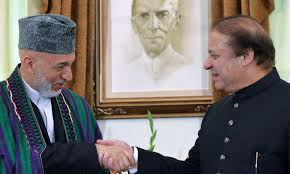
Islamabad, Aug 28: Afghanistan President Hamid Karzai is looking to Pakistan to help in the peace process and provide an opportunity for talks involving the Afghan High Peace Council and the Taliban.
Reading out a statement to the media after his one-on-one meeting with Pakistan Prime Minister Nawaz Sharif, Mr. Karzai said, “We discussed in this regard primarily and with emphasis, the issue of joint fight against extremism and reconciliation and peace building in Afghanistan with the expectation that the government of Pakistan will facilitate and help in manners it can to the peace process in Afghanistan and in providing opportunities or a platform for talks between the Afghan High Peace Council and the Taliban movement.”
On his part, Prime Minister Nawaz Sharif assured Mr Karzai of Pakistan’s strong and sincere support for peace and reconciliation. He also agreed that this process had to be inclusive, Afghan-owned and Afghan-led.
Mr. Karzai arrived on Monday with his official delegation which met government and military officials and also signed agreements on trade and economic issues. In June Mr. Karzai had refused to be part of the U.S. talks with the Taliban after it opened an office in Doha as he wanted the process to be Afghan-led.
While publicly the two leaders did not refer to the Afghan President’s demand for release of Taliban prisoners, it is an important issue for Mr. Karzai and did form part of the discussion, it is learnt.
Mr. Sharif in his statement said Pakistan’s security and future prosperity is linked to that of Afghanistan in multiple ways. The year 2014 is particularly crucial for Afghanistan and this region, he pointed out saying he hoped this milestone would be crossed peacefully and extended all possible support.
The Finance Ministers met on Sunday to discuss various projects and finalise trade and economic agreements. The two countries have agreed to the early and full implementation of Afghanistan Pakistan Transit Trade Agreement.
Mr. Karzai’s visit has been marked by scepticism in his own country and contempt from the Taliban. Former Pakistan ambassador to Afghanistan Rustom Shah Mohmand said Mr. Karzai knew that the U.S. was an indispensable partner in the peace process but he wanted to assert his Afghan nationality. There are powerful forces against reconciliation in Afghanistan and the true potential of the relationship will be realised after the coalition forces leave next year and Pakistan too is free of the overarching U.S. influence, he said.
Support
President Asif Ali Zardari on Monday said Pakistan had been consistently extending every possible support for promotion of peace and stability in Afghanistan as a peaceful, stable and united Afghanistan was in Pakistan’s own interest.
Speaking to Mr. Karzai at a meeting , Mr. Zardari stressed the need for joint efforts and close coordination to cope with the evolving situation in the region.
Bangalore, Aug 14: The separate states of India and Pakistan were created at midnight on August 15, 1947. Yet while India celebrates that day as its independence day, Pakistan celebrates its independence day a day before. Why it is so?Reason 1:Pakistan’s first independence day was also celebrated on August 15 but later on it was advanced to August 14. One of the reasons is that British Viceroy Lord Mountbatten, who had chosen August 15 to commemorate the surrender of Japan to the Allies Power marking the end of World War II in 1945, sought to transfer power to Pakistan on August 14 so that he could be present in New Delhi to observe India’s maiden independence day celebrations.
Reason 2:Also in 1948, Pakistan decided to celebrate its Independence Day on August 14 because 27 Ramadan, an auspicious date of the Islamic lunar calendar, coincided with it. Hence the Pakistanis decided to celebrate their Independence Day a day before the actual date. But otherwise, August 15 is the actual Independence Day for both India and Pakistan (Even South Korea observes its Liberation Day on August 15). The Indian Independence Act of 1947 clearly said: “As from the fifteenth day of August, nineteen hundred and forty-seven, two independent Dominions shall be set up in India, to be known respectively as India and Pakistan.
“Even Pakistan’s founding father Muhammad Ali Jinnah had declared August 15 as the birthday of the independent and sovereign state of Pakistan. The first commemorative postage stamps of Pakistan which were released in July 1948 also mentioned 15 August 1947 as its Independence Day.OneIndia News