Dozens of U.S. Missiles Hit Air Base in Syria

WASHINGTON — President Trump said Thursday night that the United States had carried out a missile strike in Syria in response to the Syrian government’s chemical weapons attack this week, which killed more than 80 civilians.
“Tonight, I ordered a targeted military strike on the air base in Syria from where the chemical attack was launched,” Mr. Trump said in remarks at his Mar-a-Lago estate in Florida. “It is in this vital national security interest of the United States to prevent and deter the spread and use of deadly chemical weapons.”

Mr. Trump — who was accompanied by senior advisers, including Stephen K. Bannon, his chief strategist; Reince Priebus, his chief of staff; his daughter Ivanka Trump; and others — said his decision had been prompted in part by what he called the failures by the world community to respond effectively to the Syrian civil war.

“Years of previous attempts at changing Assad’s behavior have all failed, and failed very dramatically,” the president said, referring to President Bashar al-Assad of Syria. “As a result, the refugee crisis continues to deepen, and the region continues to destabilize, threatening the United States and its allies.”

Dmitri S. Peskov, a spokesman for President Vladimir V. Putin of Russia, told reporters Friday morning that the strike “deals a significant blow to relations between Russia and America, which are already in a poor state,” according to the news agency RIA.

Mr. Peskov said the strike did nothing to combat international terrorism. “On the contrary, this creates a serious obstacle for building of an international coalition to fight it and to effectively resist this universal evil,” he said. Fighting terrorism was Mr. Putin’s stated goal when he dispatched the Russian military to Syria in September 2015, though its main effect has been to shore up Mr. Assad.

Capt. Jeff Davis, a Pentagon spokesman, said Russian forces had been notified in advance of the strike. “Military planners took precautions to minimize risk to Russian or Syrian personnel located at the airfield,” he said. No Russian aircraft were at the base, military officials said.

“We are assessing the results of the strike,” Captain Davis added. “Initial indications are that this strike has severely damaged or destroyed Syrian aircraft and support infrastructure and equipment at Shayrat airfield, reducing the Syrian government’s ability to deliver chemical weapons.”

The cruise missiles struck the airfield beginning around 8:40 p.m. Eastern time on Thursday, and the strikes continued for three to four minutes.

According to Captain Davis, the missiles were fired from the destroyers Porter and Ross in the eastern Mediterranean.

Talal Barazi, the governor of Homs Province, where the base sits, told Reuters early Friday that ambulances and fire trucks were scrambling to respond to fires there.

Administration officials described the strikes Mr. Trump ordered as a graphic message to the world that the president was no longer willing to stand idly by as Mr. Assad used horrific weapons in his country’s long civil war. To do otherwise, they said, would be to essentially bless the use of chemical weapons by Mr. Assad and others who might use them.

“This clearly indicates the president is willing to take decisive action when called for,” Secretary of State Rex W. Tillerson told reporters in Florida. He said Mr. Trump had concluded after seeing the results of the chemical attack that the United States could no longer “turn away, turn a blind eye.”

“The more we fail to respond to the use of these weapons, the more we begin to normalize their use,” Mr. Tillerson said, a thinly veiled reference to President Barack Obama’s decision to refrain from strikes in 2013.
Mr. Tillerson added that the United States had not informed Mr. Putin about the coming missile strikes and that Mr. Trump had not spoken with the Russian leader in the hours afterward.

The decision to act came with a swiftness that took observers of the new president by surprise. After being briefed on the chemical attack shortly after it occurred, American intelligence agencies and their allies worked quickly to confirm the source of the chemical weapons, administration officials said.

In Washington the next day, the president convened a meeting of senior members of his National Security Council, where military aides presented him with three options. Officials said Mr. Trump peppered them with questions and directed them to focus on two of those options.

On Thursday, after Mr. Trump traveled to Florida for his dinner with President Xi Jinping of China, he convened what officials described as a “decision meeting” with his top national security aides — many of them with him at Mar-a-Lago, and others on secure video screens from Washington.

After what aides called a “meeting of considerable length,” Mr. Trump authorized the missile strikes before starting the dinner with Mr. Xi.

President Trump retaliated against the Assad government for a chemical attack in Syria that killed more than 80 civilians.

“It was important during the president’s deliberations,” said H. R. McMaster, the president’s national security adviser, to weigh the risk of action against the “risk of this continued, egregious, inhumane attacks on innocent civilians with chemical weapons.”

A military official said the attack was at the more limited end of the military options presented to Mr. Trump on Thursday by Defense Secretary Jim Mattis. The official said the strike was intended to send a signal to Mr. Assad about the United States’ intention to use military force if he continues to use chemical weapons.

It was the first time the White House had ordered military action against forces loyal to Mr. Assad.
Mr. McMaster said the missile strikes would not eliminate Mr. Assad’s ability to use chemical weapons, but would degrade it. He said the United States military had specifically sought to avoid hitting what it believes is a facility containing more sarin gas at the airfield.

He said the military had also sought to “minimize risk” to citizens of other countries — specifically Russians — who might have been in the area at the time.

The Pentagon on Thursday night released a graphic showing the flight track of Syrian aircraft as they left the Shayrat field on Tuesday and carried out the chemical attack in the town of Khan Sheikhoun in Idlib Province.
Russian military delegation visits North, South Waziristan

A Russian military delegation, accompanied by senior officers of the Pakistan Army, visited Miran Shah in North Waziristan Agency and Wanna in South Waziristan Agency, said a statement by the Inter-Services Public Relations (ISPR).

The delegation of the Russian army, the first ever to visit the conflict-stricken areas, was led by Deputy Chief of General Staff Colonel General Israkov Sergi Yuryevich.

“The delegation was briefed about Pakistan Army’s efforts to clear FATA from terrorists of all hue and colours,” said the ISPR statement.

The visiting Russian military officers were also briefed about border management on the Pak-Afghan border and socio economic development projects in the area.

“The delegation acknowledged and appreciated Pakistan Army’s achievements in the fight against terrorism and efforts to bring stability in the region,” added the statement.

Cooperation between the armed forces of Russia and Pakistan has grown in recent times.

In September 2016, a contingent of Russian ground forces arrived in Pakistan for the first ever joint Pak-Russian exercise.

Around 200 military personnel of both countries participated in the drills. The special operations drills codenamed ‘Druzhbha-2016’ — a Russian word meaning “friendship” — saw Russian troops and Pakistani special forces working in close cooperation.

Building upon the cooperation, Russian Navy’s largest anti-submarine warfare ship Severmorsk arrived in Pakistan for participation in the Aman 2017 international naval exercises in February 2017.

Pakistan also confirmed purchase of Mi-35 ground attack helicopters in 2015.

The Art of a Deal With the Taliban

WASHINGTON, March 29 — This year, America’s war in Afghanistan will pass a grim milestone as it surpasses the Civil War in duration, as measured against the final withdrawal of Union forces from the South. Only the conflict in Vietnam lasted longer. United States troops have been in Afghanistan since October 2001 as part of a force that peaked at nearly 140,000 troops (of which about 100,000 were American) and is estimated to have cost the taxpayers at least $783 billion.

Despite this heavy expenditure, the United States commander in Afghanistan, Gen. John W. Nicholson Jr., recently called for a modest troop increase to prevent a deteriorating stalemate. The fall of Sangin in Helmand Province to the Taliban this month is a tactical loss that may be reversed, but it certainly suggests the situation is getting worse. With the Trump administration’s plan to increase the military budget while slashing the diplomatic one, there is a risk that American policy toward Afghanistan will be defined in purely military terms.

Absent from the current debate is a clear statement of our objectives — and a way to end the Afghan war while preserving the investment and the gains we have made, at the cost of some 2,350 American lives. It has always been clear to senior military officers like Gen. David H. Petraeus, who was the American commander in Afghanistan from 2010 to 2011, as well as to diplomats like me, that the war could end only through a political settlement, a process through which the Afghan government and the Taliban would reconcile their differences in an agreement also acceptable to the international community.

The challenges of bringing about such a reconciliation are formidable, but the basic outline of a deal is tantalizingly obvious. Despite more than 15 years of warfare, the United States has never had a fundamental quarrel with the Taliban per se; it was the group’s hosting of Al Qaeda that drove our intervention after the Sept. 11 attacks. For its part, the Taliban has never expressed any desire to impose its medieval ideology outside of Afghanistan, and certainly not in the United States.

The core Afghan government requirements for a settlement are that the Taliban ceases violence, breaks with international terrorism and accepts the Afghan Constitution. The Taliban, for its part, insists that all foreign forces withdraw. No doubt, both sides have additional desiderata, but the basic positions do not seem unbridgeable. This is particularly the case now that the Islamic State has emerged in Afghanistan, in conflict with both the government and the Taliban.

Under President Ashraf Ghani and Chief Executive Abdullah Abdullah, the Afghan government has supported reconciliation efforts. And there is no question that ordinary Afghans overwhelmingly support peace, even as most also oppose a return of the Taliban’s brutal regime of the 1990s.

At its heart, the Afghan conflict is between rural traditionalists and urban modernizers, and this has been the case since Afghan Communists seized power in 1978. However, regional powers have also played a predatory role.
Pakistan’s cynical support for the Taliban is merely the most visible of the hedging strategies that various neighbors, including the Iranians and the Russians, have adopted to ensure that they have some armed Afghan faction beholden to their interests. A comprehensive political settlement would remove the security dilemma that drives these counterproductive interventions.

So what is the way forward for an Afghan peace process?

The first step is clear, and has come close to fruition over the years. The Taliban should be allowed to open an office, most likely in Doha, Qatar, to conduct peace talks with the Afghan government. This was very nearly accomplished in 2013, but the Taliban overreached by raising its flag and putting up signs identifying the office as representing the “Islamic Emirate of Afghanistan.” The American government and the Afghan government, under President Hamid Karzai, rightly rejected these trappings of an embassy, and the deal collapsed.

All potential partners, including the government of Qatar, have learned the lessons of that debacle and have every incentive to avoid repeating it. This is an area for quiet diplomacy, led by the United States.

Once talks begin, our government will have to define its position. Even after all these years of fighting, the United States sometimes deludes itself into thinking it is not a party to the conflict; the Taliban believes otherwise. In coordination with our Afghan allies, the United States should be prepared to put on the table the conditions under which we would consider pulling our forces out of Afghanistan. Any withdrawal would have to be phased in response to the Taliban’s living up to its commitments, including guarantees that Afghan territory will never be used to enable attacks on America.

The more difficult aspect of the discussion will be among the Afghans themselves as they address the central issues that have divided them for decades. The American position should be to ensure there is no backsliding from the progress Afghanistan has made on human rights, including women’s rights, and constitutional government.

Since there have been no negotiations yet, it is difficult to assess what the Taliban’s actual demands would be. Their concern about the Afghan Constitution may be simply that they were not a party to its drafting. Like other countries’ constitutions, Afghanistan’s can be amended.

The United States must remain committed throughout to strengthening the Afghan state, including support for the Afghan Army, so that the Afghan government delegation has a strong negotiating position. Any final settlement would have to include the terms under which the Taliban enters the political system under the Constitution, specific arrangements to ensure that Afghan territory would not be used to attack others and regional commitments to end proxy warfare on Afghan territory.

I hold no brief for the Taliban — two of my friends were murdered by the group. It is brutal and indiscriminate in its violence, and its position on women’s rights has rightly been condemned by the international community. But these are not good arguments for perpetuating conflict in one of the world’s poorest countries. That would not only be a disservice to the Afghan people, but would also probably be unsupportable among the American people.
We have a president who believes in the art of a deal. We should negotiate a hard bargain with the Taliban.
Richard G. Olson was the United States ambassador to Pakistan from 2012 to 2015 and the special representative for Afghanistan and Pakistan from 2015 to 2016.

Laptop ban hits Dubai for 1.1 million weekend travelers

DUBAI, March 25: Dubai International Airport and its flag carrier Emirates began implementing a ban on laptops and tablets on direct flights to the US Saturday, on one of the busiest travel weekends of the year.

1.1 million people are expected to pass through the busiest international airport as the city marks UAE spring break, Dubai Airports’ senior vice president for communications Anita Mehra said.

An estimated 260,000 travellers were expected to pass through each day from Friday through Monday. Dubai International Airport expects 89 million passengers this year.

The United States announced a ban on all electronics larger than a standard smartphone on board direct flights out of eight countries across the middle East. US officials would not specify how long the ban will last, but Dubai-based Emirates told AFP that it had been instructed to enforce it until at least October 14.

Travellers using 10 airports across the Middle East and North Africa are subject to the ban.

The ban also covers all electronics sold at Dubai Duty Free, Dubai Airports CEO Paul Griffiths told local radio earlier this week.

Government-owned Emirates operates 18 flights daily to the United States out of Dubai. In an attempt to appease its customers, the airline announced it would be offering complimentary packing and shipping services at gates to enable passengers to use their electronic devices after check-in and until boarding.

Adding to the complication on Saturday, a number of flights out of Dubai and Abu Dhabi airports were delayed due to thunderstorms, including an Emirates flight to Houston.

The US ban affects nine airlines from eight countries: Turkey, Morocco, Jordan, Egypt, the United Arab Emirates, Qatar, Saudi Arabia and Kuwait.

Britain has also announced a parallel ban, effective Saturday, targeting all flights out of Egypt, Turkey, Jordan, Saudi Arabia, Tunisia and Lebanon.

Abu Dhabi, home to UAE national carrier Etihad Airways, is one of the few international airports with a US Customs and Border Protection Facility, which processes immigration and customs inspections before departure.

“All Etihad Airways guests travelling to the United States clear US Immigration and Customs at the US Preclearance facility in Terminal 3, the only one of its kind in the Middle East,” read a statement emailed to AFP.

“When guests land in the US, they arrive as domestic passengers with no requirement to queue for immigration checks again.”

The bans have come under criticism for targeting majority-Muslim countries. The US ban in particular has raised eyebrows for covering airports from which US airlines do not operate direct flights.

The United States and Britain have cited intelligence indicating passenger jets could be targeted with explosives planted in such devices.

US Investigating Mosul Strikes Said to Have Killed Up to 200 Civilians

Baghdad, March 24: The American-led military coalition in Iraq said Friday that it was investigating reports that scores of civilians — perhaps as many as 200, residents said — had been killed in recent American airstrikes in Mosul, the northern Iraqi city at the center of an offensive to drive out the Islamic State.

If confirmed, the series of airstrikes would rank among the highest civilian death tolls in an American air mission since the United States went to war in Iraq in 2003. And the reports of civilian deaths in Mosul came immediately after two recent incidents in Syria, where the coalition is also battling the Islamic State from the air, in which activists and local residents said dozens of civilians had been killed.

Taken together, the surge of reported civilian deaths raised questions about whether once-strict rules of engagement meant to minimize civilian casualties were being relaxed under the Trump administration, which has vowed to fight the Islamic State more aggressively.

American military officials insisted on Friday that the rules of engagement had not changed. They acknowledged, however, that American airstrikes in Syria and Iraq had been heavier in an effort to press the Islamic State on multiple fronts.

Col. John J. Thomas, a spokesman for the United States Central Command, said that the military was seeking to determine whether the explosion in Mosul might have been prompted by an American or coalition airstrike, or was a bomb or booby trap placed by the Islamic State.

“It’s a complicated question, and we’ve literally had people working nonstop throughout the night to understand it,” Colonel Thomas said in an interview. He said the explosion and the reasons behind it had “gotten attention at the highest level.”

As to who was responsible, he said, “at the moment, the answer is: We don’t know.”

Iraqi officers, though, say they know exactly what happened: Maj. Gen. Maan al-Saadi, a commander of the Iraqi special forces, said that the civilian deaths were a result of a coalition airstrike that his men had called in, to take out snipers on the roofs of three houses in a neighborhood called Mosul Jidideh. General Saadi said the special forces were unaware that the houses’ basements were filled with civilians.

“After the bombing we were surprised by the civilian victims,” the general said, “and I think it was a trap by ISIS to stop the bombing operations and turn public opinion against us.”

General Saadi said he had demanded that the coalition pause its air campaign to assess what happened and to take stricter measures to prevent more civilian victims. Another Iraqi special forces officer, who spoke on the condition of anonymity because of the sensitivity of the subject, said that there had been a noticeable relaxing of the coalition’s rules of engagement since President Trump took office.

Before, Iraqi officers were highly critical of the Obama administration’s rules, saying that many requests for airstrikes were denied because of the risk that civilians would be hurt. Now, the officer said, it has become much easier to call in airstrikes.

Some American military officials had also chafed at what they viewed as long and onerous White House procedures for approving strikes under the Obama administration. Mr. Trump has indicated that he is more inclined to delegate authority for launching strikes to the Pentagon and commanders in the field.

This is the second time this week that the military has opened an investigation into civilian deaths reported to have been caused by American airstrikes. On Tuesday, Central Command said it was investigating an American airstrike in Syria on March 16 that officials said killed dozens of Qaeda operatives at a meeting place that activists and local residents maintain was part of a religious complex.

Pentagon officials said that intelligence had indicated that Al Qaeda used the partly constructed community meeting hall as a gathering place and as a place to educate and indoctrinate fighters.

This is indefensibly sloppy work by the military, and as the Commander-in-Chief will not take responsibility for his actions.

But the Syrian Observatory for Human Rights said that 49 people had been killed in what the group described as a massacre of civilians who were undergoing religious instruction in an assembly hall and dining area for worshipers. The group has produced photos taken at the site after the strike that show a black sign outside a still-standing adjoining structure that identified it as part of the Omar ibn al-Khatab mosque.

Chris Woods, director of the observatory, a nonprofit group that monitors civilian deaths from coalition airstrikes in Syria and Iraq, said that in March alone the number of reported civilian fatalities has shot up to 1,058, from 465 in December, the last full month of the Obama administration.

“We don’t know whether that’s a reflection of the increased tempo of the campaign or whether it reflects changes in the rules of engagement,” he said. But, he added, the recent spike in numbers “does suggest something has shifted.”

American military officials said that what has shifted is that the Iraqi military, backed by the American-led coalition, is in the middle of its biggest fight so far — the battle to retake Mosul from the Islamic State, also known as ISIS or ISIL.

In particular, the campaign for West Mosul has involved block-by-block fighting in an urban environment.
“There’s been no loosening of the rules of engagement,” said Capt. Jeff Davis, a Pentagon spokesman. “There are three major offensives going on right now, at the same time,” he said, citing the battle for West Mosul; the encirclement of Raqqa, Syria, the Islamic State’s de facto capital; and the fight for the Tabqa Dam in Syria.
Captain Davis said that the investigation was looking into whether Islamic State fighters were responsible for the explosion in Mosul, or if an airstrike set something off.

“There are other people on the battlefield, too,” he said. “It’s close quarters.”

American officials said that even the timing of the strike was still in question. Col. Joseph E. Scrocca, a spokesman for the American-led command in Baghdad, said in a statement Friday that the strike under investigation happened between March 17 and Thursday.

The civilian death toll in Mosul was already widely described as heavy on account of Islamic State snipers and bombs, and intensified urban fighting in which artillery has been used. But there have been numerous reports from witnesses, including rescue workers and residents fleeing the fighting, about bodies being buried under rubble after heavy air bombardment.

Many of the reports centered on the Mosul Jidideh neighborhood, where residents said airstrikes hit a number of houses in recent days, killing dozens, including many children.

Capt. Ahmed Nuri, a soldier with Iraq’s elite counterterrorism forces, who work closely with the American military and call in airstrikes, said on Thursday that his men, facing heavy sniper fire, helped collect five bodies from the rubble of a destroyed home. He said four of them were brothers — named Ali, Omar, Khalid and Saad — whose bodies were delivered to their grieving mother.

The mother, Captain Nuri said, identified the fifth dead body as that of an Islamic State sniper who had been firing at advancing Iraqi forces from the roof of their house.

Local officials have reacted with outrage at the latest civilian deaths, warning that they will make it more difficult to fully take the city, and will alienate civilians still in Mosul, whom the Iraqi government is counting on for assistance.

“The repeated mistakes will make the mission to liberate Mosul from Daesh harder, and will push civilians still living under Daesh to be uncooperative with the security forces,” said Abdulsattar Alhabu, the mayor of Mosul, using the Arabic acronym for the Islamic State.

Mr. Alhabu estimated that at least 200 civilians had been killed in airstrikes in recent days in Mosul.

Federal Judge Blocks Trump’s Latest Travel Ban Nationwide

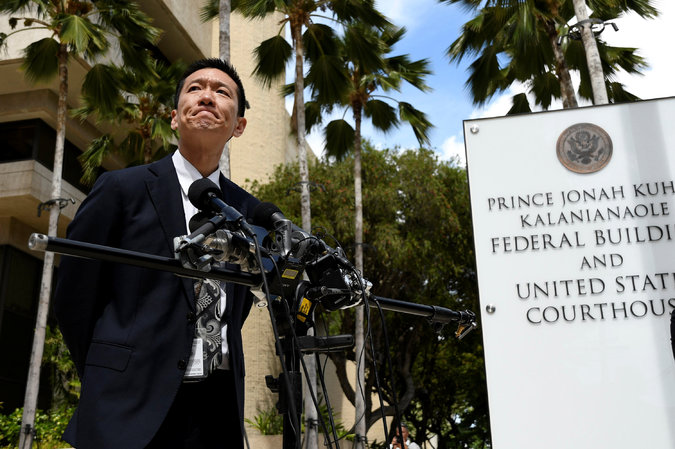
A federal judge in Hawaii issued a nationwide order Wednesday evening blocking President Trump’s ban on travel from parts of the Muslim world, dealing a stinging blow to the White House and signaling that Mr. Trump will have to account in court for his heated rhetoric about Islam.

The ruling was the second major setback for Mr. Trump in his pursuit of a policy he has trumpeted as critical for national security. His first attempt to sharply limit travel from a handful of predominantly Muslim countries ended in a courtroom fiasco last month, when a federal court in Seattle halted it.

Mr. Trump issued a new and narrower travel ban, affecting six countries, on March 6, trying to satisfy the courts by removing some of the most contentious elements of the original version.

But in a pointed decision that repeatedly invoked Mr. Trump’s public comments, the judge, Derrick K. Watson of Federal District Court in Honolulu, wrote that a “reasonable, objective observer” would view even the new order as “issued with a purpose to disfavor a particular religion, in spite of its stated, religiously neutral purpose.”

Mr. Trump lashed out at Judge Watson during a campaign-style rally in Nashville late on Wednesday. Raising his voice to a hoarse shout, Mr. Trump accused the judge of ruling “for political reasons” and criticized the United States Court of Appeals for the Ninth Circuit, which upheld the earlier decision against his administration and will hear any appeal to the Hawaii ruling.

“This ruling makes us look weak, which by the way we no longer are, believe me,” Mr. Trump said, to mounting cheers from a loyal crowd.

Mr. Trump even said he might reissue the initial version of the order, rather than the one blocked on Wednesday, which he described as “a watered-down version of the first one.”

After he signed the revised ban, Democratic attorneys general and nonprofit groups that work with immigrants and refugees raced back into court against Mr. Trump, alleging that his updated decree was still a thinly veiled version of the ban on Muslim migration that he had pledged to enact as a presidential candidate.

Judge Watson, who was appointed by President Barack Obama, ruled that the State of Hawaii and an individual plaintiff, Ismail Elshikh, the imam of the Muslim Association of Hawaii, had reasonable grounds to challenge the order as religious discrimination. And he concluded that allowing the travel restrictions to go into effect at midnight, as scheduled, could have caused them irreparable harm.

Judge Watson flatly rejected the government’s argument that a court would have to investigate Mr. Trump’s “veiled psyche” to deduce religious animus. He quoted extensively from the remarks by Mr. Trump that were cited in the lawsuit brought by Hawaii’s attorney general, Doug Chin.

“For instance, there is nothing ‘veiled’ about this press release,” Judge Watson wrote, quoting a Trump campaign document titled “Donald J. Trump is calling for a total and complete shutdown of Muslims entering the United States.”

Judge Watson singled out Mr. Elshikh, an American citizen whose Syrian mother-in-law had been pursuing a visa to enter the United States, as having an especially strong claim that the travel regulations would harm him on the basis of his religion.

“This is a great day for democracy, religious and human rights,” Mr. Elshikh, who was out of the country, said in a message relayed through Hakim Ouansafi, the chairman of the Muslim Association of Hawaii. “I am very pleased that the processing of my mother-in-law’s paperwork will not stop now but more importantly that this Muslim ban will not separate families and loved ones just because they happen to be from the six countries.”

Mr. Elshikh, who is Egyptian and previously worked in Michigan, was recruited to the Hawaii mosque more than a decade ago, Mr. Ouansafi said. And when the association began recruiting someone to serve as a plaintiff, the imam, who became a citizen last year, agreed to do so without reservation, Mr. Ouansafi said.

After Mr. Elshikh became the face of the lawsuit, he received several threats from the mainland, Mr. Ouansafi said. “If we lived in any other state, I would not have asked him to come forward,” he said.

In addition to the Hawaii suit, federal judges in Washington State and Maryland heard arguments in several other cases challenging the constitutionality of Mr. Trump’s order, including one brought by a coalition of Democratic attorneys general, and others from a collection of nonprofit groups. Judge Watson was the only one who ruled on Wednesday.

Administration lawyers have argued that the president was merely exercising his national security powers. In the scramble to defend the executive order, a single lawyer in the United States solicitor general’s office, Jeffrey Wall, argued first to a Maryland court and then, by phone, to Judge Watson in Honolulu that no element of the order, as written, could be construed as a religious test for travelers.

Mr. Wall said the order was based on concerns raised by the Obama administration in its move toward stricter screening of travelers from the six countries affected.

“What the order does is a step beyond what the previous administration did, but it’s on the same basis,” Mr. Wall said in the Maryland hearing.

After Mr. Trump’s speech in Nashville, the Justice Department released a more muted statement disputing the Hawaii decision, calling it “flawed both in reasoning and scope.” Sarah Isgur Flores, a spokeswoman for the department, said it would continue to defend the legality of the presidential order.

Refugee organizations and civil rights groups greeted the ruling with expressions of triumph and relief.

Marielena Hincapié, executive director of the National Immigration Law Center, hailed the ruling on a conference call as “a strong and unequivocal rejection of the politics of hate.”

At the same time, advocates for refugees and immigrants acknowledged that significant uncertainty would hang over some of their more practical decisions, as a longer legal process plays out around Mr. Trump’s order.

“It’s a preliminary decision, but it recognizes that there continue to be problems with the constitutionality of this revised order, particularly with discriminatory intent toward Muslims,” said Betsy Fisher, policy director at the International Refugee Assistance Project at the Urban Justice Center.

The original ban, released on Jan. 27, unleashed scenes of chaos at American airports and spurred mass protests. Issued abruptly on a Friday afternoon, it temporarily barred travel from seven majority-Muslim nations, making no explicit distinction between citizens of those countries who already had green cards or visas and those who did not. It also suggested that Christian refugees from those countries would be given preference in the future.
After the federal court in Seattle issued a broad injunction against the policy, Mr. Trump removed major provisions and reissued the order. The new version exempted key groups, like green card and visa holders, and dropped the section that would have given Christians special treatment.

Mr. Trump also removed Iraq from the list of countries covered by the ban after the Pentagon expressed worry that it would damage the United States’ relationship with the Iraqi government in the fight against the Islamic State.
Yet those concessions did not placate critics of the ban, who said it would still function as an unconstitutional religious test, albeit one affecting fewer people — an argument Judge Watson concurred with in his ruling.
The lawsuits have also claimed that the order disrupts the operations of companies, charities, public universities and hospitals that have deep relationships overseas. In the Hawaii case, nearly five dozen technology companies, including Airbnb, Dropbox, Lyft and TripAdvisor, joined in a brief objecting to the travel ban.

The second, now-halted executive order preserved major components of the original. It would have ended, with few exceptions, the granting of new visas and green cards to people from six majority-Muslim countries — Iran, Libya, Somalia, Sudan, Syria and Yemen — for at least 90 days. It would have also stopped all refugees from entering for 120 days and limited refugee admissions to 50,000 people in the current fiscal year.

Mr. Obama had set in motion plans to admit more than twice that number.

Mr. Trump has said the pause is needed to re-evaluate screening procedures for immigrants from the six countries. “Each of these countries is a state sponsor of terrorism, has been significantly compromised by terrorist organizations, or contains active conflict zones,” he wrote in the order.

Judge Watson’s order was not a final ruling on the constitutionality of Mr. Trump’s ban, and the administration has expressed confidence that courts will ultimately affirm Mr. Trump’s power to issue the restrictions.
But the legal debate is likely to be a protracted and unusually personal fight for the administration, touching Mr. Trump and a number of his key aides directly and raising the prospect that their public comments and private communications will be scrutinized.

The lawsuits against the ban have extensively cited Mr. Trump’s comments during the presidential campaign. Attorney General Bob Ferguson of Washington, who successfully challenged Mr. Trump’s first order, has indicated that in an extended legal fight, he could seek depositions from administration officials and request documents that would expose the full process by which Trump aides crafted the ban.

As a candidate, Mr. Trump first proposed to bar all Muslims from entering the United States, and then offered an alternative plan to ban travel from a number of Muslim countries, which he described as a politically acceptable way of achieving the same goal.

The lawsuits also cited Rudolph W. Giuliani, the former New York City mayor who advises Mr. Trump. Mr. Giuliani said he had been asked to help craft a Muslim ban that would pass legal muster.

And they highlighted comments by Stephen Miller, an adviser to the president, who cast the changes to Mr. Trump’s first travel ban as mere technical adjustments aimed at ushering the same policy past the review of a court.

Yes, the Russian ambassador met Trump’s team. So? That’s what we diplomats do.

At the center of many allegations swirling around the Trump administration’s relationship with Moscow is one man: Sergey Kislyak, the Russian ambassador. As U.S. intelligence agencies contend that his country attempted, through hacking and other efforts, to influence November’s election, Kislyak’s discussions with Trump campaign associates — including former national security adviser Michael Flynn (who resigned for not disclosing them) and Attorney General Jeff Sessions (who did not) — have been the subject of intense reporting and speculation.

While it is one thing to question Russia’s efforts or the truthfulness of American officials, this debate is threatening the time-honored tradition of foreign ambassadors freely meeting political figures in their country of accreditation. There is nothing inherently wrong with meeting a foreign ambassador — even one from a rival nation; even one from a rival superpower on which the United States has imposed sanctions. As Pakistan’s ambassador to the United States, I saw firsthand, in the assassination of Osama bin Laden, just how essential such consultations were.

[Chill, America. Not every Trump outrage is outrageous.]
We don’t know what Kislyak’s particular motivations were or what he discussed in these meetings, but the question before the American public is whether Trump’s allies comported themselves honorably and legally, not whether Kislyak did. Diplomacy is the process by which foreign enemies are turned into friends and friends are converted into allies. Democratic countries such as the United States have always taken pride in the relative ease with which foreign diplomats can meet Americans of all political persuasions. (This is not the case in more-restrictive nations, such as Russia.) No matter what Moscow’s policy holds, the free interaction of Americans with foreign ambassadors works to America’s advantage.
* * * * * * * *
I became Pakistan’s ambassador in May 2008, soon after the country’s return to civilian rule after nine years of military dictatorship under Gen. Pervez Musharraf. The George W. Bush administration had forged an alliance with Musharraf in the aftermath of the 9/11 terrorist attacks, hoping that economic incentives and offers of military hardware would turn Pakistan away from its long-standing policy of supporting Islamist militants, including the Afghan Taliban, as instruments of regional influence.

By 2007, Bush had realized that Musharraf either “would not or could not” fulfill his promises in fighting terrorism, as he wrote later, and the president welcomed Pakistan’s return to democracy. The civilian leaders who appointed me as ambassador — President Asif Ali Zardari and Prime Minister Yousuf Raza Gilani — looked forward to U.S. backing in reversing Musharraf’s policies at home and abroad. They said they wanted to end Pakistan’s support for the Taliban, improve relations with India and Afghanistan, and limit the role of Pakistan’s military intelligence service in defining the country’s foreign policy. In return, they sought generous U.S. aid to improve the ailing Pakistani economy.

[How Trump got his party to love Russia]
I had an advantage most ambassadors did not: I’d lived most of the Musharraf years in exile in Washington and had established close ties with members of Congress and others influential in policymaking. But I began my job in the middle of the 2008 election campaign, and I knew that the Bush administration’s policies might not continue under a new president. Within weeks of presenting my credentials to Bush that June, I was communicating with campaign officials in both parties, and soon had meetings with aides to both Sen. John McCain and Sen. Barack Obama.
The State Department facilitated the participation of Washington-based ambassadors in the Democratic and Republican national conventions that year. In Denver and in Minneapolis-St. Paul, we were briefed by officials from both campaigns. More active and better-connected ambassadors, including myself, were able to meet personally with people we expected to have major roles in the conduct of foreign policy after the election. There was nothing unusual, let alone treasonable, in this.

As a presidential candidate, Obama argued that U.S. success in Afghanistan was more important than the war in Iraq, which he had opposed. In a major speech that summer, he pledged to make “the fight against al-Qaeda and the Taliban the top priority.” He also had a particular message for my country: He said terrorists and insurgents in Pakistan’s tribal areas were waging war against the Afghan government. “We must make it clear that if Pakistan cannot or will not act, we will take out high-level terrorist targets like bin Laden if we have them in our sights.”

From Obama’s public positions and from my meetings with his aides, it was clear that a democratic, civilian government in Pakistan could join with him to help attain his objectives in Afghanistan in exchange for support of consolidation of democracy with greater U.S. economic assistance. I sent this message to my bosses in Islamabad and told Obama’s campaign team that we would be willing to play ball. Once Obama took office, this is exactly what happened: Civilian aid to Pakistan was enhanced to record levels in an effort to secure greater cooperation in defeating the Taliban.

[Trump is getting payments from foreign governments. We have no idea what they are.]
What’s more, the relationships I forged with members of Obama’s campaign team also led to closer cooperation between Pakistan and the United States in fighting terrorism over the 31/2 years I served as ambassador. These connections eventually enabled the United States to discover and eliminate bin Laden without depending on Pakistan’s intelligence service or military, which were suspected of sympathy toward Islamist militants. Friends I made from the Obama campaign were able to ask, three years later, as National Security Council officials, for help in stationing U.S. Special Operations and intelligence personnel on the ground in Pakistan. I brought the request directly to Pakistan’s civilian leaders, who approved. Although the United States kept us officially out of the loop about the operation, these locally stationed Americans proved invaluable when Obama decided to send in Navy SEAL Team 6 without notifying Pakistan.

Unfortunately, the United States did not attain victory in Afghanistan, and the Pakistani government’s behavior toward militant Islamists did not change on a permanent basis. But for the period I was in office, the two nations worked jointly toward their common goals — the essence of diplomacy.
* * * * * * * *
After I began reading about the affairs of Kislyak, I rummaged through my files and diaries to retrace my steps as ambassador in the fall of 2008. I maintained relations with three teams of American officials, politicians and professional staffers: the Bush administration and the two major-party candidates. I met senior members of the Republican and Democratic national committees, more than a dozen senators and congressmen from each party, and several individuals from both sides who were tipped to emerge in senior government positions after the election. This is totally normal for ambassadors.

Kislyak, who presented his credentials just a couple of months after I did, has probably advanced shared Russian-American interests through similar contacts in the three U.S. presidential election cycles that he has covered as ambassador. I do not know if he reached out to Hillary Clinton’s camp as vigorously as he did to Trump’s (he probably already knew Clinton’s top foreign policy players from his work with the Obama administration, in which many of them had served), but it does not matter: Ambassadors do not make policy. They only facilitate understanding between countries that leads to policymaking in their respective capitals. Any Russian decision to covertly interfere in the U.S. election would have been made in Moscow, not necessarily with Kislyak’s knowledge, just as Pakistan’s breach of promises with the Obama administration occurred in Islamabad, not in my embassy.
[How Russian ‘kompromat’ destroys political opponents, no facts required]

In November 2011, I was forced to resign as ambassador after Pakistan’s military-intelligence apparatus gained the upper hand in the country’s perennial power struggle. Among the security establishment’s grievances against me was the charge that I had facilitated the presence of large numbers of CIA operatives who helped track down bin Laden without the knowledge of Pakistan’s army — even though I had acted under the authorization of Pakistan’s elected civilian leaders.

Russia is, of course, unlike Pakistan, but U.S.-Russia relations have seesawed, too, and Kislyak’s means were no different from what probably every ambassador of every country hopes to use, even if his ends were unique.
Americans have a legitimate interest in figuring out whether Russia tried to covertly influence U.S. politics. Investigating officials who may have perjured themselves about their diplomatic contacts also seems reasonable. It should not, however, create the impression that engagement between a foreign ambassador — even one from a country with which relations are strained — and people who might hold senior positions in a future administration is inherently sinister. Such engagement is essential if new presidents want to translate their foreign policy plans into reality.

Rumblings of a ‘Deep State’ Undermining Trump? It Was Once a Foreign Concept

WASHINGTON — President Trump’s allegations that former President Barack Obama tapped his phone and his assertions that the bureaucracy is leaking secrets to discredit him are the latest signs of a White House preoccupation with a “deep state” working to thwart the Trump presidency.

The concept of a “deep state” — a shadowy network of agency or military officials who secretly conspire to influence government policy — is more often used to describe countries like Egypt, Turkey and Pakistan, where authoritarian elements band together to undercut democratically elected leaders. But inside the West Wing, Mr. Trump and his inner circle, particularly his chief strategist, Stephen K. Bannon, see the influence of such forces at work within the United States, essentially arguing that their own government is being undermined from within.

It is an extraordinary contention for a sitting president to make. Mr. Trump, who last year angrily dismissed the conclusion of intelligence officials that the Russians interfered in the presidential election to boost his candidacy, has now asked both his staff and a congressional committee investigating Moscow’s influence on the election to turn up evidence that Mr. Obama led an effort to spy on him.

How the White House and its allies see the deep state threat
“What President Trump is discovering is that he has a huge, huge problem underneath him, and I think he’s shocked that the system is as hostile as it is,” said Newt Gingrich, a top adviser to Mr. Trump’s campaign who said he has spoken with Mr. Bannon many times about his suspicion of the deep state and what he sees as its pernicious influence.

“We’re up against a permanent bureaucratic structure defending itself and quite willing to break the law to do so,” Mr. Gingrich said.

Neither Mr. Trump nor Mr. Bannon has used the term “deep state” publicly. But each has argued that there is an orchestrated effort underway, fueled by leaks and enabled by the news media, to cut down the new president and interfere with his agenda.

“Reports concerning potentially politically motivated investigations immediately ahead of the 2016 election are very troubling,” Sean Spicer, the White House press secretary, said on Sunday.

Mr. Bannon, speaking last month at the Conservative Political Action Conference, said a central element of Mr. Trump’s presidency would be the “deconstruction of the administrative state.” It was his latest articulation of a dim view of federal agencies that he argued had grabbed power at the behest of the “progressive left.”

Breitbart News, the conservative site Mr. Bannon used to run, uses the term deep state frequently in its coverage, including in a story on Sunday headlined “DeepStateGate: Trump Ends the Wiretapping Innuendo Game by Dealing Himself In.” The term has gained currency on other right-leaning websites, conservative talk radio and on social media, where Mr. Trump’s supporters are inflamed by the notion that a powerful secret cabal is plotting his downfall.

Projecting a new role for Obama

Veterans of prior administrations have been alarmed by the charge, arguing that it suggests an undemocratic nation where legal and moral norms are ignored.

“ ‘Deep state’ I would never use,” Michael V. Hayden, the former Central Intelligence Agency director under both Mr. Obama and former President George Bush, said on MSNBC on Monday. “That’s a phrase we’ve used for Turkey and other countries like that, but not the American republic.”

Loren DeJonge Schulman, a former top official in Mr. Obama’s National Security Council who is a senior fellow at the Center for a New American Security, said presidents and top White House officials often bristle at what they consider to be a sluggish bureaucracy. But it is jarring for an administration in power to claim that civil servants are actively working to subvert the government.

“A deep state, when you’re talking about Turkey or Egypt or other countries, that’s part of government or people outside of government that are literally controlling the direction of the country no matter who’s actually in charge, and probably engaging in murder and other corrupt practices,” Ms. Schulman said. “It’s shocking to hear that kind of thinking from a president or the people closest to him.”

Yet to Mr. Trump’s allies and supporters, the president is giving voice to a favorite theory.

“We are talking about the emergence of a deep state led by Barack Obama, and that is something that we should prevent,” said Representative Steve King, Republican of Iowa. “The person who understands this best is Steve Bannon, and I would think that he’s advocating to make some moves to fix it.”

Mr. King cited as evidence of a thriving deep state Mr. Obama’s decision to stay in Washington after leaving the White House, a decision he said was driven by the former president’s desire to frustrate Mr. Trump’s agenda. (Mr. Obama has said he is remaining in Washington until his younger daughter, Sasha, graduates from high school in 2019.)

Mr. Trump “needs to purge the leftists within the administration that are holdovers from the Obama administration, because it appears that they are undermining his administration and his chances of success,” Mr. King said.

Pakistan, home to military coups, is considered Exhibit A

The deep state is a phrase often heard in countries where there is a history of military coups and where generals often hold power independent of elected leaders.

Pakistan is Exhibit A: The deep state is often invoked in serious discussions about the role of the Pakistani military and its intelligence service, the Directorate of Inter-Services Intelligence.

Wide swaths of the population see the unseen hand of the security services behind major political events and all kinds of everyday happenings, such as random traffic stops.

The views are not without basis — there have been repeated military coups in Pakistan, and the military and the spy service often operate largely independent of the country’s politicians.

“The deep state concept emerges in places where the army and the security apparatus creates boundaries within which the civilian political people are allowed to operate,” said Peter Feaver, a specialist in civil-military issues at Duke University and a national security aide to Mr. Bush. “If they transgress those boundaries, then the deep state interferes to reorder things, often using military force.”

Leaks vs. serious opposition

“There are milder forms of it in healthier democracies,” Mr. Feaver said, arguing that American presidents have often chafed against the constraints of the federal bureaucracy.

“Nixon shared a similar kind of distrust of the government and felt the government was out to get him at points,” Mr. Feaver added. “President Trump’s view seems to be more on the Nixon part of the spectrum, which is far from the Pakistan part.”

In the United States, it is hardly unusual for dissent among warring factions inside the government to burst into public view. Under former President Ronald Reagan, the secretary of state, George P. Shultz, and the secretary of defense, Caspar W. Weinberger, were often at odds and would feud through dueling news reports.

“Just because you see things like leaks and interference and obstruction doesn’t necessarily mean there’s a deep state — that’s something we’ve seen before, historically, and it’s nothing new,” said James Jay Carafano, a fellow at the Heritage Foundation who advised Mr. Trump’s transition. “What would be different is if there were folks from the previous administration that were consciously orchestrating, in a serious way, inside opposition to the president.”

In the absence of evidence one way or the other, Mr. Carafano added, “It’s hard to know: Is this Trump using some strong political rhetoric, or an actual theory?”

Land rush around Gwadar port triggered by Chinese investment

LAHORE, Feb 23: Real estate giant Rafi Group made a ten-fold profit last year from its sale of hundreds of acres of land in the remote fishing town of Gwadar, acquired soon after the government announced plans for a deep-sea port there.

The windfall came after 12 years of waiting patiently for the Gwadar port to emerge as the centrepiece of China’s ambitious plans for a trade and energy corridor stretching from the Persian Gulf, across Pakistan, into western Xinjiang.

“We had anticipated the Chinese would need a route to the Arabian Sea,” Rafi Group Chief Executive Shehriar Rafi told Reuters. “And today, all routes lead back to Gwadar.”

China to build $1.5 billion power line across Pakistan
Gwadar forms the southern Pakistan hub of a $57-billion China-Pakistan Economic Corridor (CPEC) of infrastructure and energy projects Beijing announced in 2014.

Since then, land prices have skyrocketed as property demand has spiked, and dozens of real estate firms want to cash in.

“Gwadar is a ‘Made in China’ brand and everyone wants a piece,” said realtor Afzal Adil, one of several who shifted operations from the eastern city of Lahore in 2015.

Last year, government welcomed the first large shipment of Chinese goods at Gwadar, where the China Overseas Ports Holding Company Ltd took over operations in 2013. It plans to eventually handle 300 million to 400 million tons of cargo a year.

Forget India, profit from ‘quiet rise’ of Pakistan: Barron’s Asia

It also aims to develop seafood processing plants in a nearby free trade zone sprawled over 923 hectares (2,281 acres).

The route through Gwadar offers China its shortest path to the oil-rich Middle East, Africa, and most of the Western hemisphere, besides promising to open up remote, landlocked Xinjiang.

Last year, the Applied Economics Research Centre estimated the corridor would create 700,000 jobs in Pakistan and a Chinese newspaper recently put the number at more than 2 million.

Authorities have completed an expressway through Gwadar, which has a 350-km (218-mile) road network. A new international airport kicks off next year, to handle an influx of hundreds of Chinese traders and officials expected to live near the port.

The volume of Gwadar property searches surged 14-fold on Pakistan’s largest real estate database, Zameen.com, between 2014 and 2016, up from a prior rate of a few hundred a month.

“It’s like a gold rush,” said Chief Executive Zeeshan Ali Khan. “Anyone who is interested in real estate, be it an investor or a developer, is eyeing Gwadar.”

Prices, which have risen two- to four-fold on average, are climbing “on a weekly basis,” said Saad Arshed, the managing director of online real estate marketplace Lamudi.pk.

Regional fishermen have held strikes during the last two years, to protest against being displaced by the port.
To keep pace with the interest, urban officials are struggling to computerise land management and record-keeping. “We are trying to upgrade as fast as we can,” said Zakir Majeed, an official of the Gwadar Development Authority (GDA).

But Gwadar lacks basic education and health facilities, in contrast to the gleaming towers and piped drinking water of the “smart city” envisioned by the GDA.

“For commercial projects, things are moving fast,” Lamudi’s Arshed said. “But people actually living there, that will take a long time.”

Port officials expect the population to hit 2 million over the next two decades, from about 185,000 now.

Risk
The government commissioned work on the Gwadar port in 2002, but development was held up by chronic instability in the surrounding resource-rich province of Balochistan.

Since China announced the corridor plan in 2014, security has improved, with government setting up a new army division to ensure protection, while hundreds of rebels surrendered arms.

Real estate firms dismiss fears the “Gwadar bubble” might still burst, pointing to China’s enduring interest.

“The risk is always there,” Rafi said. “But our confidence comes from knowing this is not a Pakistani initiative, but a Chinese city on the Arabian Sea coast. And the Chinese will see that it is built.”

Kabul ready to talk intelligence cooperation with Pakistan ‘at any level’: Afghan official

KABUL, Feb 21: Afghanistan is ready to hold dialogue with Pakistan for intelligence cooperation at ‘any level’, an Afghan security official has told members of the Pak-Afghan track-II dialogue in Kabul.

The Afghan official, speaking informally and off-the-record, said senior security officials of the two countries had planned a ‘interaction’ but three major attacks in Kabul, Kandahar and Helmand on January 10 delayed the process. Nearly 60 people, including five UAE diplomats were killed in the attacks. The UAE ambassador, who was injured in the blast, died of wounds last week.

The remarks by the Afghan security official came amid growing tensions over the recent wave of terrorist attacks in Pakistan last week, which claimed the lives of about 100 people and injured over 300 more.

“We are ready for deep discussions on intelligence cooperation. We need a better environment. We need engagement. But only meetings and shaking hands will not give results. Sincere and effective engagement is a must to remove the mistrust,” the Afghan official told members of the dialogue titled ‘Beyond Boundaries’ which concluded on Monday.

President Ashraf Ghani had put a pause on a memorandum of understanding between the National Directorate of Security (NDS) and the Inter-Services Intelligence (ISI) in 2015. As the two sides struck the ground-breaking agreement to share intelligence and resources to combat terrorism, it was opposed in Afghanistan and some leaders, including Hamid Karzai, publicly opposed the deal as against the ‘national interests’. Afghan media had also reported then NDS Chief Rahmatullah Nabil had refused to sign the accord.

But the Afghan official said that Kabul is open for talks on intelligence cooperation at any level to explore options how to deal with the security challenges. “We also want Pakistan to extend its counter terrorism strategy to the region,” he said.

“Pakistan may be concerned only about TTP, China has apprehensions about ETIM, Arab states will be worried about Da’ish and al Qaeda, Iran may have fears about Jundullah, Uzbekistan would expect dangers of IMU but Afghanistan is fighting against nearly 30 groups.” He claimed that the Afghan Taliban have provided space to many of these groups as they all have same approach.

The Afghan official said bilateral track for Pakistan and Afghanistan is the best option to deal with the security problems and end violence in both countries as ‘no one will bring stability for us’.
He also renewed Kabul’s suggestion for a third party’s verification of the claims by both countries about the presence of the armed groups on both side of the border. The verification could either be by the US or China, he said.

On peace talks with the Taliban, he said peace dialogue is more important to Afghanistan but “we want action to be taken against the Taliban if they decline the dialogue.”